Executive Overview
For any engineer who has ever carried the pager, the scenario is painfully familiar. A centralized monitoring dashboard suddenly shifts from a placid sea of green to a flashing wall of red across a dozen disparate microservices. Almost simultaneously, an incident response channel begins filling with competing theories, frantic pings, and conflicting diagnostics. Buried deep within this wall of telemetry noise lies a single, elusive root cause, hidden behind half a dozen concurrent symptoms that look equally suspicious.
In modern software engineering, fixing a broken system is rarely the most difficult part of the equation. Figuring out what is actually broken—and why—consumes the vast majority of Mean Time to Resolution (MTTR).
Consequently, when yet another enterprise software vendor steps forward with a pitch promising that artificial intelligence has finally solved this perennial headache, engineering leaders want to believe them. The pitch is enticing: point a sophisticated machine learning model at your telemetry data, and let it magically tell you precisely what broke. To a degree, some of those promises are real. Advanced tools can ingest mountains of logs, metrics, and traces at speeds no human team could ever match.
However, the more time an engineering organization spends in the trenches of high-stakes incident response, the easier it becomes to spot the marketing sleight-of-hand. Too many commercially available tools skip past the hardest part of the job. Finding symptoms is easy; understanding root causes is a fundamentally different challenge.
As software ecosystems grow increasingly complex, blending legacy infrastructure with non-deterministic artificial intelligence workloads, the gap between simple alert correlation and true causal diagnosis is widening. Bridging that gap requires far more than just throwing a larger Large Language Model (LLM) at the problem; it requires structural changes in engineering discipline, postmortem hygiene, and how organizations view institutional knowledge.
Detailed Chronology: The Evolution of Observability and the AI Promise
To understand where modern automated incident response stands today, it is helpful to look back at how monitoring and observability have evolved over the past decade, and where expectations began to outpace architectural reality.
Phase 1: The Era of Static Thresholds and Alert Fatigue
In the early days of microservices and cloud-native architectures, Site Reliability Engineering (SRE) teams relied heavily on static metric thresholds. If CPU utilization crossed 90% or error rates ticked above 1%, a pager went off.
This era was characterized by severe alert fatigue. Because systems were brittle and tightly coupled, a single upstream database failure could trigger hundreds of independent alerts downstream, drowning on-call engineers in an unnavigable sea of noise. The primary challenge was triaging—separating the signal from the noise just to figure out which team needed to wake up.
Phase 2: The Rise of AIOps and Alert Correlation
Recognizing the unsustainable nature of alert fatigue, the industry pivoted toward AIOps (Artificial Intelligence for IT Operations). Vendors introduced tools designed to group related alerts together using time-series clustering, topology mapping, and basic machine learning algorithms.
While these tools successfully reduced the volume of raw pages by clustering related alerts into single incidents, they stopped short of genuine diagnosis. They could tell an engineer that 47 alerts were structurally related, but they could rarely explain the chain of events that linked them.
Phase 3: The GenAI and LLM Gold Rush
With the explosion of Generative AI and LLMs, the market shifted once again. Vendors began marketing "AI-driven root cause analysis." These platforms promised to ingest complex telemetry payloads, converse with engineers in natural language, and output definitive diagnostic statements.
Yet, as SRE teams rushed to adopt these solutions, a subtle realization set in. While LLMs excel at summarizing text and writing code, reasoning through the causal dependencies of a distributed, non-deterministic software system requires a rigorous, verifiable causal model—something probabilistic text generators inherently struggle to construct reliably.
Supporting Context & Metrics: Correlation vs. Diagnosis
To evaluate the current landscape of automated incident response, industry practitioners must draw a sharp, uncompromising line between two fundamentally different engineering capabilities: correlation and diagnosis.
The Anatomy of Correlation
Look closely at what most "AI-driven root cause analysis" platforms actually accomplish under the hood, and a distinct pattern emerges. They are exceptionally gifted at correlation. They can reliably determine that:
- Service A threw an HTTP 500 error at 14:02:15.
- Service B experienced connection pool exhaustion at 14:02:18.
- Service C experienced a latency spike at 14:02:20.
These capabilities are genuinely useful. They meaningfully reduce the cognitive load required during triage. However, grouping related symptoms together is not the same thing as identifying a root cause.
The Requirements of True Diagnosis
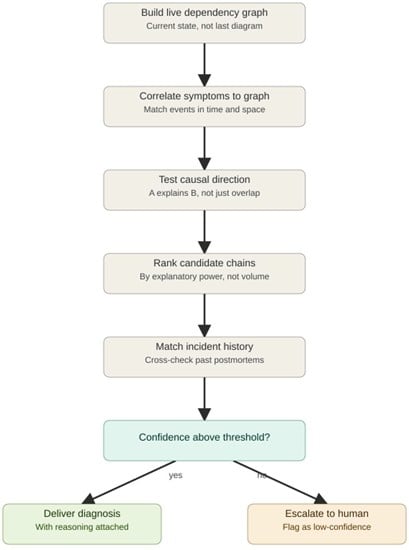
True diagnosis moves past the observation that "these things happened together" to establish that "this specific event happened because of that prior action."
[Raw Telemetry Data]
       │
       ▼
[Topology & Dependency Mapping]
       │
       ▼
[Causal Direction Testing] ──(Fails?)──> [Escalate / Uncertainty Check]
       │
       ▼ (Passes)
[Incident History Matching]
       │
       ▼
[Actionable Causal Diagnosis]
At a structural level, a system capable of genuine causal diagnosis must execute a rigorous workflow:
- Topology Mapping: Ingesting dynamic service meshes and infrastructure maps to understand real-time dependencies.
- Causal Direction Testing: Determining whether perturbing an upstream service actually explains a downstream symptom, or if the two metrics are merely moving in tandem due to an external confounder.
- Incident History Matching: Comparing current behavioral anomalies against historical postmortems and institutional knowledge bases.
- Confidence Calibration: Possessing the algorithmic maturity to state explicitly: "I am not sure; escalate this to a human operator."
In practice, the step that most commercial tools quietly skip is testing causal direction. Building a system that can accurately differentiate between a causal relationship and a spurious correlation is computationally expensive and architecturally difficult. Consequently, many tools stop at correlation, dressing it up in marketing language as causation.
The Non-Deterministic Challenge: When AI Meets AI
All of these diagnostic challenges are difficult enough when applied to traditional, deterministic infrastructure—systems where failure modes are bounded, repeatable, and governed by predictable execution paths. However, the difficulty scales exponentially once artificial intelligence and LLM-based components are integrated into the production architecture.
For over a decade, SRE teams have leaned on the four golden signals: latency, traffic, errors, and saturation. These signals fundamentally assume a deterministic system: given the exact same inputs under identical conditions, the system should behave the exact same way twice.
Modern workloads featuring Retrieval-Augmented Generation (RAG) pipelines, autonomous agentic workflows, and probabilistic foundation models offer no such guarantees. The exact same API request can fail on a Tuesday for reasons entirely divorced from traditional infrastructure health:
- A subtle shift in retrieved context documents.
- A micro-adjustment in upstream model weights or sampling temperatures.
- An automated safety guardrail intervening in an unexpected code path.
A diagnostic system trained exclusively on deterministic failure patterns will frequently misinterpret these non-deterministic anomalies. Worse, it will state its incorrect conclusions with the exact same tone of authoritative certainty that it uses when it is entirely right.
The Erosion of Trust
For engineering leaders, this behavioral quirk presents a severe organizational hazard. An automated system that is occasionally, confidently wrong is not a neutral assistant. It actively erodes an on-call engineer’s willingness to trust the tooling.
Trust, once broken during a high-pressure 3:00 AM production outage, is brutally difficult to earn back. It is common practice for engineering teams to quietly abandon sophisticated monitoring tools after a single catastrophic misdiagnosis, never to bring them back into rotation.
Official Perspectives & Industry Analysis
Industry experts and engineering executives are increasingly vocal about the need for realism when evaluating automated observability platforms.
"Finding symptoms is trivial for modern telemetry platforms. Understanding root causes requires an understanding of system intent and causal mechanics that raw data ingestion alone cannot provide," notes a prominent voice in the Site Reliability Engineering community. "If your tooling cannot articulate its own uncertainty, it is not an assistant—it is a liability."
Furthermore, engineering leaders emphasize that automated diagnosis is fundamentally bounded by the quality of an organization’s internal data practices. The most sophisticated machine learning model in the world cannot extract causal wisdom from a cultural vacuum.
During panel discussions at recent cloud-native architecture summits, CTOs have repeatedly stressed that the true training ground for automated incident response is not the vendor’s cloud environment, but the internal postmortem document.
A well-written postmortem is not merely an administrative compliance checkbox; it is a structured record of a complex causal chain that human engineers worked out under extreme pressure. It serves as the vital ground-truth data required to train or prompt effective diagnostic agents.
Future Outlook: The Path Forward for Incident Automation
Despite the hurdles, the push toward automated incident diagnosis is not slowing down. The toil of on-call rotations, the complexity of modern distributed systems, and the sheer volume of telemetry data guarantee that human operators will need computational leverage to survive.
However, the future belongs to organizations that approach automation with architectural pragmatism rather than magical thinking.
Key Questions for Evaluating Diagnostic Tooling
Before committing capital budgets to automated incident diagnosis platforms, engineering leaders should subject potential solutions to a rigorous interrogation:
- Does the tool map live dependencies? Or does it rely on static, manually updated architecture diagrams that drift out of sync within weeks?
- How does it handle uncertainty? Will the platform raise its hand and admit when it cannot find a definitive root cause, or will it force a confident, incorrect guess?
- Can it integrate organizational history? Is the platform capable of learning from your team’s specific past postmortems, or does it operate in an organizational vacuum?
- Are its conclusions defensible? Can an on-call engineer take the tool’s output into a blameless postmortem and successfully defend its reasoning to the rest of the engineering organization?
Ultimately, the teams that extract genuine, sustainable value from automated incident diagnosis will not necessarily be the ones wielding the flashiest, most expensive AI models. They will be the organizations that maintained rigorous internal discipline around incident review, institutional knowledge sharing, and data hygiene—and then fed that discipline directly into their tooling.
Solving the root cause problem is, at its core, a leadership challenge long before it becomes an engineering one. Until the industry acknowledges that reality, the dashboard will continue to flash red, and the human engineer will remain the ultimate circuit breaker.