







Executive Overview
As artificial intelligence lowers the barrier to software creation to near zero, millions of people can now spin up websites, functional apps, and rich digital presentations using little more than natural language prompts. However, the proliferation of AI coding platforms—ranging from heavyweight systems like Anthropic’s Claude Code and OpenAI’s Codex to user-facing applications like Cursor, Lovable, and Replit—has created a new bottleneck. Building a digital asset has never been easier, but finding customers, driving organic traffic, managing digital ad spend, and achieving sustainable business growth remain stubbornly difficult.
Enter Runable, a Bengaluru-based AI startup founded in 2025. Betting that the next multi-billion-dollar opportunity lies squarely in what happens after an app or website is built, Runable has secured $21 million in a Series A funding round. The all-equity, primary funding values the company at $65 million post-investment.
The round was co-led by prominent institutional backers Susquehanna Venture Capital and Nexus Venture Partners, with continued participation from early-stage backers Together Fund and Array VC.
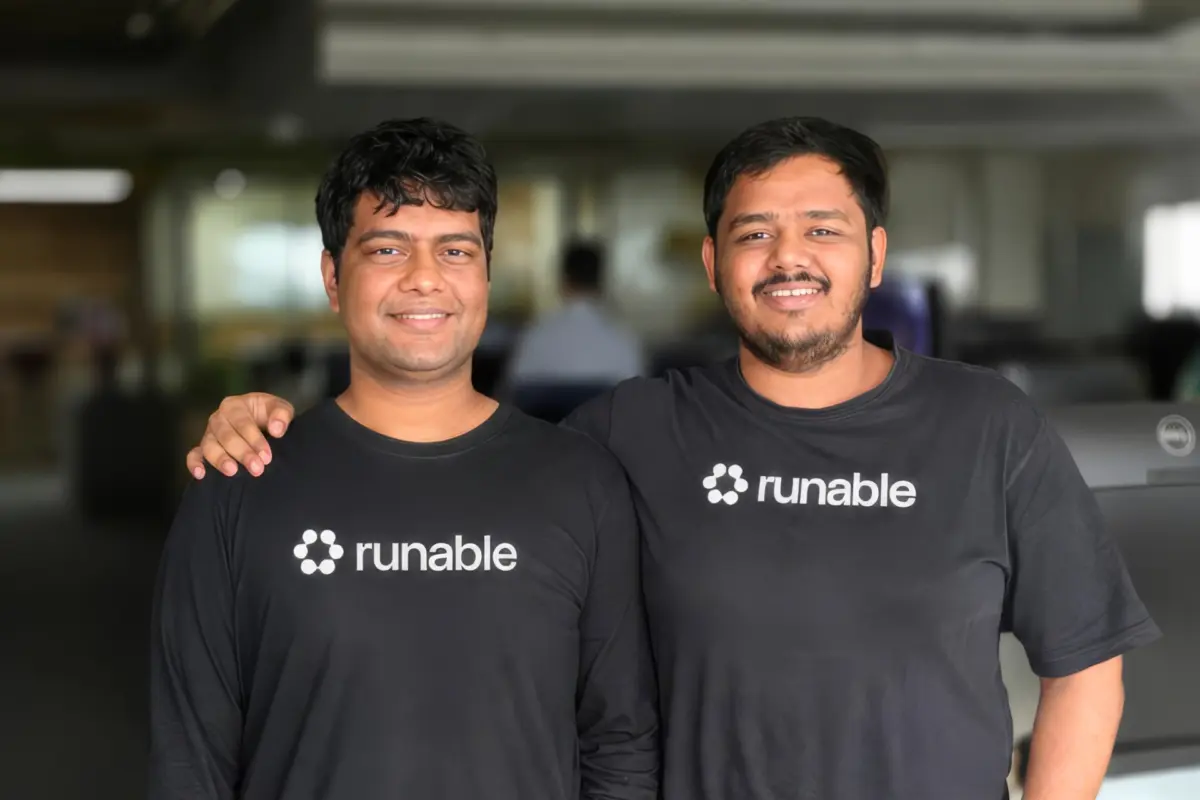
Led by co-founder and CEO Umesh Kumar and co-founder Saksham Sarda, Runable’s 15-person team is shifting the paradigm. Rather than competing directly with advanced code editors, Runable provides a general-purpose AI agent designed to shoulder the heavy lifting of business operations: identifying target audiences, launching ad campaigns, creating marketing presentations, optimizing search engine rankings (SEO), and boosting visibility across AI chatbot recommendation engines.
In a marketplace flooded with tools that answer the question, "How do I build this?" Runable is targeting the ultimate commercial imperative: "How do I make money from this?"
Detailed Chronology: From Web-Scraping Infrastructure to Growth Agent
The trajectory of Runable offers a fascinating case study in agile adaptation within the fast-moving generative AI landscape. The company did not set out to become a general-purpose business-growth assistant; rather, its current product-market fit was discovered through direct observation of user behavior.
1. The Early Infrastructure Days (Early 2025)
When Umesh Kumar and Saksham Sarda first established Runable, the startup was conceived as an infrastructure play. The original mandate was building advanced browser-based automation technology intended to scrape and aggregate data at scale. The founders engineered underlying systems capable of navigating complex web environments autonomously.
However, as users interacted with the browser infrastructure agent, the founders noticed an unexpected pattern. Customers were not just using the system for automated data extraction; they were repeatedly prompting the agent to construct functional software assets, layout slides, and deploy basic web pages.
2. The Pivot and Explosive Revenue Growth
Recognizing the broader market appetite, Kumar and Sarda pivoted the company’s core architecture toward a general-purpose AI agent capable of end-to-end content and software creation.
This strategic shift unlocked immediate commercial traction. After launching its payment rails in March 2025, Runable scaled from zero to a $2 million annualized revenue run rate (ARR) in just three weeks.
3. Expanding the Scope: Moving to the "Grow" Side
With its initial product validated, Runable began expanding its capabilities. Today, the platform enables users to build websites, applications, and promotional materials via conversational prompts while managing underlying hosting, deployment, and analytics infrastructure.
Now, backed by its Series A capital infusion, Runable is aggressively expanding into what the executive team calls the "grow" side of the enterprise lifecycle. The goal is to move beyond passive creation and actively execute digital marketing strategies, manage social channels, handle technical SEO, and optimize brand placement within LLM and chatbot search results.
Supporting Context & Metrics: Traction, Margins, and Global Reach
Despite its lean team of just 15 employees, Runable has achieved global scale at an astonishing pace.
Global User Base and Geographic Distribution
According to CEO Umesh Kumar, Runable has amassed 1.7 million registered users worldwide. The platform’s early adoption is heavily concentrated in Western markets and select Asian economies, with the United States, the United Kingdom, and Japan serving as its largest strongholds. While the platform also maintains an active user base in Brazil, the startup has strategically narrowed its primary geographic focus to the U.S., U.K., and Japan. Notably, Kumar projects that Japan will soon rival the United States as one of the startup’s top two revenue-generating markets.
Token Consumption and Unit Economics
While the company is keeping its exact current revenue figures and paying subscriber counts close to the chest, broader usage metrics point to heavy platform engagement. Runable users consumed more than 1 trillion tokens over a recent 90-day window, with 60% to 70% of that computational volume originating from paying customers.
This massive consumption of foundational model intelligence comes with substantial overhead. Kumar candidly acknowledges that Runable currently operates with negative gross margins, primarily because the startup heavily subsidizes AI usage for its user base. To combat this margin pressure, Runable is implementing a hybrid model strategy—utilizing third-party foundation models while concurrently experimenting with proprietary model development.
The management team is betting heavily on industry-wide deflation in compute expenses. As inference costs continue to plummet globally, Runable expects its financial margins to normalize.
"We are seeing this path where you can provide the same quality of inference at almost 10x less cost," Kumar noted in an interview with TechCrunch.
Official Statements and Industry Positioning
The core philosophy driving Runable’s product roadmap is rooted in pragmatic commercial outcomes rather than technical novelty. For the average small business owner—be it a local boutique, a freelance consultant, or an e-commerce startup founder—complex developer workflows and disparate software subscriptions represent friction, not value.
The Death of Piecemeal Tooling
Umesh Kumar argues that small business operators do not care about the underlying mechanics of large language models. They do not wake up wishing to master Codex, Claude Code, or complex API integrations.
"In the end, a business doesn’t require Codex or Claude Code or anything. They require real outcomes," Kumar explained. "If I am paying an agency $10,000 to run my Google Ads, can someone come in and do it for me for a lower price? That’s where Runable comes in."
Rather than forcing a non-technical entrepreneur to separately provision a domain name, configure Google Analytics, establish a Meta advertising manager account, and orchestrate search engine optimization campaigns, Runable’s ultimate vision is singular: a business owner should be able to instruct the agent to acquire a precise number of paying customers, leaving the execution entirely to autonomous AI workflows.
Hands-On Testing: Promise Versus Reality
When tested in real-world scenarios, general-purpose AI agents reveal both the immense promise and the current structural limitations of autonomous business operations.
In a simulation conducted by tech analysts, Runable was tasked with building and deploying a complete website for a fictional coffee subscription business, setting up visitor analytics, and launching an initial customer acquisition campaign using a $25 ad budget.
Runable successfully generated and deployed the website and prepared the corresponding ad campaign. However, it paused before execution, noting that an external advertising account needed to be connected. Similar tests performed on competing coding agents, such as Cursor, yielded comparable structural friction points—requiring third-party deployment services, active payment methods, and pre-existing advertising account credentials to execute real-world marketing spend.
When questioned about these integration barriers, Runable revealed a unique differentiator: its platform can execute live ad placements without requiring customers to connect personal advertising accounts, though this capability is currently restricted to advertisements served directly within ChatGPT. The startup confirmed it has established strategic partnerships enabling these ad deployments, describing the integrations as a deliberate "soft wedge" into the broader digital marketing ecosystem.
Future Outlook: Navigating Competition in an Agent-Driven Economy
As Runable deploys its newly secured $21 million war chest, it enters a crowded and rapidly evolving competitive landscape.
Defining the Competitive Frontier
Runable does not view itself as a direct competitor to developer-first coding environments. For software engineers writing production code or manipulating local files, platforms optimized for pure code generation remain the superior choice. Instead, Runable’s primary competitive set includes general-purpose enterprise agents such as Manus and Genspark, which target non-technical users and cross-functional operational workflows.
Furthermore, Runable faces a looming strategic threat from the very AI giants whose foundational models it relies upon. As OpenAI, Anthropic, and Google increasingly develop their own end-to-end agentic frameworks, startups building atop their APIs must continuously prove their value-add.
The Runable Moat
Kumar contends that Runable’s enduring advantage lies in frictionless synthesis. While foundational models provide raw intelligence, they require users to stitch together disparate services, analytics pipelines, and distribution channels. By packaging infrastructure, deployment, web analytics, and customer acquisition into a single, unified conversational layer, Runable bridges the gap between software creation and commercial viability.
As the generative AI revolution matures, the true winners will not necessarily be the companies that make building websites easier—it will be the platforms that ensure those websites actually survive and thrive in the market. With its latest funding round, Runable is positioning itself as the definitive operational partner for the next generation of small business entrepreneurs.