







Executive Overview
In the high-stakes world of modern distributed systems, incident post-mortems invariably begin with a familiar line of inquiry: What broke? Engineers hunt down the culprits with forensic precision—a faulty storage service, a botched software deployment, an insidious memory leak, an orphaned dependency, or a severed network route. This is a natural starting point for debugging, yet it frequently leads investigators astray. By fixating on component failure, teams risk narrowing their focus far too early.
A growing body of architectural analysis reveals a more unsettling truth: some of the most catastrophic production failures occur not when components break, but when every single part of a system behaves exactly as it was designed to. The fault does not live in any discrete line of code or independent microservice; it emerges dynamically from the complex interplay between them.
Recent operational post-mortems from large-scale provisioning environments shed light on this phenomenon. When software systems are scaled horizontally or subjected to high degrees of concurrency, assumptions baked into localized design decisions can morph into systemic risks. To prevent these failures, software engineering must look beyond traditional component-level reliability testing and embrace system-safety frameworks—such as System-Theoretic Process Analysis (STPA)—to analyze how safe behaviors can compound into unsafe outcomes.
Detailed Chronology: Anatomy of a Flawless Failure
To understand how a system can fail while all its internal parts operate with pristine correctness, we must examine a real-world incident within a large-scale enterprise provisioning ecosystem.
Phase 1: The Dual-Purpose Library
The architecture in question relied on a core automated provisioning service designed to create storage partitions on demand. A critical requirement of this workflow was enforcing an access-control policy on every newly minted partition. Rather than writing custom enforcement code for the service, developers utilized an existing, shared policy logic library.
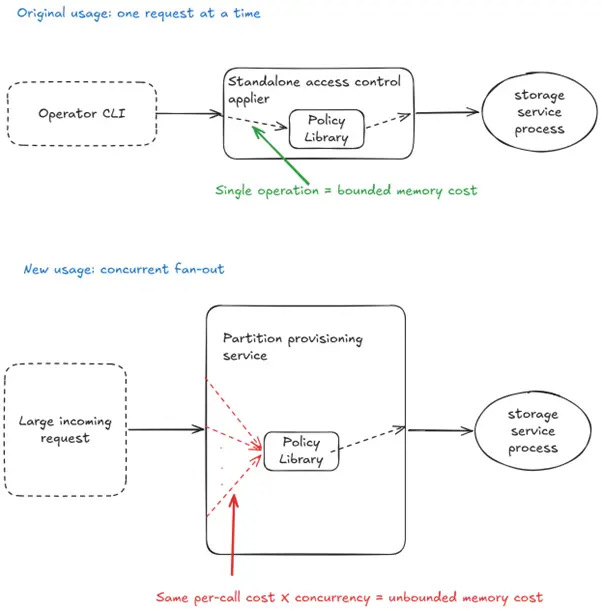
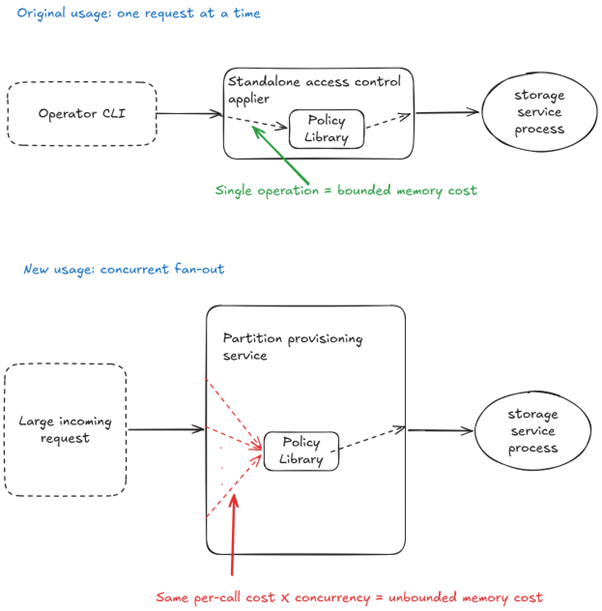
Crucially, this shared library already had a well-established production consumer: an operator command-line interface (CLI) tool used by site reliability engineers (SREs) and administrators to apply security policies manually, one storage instance at a time.
For the CLI, this architectural choice was a triumph of efficiency. Each manual invocation read the current policy state of a singular storage instance into memory, calculated the required delta, and applied the changes. Because the CLI operated strictly in a serial, one-at-a-time fashion, the computational footprint and memory overhead remained tightly bounded and entirely predictable.
Phase 2: The Fan-Out Bottleneck
Seeking to accelerate operations and improve throughput, the team behind the automated provisioning service integrated the same policy library. However, the automated service introduced a fundamentally different usage pattern. Unlike the human-driven CLI, the automation engine was built for scale. It could orchestrate the creation of dozens—or even hundreds—of storage partitions simultaneously.

A single API request directed at the provisioning service could organically fan out into a massive wave of concurrent calls to the shared policy library. Under normal operating conditions, this parallelism yielded stellar throughput metrics. Requests cleared the pipeline swiftly, and downstream services absorbed the load without apparent strain.
Phase 3: The Breaking Point
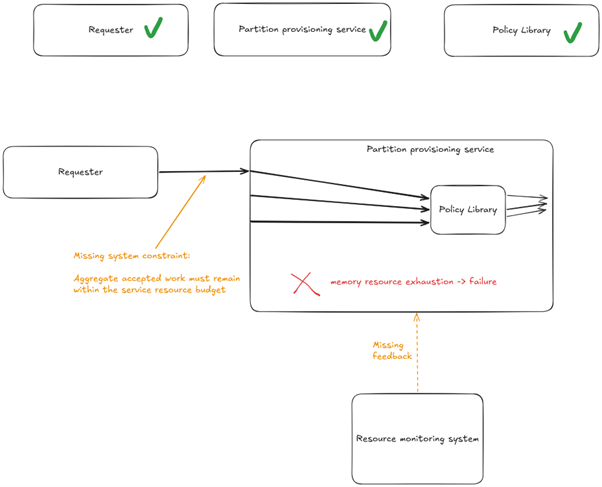
The fragility of the architecture remained completely invisible until a uniquely large provisioning request arrived. The automated service accepted the payload and dutifully initiated dozens of policy evaluation operations in parallel.
Instead of queuing or staggering these operations, each parallel thread independently loaded its required state from the underlying storage service. The aggregate memory footprint began to climb exponentially. As the concurrency multiplier took effect, the provisioning service quickly exhausted its allocated memory limit, triggering an abrupt and catastrophic out-of-memory (OOM) crash.
Phase 4: Misdiagnosing the Symptom
Initial triage pointed down a familiar troubleshooting path. Engineers suspected a standard resource starvation issue: perhaps the policy library harbored an unoptimized memory leak, or the configured concurrency limits were simply too aggressive for the host instances. The immediate remediation discussion centered on vertical scaling—allocating more RAM to the provisioning service or dialing back concurrency caps.
Yet, a deeper architectural review revealed a stark reality: every single component had performed its job flawlessly. The policy library executed its logic accurately; the provisioning service successfully leveraged concurrency to maximize throughput; and the client submitted a structurally valid request. The failure was entirely systemic, born of the invisible friction between local optimization and global scale.
Supporting Context & Metrics: Uncovering the Hidden Assumptions
The root cause of the incident traced back to a silent, unwritten assumption embedded deep within the shared policy library’s original design: The resource cost of an operation is inherently safe because callers will invoke it in a bounded, serial manner.
This assumption held true for the operator CLI, but it dissolved the moment the provisioning service introduced high-frequency concurrency. Compounding the issue, the development team had recently optimized the policy library for speed. While these performance tweaks delivered impressive speedups during isolated, serial test cycles, they were never subjected to stress testing under aggregate, multi-threaded workloads. A micro-operation that demanded negligible memory in isolation became an unbounded memory monster at the system level.
The Mathematics of Multi-Tenant Fan-Out
To quantify the risk, architects use the following conceptual model:
$$textTotal System Memory Footprint = sum_i=1^n (textState Size_i + textProcessing Overhead_i) times textConcurrency Factor$$
In the legacy CLI workflow, $n = 1$ and the concurrency factor was strictly controlled by human pacing. In the automated provisioning pipeline, $n$ scaled dynamically based on customer demand, and the concurrency factor surged unhindered. Without an upstream throttling mechanism tied to available RAM, the equation guaranteed eventual memory exhaustion whenever a sufficiently large batch request crossed the system boundary.
[Incoming Request] ---> [Provisioning Service] ---> (Unbounded Fan-Out)
                                |
                                v
                        [Policy Library x N] ---> OOM Crash!
                                (Missing Feedback Loop)
The system lacked an explicit architectural constraint: a programmatic rule dictating that the provisioning service must never accept or execute more work than it could safely process within its active memory budget. While reactive monitoring could alert engineers after memory utilization spiked, the control loop lacked the proactive feedback mechanisms required to shed load or push back against incoming requests before a crash occurred.
Official Statements & Industry Perspectives
The challenges exposed by this incident are far from isolated; they represent a fundamental blind spot in modern distributed systems design. Industry veterans and reliability experts increasingly emphasize that traditional unit and integration testing are insufficient for catching emergent system flaws.
"When we review system components in isolation, we ask comforting questions: Can this function handle malformed input? Can this microservice recover gracefully from a dropped database connection? Can this API safely retry failed operations? These are necessary inquiries, but they blind us to the ultimate system-level reality: What happens when five microservices, all operating with absolute correctness, decide to execute their perfect routines at the exact same millisecond?"
— Principal Distributed Systems Architect
Security and reliability engineers point out that traditional failure analysis focuses overwhelmingly on broken parts—timeouts, dropped packets, and dead nodes. Systems-safety engineering, however, demands a shift toward behavioral interactions.
Frameworks like System-Theoretic Process Analysis (STPA)—pioneered at the Massachusetts Institute of Technology (MIT)—reframe safety not merely as component reliability, but as enforced constraints on component behavior. Under an STPA lens, an incident is analyzed through three foundational elements:
- Controllers: The decision-making components that issue commands (in this case, the automated provisioning service).
- Controlled Processes: The downstream workers executing those commands (the policy library and storage services).
- Feedback Loops: The real-time operational signals (such as memory pressure, queue depth, and active thread counts) that must inform the controller’s future actions.
When a controller issues commands without listening to resource feedback loops, the system inevitably drifts into an unsafe operational state—even if every line of code complies with its unit tests.
Future Outlook: Redesigning for Systemic Resilience
As enterprise architectures grow increasingly complex—spanning serverless functions, multi-region Kubernetes clusters, and deeply nested microservice dependencies—the lessons learned from emergent system failures must reshape how engineering teams design, review, and operate software.
1. Shifting from Component Audits to Interaction Reviews
Engineering organizations must update their design review (RFC) and architecture review processes. Beyond asking what happens when a dependency fails, review boards must explicitly model high-concurrency compounding effects. Teams should ask:
- What is the theoretical maximum resource footprint of this request if all child operations execute simultaneously?
- Does this component assume a bounded caller, and what enforces that bound?
2. Implementing Dynamic Backpressure and Load Shedding
Static concurrency limits (e.g., capping a thread pool at 50 workers) are rarely sufficient in dynamic cloud environments, where the resource cost of a single task can vary wildly based on payload size or database state. Modern services must implement dynamic backpressure—adaptive control loops that tie incoming work admission directly to runtime telemetry, such as available heap memory, CPU utilization, and event loop latency. If resource pressure crosses a safe threshold, the system should gracefully shed load or return HTTP 429 (Too Many Requests) signals rather than degrading into an unrecoverable crash.
3. Embracing Systems-Safety Methodologies
Integrating lightweight adaptations of STPA into post-incident reviews and architectural design sessions helps unearth the invisible assumptions that trap modern engineering teams. By mapping out control actions and missing feedback loops, organizations can transition from a reactive posture—fixing symptoms after production goes dark—to a proactive posture that guarantees safety by design.
Ultimately, engineering reliable software requires accepting a humbling paradox: perfection in the parts does not guarantee safety in the whole. By acknowledging that systems possess emergent properties of their own, engineering leaders can build architectures robust enough to survive not just when things break, but when everything works all at once.