









Executive Overview
In the crosshairs of international copyright enforcement, the illicit streaming application MovieBox has emerged as one of the most prolific digital piracy operations in the world today. Surpassing a staggering 305 million downloads on the official Palm Store—the native app marketplace preinstalled on millions of mobile devices across Africa—the application has drawn the ire of major entertainment conglomerates.
The scope of MovieBox’s distribution has escalated the dispute from a regional nuisance to a high-stakes regulatory showdown in Europe. Both the Motion Picture Association (MPA) and the French pay-TV giant Canal+ have formally flagged MovieBox in their submissions for the European Commission’s upcoming 2027 Counterfeit and Piracy Watch List.
However, what separates this case from standard digital copyright infringement is the alleged intersection between the piracy platform and mainstream consumer hardware. Canal+ has gone a step further than Hollywood regulators, presenting evidence that attempts to link MovieBox’s infrastructure, domain registrations, and security certificates directly to Transsion, the dominant Chinese multinational smartphone manufacturer behind popular brands like Tecno, Infinix, and itel.
As the European Commission prepares to review the submissions and invite targeted entities to respond, the unfolding controversy exposes the complex gray areas of app ecosystem governance, corporate accountability, and the explosive growth of mobile-first piracy in emerging markets.
Detailed Chronology: From Nigerian Domain Bans to European Regulatory Scrutiny
The West African Crackdown and the Pivot to .ph
The modern saga of MovieBox gained widespread visibility last year when Nigeria’s national copyright watchdog celebrated a major enforcement victory: the suspension of MovieBox.ng. At the time of the takedown, the localized pirate streaming hub was pulling in tens of millions of monthly visits, serving as a primary portal for bootleg cinema and television across the region.
However, the operators of MovieBox demonstrated the resilience typical of contemporary large-scale piracy networks. Rather than folding under regulatory pressure, the platform executed a swift infrastructure migration, moving its operations to the .ph top-level domain (moviebox.ph). While domain-level seizures managed to disrupt the web portal temporarily, the Android application associated with the service remained entirely functional, accessible, and primed for continuous expansion through established mobile channels.

Escalation to Brussels
With the web domain operating largely out of reach of localized African enforcement, major rightsholders shifted their strategy toward international administrative channels. In official filings submitted for the European Commission’s 2027 Counterfeit and Piracy Watch List, both the MPA and Canal+ targeted MovieBox as an industrial-scale piracy apparatus that demands direct regulatory attention from European authorities.
By appealing to the European Commission, rightsholders hope to leverage the Watch List mechanism—a diplomatic and economic tool designed to name and shame marketplaces and service providers that facilitate intellectual property theft. Although inclusion on the Watch List does not constitute a formal legal finding of guilt, it serves as a powerful catalyst, signaling to governments, payment processors, and app operators that formal actions, trade measures, or legal repercussions may be imminent.
Supporting Context & Metrics: Unprecedented Growth in the Palm Store Ecosystem
The Scale of Distribution
The numbers associated with MovieBox’s distribution defy conventional understanding of indie app growth, rivaling the metrics of legitimate, VC-backed tech startups.
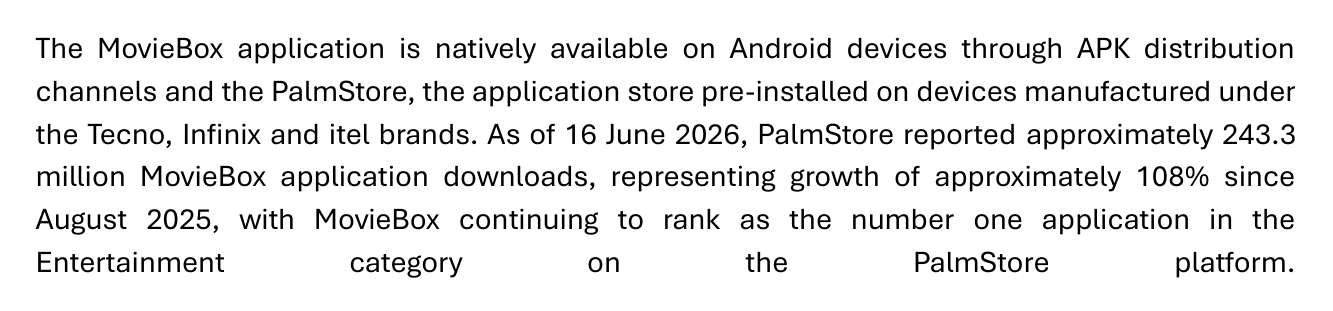
According to official figures cited in the Canal+ submission, PalmStore reported approximately 243.3 million downloads of the MovieBox application as of June 16, 2026. This milestone represented an astonishing 108% growth rate in less than a year, tracking upward from August 2025. Furthermore, Canal+ noted that MovieBox consistently held the coveted number-one ranking in the Entertainment category on the Palm Store platform.
Yet, even those figures quickly became outdated. By the time of subsequent platform audits, Palm Store listings confirmed that total downloads had climbed to 305.6 million, reflecting a massive influx of more than 60 million new installs in under four months.
Inside the Palm Store Ecosystem
To understand how an illegal streaming app achieves hundreds of millions of downloads, one must examine the unique structural architecture of Palm Store. Unlike independent, open marketplaces like Google Play or third-party repositories like APKMirror, Palm Store is a proprietary, preinstalled distribution platform embedded deeply within the operating systems of mobile devices manufactured by Transsion Holdings.

Transsion is a titan of the global mobile device market, particularly across the African continent. According to the company’s own corporate financial filings, Transsion accounted for an overwhelming 61.5% of all mobile phone sales in Africa in 2024 through its core device brands: Tecno, Infinix, and itel.
In a draft prospectus filed for a planned public listing on the Hong Kong Stock Exchange, Transsion outlined the commercial mechanics of its ecosystem. The company reported that Palm Store maintained over 180 million monthly active users on average. Crucially, the prospectus detailed the app store’s monetization strategy: Transsion typically extracts revenue from third-party application developers based directly on the volume of software installations processed through its distribution network. While concrete financial records confirming whether Transsion received direct installation bounties for MovieBox remain publicly unverified, the business model guarantees that application volume drives structural revenue for the platform operator.
Content and Promotional Strategies
MovieBox makes little effort to conceal its infringing nature. A review of its current store listings and promotional material reveals explicit marketing claims targeting sports fans and cinephiles alike. The application description proudly advertises:
"Enjoy free access to sports live streams right in our app,"
with direct references to live broadcasts from Europe’s top five elite football leagues.
Furthermore, promotional graphics utilized within official store listings heavily feature high-profile copyrighted properties, intellectual characters, and media conglomerates, including prominent references to Marvel and Disney universes. Users are offered free, uninhibited access to a massive library of copyrighted movies, premium television series, and live television streams without any licensing agreements in place with the rightful owners.
Official Statements and Corporate Connections: The Transsion Link
While hosting an application within an app store does not automatically imply operational complicity on the part of the store owner, Canal+’s dossier presented to the European Commission argues that the ties connecting MovieBox to the corporate ecosystem of Transsion run significantly deeper.
The Canal+ Findings
In its formal submission, Canal+ details technical and administrative analyses that purportedly tie the piracy operation directly to corporate infrastructure associated with Transsion:
"MovieBox has been closely linked to the Transsion / Transsnet ecosystem. Historical domain registration records identified Transsion-linked registration details for moviebox.ng, while technical analysis of the Android application revealed certificates signed under the Transsion name and references to Transsion-owned infrastructure and services," Canal+ asserted in its filing.
While the summary submission stops short of explicitly accusing Transsion of directly owning or running the day-to-day operations of MovieBox, the identification of code-signing certificates and infrastructure flags tied to the manufacturer raises vital questions regarding corporate due diligence and platform governance.
Additionally, Canal+ isolated a specific intermediary corporate entity: Excellent Innovation Limited, a Hong Kong-registered company. Through cross-referencing domain registrations, Secure Sockets Layer (SSL) certificates, developer attributions, and trademark filings, Canal+ linked this corporate entity to MovieBox. Notably, Palm Store’s public metadata lists Excellent Innovation Limited as the official developer of the application.
The MPA’s Perspective
The Motion Picture Association took a slightly broader, less localized approach in its parallel submission. Hollywood’s primary lobbying and anti-piracy arm did not name Transsion directly in its filing. Instead, the MPA focused its critique on the structural vulnerabilities of unregulated mobile app distribution channels, noting that MovieBox is widely believed to be systematically operated out of mainland China, targeting consumers in developing markets with impunity.

Canal+’s Commercial Stakes
The aggressive stance taken by Canal+ is also driven by distinct commercial incentives. The French media giant maintains extensive financial interests in the exact geographic markets where MovieBox is thriving. Canal+ owns MultiChoice, the dominant pay-TV operator behind DStv, which provides subscription television and streaming services across Sub-Saharan Africa. The unchecked proliferation of a free, multi-hundred-million-download pirate application directly undermines MultiChoice’s subscriber growth and revenue models across the region.
Future Outlook and Regulatory Implications
As the European Commission processes the submissions for its 2027 Counterfeit and Piracy Watch List, the legal and administrative framework enters a procedural phase designed to ensure due process.
Before the Commission publishes its definitive findings, the targeted service providers and platforms cited in the complaints—including entities linked to MovieBox and its distribution channels—will be granted an official opportunity to present their defenses. According to the consultation guidelines:
"The Commission will also make reasonable efforts to contact the service providers reported in the submissions and invite them to respond in writing to the allegations made against them."
To date, public outreach efforts directed at MovieBox operators, Excellent Innovation Limited, and Transsion Holdings regarding the allegations have yielded no formal statements or replies.
The finalized Counterfeit and Piracy Watch List is scheduled for official release in the spring of next year. While inclusion on the list does not carry immediate punitive fines or judicial penalties, it serves as a vital instrument of international policy pressure. By spotlighting platforms that facilitate massive copyright infringement, the European Commission aims to compel foreign manufacturers, app store operators, and national governments to take proactive steps toward cleaning up digital supply chains.
The case of MovieBox represents a watershed moment in the evolution of digital piracy. It highlights a troubling modern paradigm where illicit streaming services no longer rely solely on obscure underground websites, but instead integrate seamlessly into mainstream, factory-installed mobile application ecosystems—challenging regulators, device manufacturers, and rightsholders to establish new boundaries of digital accountability in the global marketplace.