







Executive Overview
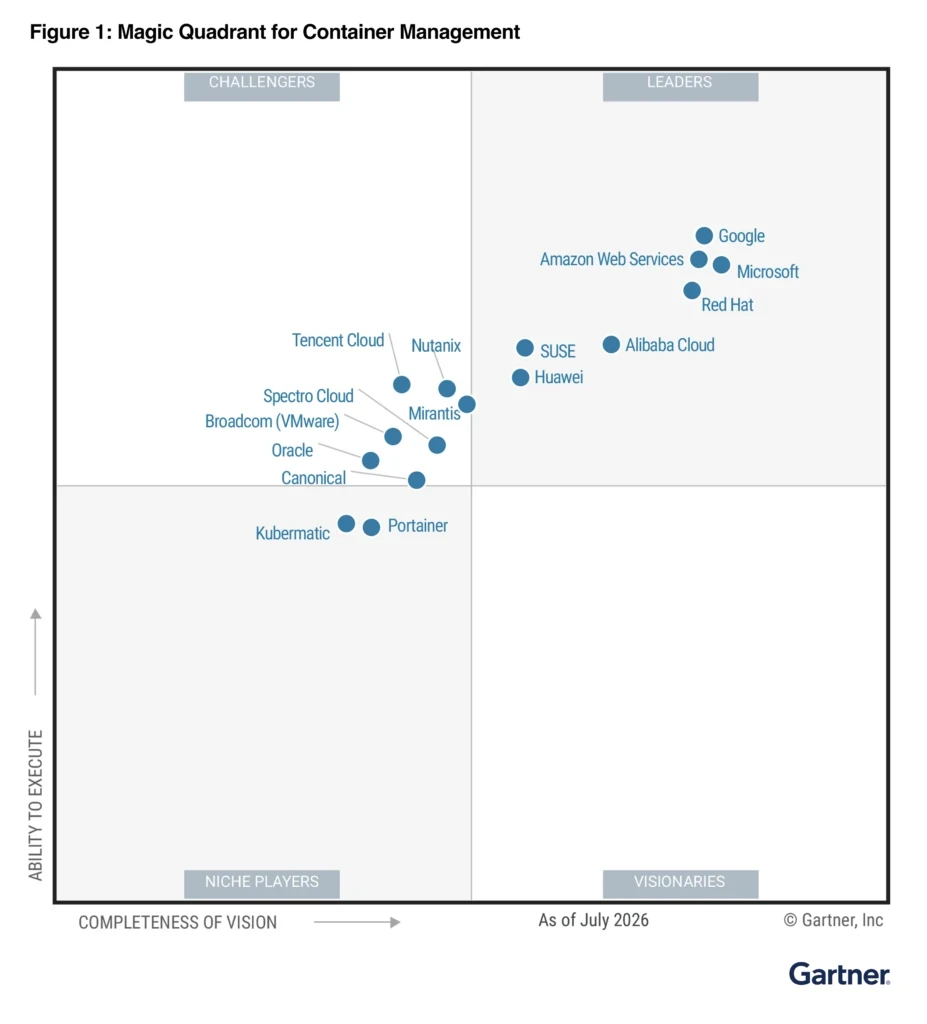
In an evaluation reflecting the ongoing realignment of enterprise cloud infrastructure around artificial intelligence, Gartner, Inc. has named Microsoft a Leader in the 2026 Magic Quadrant for Container Management. Placed furthest to the right on the "Completeness of Vision" axis, Microsoft’s positioning underscores a pivotal shift in the technology landscape: container orchestrators are no longer evaluated merely on their ability to host lightweight microservices, but on their capacity to manage hyper-scaler AI models, serverless agentic execution, and distributed edge infrastructure across sovereign regulatory boundaries.
The research report—authored by analysts Dennis Smith, Tony Iams, Wataru Katsurashima, and Lucas Albuquerque, published on September 2, 2026—comes at a time when enterprise IT departments face escalating operational fragmentation. Modern application estates are increasingly required to bridge central cloud environments, regional data hubs, sovereign localized clouds, and on-premises edge nodes.
Microsoft’s container portfolio, which encompasses Azure Kubernetes Service (AKS), Azure Container Apps, Azure Arc, and Azure Kubernetes Fleet Manager, has been engineered to present a single, unified operating model across these disparate topologies. By abstracting operational complexity, the software giant aims to let enterprise platform teams deploy high-density GPU clusters and serverless AI agents without forcing developers to rewrite core application logic or adopt fragmented management toolchains.
+-----------------------------------------------------------------------+
|                GARTNER MAGIC QUADRANT POSITIONING (2026)              |
|                                                                       |
|   Ability to Execute                                                  |
|         ^                                                             |
|         |                     |                                       |
|         |   CHALLENGERS       |   LEADERS                             |
|         |                     |     * MICROSOFT                       |
|         |                     |       (Furthest Right on Vision)      |
|         |                     |                                       |
|         +-------------------------------------------------->          |
|         |                     |                                       |
|         |   NICHE PLAYERS     |   VISIONARIES                         |
|         |                     |                                       |
|         |                     |                                       |
|                               Completeness of Vision                  |
+-----------------------------------------------------------------------+
Detailed Chronology: The Decade-Long Evolution of Container Orchestration
To understand Microsoft’s current architectural strategy, one must examine the ten-year evolution of open-source container management and how the requirements placed upon orchestrators have fundamentally changed.
+-----------------------------------------------------------------------+
|                       TEN-YEAR CONTAINER EVOLUTION                    |
|                                                                       |
|  2014-2016 : Microservice Orchestration                               |
|              • Abstracting compute and democratizing distributed systems|
|              • Decoupling workload intent from physical node placement|
|                                                                       |
|  2017-2021 : Enterprise Hybrid Consolidation                          |
|              • Kubernetes emerges as the definitive standard          |
|              • Multi-cloud management and hybrid extensions (Azure Arc)|
|                                                                       |
|  2022-2026 : The AI & Sovereign Edge Era                              |
|              • GPU scheduling and AI Toolchain automation             |
|              • Serverless agentic sandboxes & localized compliance    |
|              • Autonomous SRE agents & Fleet-wide coordination       |
+-----------------------------------------------------------------------+
The Initial Abstraction Phase (2014–2017)
When hyperscalers began investing heavily in Kubernetes over a decade ago, the primary technical challenge was relatively narrow: democratizing distributed systems to simplify the construction of reliable services. Early engineering efforts prioritized decoupling application logic from physical host machines. By expressing workloads strictly through declarative resource requirements rather than hardcoded destination targets, orchestrators were given the latitude needed to make dynamic scheduling decisions.
This scheduler-neutral approach proved unexpectedly resilient. Because the underlying platform maintained an agnostic posture toward the nature of the application, container runtimes were inherently positioned to accommodate workloads that engineers had not yet envisioned.
Enterprise Hybrid Expansion (2018–2022)
As corporate enterprises migrated core business applications away from legacy virtual machines, container orchestration became the standard abstraction layer across hybrid infrastructure. However, this period introduced the challenge of configuration drift. Organizations deploying clusters across multi-cloud environments found themselves managing disparate identity providers, network security group policies, and monitoring stacks. Microsoft responded during this era by introducing Azure Arc, designed to extend Azure’s governance, identity, and policy frameworks to native Cloud Native Computing Foundation (CNCF) conformant clusters running on third-party clouds or bare-metal data centers.
The AI Infrastructure & Sovereignty Era (2023–2026)
The rapid adoption of Generative AI completely altered container platform requirements. Generative models, agentic workflows, and real-time inference loops introduced unprecedented demands for GPU scheduling, dynamic elasticity, low-latency data access, and hardware isolation. Simultaneously, strict digital sovereignty laws enacted across global jurisdictions forced enterprises to move inference engines closer to local data repositories and end-users.
Consequently, container management shifted from localized cluster administration to broad multi-region and multi-edge fleet orchestration.
Supporting Context & Metrics: Dual AI Architectures and Fleet Operations
Data from modern enterprise deployments reveals that AI integration typically splits into two distinct architectural patterns. Microsoft’s container ecosystem is designed to support both paradigms while maintaining a shared security, network, and identity control plane.
+-----------------------------------------------------------------------+
|                    DUAL AI ARCHITECTURAL MODELS                       |
|                                                                       |
|  MODEL 1: Persistent Infrastructure Layer                             |
|  +-----------------------------------------------------------------+  |
|  |  Platform Team Governance | High-Volume, Predictable AI Ops    |  |
|  |  • Automated GPU Provisioning via AI Toolchain Operator        |  |
|  |  • CNCF AI Conformance Certification                           |  |
|  |  • Strict Compliance Boundaries & Fine-Tuned Model Life Cycles   |  |
|  +-----------------------------------------------------------------+  |
|                                                                       |
|  MODEL 2: Serverless Elastic / Agentic Layer                          |
|  +-----------------------------------------------------------------+  |
|  |  Application & Agent Developer Agility | Dynamic Scaling        |  |
|  |  • Serverless GPU Provisioning (On-Demand Inference)           |  |
|  |  • Hardware-Isolated Sandboxes (Stateful Agent Hosting)        |  |
|  |  • Zero Kubernetes Abstraction Overhead for App Developers     |  |
|  +-----------------------------------------------------------------+  |
+-----------------------------------------------------------------------+
Paradigm 1: The Persistent Infrastructure Layer
For mission-critical LLM serving, deep learning fine-tuning, and high-throughput vector indexing, platform operations teams maintain persistent infrastructure.
- Operational Control: Central engineering teams own GPU cluster scheduling, model lifecycle automation, continuous security patching, and strict regulatory compliance boundaries.
- Tooling Integration: On Azure Kubernetes Service (AKS), open-source capabilities like the AI toolchain operator automate the provisioning of specialized hardware nodes and streamline large language model deployment.
- Standardization: AKS holds official CNCF AI Conformance certification, assuring enterprise customers that their underlying cluster APIs remain standard and compatible with ecosystem tools as the broader AI ecosystem evolves.
Paradigm 2: Serverless Elasticity and Agentic Sandboxing
Conversely, modern software applications and autonomous AI agents invoke inference unpredictably. These workloads require rapid capacity expansion followed immediately by teardown to eliminate idle compute costs.
- On-Demand Capacity: Azure Container Apps offers serverless GPU support, allowing ephemeral inference workloads to spin up rapidly and scale to zero.
- Stateful Isolation: Dedicated hardware-isolated sandboxes secure autonomous AI agents. These sandboxes safely contain untrusted generated code while preserving state across multi-step conversations or execution flows.
- Developer Abstraction: Application developers access these execution environments via straightforward APIs without needing deep operational familiarity with underlying Kubernetes constructs.
Enterprise Fleet Metrics & Open Source Commitment
Managing thousands of clusters spread across edge sites, cloud regions, and sovereign zones exposes platforms to high operational risk. A major cause of system downtime in large-scale deployments stems from coordination failures—such as uneven patch rollouts, configuration drift, and asymmetric policy application—rather than isolated hardware faults.

| Capability Matrix | Azure Kubernetes Service (AKS) | Azure Container Apps | Azure Arc for Kubernetes | Azure Kubernetes Fleet Manager |
|---|---|---|---|---|
| Primary Target | Managed Kubernetes Clusters | Serverless Microservices & Agents | Multi-Cloud & Edge Clusters | Multi-Cluster Fleet Coordination |
| Compute Profile | Dedicated & Autoscaled Nodes | Ephemeral & Serverless GPUs | Heterogeneous / On-Premises | Fleet-wide Resource Scheduling |
| Operational Model | Full Kubernetes API Access | High Abstraction / Zero-K8s | Centralized Azure Control Plane | Centralized Governance & Drift Prevention |
| AI Workload Focus | Heavy Serving / Fine-Tuning | Ephemeral Inference / Sandboxes | Edge Data Processing | Multi-Region Deployment Schedules |
To address coordination bottlenecks across heterogeneous environments, Microsoft relies on Azure Kubernetes Fleet Manager for update scheduling and workload placement, combined with AKS Everywhere to deploy standardized Kubernetes footprints from cloud to edge.
Crucially, this ecosystem remains anchored in upstream open source rather than proprietary forks. Engineering statistics confirm that Microsoft stands as the second-largest overall contributor to CNCF projects globally, and the number-one cloud provider contributor over the past three years. This commitment guarantees that application APIs remain uniform across public, private, and hybrid deployment targets.
Official Statements & Industry Perspectives
Discussing the company’s positioning in the 2026 Gartner Magic Quadrant, Microsoft executives emphasized that container management platforms must evolve past basic cluster provisioning to handle complex infrastructure realities.
"When we started working on Kubernetes over a decade ago, the problem was narrow: democratize distributed systems so that reliable services were easier to build," noted Microsoft leadership in an official platform announcement. "AI has reshaped the requirements for container management… Organizations now need more than container orchestration; they need a platform that provides a consistent operating model across cloud, edge, and hybrid deployments while adapting to new requirements without needing applications to be rebuilt."
Microsoft highlighted that bridging the gap between platform engineers managing heavy infrastructure and software teams building dynamic AI agents represents the core focus of their architectural investment:
"Almost every enterprise we work with needs both [architectural models], and the interesting engineering problem is making the boundary between them easy to cross: the same image, the same identity and network controls, the same policy, whichever side a team lands on… At the end of the day, only the team running a workload can decide where it belongs… The platform’s role is to let that answer change without forcing the team to redesign the application."
Enterprise customers adopting this unified container management model report significant operational efficiency and cost advantages. CallRevu, an industry leader in automotive communication intelligence, pointed to resource elasticity as a primary business enabler:
"Azure Kubernetes Service gives us the control and cost efficiency we need. We can scale GPU resources based on call volume and test new models without touching production," stated Brian Sutliffe, Vice President of Engineering at CallRevu.
Future Outlook: Agentic Operations and Automated Platform Engineering
Looking beyond traditional management portals, the industry is entering an era defined by agentic operations. As cluster counts multiply across multi-cloud and edge landscapes, the volume of telemetry data and operational alerts quickly exceeds human capacity. Platform operations are moving toward AI-native diagnosis and remediation architectures.
+-----------------------------------------------------------------------+
|                    THE AGENTIC OPERATIONS CYCLE                       |
|                                                                       |
|   +-------------------+         +-------------------------------+     |
|   | Cluster Telemetry | ------> | Azure SRE Agent               |     |
|   | & Health Metrics  |         | (Context-Aware Diagnosis)     |     |
|   +-------------------+         +-------------------------------+     |
|                                                 |                     |
|                                                 v                     |
|   +-------------------+         +-------------------------------+     |
|   | Automated Human-  | <------ | AKS MCP Server                |     |
|   | Guided Remediation|         | (Policy & RBAC Safe Execution)|     |
|   +-------------------+         +-------------------------------+     |
+-----------------------------------------------------------------------+
To streamline these operations, Microsoft is advancing tools like AKS Automatic, which injects cloud-scale operational best practices out of the box while preserving access to raw Kubernetes APIs. Simultaneously, the integration of the Azure SRE Agent and the AKS Model Context Protocol (MCP) Server enables AI operators to automatically move from incident alerts to root-cause diagnosis and actionable remediation.
Crucially, these agentic SRE systems execute actions strictly within the established Role-Based Access Control (RBAC), network controls, and security policies already configured by enterprise platform teams. Rather than replacing human oversight, agentic operations aim to eliminate repetitive, manual investigative triage.
As cloud computing matures, the defining metric for container management platforms has shifted from maximum feature density to operational resilience under scale. Microsoft’s placement as the visionary leader in the 2026 Gartner Magic Quadrant reflects an industry-wide consensus: container infrastructure must seamlessly support traditional enterprise workloads, hyper-scale AI pipelines, and distributed sovereign nodes under a single, unified operational model.