








Executive Overview
In the fast-evolving landscape of B2B sales and tech events, a quiet revolution is taking place at SaaStr. Operating with a lean team of just three humans alongside a fleet of 21 specialized AI agents in production, the company has doubled its sponsorship revenue over the last 12 months. This is not merely a story about experimenting with lightweight chatbots or automated cold email sequences. It is a comprehensive blueprint for running an entire revenue operation (RevOps) natively through AI.
In a recent, deep-dive episode of The Agents podcast, Amelia walked through the exact, screen-by-screen architecture of the SaaStr agent stack. Displaying real inputs, live outbound emails, custom prospect decks, and active conversion metrics, the team exposed how modern artificial intelligence has fundamentally altered their go-to-market motion.
The core takeaway is striking: while off-the-shelf software excels at processing external signals, the true competitive advantage lies in utilizing proprietary, internal company data. By building a custom orchestration layer—affectionately named "10K"—SaaStr has turned Salesforce into a headless database, automated 17,000 customer conversations, booked 600 meetings, and achieved a 2.1x year-over-year revenue increase for CY2027.
This report provides an exhaustive, investigative breakdown of how SaaStr achieved these numbers, the specific technical architecture behind their success, the granular details of their inbound and outbound funnels, and the critical lessons other organizations can copy to transform their own growth engines.
Detailed Chronology: Building the Autonomous Revenue Engine
Building a headless, AI-first sales machine did not happen overnight. It is the result of iterative engineering, architectural pivots, and continuous system refinement over the span of more than six months.
Phase 1: The Genesis on Replit and Headless Salesforce
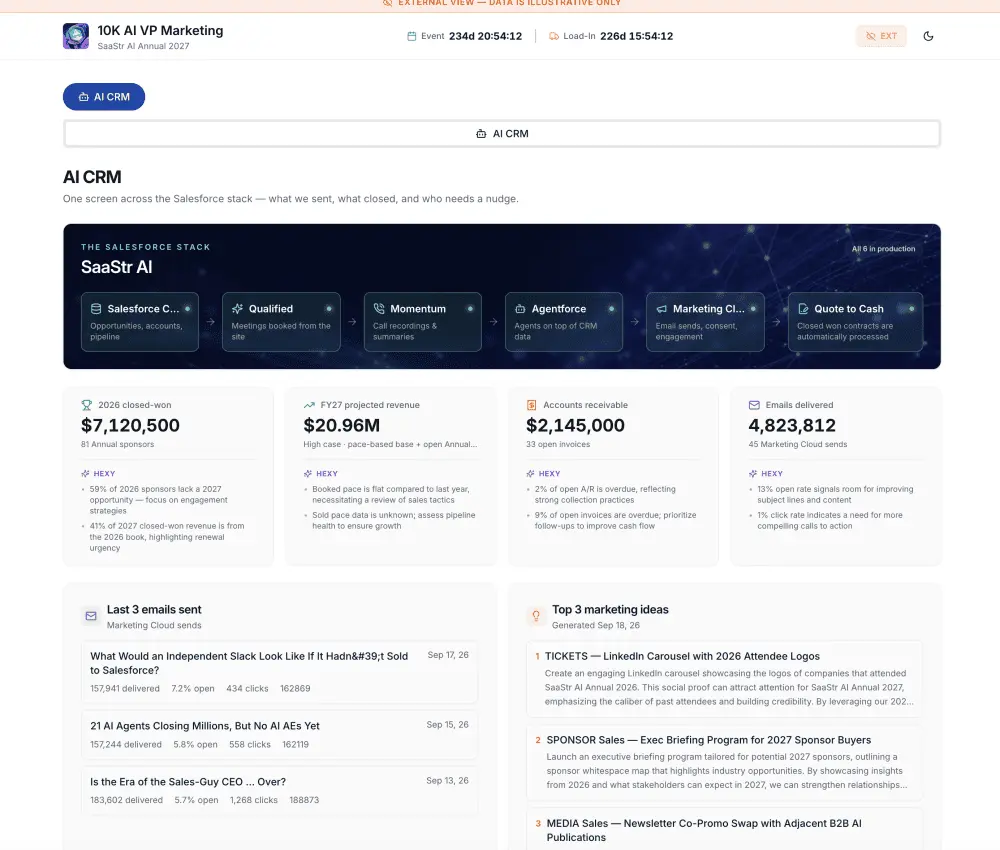
Six months ago, the first rudimentary version of "10K"—dubbed their AI VP of Revenue—was spun up as a basic dashboard on Replit. The team hooked Salesforce into it as an experiment. Almost by accident, this architecture evolved into a "headless Salesforce" model.
Today, the traditional Salesforce user interface (UI) is rarely touched. A full-time human sales executive logs in occasionally, Amelia visits it to click specific authorization buttons when necessary, and other team members never open the UI at all. Yet, Salesforce remains the core system of record. It feeds data continuously into 10K, alongside a suite of tools including Momentum for call recording, Qualified, Marketing Cloud (now integrated with Salesforce Agentforce), Sales Cloud, and Slack.
Because 10K is plugged into approximately 30 additional data layers on top of these tools, the AI agent can simultaneously pull context from across the entire ecosystem. When a human looks at Salesforce, they see a static CRM; when 10K looks at Salesforce, it sees a dynamic, real-time web of customer engagement, renewal history, and behavioral signals.
Phase 2: Overhauling the Inbound Funnel
Thirteen months ago, SaaStr’s "contact us" and sponsor landing pages operated on traditional, friction-heavy models. A prospective sponsor filled out a long contact form, which was manually round-robined to Amelia or David, resulting in a follow-up lag of roughly 24 hours. The standard outreach message was a generic form letter: "Hey [company], you look like a great fit for SaaStr, let’s book a time."
According to Amelia, unedited, that was "the worst email on planet Earth." Modern tech buyers—especially AI-native enterprises—dislike raising their hand only to receive an automated template and a two-day delay.
SaaStr completely dismantled this process by introducing two distinct inbound pathways:
- Door One (Conversational AI): Powered by an avatar on Qualified, this agent engages users in real time. It qualifies inbound leads by assessing budgets, distinguishing between lead generation, brand awareness, or speaking slots, and identifying competitor interest. Crucially, it books meetings on the spot. Over the past 12 months, this agent has handled 17,000 conversations and booked 600 meetings.
- Door Two (The Tokenized, Self-Revising Prospectus): For buyers who prefer reviewing packages and pricing independently rather than talking to an avatar immediately, SaaStr discarded static Google Slides prospectuses. In their place, they engineered a self-serve path featuring a tokenized prospectus that dynamically rewrites itself within 10 minutes of a download, integrating the prospect’s specific company data, active competitors, and recommended sponsorship tiers.
Phase 3: Closing the Calendar and Scheduling Silos
Recognizing that fragmented scheduling tools created friction, SaaStr bypassed third-party calendar silos by having 10K build a custom calendar booking tool in just 20 minutes.
This custom calendar automatically embeds the prospect’s company name, tracks whether a visitor hit the page without booking, and ties the interaction back to the exact prospectus they were reviewing. If a visitor opens the booking link and bounces, 10K instantly alerts Amelia and drafts a contextual follow-up email. Furthermore, routing decisions are handled autonomously by the agent; for instance, routing a lead like Base44 to Amelia because she manages the Replit and Lovable portfolios, weighted against other team members’ account distributions.
Phase 4: Deploying the Renewal Agent
The most recent architectural addition—deployed roughly a month ago—is the Renewal Agent, which is largely credited with driving a 60% increase in contract renewals.

Before this agent, the team relied on a top-down manual approach, focusing primarily on high-annual contract value (ACV) accounts. The Renewal Agent changed the mechanics entirely by ensuring every single renewal, across all ACV tiers, receives proactive touchpoints. Moreover, it aggregates real-time data on leads, impressions, and media coverage into continuous monthly updates rather than saving all communication for the renewal deadline.
Supporting Context & Metrics: The Anatomy of a 2.1x Surge
The raw metrics driving SaaStr’s 2027 projections underscore the viability of agent-led go-to-market motions:
- Revenue Growth: A 2.1x year-over-year surge in sponsorship revenue.
- New Business Increase: A 60% boost in new business acquisition.
- Inbound Scale: 17,000 actual customer conversations executed by AI agents.
- Meeting Generation: 600 qualified meetings booked directly through conversational and self-serve interfaces.
- Team Efficiency: Maintained entirely by a human core of three people operating alongside 21 production-grade AI agents.
The Power of Audience Segmentation and Custom Decks
A standout capability of the Renewal Agent is its advanced audience segmentation. When generating renewal decks—built via Gamma to ensure strict adherence to real data, metrics, and actual customer booth photos rather than bizarre, AI-generated festival imagery—the agent tailors content dynamically based on the recipient.
For example, when preparing a renewal package for Replit, the agent determined that the events and marketing teams needed to see proof of their top-leaderboard status at the annual event. However, for the CEO, the agent generated a single, highly focused slide highlighting the six million cumulative impressions achieved across all collaborative touchpoints throughout the year.
In another instance, when dealing with a three-time sponsor whose engagement metrics had dipped, the agent independently flagged the downward trend before the renewal conversation began. Instead of pushing a generic happy-path narrative, it drafted a constructive analytical review: evaluating why the company’s market category and sponsorship tier performance dropped, and proposing strategic adjustments for 2027. This proactive approach successfully re-engaged the account, preventing a planned hiatus.
Official Statements & Insights from Leadership
During The Agents podcast walkthrough, the leadership team shared candid insights regarding the realities of building proprietary AI infrastructure:
"Our AI agents did 17,000 actual customer conversations and booked 600 meetings in the past 12 months. For CY2027, that’s led to a 2.1x growth in revenue year-over-year."
— Jason Lemkin, Founder of SaaStr
Reflecting on the evolution of their internal systems, the team emphasized that third-party tools, while useful for gathering external signals, fundamentally lack deep, proprietary context.
"The most valuable asset we have is our own data. The email that remembers you sponsored three years ago, names your three competitors and two partners who will be there, and shows your 2024 ROI even though you skipped 2025 and 2026, is not something any third-party tool will build."
The team also addressed the growing pains of managing complex agent architectures. For several weeks, 10K experienced a "stupid mode" where its performance degraded noticeably. Diagnosis revealed that the system had simply grown too bloated—accumulating too much data, too many APIs, and an overly expansive surface area. By modularizing the application and leveraging advanced underlying model updates (such as Fable 5.1), the quality of the agent’s strategic recommendations rebounded sharply.
Future Outlook: The Next Frontier for Autonomous RevOps
As SaaStr looks toward the future, the character of the AI agent’s recommendations has fundamentally shifted. A year ago, 10K suggested tactical updates like referral programs for event tickets. Today, the agent is proposing strategic shifts, such as positioning SaaStr to become the premier event that AI agents themselves recommend to other agents, anticipating a future where autonomous agents act as primary corporate buyers.
Additionally, the team plans to expand the agent’s scope by building a dedicated RevOps copilot specifically tailored for human sales executives—such as David—to streamline internal workflows just as effectively as it automates inbound and renewal pipelines.
Recommended Implementation Blueprint for Organizations
For companies looking to transition away from traditional contact forms and manual round-robin queues, SaaStr recommends a disciplined, stair-step implementation order:
- Invest in Data Plumbing First: Centralize your proprietary history, customer interactions, and historical touchpoints where you have the richest dataset (e.g., renewals). Build the heavy data architecture once.
- Deploy Conversational Inbound: Implement qualified conversational avatars on high-intent pages to eliminate form-fill lag and offer instant discovery and booking pathways.
- Upgrade Self-Serve Assets: Replace static, downloadable PDFs and slides with dynamic, tokenized prospectuses that continuously update based on real-time visitor behavior and firmographic data.
- Automate Calendars and Routing: Close tracking gaps by integrating custom scheduling tools that monitor bounce rates and trigger immediate, context-aware follow-up sequences.
- Scale Outbound and Enrichment: Combine multi-source enrichment tools (such as Clay, Exa, and CoreSignal) via automated agent skills to verify lists before executing highly targeted, low-volume, high-relevance outbound messaging.
By treating AI agents not as simple productivity plugins, but as core architectural members of the operational stack, businesses can achieve unprecedented revenue multiples while keeping human teams lean, focused, and strategic.