








Executive Overview
The landscape of digital marketing is undergoing a seismic, data-verified shift. For years, direct-to-consumer brand campaigns, highly polished corporate aesthetics, and traditional brand-published posts formed the bedrock of social media advertising. However, fresh empirical data from customer experience and social media marketing platform Emplifi reveals a striking reality: when it comes to brand promotions on Instagram, creator-published collaborations consistently outperform traditional brand posts and brand-initiated partnerships.
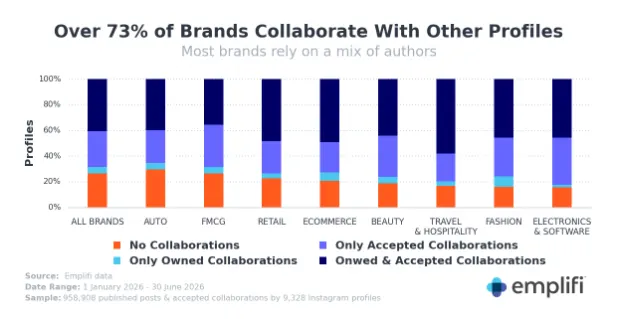
Analyzing more than 520,000 posts across 3,791 brand profiles on Instagram, Emplifi’s comprehensive study underscores a broader evolution in consumer trust and digital behavior. Over 73% of major brands on Instagram have actively adopted the platform’s "Collab" feature, recognizing that cooperative posting yields exponential reach. Yet, the method of execution is everything. The data demonstrates that who hits the "publish" button matters immensely.
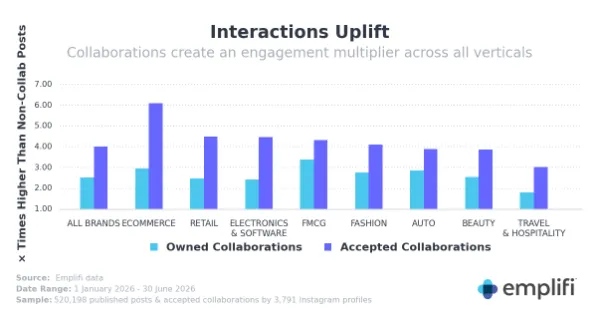
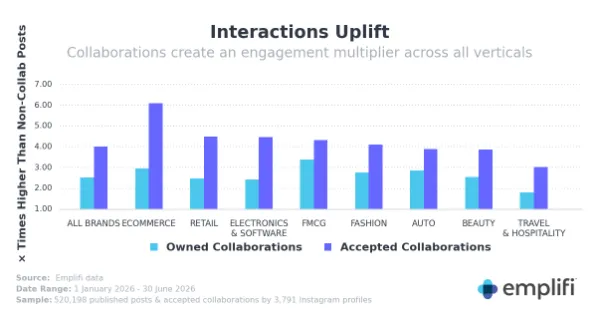
When a content creator originates a post and invites a brand to collaborate—as opposed to a brand originating the post and tagging a creator—the resulting engagement, amplification, and reach skyrocket. In sectors like e-commerce and retail, these creator-led campaigns deliver more than five times the amplification of standard, non-collaborative brand posts.
This deep-dive report explores the mechanics behind this trend, the shifting dynamics of Meta’s creator ecosystem, the structural differences between owned and accepted collaborations, and what this means for digital marketers striving to optimize their social media ROI.
Detailed Chronology: The Evolution of Instagram’s Collaboration Architecture
To understand how creator-published collaborations achieved their current dominance, it is necessary to examine how Meta systematically built and refined the infrastructure supporting these partnerships over recent years.
The Rise of the Native "Collab" Feature
Historically, digital partnerships between brands and influencers were fraught with friction. Brands would sponsor content, requiring creators to manually tag them, use disclaimers like #ad or #sponsored, and hope that audience members would click through to the brand’s profile. Engagement was fragmented; comments and likes were split across two separate pieces of content, and attribution was notoriously difficult to measure accurately.
Meta’s introduction of the native Instagram Collab feature fundamentally changed this dynamic. By allowing two accounts to co-author a single post or Reel, the platform merged audiences, engagement metrics, and comment sections into a singular digital footprint. Both accounts’ followers could see the content organically in their feeds, and likes and comments were pooled together.
Expanding the Toolkit: Meta’s Creator Marketing Hub
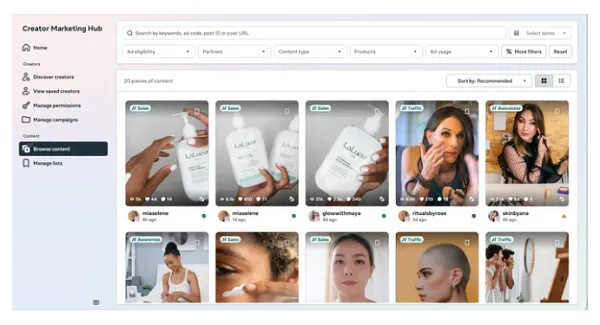
As the creator economy matured, Meta recognized the need for centralized infrastructure to streamline these relationships. The tech giant rolled out advanced creator partnership tools designed to facilitate discovery, outreach, and campaign management.
These platforms bridged the gap between brands looking for vetted talent and creators seeking reliable monetization streams. Through Meta’s evolving Creator Marketing Hub, brands gained the capacity to systematically review, accept, and manage sponsorship requests, turning what was once a chaotic process of direct messaging and email negotiations into an organized workflow.
The Affiliate Program Expansion
A major catalyst for the current landscape arrived in March, when Meta announced a significant expansion of its affiliate program to include direct brand links within Reels clips. This enhancement allowed creators to browse a catalog of products, select items that aligned with their personal brand, and seamlessly integrate them into short-form video content with direct purchasing pathways.

The Emplifi dataset—covering performance metrics from January 1 through June 30—captures this exact transitional window. As more creators leaned into affiliate commissions and leveraged Meta’s integrated tools, the volume and efficacy of creator-led partnerships surged, culminating in the performance disparities highlighted in the mid-year data review.
Supporting Context & Metrics: Unpacking the Emplifi Data
The numbers compiled by Emplifi leave little room for ambiguity. By breaking down collaboration types into distinct categories, the study offers a granular view of how content distribution affects audience reception.
Defining the Two Collaboration Models
Emplifi’s research categorizes Instagram brand partnerships into two distinct operational frameworks:
- Owned Collaborations: These are brand-initiated posts. The brand publishes the content from its official corporate profile and invites a creator to co-author or collaborate on the post.
- Accepted Collaborations (Creator-Led): These are creator-initiated posts. The creator publishes the promotional or sponsored content from their personal handle and invites the brand to collaborate on the post.
While both models outperform traditional, standalone brand posts, accepted collaborations emerge as the undisputed champions of engagement.
[Standard Brand Post] ----------------> Baseline Reach & Engagement
[Owned Collaboration] --------------> Moderate Lift (Brand-initiated)
[Accepted Collaboration] -----------> Massive Lift (5x+ Amplification in Retail/E-commerce)
The Amplification Effect Across Verticals
The sheer multiplier effect of creator-led posts is most visible in consumer-heavy verticals. According to Emplifi, accepted collaborations in the e-commerce and retail sectors achieve more than five times the organic amplification compared to standard, non-collab brand posts.
Even in niche or highly specialized B2B and service-oriented verticals where consumer engagement is historically lower, the structural advantage of the Collab feature remains undeniable. Both owned and accepted collaborations generate significantly higher volumes of shares, reposts, and saves than traditional brand-published content. Shares and saves are particularly valuable algorithmic signals on Instagram, indicating that content is resonant enough for users to distribute within their own private networks or bookmark for future reference.
Reels: The Undisputed King of Content Formats
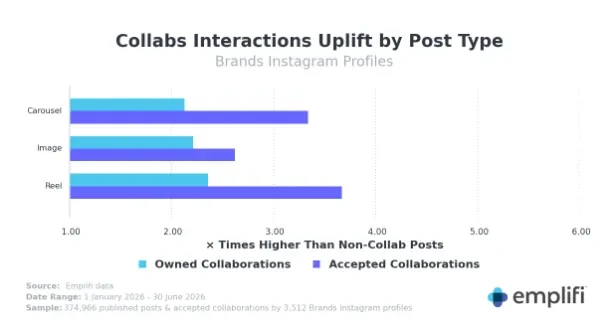
When analyzing content types within these collaborations, Emplifi’s findings point to one clear format dominating performance metrics: Reels.
While collaboration boosts performance across static imagery, carousels, and video alike, short-form video content sees the most dramatic gains. This phenomenon highlights a core truth of modern digital media: audience attention is an increasingly scarce commodity, and capturing it requires specialized narrative pacing, trend awareness, and platform fluency.
Creators spend hours every day immersed in the native culture, audio trends, and algorithmic nuances of short-form video. Consequently, they possess an innate understanding of how to weave a brand message into a Reel without making it feel like a jarring, commercial interruption. When a brand hands over the creative reins—allowing the creator to host the post on their feed—the content retains the authentic, native feel that audiences trust.
Official Industry Perspectives & Expert Analysis
The shift toward creator-led dominance aligns with broader structural changes in digital advertising and consumer psychology. Modern consumers, particularly Gen Z and Millennials, have developed a sophisticated filter against overt, corporate advertising. They tune out slick, high-budget brand commercials in favor of peer recommendations, authentic reviews, and relatable storytelling.
The Power of Native Trust
Industry analysts point out that when a creator publishes a collaboration, they are lending their hard-earned credibility to the brand. Followers trust creators because of a perceived parasocial relationship built on consistency, transparency, and shared interests.
When a brand forces its own corporate account to lead the narrative, the psychological contract changes. It shifts from a trusted recommendation from a peer to an explicit advertisement from a commercial entity.
"Grabbing audience attention with short-form video requires a level of understanding of the medium and of key trends that are driving engagement," industry experts note. Because content creation is their primary focus, creators are uniquely positioned to craft narratives that resonate deeply with audiences, resulting in higher watch times, deeper engagement, and ultimately, superior conversion rates.
Future Outlook: What Marketers Must Do Next
As the digital marketing landscape heads deeper into the decade, the data from Emplifi serves as both a warning and an invitation for brand marketers. The playbook of the past—where brands dictated every pixel of a campaign, housed all content on corporate profiles, and treated creators merely as distribution megaphones—is officially obsolete.
1. Cede Creative Control
Marketers must learn to trust the talent they hire. The data proves that allowing creators to take the lead, produce the content on their own channels, and invite the brand to collaborate yields exponentially better returns. Micromanaging creator content often strips away the very authenticity that made the creator successful in the first place.
2. Optimize for Instagram Collab and Affiliate Tools
With over 73% of brands already utilizing Instagram’s collaboration feature, simply using the tool is no longer a competitive advantage—it is table stakes. Brands must operationalize their relationships through Meta’s evolving Creator Marketing Hub and lean into affiliate structures. By aligning influencer compensation with performance-driven affiliate models, brands can incentivize creators to drive genuine consumer action.
3. Prioritize Short-Form Video Partnerships
Budget allocation must continue to pivot toward video-first collaborations. Investing in creator-led Reels should be a foundational pillar of any social media strategy, particularly for retail, fashion, beauty, and direct-to-consumer lifestyle brands.
Conclusion
Emplifi’s study is a clear indicator that the democratization of media is maturing. Brands that recognize the supremacy of the creator-led approach—embracing shared ownership, relinquishing creative control, and aligning with digital native talent—will capture the lion’s share of audience attention. Those that cling to outdated, top-down corporate broadcasting models risk talking to an empty room.