









Executive Overview
In the high-stakes world of digital copyright enforcement, plaintiffs typically present themselves as aggrieved creators seeking to unmask anonymous file-sharing networks. However, a federal lawsuit targeting several of the world’s most prominent private torrent trackers—including PTP (PassThePopcorn) and BTN (BroadcastheNet)—has devolved into an unprecedented legal soap opera. What began as a standard copyright infringement complaint has morphed into a baffling mystery of alleged identity theft, astronomical mathematical coincidences, procedural counterattacks, and a last-minute voluntary dismissal that leaves profound questions unanswered.
At the heart of the controversy is a plaintiff who initiated legal action under the name "Matthew Schneider," claiming ownership of various short films and literary works. Defense attorneys representing the anonymous operators of the targeted trackers soon uncovered a staggering revelation: the actual Matthew Schneider—a Canadian independent filmmaker whose credits match the works cited in the complaint—claims he has never heard of the lawsuit, has never met the plaintiff, and is entirely uninvolved.
Rather than folding, the individual operating as the plaintiff doubled down, arguing before U.S. District Judge Andrea R. Wood that a remarkable coincidence had occurred: two distinct independent filmmakers named Matthew Schneider happened to exist, both of whom coincidentally created distinct films bearing the exact same, highly specific titles years apart.
As the case hurdles toward a crucial in-person hearing following a dramatic, eleventh-hour notice of voluntary dismissal, this legal battle serves as a cautionary tale about the vulnerabilities of anonymous digital litigation, the tenacity of privacy-focused defense counsel, and the lengths to which bad actors might go to pierce the veil of protected online communities.
Detailed Chronology: From Copyright Complaint to Identity Crisis
The Inception of a High-Profile Digital Lawsuit
The seeds of this legal drama were planted when a plaintiff styling himself as Matthew Schneider initiated a federal lawsuit in the United States. Operating under the guise of an independent creator whose intellectual property was allegedly being shared without authorization, the plaintiff took aim at several heavily guarded, invite-only private torrent trackers. These platforms—including elite communities like PTP and BTN—pride themselves on strict security measures designed to protect their infrastructure and user bases from external legal threats.

To unmask the operators and financial backers of these networks, the plaintiff launched a barrage of third-party subpoenas. Tech and financial giants including Reddit, GoDaddy, Cloudflare, PayPal, Stripe, Namecheap, and X Corp (formerly Twitter) were ordered to hand over identifying logs and transactional records. However, in May, the court intervened, placing all subpoena productions on a strict hold while preliminary matters were weighed.
The Defense Unearths an Impostor
As defense attorneys Erin Russell and Haley Finch dug deeper into the plaintiff’s filings and foundational claims, glaring inconsistencies began to emerge. The address provided by the plaintiff traced back to a mail-drop service rather than a legitimate residential or commercial studio. Furthermore, the copyright claims attached to the core works appeared shaky upon preliminary inspection.
Armed with these red flags, defense counsel took the extraordinary step of alerting the court to potential fraud, prompting U.S. District Judge Andrea R. Wood to place the entire matter on a sanctions track and schedule an in-person evidentiary hearing. The defense subsequently filed a motion asking the court to hold the plaintiff in contempt for misrepresenting his identity, fraudulently claiming copyright ownership, and leveraging a mail-drop address to deceive the federal judiciary.
Enter the "Real" Matthew Schneider
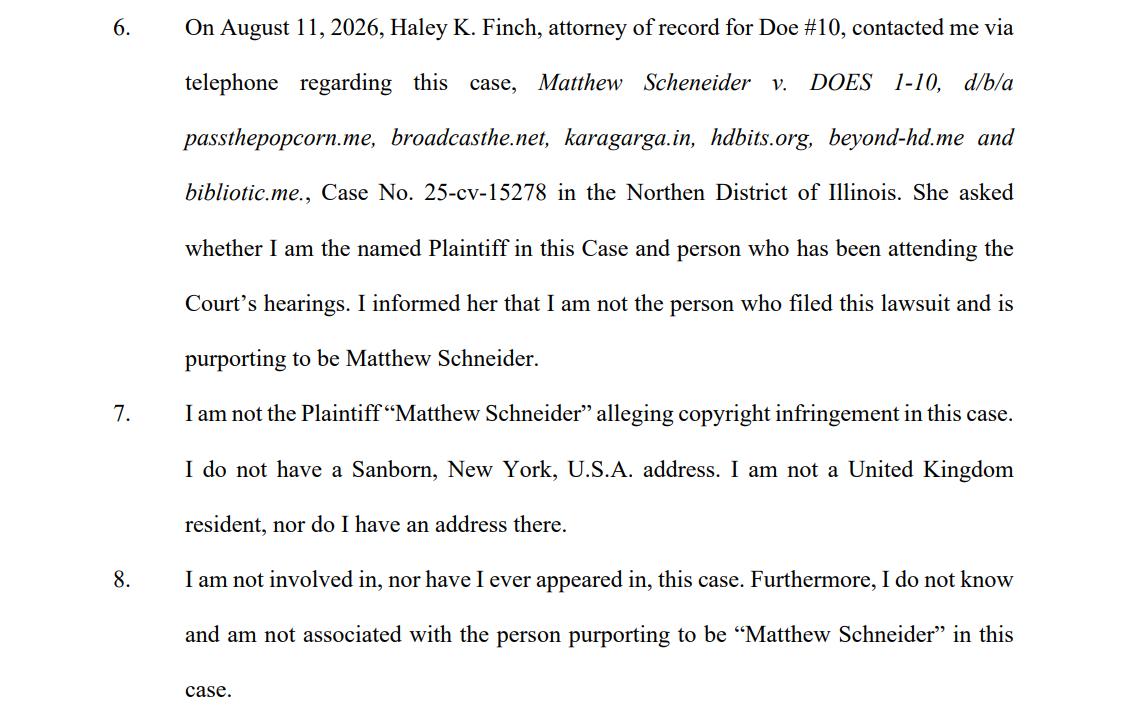
The defense’s breakthrough came with the introduction of a sworn declaration from Matthew A. Schneider, a resident of Ottawa, Ontario. A quick review of IMDb credits for the three foundational films cited in the federal complaint—Split: A Film Anthology, Do Us Part, and Orlando Gloom, Always the Same—points directly to this Canadian creator.
Under oath, the Canadian filmmaker clarified his true position:
"I am not involved in, nor have I ever appeared in, this case. Furthermore, I do not know and am not associated with the person purporting to be ‘Matthew Schneider’ in this case."
Further corroboration materialized via Solmund MacPherson, a collaborator from the high-school filmmaking collective known as "Dirtbag Films." MacPherson submitted a sworn declaration confirming that the collective never sold the rights to their cinematic works, nor did they recognize matthew.schneider94, the email address plastered across every single filing in the federal lawsuit.
To aid the court in potential voice and identity verification, MacPherson successfully tracked down an archival copy of Do Us Part, in which the real Canadian Schneider appears on screen in a speaking role. Additional identifying markers, including a historical Instagram post featuring a photograph of the Canadian filmmaker—who has since transitioned away from professional filmmaking—were presented to contrast against the anonymous plaintiff.
Supporting Context & Metrics: The Improbability Matrix
Faced with overwhelming evidence pointing toward a stolen identity, the individual litigating the case adopted a defense strategy defined by mathematical improbability: the existence of a parallel universe of independent filmmaking.
The "Two Matthew Schneiders" Defense
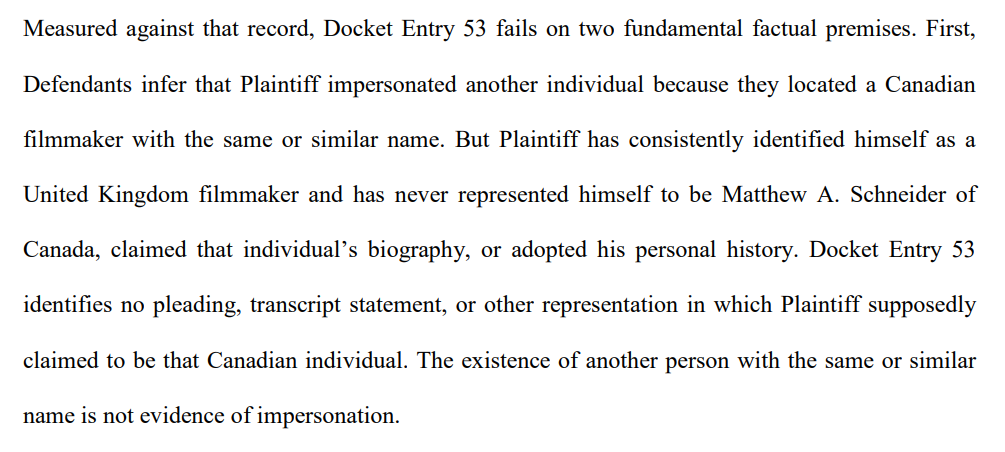
In a formal response filed late last week, the plaintiff argued that the defense had fundamentally misunderstood the situation. He asserted that he had consistently identified himself as an independent filmmaker and creative professional hailing from the United Kingdom, maintaining that he never explicitly claimed to be the Canadian Schneider nor referenced Dirtbag Films.
"The existence of another person with the same or similar name is not evidence of impersonation," the plaintiff argued in court documents, brushing aside the profound confusion generated by sharing both a legal name and a specific artistic portfolio.
The Curious Case of Identical Film Titles
To substantiate his claims, the plaintiff submitted an exhibit containing metadata for his own alleged UK-based versions of the three disputed films. According to his metadata logs, his iterations were allegedly produced in 2011 (Split), 2012 (Do Us Part), and 2012 (Orlando Gloom, Always the Same).
This timeline predates the Canadian Dirtbag Films productions by five to six years, leading the plaintiff to argue that he could not possibly have copied works that "did not yet exist."
However, a closer examination of the plaintiff’s Exhibit 1 reveals stark omissions:
- Total Absence of Documentation: The metadata lists basic filenames, resolutions, and frame rates, but completely lacks copyright office registration numbers.
- No Cast or Crew: Unlike the verifiable IMDb-listed Dirtbag productions, the UK versions boast no credited actors, production assistants, or crew members.
- Zero Promotional Material: No production stills, posters, or online portfolios exist to verify the physical creation of these UK films.
Furthermore, statistical probability heavily favors the defense. The odds of two completely unrelated independent filmmakers sharing the exact same name and independently producing three distinct short films with identical titles are virtually zero. This is amplified exponentially by the inclusion of "Orlando Gloom" in the third title—a direct reference to the independent musician for whom the Canadian Dirtbag collective specifically crafted a companion music video.

Official Statements and Procedural Counterattacks
Sensing the mounting pressure from the court and defense counsel, the plaintiff launched a fierce procedural counterattack, pivoting from a defense of his copyright claims to an aggressive offensive targeting the professional conduct of the defense attorneys.
Accusations of Improper Ex Parte Communication
In his court filings, the plaintiff accused defense attorneys Erin Russell and Haley Finch of violating established judicial ethics by engaging in improper ex parte (one-sided) communication with Judge Wood. Specifically, he pointed to the phone call placed by defense counsel to the judge’s chambers prior to the pivotal August hearing—a move Russell had openly described at the time as an extraordinary step necessary to flag a potential fraud upon the court.
Citing the American Bar Association’s (ABA) strict rules of professional conduct and Seventh Circuit precedents governing judicial ethics, the plaintiff argued that this communication violated the absolute ban on unilateral dialogue with a presiding judge. He formally requested that the court:
- Disclose the exact dates and substance of the communication.
- Disregard any representations made outside his presence.
- Weigh the imposition of professional sanctions against defense counsel.
Additionally, the plaintiff highlighted interconnected geographic and professional associations, noting that both supporting Canadian declarants and defense attorney Finch share historical ties to the same Winnipeg high school. He argued that these relationships invalidate the declarations as truly "independent" corroboration without further judicial scrutiny.
Scope of the Original Complaint
Adding further weight to the defense’s skepticism, the plaintiff’s responsive pleadings selectively defended only three of the ten total works enumerated in the original federal complaint. The remaining five short films and two literary works—which the defense asserts have no verifiable human creator or paper trail whatsoever—were conspicuously ignored, leaving vast swaths of the lawsuit entirely undefended against allegations of fabrication.
Future Outlook and Unresolved Mysteries
As the legal community watches developments unfold in Judge Wood’s courtroom, the overarching narrative remains suspended in a state of high-stakes suspense.
The Notice of Voluntary Dismissal
In a dramatic twist arriving just ahead of the highly anticipated in-person evidentiary hearing, the individual litigating under the name Matthew Schneider filed a formal notice of voluntary dismissal. In standard civil litigation, a voluntary dismissal typically allows a plaintiff to walk away from a dispute without prejudice. However, the legal road does not simply clear because a plaintiff decides to drop their claims.
Crucially, the defense’s pending motion for a rule to show cause—aimed at uncovering the true identity of the individual, evaluating potential perjury, and weighing punitive sanctions—remains entirely active and unresolved on the court’s calendar. Judge Wood has maintained the scheduled in-person hearing, signaling that the judiciary takes potential misrepresentations and fraud upon the court very seriously, regardless of whether a plaintiff attempts a hasty retreat.
Broader Implications for Digital Privacy and Copyright Law
Regardless of how Judge Wood rules on the sanctions track, the "Phantom Filmmaker" case exposes critical vulnerabilities within modern digital litigation.
- The Weaponization of Subpoenas: Copyright litigation has frequently been utilized as a blunt instrument to pierce the anonymity of privacy-centric online communities. When bad actors can initiate federal proceedings using fabricated credentials, mail-drop addresses, and illusory intellectual property, the entire judicial system risks being weaponized for harassment or unauthorized doxxing.
- The Resilience of Private Trackers: For platforms like PTP and BTN, this ordeal highlights the value of aggressive, well-coordinated legal defense teams. Had the operators yielded immediately or failed to scrutinize the plaintiff’s background, anonymous users and infrastructure providers might have been needlessly exposed.
- The Limits of Anonymity in Court: Ultimately, the law demands accountability. An individual seeking the coercive power of the federal government to unmask others must ultimately stand in the light themselves. As the dust settles in Chicago, the enduring question remains: Who was really pulling the strings behind the mask of Matthew Schneider?
The upcoming courtroom proceedings will undoubtedly provide the final chapter to this bizarre legal saga, establishing a firm precedent for how federal courts handle suspected identity fraud in the digital age.