Executive Overview: The Dawn of the Thunderbolt 5 eGPU Era
The landscape of mobile workstation computing is undergoing a structural shift. As professional software applications in video editing, 3D rendering, visual effects, and artificial intelligence demand unprecedented computational power, the physical limitations of thin-and-light laptops have become glaringly apparent. Thermal throttling, restricted power envelopes, and soldered, non-upgradeable graphics processors regularly bottle up professional workflows.
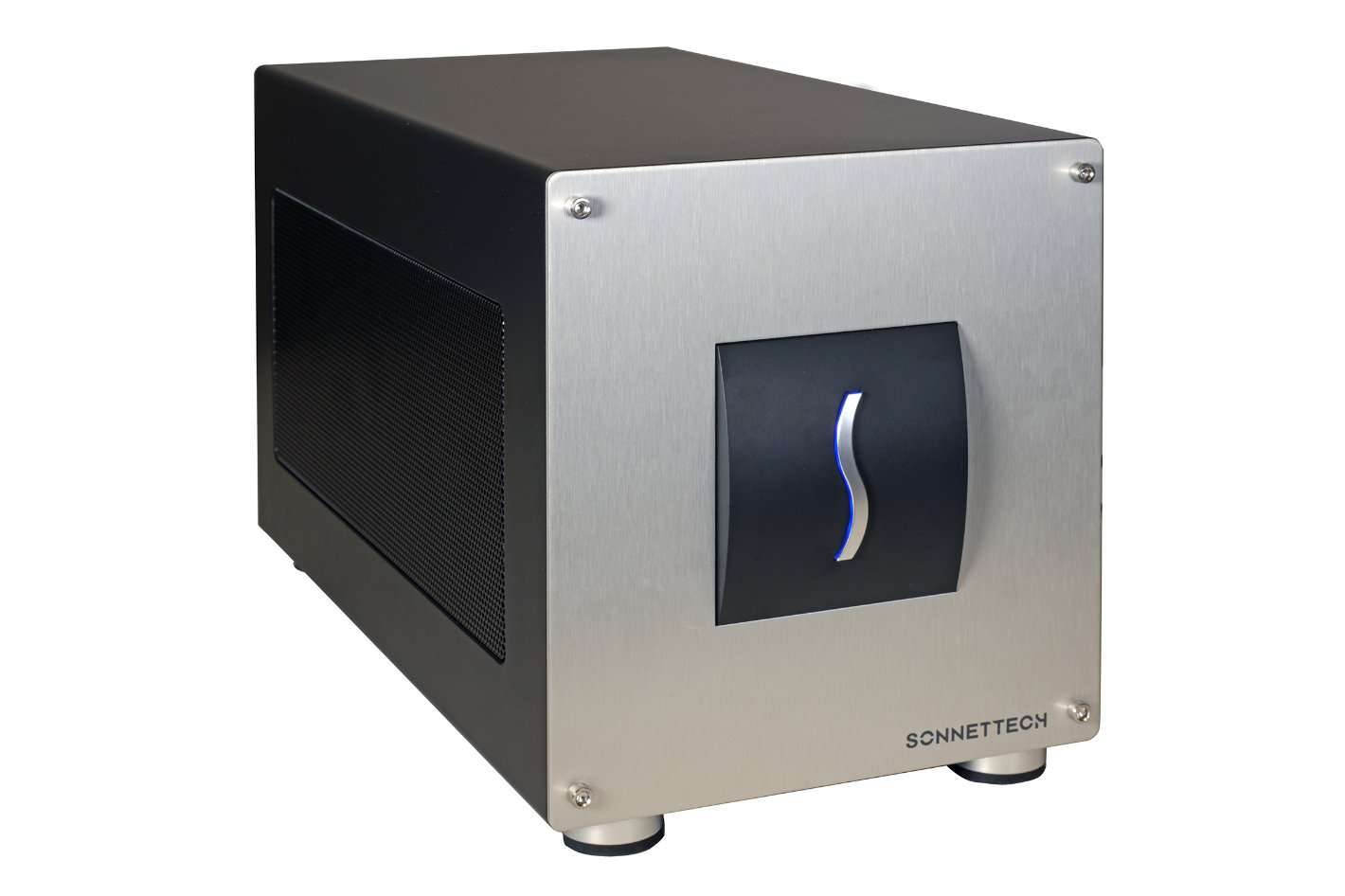
To bridge this performance gap, Sonnet Technologies has announced the launch of the Breakaway Box 850 T5, a next-generation external graphics processing unit (eGPU) enclosure leveraging the newly minted Thunderbolt 5 standard. Designed primarily for Windows 11 environments, this high-performance PCIe card expansion system allows users to tether desktop-class GPU power to portable computers via a single cable.
By utilizing the massive bandwidth upgrade offered by Thunderbolt 5, the Breakaway Box 850 T5 promises to mitigate, if not entirely eliminate, the data bottlenecks that plagued previous generations of eGPUs. Priced at $599.99, the unit features a high-wattage 850W internal power supply, an integrated multi-port docking station with 5 Gigabit Ethernet, and support for triple-width graphics cards. It represents a major step forward for mobile professionals, remote digital artists, and AI researchers who require uncompromised desktop performance without sacrificing the mobility of a laptop.
Technical Chronology: From Bottlenecked Pioneers to Thunderbolt 5
To appreciate the engineering leap represented by the Breakaway Box 850 T5, one must understand the historical constraints of external GPU technology.
eGPU Evolution & Bandwidth Roadmap:
+-------------------+--------------------------------------------+
| Interface         | Max Bandwidth / PCIe Allocation            |
+-------------------+--------------------------------------------+
| Thunderbolt 3     | 40 Gbps (PCIe Gen 3 x4 - ~22-32 Gbps data) |
| Thunderbolt 4     | 40 Gbps (PCIe Gen 3 x4 - Mandated 32 Gbps) |
| Thunderbolt 5     | 80 Gbps / Up to 120 Gbps (PCIe Gen 4 x4)   |
+-------------------+--------------------------------------------+
The Legacy of Thunderbolt 3 and 4
External GPUs first gained mainstream traction with the introduction of Thunderbolt 3. While revolutionary, the interface was bottlenecked by a maximum theoretical bandwidth of 40 Gbps. In practice, after accounting for display signals and protocol overhead, the actual data allocation for PCIe traffic was capped at roughly 22 to 32 Gbps (equivalent to PCIe Gen 3 x4).
When Thunderbolt 4 arrived, it standardized these requirements—mandating the full 32 Gbps of PCIe data bandwidth—but did not increase the overall speed limit. For high-end desktop graphics cards, which are designed to run on PCIe Gen 4 or Gen 5 interfaces with 16 lanes (x16), compressing this data down to a PCIe Gen 3 x4 connection resulted in a notable "eGPU performance tax." Depending on the application, performance losses could range from 10% to upwards of 30%, particularly in scenarios requiring frequent assets transfers between system RAM and the GPU’s VRAM.
Enter Thunderbolt 5: Breaking the PCIe Bandwidth Barrier
The release of Thunderbolt 5 changes this paradigm. Operating on a base bi-directional bandwidth of 80 Gbps—and capable of dynamically boosting up to 120 Gbps for display-heavy workloads—Thunderbolt 5 effectively doubles the data throughput of its predecessor.
More importantly for eGPUs, Thunderbolt 5 supports PCIe Gen 4 speed across four lanes (PCIe Gen 4 x4). This upgrade doubles the available PCIe bandwidth to the graphics card, bringing it in line with the native internal slots of many desktop motherboards. The Sonnet Breakaway Box 850 T5 is among the first commercial chassis engineered to exploit this expanded pipeline, offering a near-lossless transmission medium for external desktop GPUs.
Deep-Dive Analysis: Specs, Performance Metrics, and Architecture
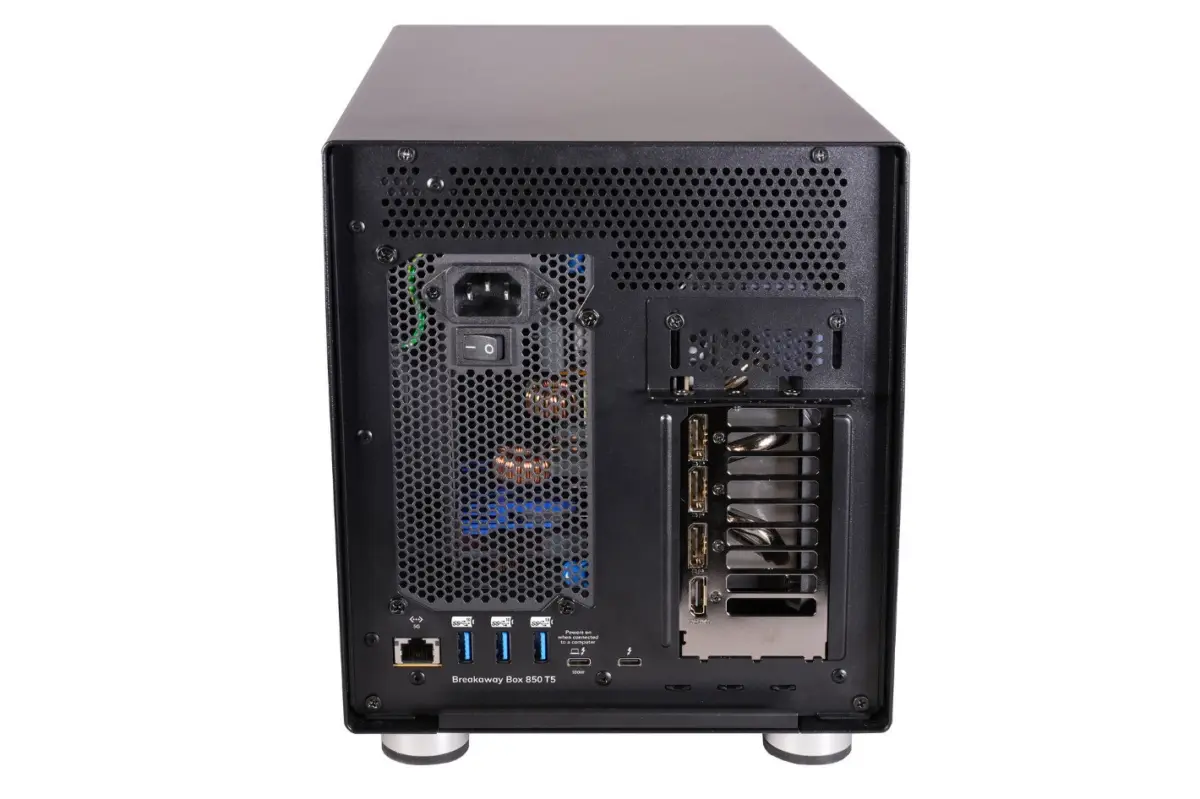
The Breakaway Box 850 T5 is designed to function as both a high-throughput computational accelerator and an enterprise-grade docking station. Below is an analytical breakdown of its core architectural components.
Sonnet Breakaway Box 850 T5 System Architecture:
+-----------------------------------------------------------------------+
|                       Breakaway Box 850 T5                            |
|                                                                       |
|  +-------------------------+      +--------------------------------+  |
|  |   850W Power Supply     | ---> | Triple-Width GPU Slot (PCIe)   |  |
|  |   (Active PFC, Quiet)   |      | (Supports NVIDIA & AMD Cards)  |  |
|  +-------------------------+      +--------------------------------+  |
|                                                  ^                    |
|                                                  |                    |
|  +-----------------------------------------------+-----------------+  |
|  |                 Intel Thunderbolt 5 Controller                  |  |
|  +-----------------------------------------------------------------+  |
|            |                      |                      |            |
|            v                      v                      v            |
|     [TB5/USB4 Port]       [3x USB-A 10Gbps]       [5Gb Ethernet]      |
+-----------------------------------------------------------------------+
Physical Dimensions and Card Compatibility
The enclosure is built to accommodate the physically imposing footprints of modern workstation and gaming graphics cards. It natively supports triple-width GPU configurations, ensuring compatibility with the largest custom-cooled cards from both NVIDIA (including the GeForce RTX 40-series) and AMD (such as the Radeon RX 7000-series).
The Power Supply Advantage: Feeding Next-Gen Monsters
One of the most common points of failure or user frustration with third-party eGPU enclosures is power delivery. Many entry-level chassis require users to purchase their own SFX or ATX power supplies, or they ship with underpowered units that cannot handle the transient power spikes of modern GPUs.
Sonnet has addressed this by integrating an 850-watt internal power supply directly into the chassis. This high-capacity unit provides:
- Plenty of continuous power to comfortably run top-tier, power-hungry GPUs.
- Significant headroom to absorb transient power draws that can otherwise cause system crashes during intense rendering sequences.
- Future-proofing for upcoming GPU architectures (such as NVIDIA’s highly anticipated 50-series Blackhawk/Blackwell consumer cards and AMD’s RDNA 4 lineup) which are expected to maintain high power demands.
The Integrated I/O Hub: A True Single-Cable Workspace
Rather than dedicating the entire Thunderbolt 5 connection exclusively to the GPU, Sonnet has integrated an active 80 Gbps docking hub into the chassis. This design choice maximizes the utility of the single-cable connection to the host laptop. The onboard hub includes:
- One Thunderbolt/USB Peripheral Port: Allows for the daisy-chaining of additional high-speed storage arrays or high-resolution displays.
- Three 10 Gbps USB-A Ports: Ideal for connecting high-speed external SSDs, audio interfaces, and standard desktop peripherals without causing data bottlenecks.
- One 5 Gigabit Ethernet Port: A major upgrade over the standard 1 GbE ports found on typical consumer docks, enabling lightning-fast network storage (NAS) access and high-speed local file transfers essential for collaborative video editing environments.
Thermal Design and Quiet Operation
High performance inevitably generates significant heat. The Breakaway Box 850 T5 utilizes a temperature-controlled, variable-speed fan. This cooling system adjusts its RPM dynamically based on the internal ambient temperature of the enclosure. By avoiding a constant-maximum-RPM profile, the unit remains ultra-quiet during idle or light-use periods, only ramping up to its full cooling capacity during heavy rendering or computational runs. This design focus on acoustics is critical for audio production environments and quiet creative studios.
Market Context: Addressing the Professional and AI Hardware Deficit
The release of the Breakaway Box 850 T5 comes at a pivotal moment in personal computing. The industry is currently experiencing a dual-pronged demand curve driven by advanced video workflows and local artificial intelligence execution.
Workflow Bottlenecks: Laptop vs. eGPU Workstation
+-------------------------+-------------------------+-------------------------+
| Parameter               | Mobile Laptop GPU       | Desktop GPU via TB5     |
+-------------------------+-------------------------+-------------------------+
| Thermal Envelope        | 35W - 140W (throttled)  | 250W - 450W+ (sustained)|
| VRAM Capacity           | Typically 6GB - 16GB    | Up to 24GB - 48GB       |
| Memory Bus Width        | 128-bit - 256-bit       | 384-bit+                |
| Primary Use Case        | Mobility, light editing | Heavy VFX, 3D, Local AI |
+-------------------------+-------------------------+-------------------------+
Why Laptops Fall Short for Modern Creative Workflows
Even the most powerful modern creator laptops are bound by the laws of thermodynamics. A mobile GPU, even one sharing a marketing name with its desktop counterpart (such as a mobile RTX 4090 vs. a desktop RTX 4090), operates under a drastically reduced power envelope—often limited to 80W–150W compared to the desktop version’s 350W–450W. Furthermore, mobile GPUs suffer from:
- Constrained VRAM: Lower video memory capacities make it difficult to load massive 3D scenes, complex geometry, or 8K raw video timelines.
- Narrower Memory Buses: Reduced memory bandwidth slows down real-time color grading and effects processing in applications like DaVinci Resolve and Adobe Premiere Pro.
By bypassing the laptop’s internal GPU and offloading these tasks to a desktop card housed in the Breakaway Box 850 T5, professionals can achieve true workstation-class rendering speeds without purchasing a secondary, stationary desktop tower.
The Local AI and LLM Revolution
Beyond traditional creative arts, the explosion of local artificial intelligence development has created a massive market for high-VRAM hardware. Developers, data scientists, and researchers are increasingly running Large Language Models (LLMs), Stable Diffusion instances, and custom machine learning training pipelines locally on their machines to protect intellectual property and avoid expensive cloud computing fees.
These AI models are highly dependent on GPU memory (VRAM) capacity and tensor core speed. Running a 70-billion parameter model locally is impossible on a standard laptop with 8GB or 16GB of system/video memory. An eGPU enclosure housing an NVIDIA card with 24GB of high-bandwidth GDDR6X VRAM democratizes access to these AI tools, transforming a standard Windows 11 ultrabook into a highly capable local AI development node.
Executive Perspectives and Official Positioning
In launching the Breakaway Box 850 T5, Sonnet Technologies has positioned the product as a no-nonsense, utility-first tool for serious professionals.
Company representatives have emphasized that the unit’s design philosophy deliberately avoids the superfluous "bells and whistles" that often drive up the cost of consumer-grade gaming eGPUs—such as customizable RGB lighting, aggressive gaming aesthetics, or unnecessary software suites. Instead, Sonnet has focused its engineering budget on structural reliability, thermal efficiency, maximum power delivery, and high-speed I/O integration.
An official statement highlighting the practical design choices of the system notes:
"The integrated 80 Gbps Thunderbolt 5 dock is incorporated to maximize efficiency, adding a secondary Thunderbolt/USB peripheral port, three 10 Gbps USB-A ports, and a 5 Gigabit Ethernet port. This enables users to connect their most critical workflow tools directly to the Breakaway Box and access them all through a single cable connected to their computer."
Furthermore, Sonnet’s marketing emphasizes the economic efficiency of this setup. Instead of purchasing both a high-end laptop for travel and an expensive desktop computer for the office, professionals can invest in a single premium laptop. When they return to their desks, a single Thunderbolt 5 cable connects them to their displays, high-speed wired networks, external storage devices, and a top-tier desktop GPU, streamlining their workspace and simplifying data management.
Future Outlook: The Road Ahead for eGPUs and External Workstation Nodes
As the industry begins to adopt the Thunderbolt 5 standard, the Sonnet Breakaway Box 850 T5 stands as an early indicator of where modular computing is headed.
The Future of Modular Workstations:
+-------------------+      +------------------------------------------+
|  Host Device      | ---> | Single Thunderbolt 5 Connection          |
|  (Ultrabook, Mini)|      | (Dynamic Bandwidth Boost up to 120 Gbps) |
+-------------------+      +------------------------------------------+
                                               |
                                               v
                           +------------------------------------------+
                           |  Sonnet Breakaway Box 850 T5             |
                           |  - Desktop GPU Acceleration (PCIe Gen 4) |
                           |  - High-Speed Local Storage (10 Gbps)    |
                           |  - Ultra-Fast Networking (5 GbE)         |
                           +------------------------------------------+
The Mini-PC and Handheld Market Expansion
While laptops are the primary target market for eGPUs, the rise of powerful Mini-PCs (such as those from Intel, ASUS, and Minisforum) and PC-based handheld gaming consoles has opened up a new front for external graphics expansion. These compact devices are highly capable from a CPU perspective but lack the physical space for discrete graphics. The integration of Thunderbolt 5 into next-generation Mini-PCs will allow these tiny machines to quickly scale up to full-scale workstations when docked with the Breakaway Box 850 T5.
OS Compatibility Dynamics
It is important to note a critical market division regarding operating system support. While the Breakaway Box 850 T5 is fully compatible with Windows 11 machines equipped with Thunderbolt 5, Thunderbolt 4, or USB4 ports, the Apple ecosystem remains a distinct territory. Since Apple’s transition to its proprietary Apple Silicon (M-series chips), macOS no longer natively supports external GPUs, though it does support other PCIe expansion cards. Consequently, Sonnet’s marketing and validation focus heavily on the Windows 11 ecosystem, where driver support for external AMD and NVIDIA graphics cards remains robust.
Conclusion
With the release of the Breakaway Box 850 T5, Sonnet Technologies has delivered a well-engineered, highly capable solution to one of the computing industry’s most persistent challenges: how to provide desktop-class graphics performance to mobile computers without compromise. By harnessing the doubled bandwidth of Thunderbolt 5, providing a massive 850W power supply, and integrating a high-speed multi-port dock, Sonnet has established a new benchmark for external PCIe expansion. For creative professionals, developers, and power users seeking to future-proof their mobile workspaces, the $599.99 enclosure represents a critical, high-performance link to the next generation of computing.