
Executive Overview
Content marketing remains one of the most powerful digital strategies for scaling a business, driving organic traffic, and converting attention into sustainable revenue. Yet, entering the education market reveals a paradox: on the surface, almost every content marketing course looks identical. They promise video modules on keyword research, content planning, and foundational writing frameworks, backed by a handful of static action items.
However, the chasm between a mediocre course and a high-impact program is vast. The content marketing courses that genuinely accelerate career trajectories and generate measurable revenue diverge sharply in three critical areas: instructor credibility, direct feedback opportunities, and advice recency—specifically how well the curriculum accounts for the seismic shifts introduced by generative artificial intelligence (AI) and evolving search algorithms.
To help modern marketers, entrepreneurs, and side hustlers cut through the noise, this guide establishes a rigorous evaluation framework. We analyze eight of the industry’s most prominent content marketing programs against this criteria, providing an authoritative breakdown to help you select the ideal educational resource for your specific growth goals.
Content Marketing Course Evaluation Criteria
Before diving into individual platform reviews, it is essential to understand what separates actionable education from theoretical fluff. While many programs follow established industry best practices, execution requires nuance, speed, and real-time adaptation.
The evaluation metrics used in this report measure each course against the following core factors:
- Instructor Credibility: Has the instructor successfully used content marketing to build and scale a real business? Are there verified statistics or demonstrable case studies to substantiate their claims?
- Content Formats Covered: Modern digital marketing extends far beyond traditional blog posts. Comprehensive courses must address holistic ecosystems, including social media, personal branding, email marketing, SEO, and client acquisition.
- Advice Recency: The AI revolution has fundamentally altered search intent, content velocity, and production workflows. Does the curriculum address modern trends, or is it recycling outdated playbooks?
- Feedback and Individual Support: Is the learning experience isolated, or do students have direct access to personalized critiques and one-on-one guidance from seasoned practitioners?
- Community: Does the program offer an active, collaborative network where members can troubleshoot, share insights, and build strategic alliances?
- Pricing: Is the investment structured as a one-time fee, a low-barrier trial, or a recurring membership model?
1. Copyblogger Academy
Instructor Credibility
Operated by seasoned entrepreneurs Tim Stoddart and Charles Miller, Copyblogger Academy is built on real-world, seven-figure execution. Charles Miller has cultivated massive digital footprints—amassing over 220,000 followers on X and more than 100,000 on LinkedIn—while helping dozens of founders construct lucrative personal brands. Tim Stoddart has founded multiple seven-figure companies, including Copyblogger itself and the digital marketing agency Quantum Leads. Crucially, both founders remain active operators, ensuring the strategies taught reflect current market conditions rather than historical anecdotes.
Course Content & Community
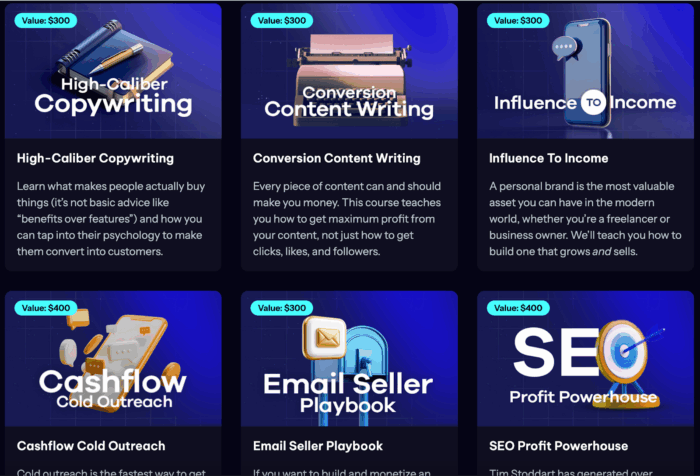
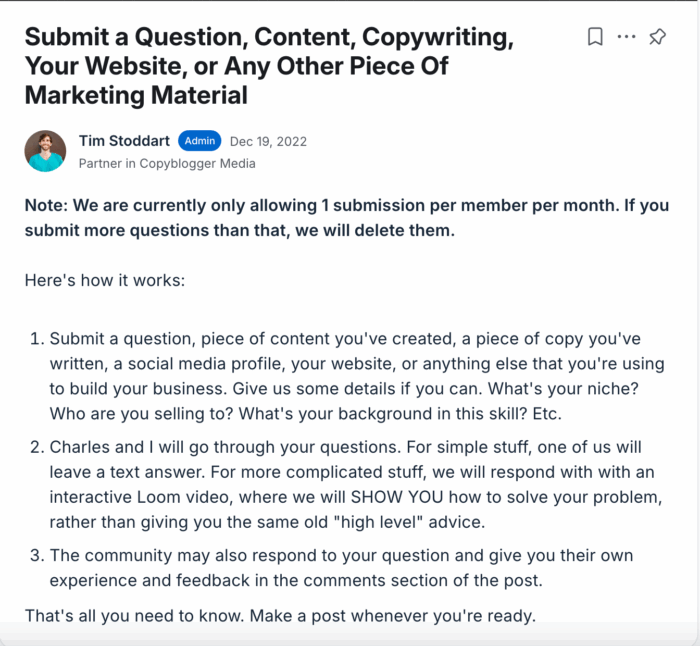
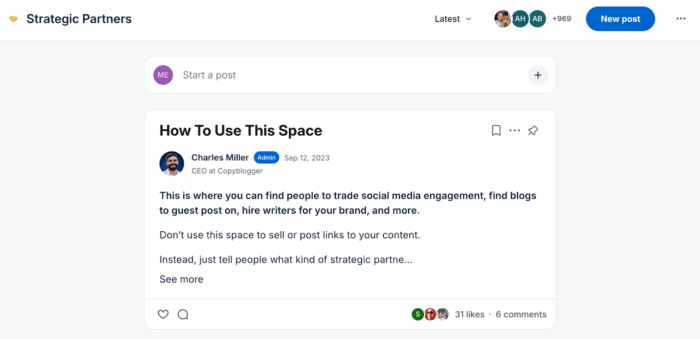
Recognizing that modern content marketing requires an omnichannel approach, Copyblogger Academy offers six hyper-specific courses covering copywriting, SEO content, email strategies, and personal branding. Unlike pre-recorded courses that leave students stranded, the program features active community spaces where members can submit work directly for personalized feedback from Tim, Charles, and peer operators. Members also gain access to exclusive monthly mini-courses, networking channels, and collaborative hubs designed to turn content into a predictable cash-flow asset.

Pricing
New members can test the ecosystem for a nominal $1 entry fee, transitioning into a monthly membership model if they find value.
2. HubSpot Content Marketing Course
Instructor Credibility
HubSpot’s Content Marketing Certification Course is an 8.5-hour free program led primarily by Justin Champion, HubSpot’s Global Head of Surround Sound Growth (SEO + AEO). The curriculum also features heavyweight guest instructors such as Andy Crestodina (co-founder of Orbit Media) and Matthew Howells-Barby, ensuring strong theoretical grounding from certified industry experts.
Course Content & Limitations
Structured across 14 lessons, 54 videos, and 11 quizzes, the course excels at teaching traditional blogging, guest posting, and video marketing strategies. Upon completion, students receive a recognized digital badge for LinkedIn. However, the program lacks coverage of modern imperatives like personal branding, email copywriting, and client conversion tactics. Furthermore, because it is entirely self-paced and pre-recorded, it lacks individualized support, direct instructor feedback, and an interactive community.
Pricing
Completely free of charge.
3. Grow and Convert’s "Customers from Content"
Instructor Credibility
Created and taught by Benji Hyam and Devesh Khanal, co-founders of the Grow and Convert agency, this program is anchored in a documented system used to scale traffic and inbound leads for over 40 prominent B2B and B2C brands, including Patreon, CrazyEgg, and Leadfeeder. Their central thesis rejects vanity metrics in favor of driving trackable business conversions and measurable ROI.
Course Content & Community
Broken down into five granular modules covering keyword research, conversion-focused writing, distribution, and analytics, the course functions more like an agency apprenticeship than a traditional seminar. Real client case studies anchor every lesson, and the instructors actively participate in community discussions. The curriculum is continuously updated to reflect ongoing agency experiments.
Pricing
Available for a one-time payment of $699 or structured across six monthly installments of $135, granting lifetime access to future updates and community calls.
4. Superpath
Instructor Credibility
Founded by Jimmy Daly, a veteran content leader formerly at Animalz, Superpath functions less as a linear course and more as an elite professional network. The primary educational value stems from contributions by content leaders working inside high-growth SaaS and B2B enterprises such as Shopify, HubSpot, Intercom, and Clearscope.
Course Content & Community
Superpath offers graduate-level mini-courses, teardowns, templates, and live workshops. The community shines through active peer discussions, AMA sessions, and professional networking channels tailored specifically for mid-to-senior level content professionals navigating complex enterprise environments.
Pricing
Features a free tier, with Pro memberships starting at $50/month (or $500/year) and Advanced tiers scaled at $1,000/year.
5. Ahrefs’ Blogging for Beginners
Instructor Credibility
Taught by Tim Soulo, Chief Marketing Officer at Ahrefs, this 5-hour YouTube course outlines the precise organic search strategies used to scale the Ahrefs blog into a multi-million-visitor engine. Guest interviews with prominent founders like Noah Kagan and Bryan Harris add extra dimensions on list-building and monetization.
Course Content & Limitations
The course provides a tactical, step-by-step framework for keyword research and foundational blogging. However, because it was recorded in 2020, it does not account for modern algorithmic updates or the integration of generative AI into search landscapes. It also remains strictly siloed within SEO blogging, omitting social media, email, and video.
Pricing
Free via YouTube and open platforms.
6. Semrush Academy Content Marketing
Instructor Credibility
Semrush’s advanced courses are anchored by Brian Dean, a globally recognized SEO authority and founder of Backlinko and Exploding Topics (both acquired by Semrush). His frameworks are derived from scaling multi-million-reader digital properties.
Course Content & Limitations
Semrush offers comprehensive modules like Advanced Content Marketing and Content-Led-SEO. Packed with worksheets and step-by-step guides, the materials are highly actionable. The primary drawback is that these courses were recorded around 2022, meaning they pre-date the widespread adoption of modern AI search features and require supplementation with real-time industry updates.
Pricing
Free of charge.
7. CXL Content Marketing Course
Instructor Credibility
Taught by Derek Gleason, SEO and Content Lead at Shopify and former digital agency strategist for major brands like Twitter and Virginia Tech, the CXL Content Marketing Research Course provides strategic oversight on enterprise-level content planning and distribution.
Course Content & Community
Spanning roughly an hour across six core lessons, the curriculum focuses heavily on macro-level strategy and distribution frameworks rather than tactical writing instruction. While published recently, it offers limited instruction on direct execution or AI writing workflows and lacks a dedicated student community.
Pricing
Available through CXL subscription tiers or as a standalone purchase for $299.
8. Content Marketing Masterclass (Udemy)
Instructor Credibility
Taught by Brad Merrill, CEO of Merrill Media and founder of VentureBreak, this masterclass provides a broad survey of digital marketing disciplines, drawing from Merrill’s extensive publishing background.
Course Content & Limitations
Spanning nearly four hours across 95 lectures, the course covers storytelling, buyer personas, SEO, copywriting, and email marketing. Because of its broad scope, it lacks the deep, laser-focused execution found in specialized platforms. Recorded in mid-2023, it contains minimal coverage of advanced AI applications.
Pricing
Included in Udemy premium subscriptions or available individually for $109.99.
Supporting Context & Metrics
To contextualize the digital education landscape, market data indicates that organizations investing in robust content marketing frameworks experience conversion rates roughly six times higher than those relying solely on outbound advertising. However, the proliferation of AI-generated content has saturated digital channels, making tactical execution and distribution more critical than ever.
As search engine result pages (SERPs) evolve to feature conversational AI summaries, static SEO playbooks from 2020 or 2022 yield diminishing returns. Modern learners must prioritize programs that emphasize audience retention, proprietary insights, and multi-channel distribution.
Official Statements
Industry leaders emphasize the shifting nature of digital publishing:
- Tim Stoddart (Co-founder, Copyblogger Academy): "Content marketing is no longer just about publishing a 2,000-word blog post and waiting for Google to send traffic. You need an interconnected ecosystem—combining SEO, personal branding on social media, and email nurturing—to turn attention into actual cash."
- Justin Champion (HubSpot): "Strategy must precede execution. Marketers who fail to understand audience intent and surround-sound growth frameworks will continue to chase vanity metrics rather than bottom-line revenue."
Future Outlook
The trajectory of content marketing education points toward hyper-specialization, community-driven accountability, and real-time adaptability. As generative AI flattens the barrier to entry for content production, raw writing volume is no longer a competitive advantage.
Future-proof educational programs will move away from static, pre-recorded video libraries that sit untouched on hard drives. Instead, the market will increasingly favor dynamic communities, mentorship-driven incubators, and agile networks where operators can test emerging tactics, analyze algorithm shifts collectively, and refine their conversion funnels in real time. Marketers choosing their next educational investment should prioritize programs that offer not just information, but active execution support and peer collaboration.