Executive Overview
The modern digital music economy has revolutionized how art is created, shared, and monetized. Platforms like Apple Music, Spotify, TikTok, and YouTube have broken down traditional industry gatekeeping, enabling independent artists to reach global audiences with unprecedented ease. Yet, this democratization of music distribution has a darker, more vulnerable underbelly: it has inadvertently handed bad actors the digital keys to the kingdom.
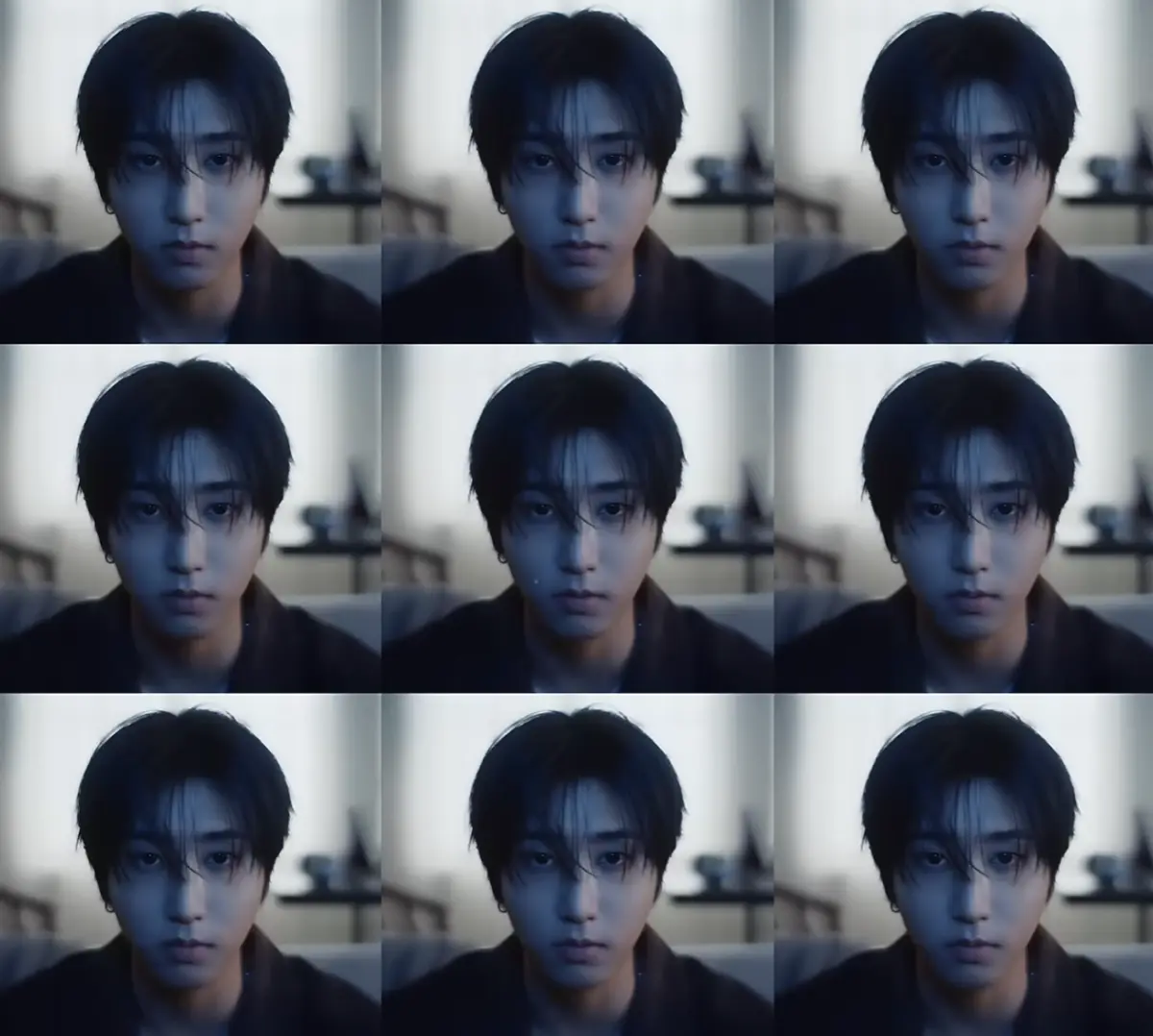
In an aggressive escalation of anti-piracy enforcement, K-pop powerhouse JYP Entertainment has initiated a high-stakes legal battle in a California federal court. The target is not a notorious offshore torrent site or a shadowy dark web repository, but rather an independent digital music distributor, Symphonic Distribution. JYP Entertainment is seeking to unmask the operator behind a rogue account operating under the moniker "New Vibs," which illicitly monetized an unreleased solo track by Han, a member of the globally renowned boy band Stray Kids.
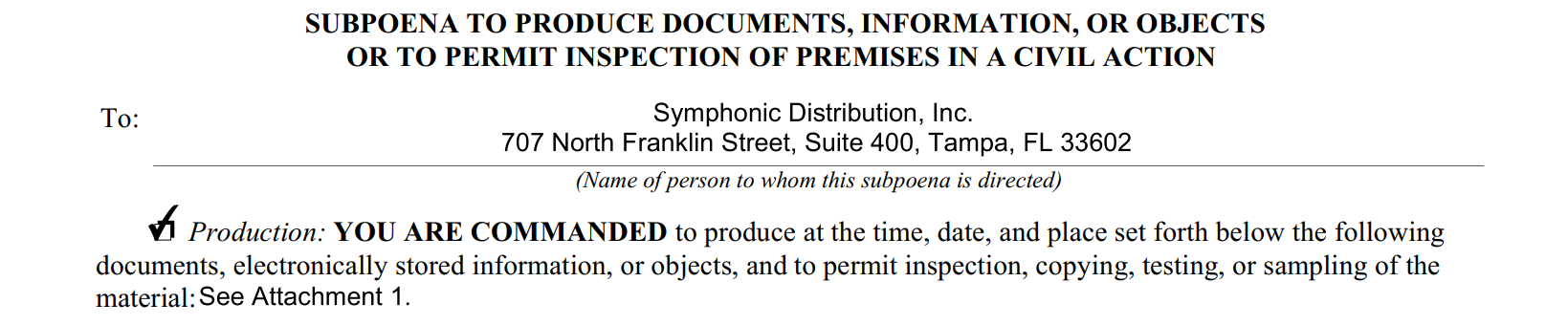
Rather than merely chasing disappearing links across social media platforms, JYP’s legal team at Arnold & Porter has deployed a Digital Millennium Copyright Act (DMCA) subpoena. This powerful legal instrument aims to pierce the veil of digital anonymity, demanding names, physical addresses, IP logs, telephone numbers, email addresses, and—crucially—comprehensive banking and financial records.
This case exposes a systemic vulnerability in the architecture of modern music distribution: the ease with which bad actors can exploit automated aggregation services to inject bootlegs into legitimate streaming ecosystems. As the line between official releases and illicit digital counterfeits blurs, JYP Entertainment’s legal crusade serves as a warning shot to digital intermediaries and opportunistic pirates alike.
Detailed Chronology: From YouTube Exclusive to Federal Court
The saga of the unauthorized "New Vibs" release illustrates how quickly digital content can be intercepted, weaponized, and monetized across mainstream networks before original rights holders can intervene.
May 9: The Genesis of "Back to Life"
On May 9, JYP Entertainment executed a routine rollout for one of its marquee artists, releasing a solo track titled "back to life" performed by Han of Stray Kids. The song was published directly to the official Stray Kids YouTube channel as part of the group’s popular SKZ-PLAYER content series.
True to JYP’s strategy for this promotional vehicle, the track was intentionally withheld from subscription-based streaming platforms (DSPs) like Apple Music and Spotify at launch. It existed solely as a video asset on YouTube, creating an immediate supply-and-demand imbalance among the group’s millions of hyper-engaged fans.
Immediate Exploitation and Unauthorized Aggregation
Almost instantly, the track’s limited availability triggered opportunistic piracy. Within hours, audio rips of "back to life" surfaced across decentralized social media networks, TikTok videos, and user-generated bootleg hubs.
However, the perpetrators went far beyond standard peer-to-peer file sharing or amateur YouTube uploads. Utilizing the services of Tampa-based independent music distributor Symphonic Distribution, an anonymous user operating under the alias "New Vibs" uploaded the audio files into the legitimate global supply chain.
By paying a modest administrative or subscription fee, the user bypassed standard platform checks. The bootlegged track was assigned official International Standard Recording Codes (ISRC) and Universal Product Codes (UPC), allowing it to integrate seamlessly into major digital service providers (DSPs). Overnight, fans searching for Han’s solo track found it sitting comfortably on Apple Music, Instagram, TikTok, and YouTube Music alongside legitimate releases from the world’s biggest music superstars.
May 20: The Initial DMCA Takedown Notice
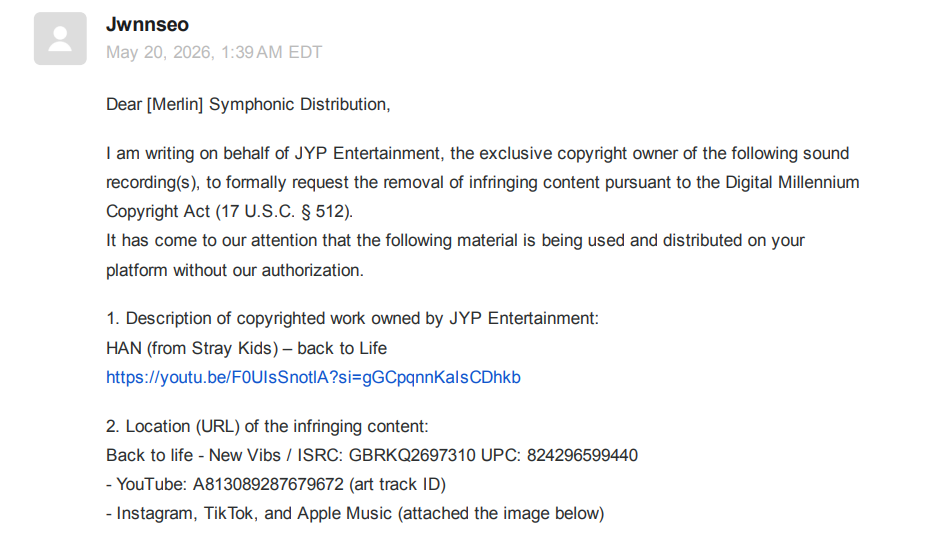
Alerted by fans and internal monitoring teams, JYP Entertainment acted swiftly. On May 20, the label issued a formal DMCA takedown notice to Symphonic Distribution. The notice explicitly identified the infringing release—"Back to life" by "New Vibs"—and demanded its immediate removal from all connected platforms, including YouTube, Instagram, TikTok, and Apple Music.
The notice carried an explicit warning:
"If the infringing content is not taken down promptly, we will have no choice but to pursue legal action to protect our copyrighted material."
Symphonic’s legal and compliance teams acknowledged receipt of the notice, assuring the label that the matter would be investigated. In the weeks that followed, as fan demand continued to surge and the bootleg fallout played out, JYP officially released "back to life" on streaming platforms under its own banner.
The Escalation to a Federal DMCA Subpoena
Although the infringing track was ultimately scrubbed from major platforms, JYP Entertainment determined that a simple takedown was insufficient retribution for a coordinated, commercialized act of intellectual property theft.
Last week, JYP’s legal representation filed an official DMCA subpoena application in a United States federal court in California. The legal maneuver targets Symphonic Distribution directly, requesting that the court compel the independent distributor to hand over all identifying dossiers associated with the "New Vibs" account.
Supporting Context & Metrics: The Scale of Stray Kids and the Perils of DIY Distribution
To understand why JYP Entertainment is investing significant resources into unmasking a single bootlegger, one must examine the staggering commercial scale of Stray Kids and the democratization vulnerabilities plaguing the modern music industry.
The Phenomenon of Stray Kids
Managed by JYP Entertainment, Stray Kids has established itself as an absolute titan in the contemporary music landscape. Key milestones underpinning their global dominance include:
- Billboard Dominance: The group has secured nine number-one albums on the prestigious Billboard 200 chart.
- Global Footprint: Their stadium tours consistently sell out across North America, Asia, and Europe, pulling in hundreds of thousands of screaming fans per leg.
- Digital Engagement: Billions of cumulative streams across Spotify, Apple Music, and YouTube make every asset produced by its members—including individual solo tracks like Han’s—lucrative commercial properties. When a song carries this level of organic demand, unauthorized releases can siphon millions of streams, ad revenue, and brand equity away from the rightful owners.
+------------------------------------------------------------+
|                     STRAY KIDS METRICS                     |
+------------------------------------------------------------+
| Billboard 200 #1 Albums         | 9                          |
| Touring Footprint               | Stadiums across 3 continents|
| Primary Content Mediums         | YouTube, Spotify, Apple    |
| Target of Infringement          | Solo tracks (SKZ-PLAYER)   |
+------------------------------------------------------------+
The Democratization Paradox of DIY Distributors
Historically, distributing music to global digital storefronts required signing with a major record label or specialized aggregator equipped with stringent vetting procedures. Over the past decade, however, the rise of "DIY" and independent distributors—such as DistroKid, TuneCore, and Symphonic—has disrupted this paradigm.
For a minimal annual subscription or per-release fee, virtually anyone can upload audio files to a dashboard, select desired territories and platforms, and push content directly to Apple Music, Spotify, Amazon Music, and TikTok.
While this model has empowered independent artists worldwide, it has simultaneously created a gaping loophole for bad actors:
- Automated Onboarding: Because millions of tracks are uploaded daily, distributors rely heavily on automated algorithms rather than manual human inspection to vet incoming audio files.
- Metadata Manipulation: Bad actors routinely use pseudonyms (such as "New Vibs") and misattribute songwriting credits to evade automated copyright-matching algorithms (like YouTube’s Content ID or Audible Magic).
- Monetization Hijacking: Once a bootleg is live, streaming revenue accumulates in the distributor’s account balance, waiting to be paid out via PayPal, wire transfer, or direct deposit before the label notices and issues a takedown.
Official Statements and Industry Reactions
The unfolding dispute has drawn sharp distinctions between the proactive stance of the copyright holder and the compliance procedures practiced by digital intermediaries.
Symphonic Distribution’s Position
In response to inquiries regarding the federal subpoena, a representative for Symphonic Distribution issued a clarifying statement emphasizing the company’s swift operational response and adherence to standard industry protocols:
"As soon as we received the claim in May, the content was taken down from all DSPs, and the account that distributed the link was terminated. We have not received any further correspondence on this issue from JYP Entertainment since the initial notice."
Symphonic maintains that it acted in good faith upon receiving the initial May 20 notice, neutralizing the threat by pulling the content and terminating the offending account. From the distributor’s perspective, the operational crisis was resolved months ago.
JYP Entertainment’s Unyielding Stance
JYP Entertainment’s legal strategy, however, signals a broader industry shift: takedowns are no longer considered an adequate remedy for intentional, bad-faith piracy. By pursuing a federal subpoena for financial records, JYP is signaling that accountability must extend beyond mere content removal.
Legal analysts note that identifying the person behind "New Vibs" allows JYP to evaluate civil litigation for copyright infringement, statutory damages, and the disgorgement of any ill-gotten royalties generated during the brief window the track was live.
Future Outlook: Legal Precedents and the Crackdown on Digital Counterfeits
As the legal proceedings in California press forward, several key questions remain regarding how this case will shape the future of digital music distribution.
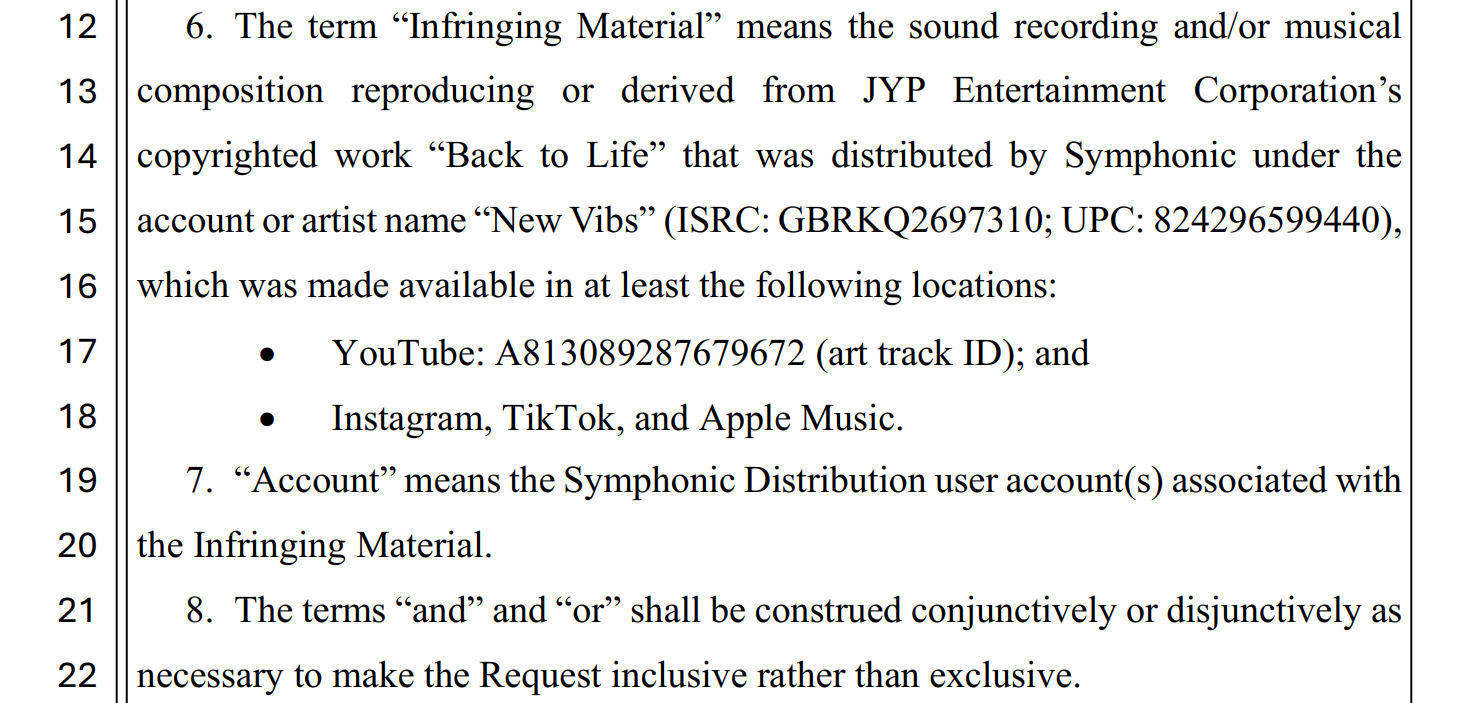
The Mechanics of the DMCA Subpoena
Under Section 512(h) of the DMCA, copyright holders can request a court clerk to issue a subpoena demanding that a service provider disclose the identity of an alleged infringer. Unlike standard civil lawsuits, which require complex discovery phases and formal service of process, a DMCA subpoena is designed to be an efficient, streamlined tool for unmasking anonymous uploaders.
JYP’s proposed subpoena asks the court to order Symphonic to produce:
- Full legal names and physical mailing addresses.
- Associated telephone numbers and email addresses.
- Complete IP addresses used during account creation and file uploads.
- Account history, modification logs, and communication records.
- Detailed financial records: Bank routing numbers, account numbers, and payment processing details.
It is this final category—the financial paper trail—that poses the greatest existential threat to the perpetrator. By tracking where the royalty payouts were scheduled to land, JYP’s investigators hope to unmask a real-world identity behind the digital mask.
Industry-Wide Implications
If JYP Entertainment successfully obtains and executes this subpoena, it could establish a powerful precedent across the global music industry:
- Heightened Distributor Scrutiny: Independent distributors may face increased pressure from major labels to implement rigorous Know-Your-Customer (KYC) verification protocols, such as requiring government-issued identification and tax documentation before allowing users to distribute content.
- Deterrence for Copycat Bootleggers: The ease of exploiting DIY distribution platforms for quick profit may diminish if uploaders realize that anonymity behind pseudonyms like "New Vibs" can be easily pierced via federal subpoenas.
- Cross-Border Enforcement: Given that K-pop labels manage assets originating in South Korea but frequently litigate in U.S. federal courts, foreign entertainment giants are increasingly comfortable wielding American intellectual property laws to protect their global catalogs.
Whether the "New Vibs" account holder will step forward to contest the subpoena in court, or whether Symphonic will comply with the clerk’s final order, remains to be seen. What is certain, however, is that the era of anonymous digital bootlegging via legitimate music aggregators is drawing to a close, with legal heavyweights like JYP Entertainment leading the charge.