







Executive Overview
As the United States hurtles toward a critical political cycle, media platforms are locked in an intense battle for the attention—and budgets—of political campaigns. Among them, Snapchat has launched a calculated and aggressive pitch to capture a substantial share of political advertising spend ahead of the November U.S. midterm elections.
At the center of this strategic offensive is a newly released, comprehensive research report detailing civic engagement trends within the app. Commissioned by Snap Inc. and conducted by research firm Alter Agents earlier this year, the study paints a surprising portrait of the platform’s user base. Contrary to the common dismissive trope that younger demographics are politically apathetic or cynical, the report reveals that nearly 80% of Snapchat users—affectionately known as "Snapchatters"—plan to cast their ballots in the upcoming midterms.
Furthermore, the data suggests that these users are not merely passive consumers of content; they are actively seeking out diverse viewpoints, demonstrating a high degree of open-mindedness, and proving exceptionally responsive to digital political advertisements. By surveying over 1,000 Snapchat users aged 18 to 45, the platform is attempting to convince political strategists that its ecosystem is no longer just a space for ephemeral personal messaging, but a vital, highly influential battleground for modern civic engagement.
This report arrives at a pivotal moment. With political campaigns increasingly looking for effective ways to bypass traditional media channels and connect directly with Gen Z and Millennial audiences, Snapchat is positioning itself as an indispensable tool. By highlighting its proven history of driving voter registration and showcasing how digital ads successfully introduce users to unfamiliar candidates and causes, Snap is making a compelling financial and strategic argument: to win the popular vote, campaigns must win over the Snapchat demographic.
Detailed Chronology: The Evolution of Snapchat’s Civic Engagement Strategy
Snapchat’s latest report is not an isolated marketing ploy; rather, it is the latest milestone in a multi-year, deliberate evolution of the platform’s role in American democracy. To fully understand the weight of Snap’s current pitch to political advertisers, one must examine how the company has progressively built its reputation as a civic engagement powerhouse over the past several years.
The Foundation Years (Pre-2018)
Long before political consultants viewed Snapchat as a viable medium for serious electoral campaigns, the platform recognized its unique position among younger demographics. Traditional voter mobilization efforts often struggled to reach teenagers and young adults aged 18 to 24 through legacy channels like local newspapers, cable television news, or direct mail. Recognizing this gap, Snap began experimenting with subtle, non-partisan in-app features designed to demystify the voting process. These early initiatives laid the groundwork for what would become a sophisticated, data-driven approach to digital civic participation.
The 2018 Midterm Breakthrough
The watershed moment for Snapchat’s political influence arrived during the 2018 U.S. midterm elections. Facing historically low youth voter turnout rates in previous cycles, Snap deployed targeted in-app resources, registration links, and creative filters to mobilize its base. The results were staggering. Data released by the platform following the election revealed that Snapchat had directly driven more than 450,000 people to register to vote. This monumental achievement caught the attention of political scientists and campaign managers alike, proving for the first time that a social media app could tangibly alter electoral behavior at scale.
The 2020 Presidential Election Expansion
Capitalizing on the momentum of 2018, Snap dramatically expanded its civic toolset ahead of the high-stakes 2020 presidential election. Through its comprehensive "CitizenSnap" initiative, the platform introduced advanced in-app prompts, registration status checkers, and educational resources regarding mail-in ballots and polling locations. The impact of these expanded features was profound: Snapchat successfully helped 1.2 million users register to vote in 2020—nearly triple its impact from two years prior. This exponential growth cemented the platform’s status as a trusted, authoritative source of election-related information for first-time and young voters.
The 2022 Midterm Pitch and Beyond
Now, looking toward the upcoming November midterms, Snap is translating its historical success into a commercial value proposition. Having proven its ability to mobilize millions of voters without taking partisan stances, the company is pivoting to monetize this influence. The release of the Alter Agents study is the centerpiece of this current phase, serving as a bridge between Snap’s altruistic civic mission and its commercial pitch to political advertisers seeking measurable returns on investment in an increasingly fragmented digital landscape.
Supporting Context & Metrics: Decoding the Alter Agents Study
To substantiate its claims to political advertisers, Snap relies heavily on hard data. The study conducted by Alter Agents earlier this year provides a granular look at the psychographics and media consumption habits of Snapchat users, offering deep insights into how younger generations approach the democratic process.
Voter Propensity and Enthusiasm
The headline statistic from the report is both striking and commercially vital for campaigns: nearly 80% (specifically 78%) of surveyed Snapchatters plan to vote in the upcoming midterm elections. When compared against broader population metrics, the data reveals that Snapchat users are 1.2 times more likely to vote than non-users within the same demographic window. This shatters the persistent myth that younger demographics are entirely detached from electoral politics. For political campaigns operating on tight budgets, this high propensity to vote makes the Snapchat user base an efficient and high-yield target.
Open-Mindedness and the Search for Viewpoints
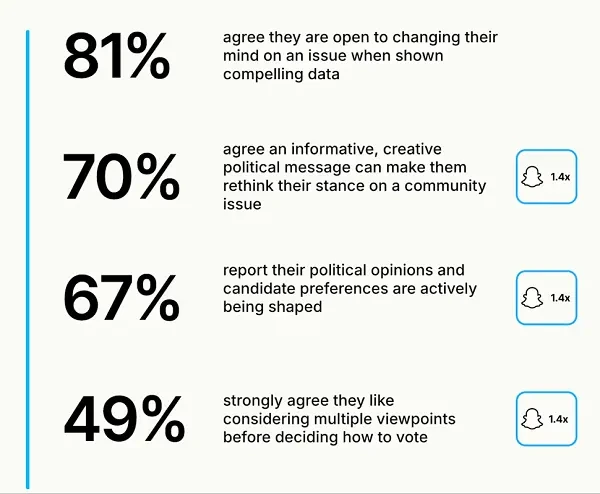
In an era defined by intense political polarization and echo chambers, the Alter Agents study uncovered a refreshing behavioral trend among Snapchat users. According to Snap’s synthesis of the data:
"In a complex political landscape, Snapchatters are uniquely open-minded in their political approach, seeking out viewpoints before choosing how to vote and open to changing their positions."
This psychological openness represents a goldmine for political advertisers. Rather than preaching exclusively to the converted, campaigns utilizing Snapchat have a genuine opportunity to persuade undecided voters, introduce alternative policy platforms, and sway public opinion among demographics that are actively evaluating their choices rather than locking themselves into rigid partisan camps.
The Power of Digital Ads in Candidate Discovery
How do young voters discover down-ballot candidates, ballot initiatives, and lesser-known political causes? Increasingly, the answer is through social media advertising. The survey revealed that 80% of respondents stated that political promotions on Snapchat had successfully introduced them to candidates and causes they were previously completely unaware of.
Furthermore, the ad format translates directly into offline or secondary digital action: 74% of surveyed users indicated that they are significantly more likely to actively look up candidates and research their policy stances after seeing ads for them on the platform. This demonstrates that Snapchat ads do not merely exist in a vacuum of brand awareness; they actively drive top-of-funnel curiosity that leads to deeper political research.
Summary of Key Research Metrics
- 78%: The percentage of Snapchat users who plan to vote in the upcoming U.S. midterm elections.
- 1.2x: The factor by which Snapchat users are more likely to vote compared to non-users.
- 80%: The percentage of respondents who discovered new political candidates or causes via digital ads on the platform.
- 74%: The percentage of users who are more likely to research candidates after encountering their advertisements on Snapchat.
- 1,000+: The sample size of Snapchat users aged 18 to 45 surveyed by Alter Agents for the study.
Official Statements and Industry Perspective
Snap Inc. has framed its latest initiative not merely as a business venture, but as a continuation of its long-standing commitment to public service and democratic health. In promotional materials released alongside the Alter Agents study—including a dedicated blog post on the Snap for Business portal titled "Win the Popular Vote Among Snapchatters"—company leadership has emphasized the unique symbiosis between the platform’s user experience and effective political outreach.
Industry analysts and political media observers have taken note of the timing and tone of Snap’s pitch. In recent years, legacy platforms like Meta (Facebook and Instagram) and X (formerly Twitter) have faced intense regulatory scrutiny, algorithmic controversies, and, in some cases, policy rollbacks regarding political advertising. Several major tech companies have chosen to restrict, heavily police, or entirely ban certain types of political ads to avoid the public relations fallout associated with misinformation and election interference.

In contrast, Snapchat has maintained a carefully curated approach. By combining strict vetting processes for political ads with proactive, non-partisan voter registration initiatives, Snap has carved out a distinct brand identity. Company representatives argue that because Snapchat is designed for communication between close friends rather than public viral broadcasting, the spread of toxic political polarization is naturally mitigated.
Political consultants who have reviewed the Alter Agents report point out that reaching younger generations requires meeting them on platforms where they already spend significant time. Traditional television advertising increasingly fails to reach voters under 40 who have largely abandoned cable packages in favor of streaming services and mobile-first apps. Consequently, Snap’s pitch offers a lifeline to campaigns struggling with multi-platform media mixes, providing a direct pipeline to a notoriously difficult-to-reach segment of the electorate.
Future Outlook: The Role of Mobile Platforms in Modern Democracy
As the political landscape continues to evolve, the intersection of technology, advertising, and civic participation will only grow more complex. The findings from Snapchat’s latest report offer a clear glimpse into the future of election campaigns—one where digital-first, mobile-centric platforms play an indispensable role in shaping voter behavior.
Looking ahead beyond the November midterms, several key trends are likely to shape how platforms like Snapchat interact with the political sphere:
1. Hyper-Targeted, Issue-Based Campaigns
The data shows that Snapchat users are highly responsive to outreach based on specific causes rather than broad, abstract party affiliations. Future political advertising will likely lean heavily into micro-targeted campaigns focused on single issues—such as climate change, reproductive rights, economic mobility, and education reform—which naturally resonate with younger, open-minded demographics.
2. The Battle for First-Time Voters
With millions of Gen Z voters entering the electorate in every subsequent election cycle, platforms that successfully cultivate trust and provide frictionless civic tools will retain immense value. Snap’s proven track record of registering over 1.2 million voters in 2020 demonstrates that early brand loyalty among first-time voters can translate into long-term civic habits.
3. Ethical Advertising and the Fight Against Misinformation
As artificial intelligence and deepfake technologies introduce unprecedented challenges to electoral integrity, platforms like Snapchat will face mounting pressure to maintain rigorous verification standards for political ad spend. The commercial viability of these platforms will depend heavily on their ability to assure advertisers and users alike that the digital environment remains secure, transparent, and free from malicious manipulation.
In conclusion, Snapchat’s aggressive pitch for political ad spend ahead of the midterms is grounded in compelling empirical reality. By proving that its user base is enthusiastic, politically active, open-minded, and deeply reliant on digital discovery, Snap has successfully positioned its platform as a critical arena for modern political campaigns. For candidates looking to capture the popular vote among the nation’s youngest and most dynamic voters, ignoring the insights of the Alter Agents report may prove to be a perilous electoral miscalculation.