







Executive Overview
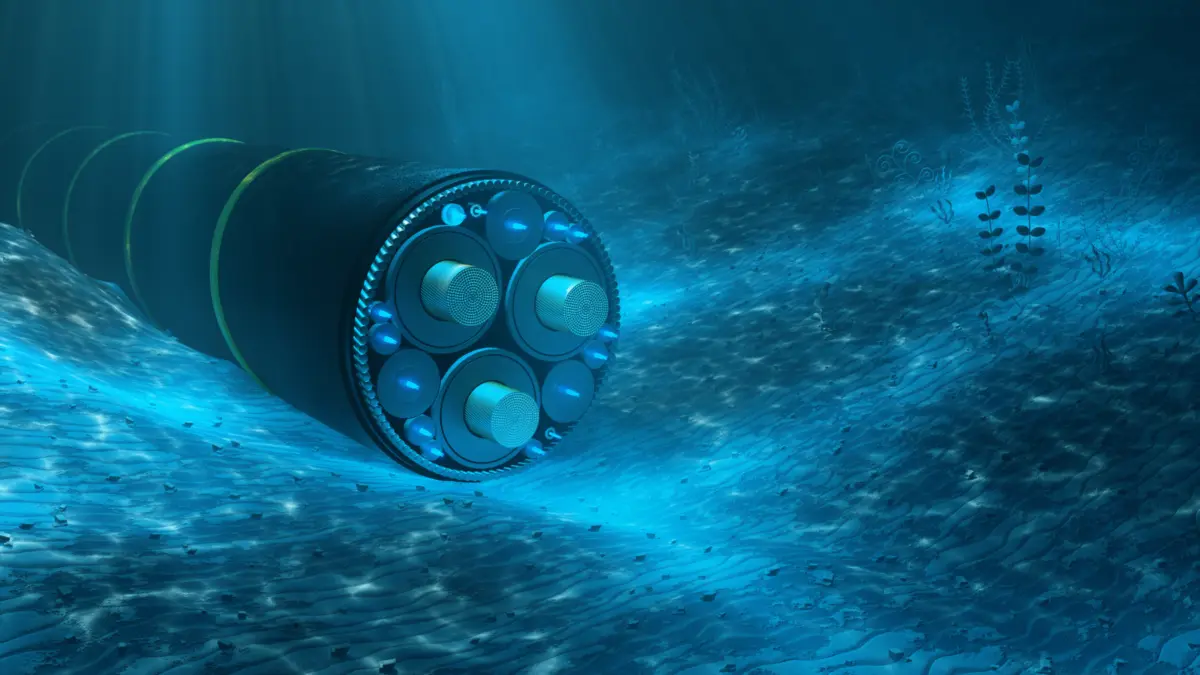
The modern digital economy—spanning global finance, enterprise business operations, national security protocols, and real-time digital entertainment—operates entirely upon the resilient connectivity provided by global fiber-optic networks. Deep beneath the world’s oceans, vast webs of subsea fiber cables carry massive volumes of data across marine trenches to link continents and island nations. Increasingly, however, these intercontinental corridors are no longer stopping at traditional coastal endpoints. Instead, they are being extended directly into the massive, high-performance data centers that power today’s cloud ecosystems and artificial intelligence services.
This shift marks a fundamental transformation in digital infrastructure. Today, tens of thousands of hyperscale data centers rely on this undersea backbone to support resource-intensive AI workloads, including complex model training, real-time inference, autonomous agents, and high-throughput applications. This reliance is projected to accelerate dramatically over the coming years. Global data center capacity, which currently hovers around 100 gigawatts (GW), is widely expected to double, reaching 200 GW by the end of the decade.
The resulting surge in data center interconnections—coupled with a rapid escalation in compute and storage capacity—is driving a parallel investment supercycle in subsea cable capacity and terrestrial backhaul networks. According to global industry trackers, more than 570 subsea cable systems now span roughly 1.5 million kilometers of ocean floor. This includes an extraordinary pipeline of over 40 new subsea cable systems scheduled to enter service in 2026 alone, with additional multi-terabit routes planned through the close of the decade.
This unprecedented expansion is forcing subsea network operators, telecommunications consortia, and their terrestrial infrastructure partners to confront complex engineering challenges. Most notably, they must find ways to accommodate substantially higher capacities at cable landing stations (CLS) and across terrestrial backhaul networks without sacrificing reliability, energy efficiency, or cost-effectiveness.
Detailed Chronology & Evolution: From Telecom Consortia to Hyperscale Directness
To understand the current pressures facing global subsea networks, it is necessary to examine how the operational landscape has evolved over the past several decades.
Historical Paradigm: The Consortia Era
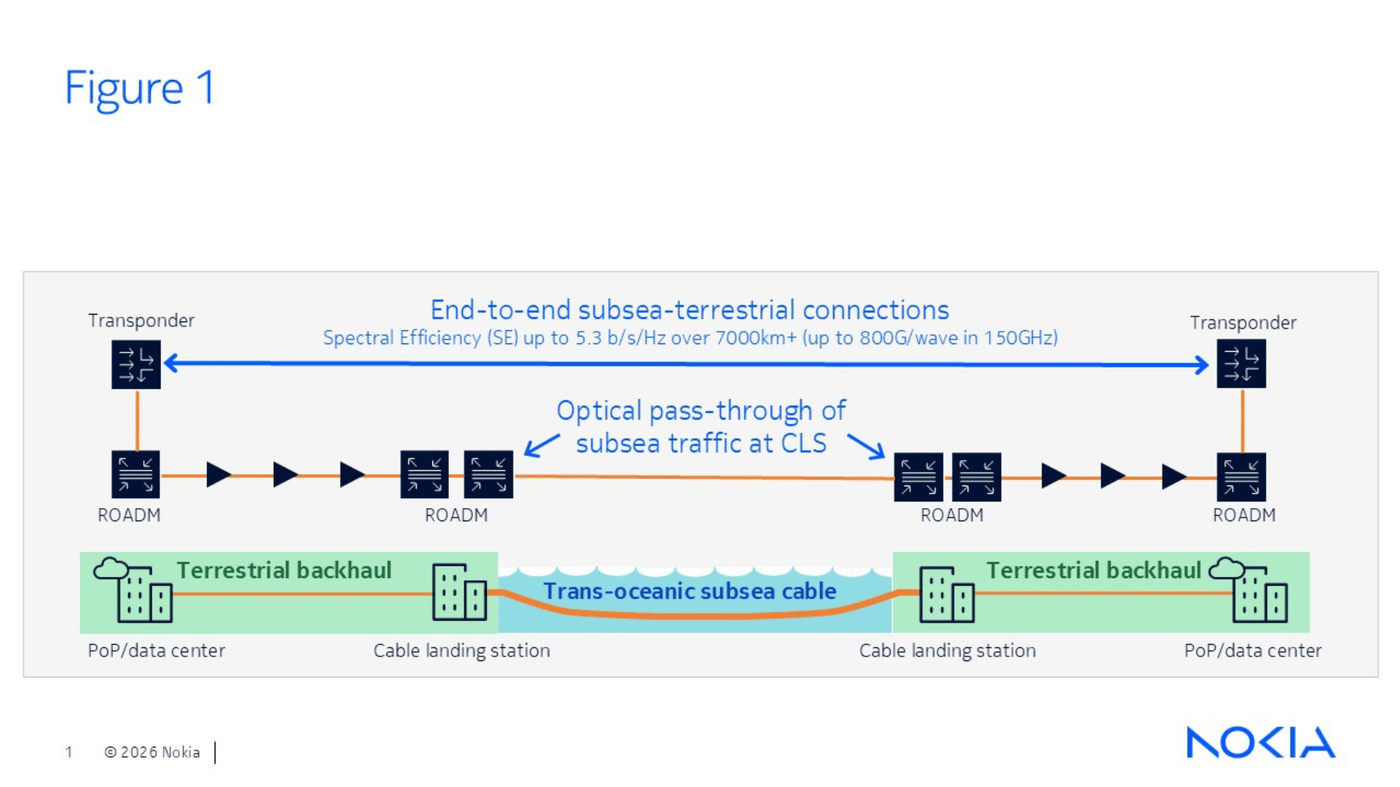
Historically, the deployment and management of subsea cables were the exclusive domain of traditional telecommunications providers, wholesale international carriers, and regional carrier consortia. In this legacy model, submarine line terminating equipment (SLTE) was installed directly at the cable landing station (CLS). The CLS served as a hard functional boundary—a critical operational junction where undersea traffic was physically and logically handed off from high-capacity marine transmission systems to terrestrial backhaul networks.
At the CLS, submarine signals were terminated, converted, and re-transmitted onto inland networks. While this model provided clear administrative boundaries and simplified maintenance responsibilities, it also introduced latency, equipment redundancy overhead, and significant space and power requirements at coastal sites.
The Modern Paradigm: Hyperscale Dominance and Direct Data Center Integration
Today, the foundational market dynamics look radically different. Hyperscale cloud providers and AI giants are increasingly taking the lead in global subsea deployments, directly funding and engineering cables to connect specific, high-density data centers across oceans.
In this new architectural model, the cable landing station is no longer treated as a mandatory network endpoint. Instead, traffic can travel seamlessly and directly from an overseas data center, through the landing site, and straight into an inland or metro data center facility. This end-to-end integration eliminates unnecessary equipment transitions, reduces latency, and optimizes data throughput for latency-sensitive AI and cloud workloads.
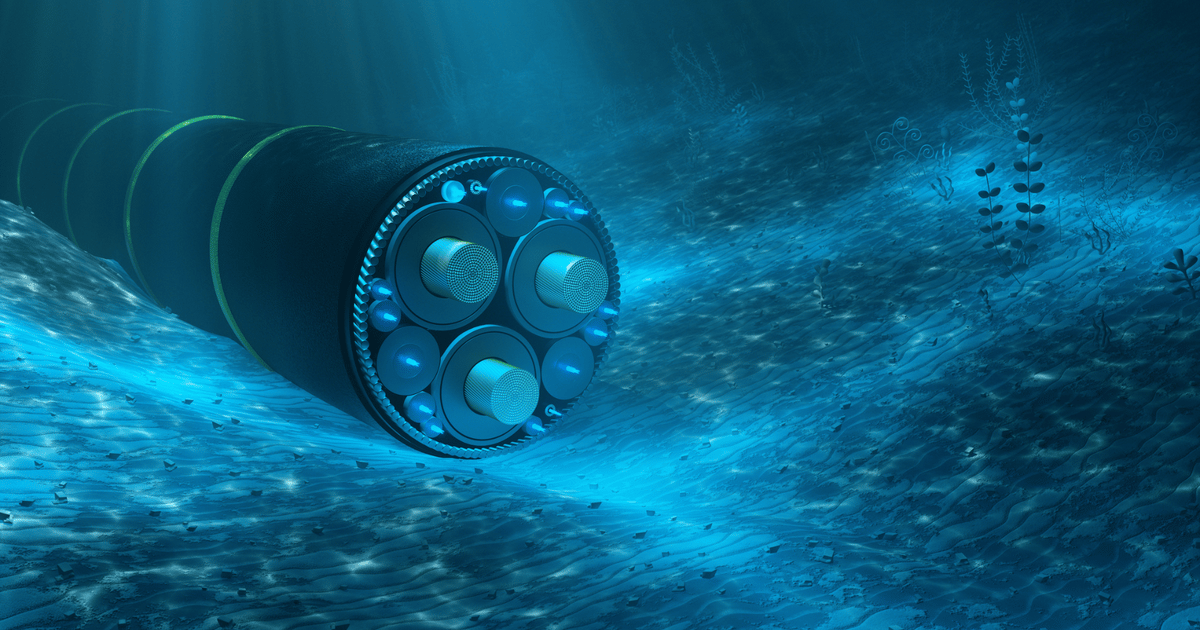
Furthermore, this shift has transformed cable design itself. Subsea systems that historically relied on four, six, or eight fiber pairs are rapidly giving way to spatial division multiplexing (SDM) architectures featuring 24 or more pairs. Consequently, a single CLS may now handle at least four times the traffic volume of older systems. This exponential growth intensifies pressure on operators to reduce physical space, lower power consumption, and control capital expenditures at landing sites, while simultaneously upgrading the capacity of terrestrial backhaul routes.
Supporting Context & Metrics: Quantifying the Infrastructure Boom
The convergence of cloud computing, generative AI, and geopolitical imperatives is reshaping global networks at a historic scale. To grasp the sheer magnitude of this transformation, industry analysts point to several key metrics and architectural benchmarks:
- Global Data Center Growth: Current global data center capacity stands at approximately 100 GW. Driven primarily by the relentless infrastructure demands of AI model training and inference clusters, this figure is projected to double to 200 GW by 2030.
- Undersea Footprint: The global submarine network currently comprises over 570 active and planned subsea cable systems, stretching approximately 1.5 million kilometers across the globe.
- The 2026 Surge: Infrastructure activity is currently at an all-time high, with more than 40 new subsea cable systems scheduled to enter commercial service in 2026 alone.
- Fiber Pair Scaling: Legacy subsea cables utilized 4 to 8 fiber pairs, whereas modern SDM architectures scale to 24 or more fiber pairs per cable, multiplying total system throughput.
- Terrestrial vs. Subsea Spectrum: While a typical subsea fiber is restricted to roughly 4.5 THz of wavelength division multiplexing (WDM) spectrum, modern terrestrial backhaul fibers can support approximately 9.6 THz using combined C and L bands ("C+L"), and even higher capacities when utilizing extended spectral bands like Super-C and Super-L.
Technological Innovations: Overcoming Bottlenecks in Subsea-Terrestrial Networks
To keep pace with the insatiable demand for bandwidth driven by AI and cloud services, network operators are deploying a suite of advanced optical networking technologies. These innovations aim to optimize end-to-end network architecture, blending subsea and terrestrial domains into a unified, highly efficient transmission fabric.
1. 800G Coherent Pluggable Optics
New generations of 800G coherent pluggable optics are expanding rapidly from high-density metro deployments into regional and long-haul transport roles. When deployed directly into routers for IP-over-WDM architectures, or utilized in streamlined transponder setups that handle service demarcation and lower-speed aggregation, coherent pluggables offer massive space, power, and capital cost savings compared to traditional performance-optimized transponders.
These advantages make 800G coherent pluggables exceptionally well-suited for terrestrial backhaul links. They provide cost-effective, low-power operation across combined C and L bands, maximizing fiber utility. Crucially, operators are also proving the technology on challenging subsea routes.
In a recent field trial on a subsea route connecting the United States to Puerto Rico, coherent pluggables successfully achieved data rates of 600G per wavelength over a distance of 2,841 kilometers, and 400G per wavelength over an extended span of 5,862 kilometers. Newer iterations currently in development aim to extend these impressive performance thresholds to full transatlantic distances.
2. Offloading Landing Sites via Optical Pass-Through
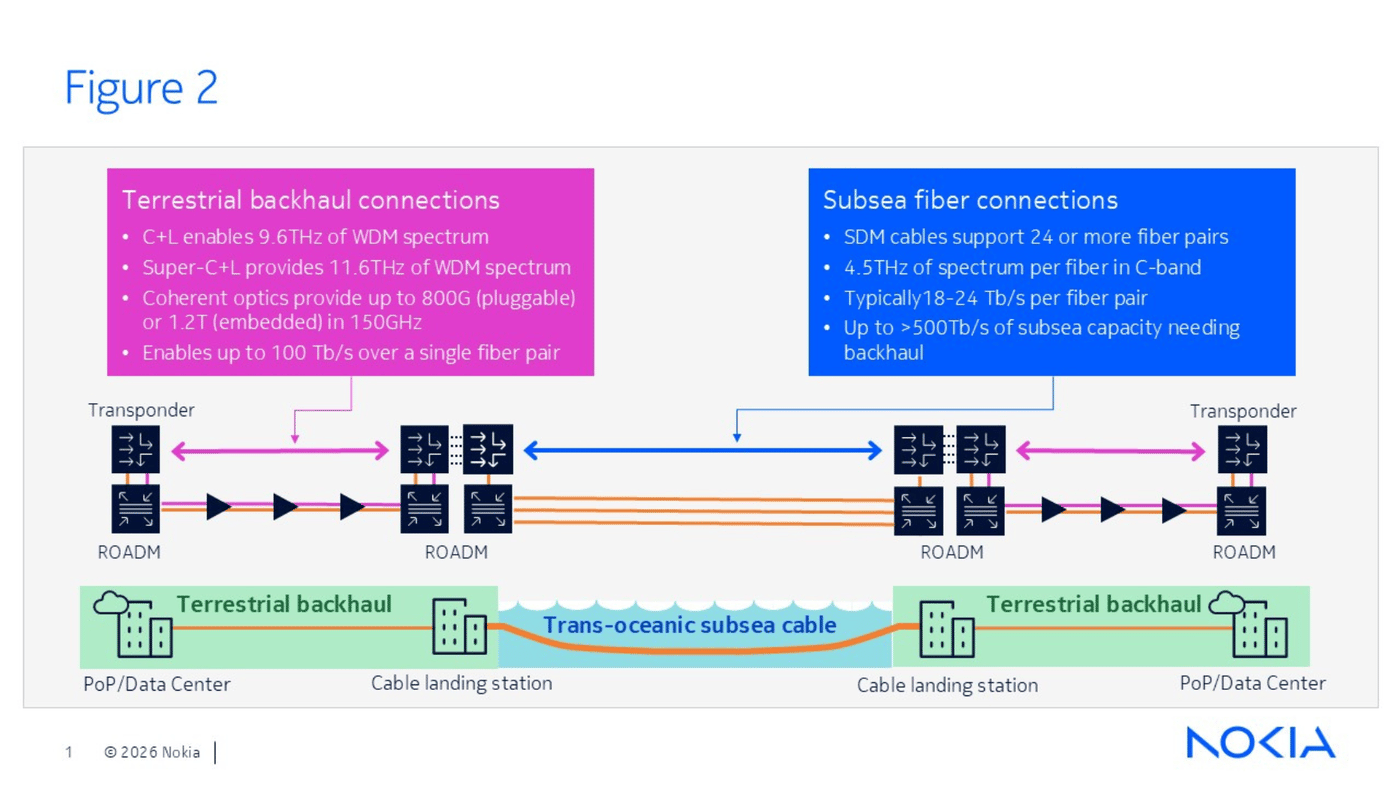
When a single network operator controls both its subsea fiber assets and the corresponding terrestrial backhaul, deploying reconfigurable optical add/drop multiplexers (ROADMs) at the cable landing station enables advanced "optical pass-through."
Instead of terminating wavelengths at the CLS—which requires back-to-back transponders and drives up equipment costs, power consumption, and footprint—wavelengths can pass optically through the landing site. They continue uninterrupted directly into the terrestrial backhaul, terminating only when they reach their destination data centers.
Executing this architecture successfully requires several sophisticated ROADM functions to work in concert, including amplified spontaneous emission (ASE) spectrum power insertion, dynamic spectrum sharing, optical channel monitoring, and constant-power operation across terrestrial inline amplifiers. By eliminating redundant transponder equipment at the CLS, operators dramatically slash operational friction, power overhead, and capital expenditure.
3. Maximizing Backhaul Capacity with C+L WDM Spectrum
Reaching inland data centers is not always achievable over an operator’s proprietary fiber. When third-party infrastructure must be utilized for the backhaul segment, operators frequently rely on dark fiber leases or managed optical fiber network (MOFN) services. However, leasing high-count SDM cables supporting 24 or more fiber pairs can become prohibitively expensive.
To optimize these costs, operators are deploying simultaneous C+L band transmission across terrestrial backhaul links. While subsea fibers face strict optical constraints limiting them to roughly 4.5 THz of WDM spectrum, terrestrial routes can easily support 9.6 THz using C+L bands—and even more with extended spectral variations. This effectively allows terrestrial backhaul routes to carry double the capacity per fiber compared to the submarine segment.
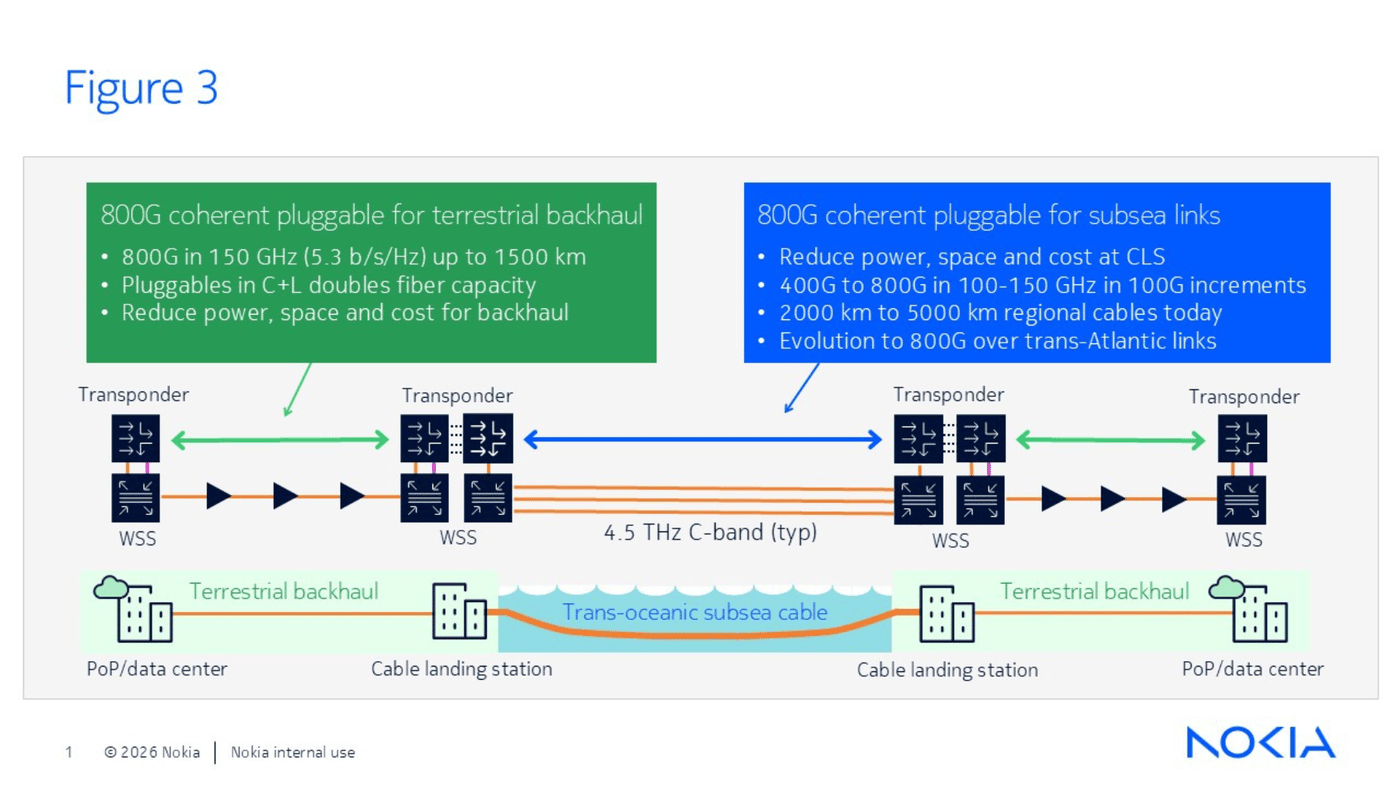
Furthermore, because terrestrial spans are generally shorter than subsea spans, wavelengths can be driven at higher modulation and data rates. Combined with C+L spectrum expansion, this capability allows subsea cable operators to reduce their required backhaul fiber footprint by 50% to 75%, yielding profound financial savings on leased fiber and MOFN operational expenditures.
Official Perspectives & Industry Insights
As the telecommunications and data center industries navigate this transformative period, leading technical experts emphasize the critical importance of holistic network design.
According to Serge Melle, Director of Optical Networks Product Marketing at Nokia, the integration of subsea networks into broader enterprise architectures represents a paradigm shift for the industry. Having spent decades working on pioneering optical transport deployments, Melle notes that network operators can no longer treat submarine and terrestrial domains as isolated operational silos.
"Subsea networks are now integral to end-to-end data center fabrics, enabling global scale across interconnection for AI and cloud traffic," Melle explains. "By leveraging new technologies and optimized architectures, subsea network operators can stay ahead of capacity growth while lowering costs and power consumption and maximizing operational efficiency across both subsea and terrestrial domains."
Industry analysts echo this perspective, emphasizing that as artificial intelligence workloads continue to scale horizontally and vertically across global regions, performance will increasingly depend on the seamless harmonization of submarine transmission systems, landing station architectures, and inland backhaul capacity.

Future Outlook: The Road to 2030 and Beyond
Looking toward the close of the decade, the trajectory of global subsea and terrestrial networking is inextricably bound to the expansion of artificial intelligence. With global data center capacity on track to reach 200 GW by 2030, the demand for ultra-low latency, high-bandwidth intercontinental connectivity will only accelerate.
To meet this demand, the industry must continue to innovate across multiple fronts:
- Transatlantic and Transpacific Pluggables: Continued advancement in coherent pluggable optics will likely eliminate the need for discrete, power-hungry transponders even on ultra-long-haul oceanic routes, further simplifying network topologies.
- Advanced Spectrum Utilization: Research into ultra-wideband optical transmission—moving beyond C+L into S-band and U-band architectures—will unlock even greater spectral efficiency, multiplying the data-carrying capacity of existing and planned fiber pairs.
- Unified Network Automation: The deployment of software-defined networking (SDN) control planes that span both submarine and terrestrial domains will enable real-time traffic engineering, automated restoration, and dynamic resource allocation on a global scale.
Ultimately, the convergence of hyperscale cloud requirements, advanced spatial division multiplexing, and intelligent optical routing ensures that subsea cables will remain the invisible, indispensable circulatory system of the global digital economy for decades to come.