








Executive Overview
For over two decades, enterprise cybersecurity has operated on a foundational structural flaw: the strict organizational segregation of offensive and defensive teams. Traditionally, red teams and penetration testers were brought in to probe corporate networks, compile exhaustive static reports, and walk away—leaving behind a PDF of vulnerabilities that often gathered digital dust. Meanwhile, security operations center (SOC) analysts sat thousands of miles away, staring at SIEM alerts and fielding noisy telemetry without ever seeing the actual, bespoke techniques employed by adversaries during live drills.
Today, advanced threat actors actively exploit this operational seam. They bypass perimeter defenses not by deploying never-before-seen malware, but by chaining minor, unpatched misconfigurations together in ways that static rule sets miss entirely.
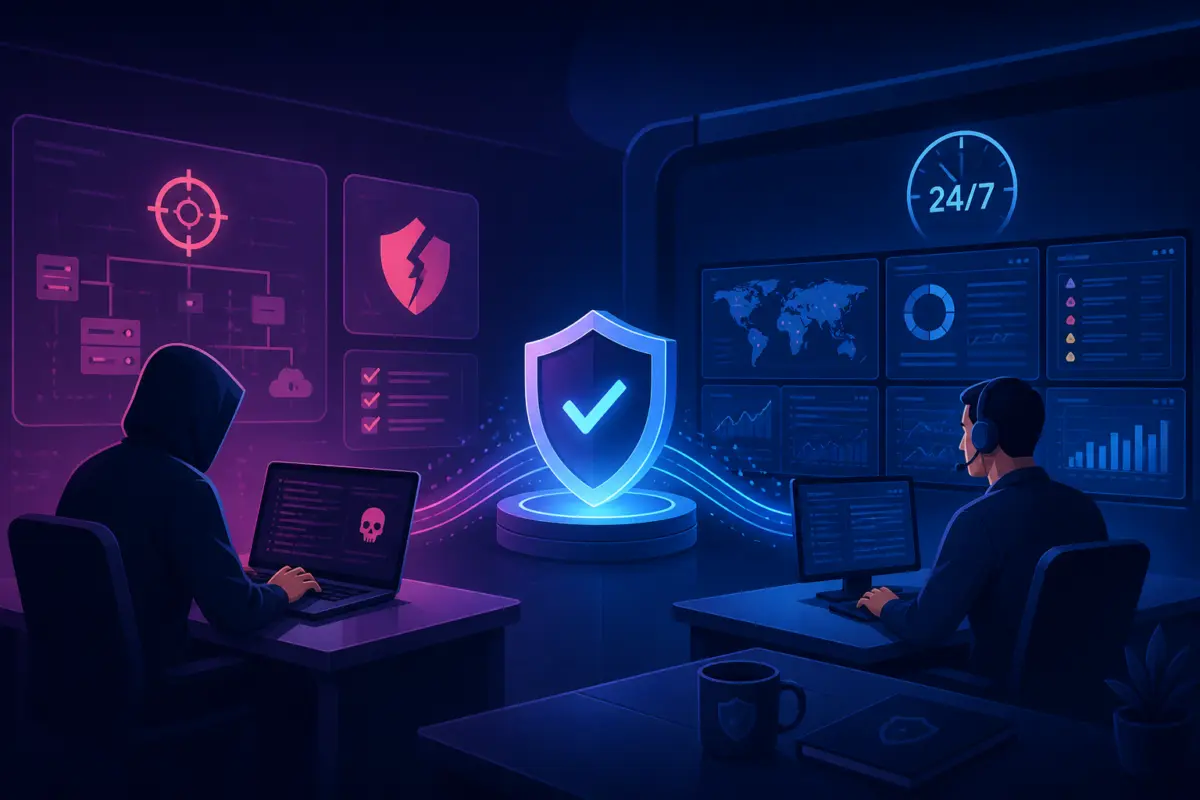
To combat this, the cybersecurity industry is undergoing a structural evolution. The most elite Managed Detection and Response (MDR) providers are no longer satisfied with merely bundling offensive testing and 24/7 monitoring under a single corporate contract. Instead, they are engineering automated, structured feedback loops where penetration testing results directly and immediately update SOC detection rules.
Driven by escalating infrastructure complexity and a severe global cybersecurity talent shortage, the market for unified defense is expanding rapidly. According to research from MarketsandMarkets, the global MDR market is projected to reach $17.64 billion by 2031. Organizations are increasingly realizing that fragmented tooling and isolated security audits are no longer viable. This comprehensive guide examines the concept of the "closed-loop" security model, analyzes the top seven MDR providers bridging this divide, and outlines why integrated offensive and defensive operations represent the gold standard of modern enterprise protection.
Detailed Chronology: The Evolution of the Offense-Defense Security Divide
To understand why the integration of MDR and offensive security is so revolutionary today, it is helpful to trace how these two disciplines evolved in isolation.
Phase 1: The Era of Compliance Checkboxes (Early 2000s–2010s)
In the early days of structured enterprise cybersecurity, security was largely treated as a compliance exercise. Penetration testing emerged as an annual or quarterly ritual driven by regulatory mandates (such as PCI-DSS or HIPAA). Organizations hired external third-party auditors to run automated vulnerability scanners and attempt basic exploits. Once the test concluded, a static report was delivered to the CISO, handed to IT administrators for ad-hoc patching, and filed away until the following year.
Concurrently, internal security monitoring was in its infancy. Organizations relied on basic signature-based firewalls and rudimentary event logs. The concept of continuous, 24/7 human-led threat hunting was reserved exclusively for financial institutions and defense contractors.
Phase 2: The Rise of the Managed SOC and the Proliferation of Tools (2010s–2020)
As cyber threats grew more sophisticated, internal IT teams became overwhelmed by alert fatigue. This catalyzed the explosive growth of Managed Detection and Response (MDR). Enterprises outsourced their continuous monitoring to specialized providers who could ingest telemetry from endpoints, servers, and networks around the clock.
However, MDR providers focused almost exclusively on defense. They built monitoring platforms and optimized incident response playbooks based on generalized threat intelligence feeds. They rarely communicated with the boutique offensive security firms hired to conduct annual red team engagements. The barrier between "breaking things" (offense) and "watching things" (defense) remained firmly entrenched.
Phase 3: The Convergence and the "Closed-Loop" Imperative (Present Day)
By the early 2020s, CISOs began recognizing the diminishing returns of isolated security spending. An annual penetration test might reveal hundreds of vulnerabilities, but because those findings never informed the SOC’s daily alert tuning, the organization remained susceptible to the exact same attack paths weeks later.
Forward-thinking security providers began acquiring or building internal offensive practices to merge them with their MDR platforms. Today, true industry leaders are moving beyond mere co-location of services. They are engineering operational workflows where an ethical hacker’s successful exploit on a Tuesday automatically triggers a detection rule update in the SOC by Wednesday morning. This evolution has transformed offensive testing from a stagnant compliance hurdle into a dynamic, real-time calibration tool for defensive operations.
Supporting Context & Metrics: The Cost of Isolation
The argument for a closed-loop security architecture is validated by staggering industry metrics regarding breach lifecycles, dwell times, and market dynamics.
The Dwell-Time Crisis
According to data from the IBM Cost of a Data Breach Report, the average enterprise breach lifecycle spans an astonishing 241 days. On average, organizations take 181 days simply to identify that an intrusion has occurred, and another 60 days to contain the threat.
This protracted timeline is a direct symptom of disconnected security operations. When an organization’s red team discovers a novel lateral movement technique during an exercise, but that intelligence fails to reach the SOC monitoring the network, front-line analysts remain blind to that specific adversary tradecraft. Consequently, when a real-world attacker utilizes that exact technique, the SOC treats it as a low-priority anomaly or misses it entirely, directly contributing to hundreds of days of hidden dwell time.
Market Momentum
The demand for unified, continuous security oversight is reflected in macroeconomic trends. MarketsandMarkets projects that the global MDR market will surge to $17.64 billion by 2031. This growth is propelled by two primary market pressures:
- The Global Talent Shortage: Enterprises continue to struggle to recruit, train, and retain tier-3 threat hunters and specialized red team operators in-house.
- Tool Sprawl Consolidation: Organizations are actively moving away from fragmented ecosystems of point solutions in favor of unified vendors who can seamlessly bridge proactive testing with reactive defense.
Evaluating the Top 7 MDR Providers: How Closed Is the Loop?
Not all vendors marketing "offensive and defensive capabilities" execute them with equal integration. True integration requires automated or structured feedback loops where offensive testing updates defensive detection rules. Below is an evaluation of the top seven MDR providers ranked by the maturity of their closed-loop architecture.
1. DeepSeas: The Closed Loop by Design
- Overview: DeepSeas was architected specifically around the premise that offense and defense must operate as a single continuous system. Its offensive suite, DeepSeas RED, pairs directly with DeepSeas MDR+, ensuring that adversary intelligence gained during simulated exercises flows immediately into active threat hunting rules.
- The Offensive Side: Through the integration of RedTeam Security, DeepSeas RED delivers a comprehensive offensive practice encompassing red teaming, penetration testing, and continuous security validation. Engagements simulate complete, multi-stage attack paths across cloud environments, identity directories, and user endpoints.
- The Monitoring Side: DeepSeas MDR+ delivers 24/7 threat detection and response spanning corporate IT and operational technology (OT) networks, cloud infrastructure, and mobile fleets. Backed by a top-five Frost Radar ranking in MDR, the SOC protects over 350 organizations, including Fortune 100 enterprises.
- Best For: Enterprises seeking a natively unified, zero-seam architecture where offensive findings instantly reshape defensive telemetry.
2. Rapid7
- Overview: Rapid7 combines around-the-clock SOC operations with an established vulnerability management heritage, connecting active attacker behaviors directly with exposed internal assets via its Managed Threat Complete package.
- The Offensive Side: Rapid7’s proactive strength is rooted in its attack surface visibility platform, InsightVM, and hands-on penetration testing. Its historical ties to the Metasploit project give the organization deep credibility in adversarial tooling, helping security teams prioritize remediation based on real-world exploitability.
- The Monitoring Side: Managed Threat Complete delivers 24/7 SOC coverage built on the InsightIDR SIEM, bolstered by bi-directional Microsoft Defender integrations and bundled incident response.
- Best For: Mid-market and enterprise teams seeking highly customizable detection engineering backed by robust vulnerability management.
3. eSentire
- Overview: eSentire provides a balanced approach to the security equation, offering dedicated offensive security services alongside a multi-signal MDR platform designed for rapid automated disruption.
- The Offensive Side: eSentire conducts rigorous penetration testing and red team simulations designed to discover exploitable weaknesses before malicious actors can leverage them, providing customers with direct access to specialized ethical hackers.
- The Monitoring Side: Its multi-signal MDR merges Extended Detection and Response (XDR) technology with 24/7 threat hunting across multi-cloud workloads, endpoints, and networks, with identity stores integrated directly into ongoing investigations.
- Best For: Global enterprises requiring hands-on remediation and continuous protection across diverse multi-cloud environments.
4. Sophos
- Overview: Sophos delivers around-the-clock detection through global operations centers utilizing an open architecture that integrates seamlessly with third-party security tools. Its offensive testing assessments complement its defensive core, reinforced by threat intelligence capabilities gained through its integration with Secureworks.
- The Offensive Side: Sophos provides penetration testing and posture assessments. The integration with Secureworks brings deep adversarial research and countermeasure development to the broader Sophos Adaptive Cybersecurity Ecosystem.
- The Monitoring Side: Sophos MDR analysts ingest telemetry from a wide array of sources—including firewalls, email gateways, identity providers, and cloud environments—making it exceptionally practical for organizations running heterogeneous software stacks.
- Best For: Organizations with diverse software environments looking for vendor-agnostic threat ingestion and preapproved response playbooks.
5. Arctic Wolf
- Overview: Arctic Wolf utilizes a distinct concierge SOC model, pairing customers with named security experts who guide detection, incident containment, and posture management over time.
- The Offensive Side: Arctic Wolf focuses primarily on defensive monitoring and external attack surface management rather than full-scale adversarial red teaming. In-depth penetration testing and custom exploit simulations are typically delivered through third-party strategic partners.
- The Monitoring Side: Defense is Arctic Wolf’s core competency. Its Concierge Security Team provides dedicated guidance, documented runbooks, and 24/7 alert handling across endpoints, cloud infrastructure, and identity directories.
- Best For: Mid-market organizations prioritizing dedicated, human-led guidance and continuous risk reduction.
6. Trustwave
- Overview: Trustwave is a long-standing managed security leader that combines 24/7 SOC operations with deep offensive expertise channeled through its renowned SpiderLabs unit.
- The Offensive Side: The SpiderLabs team provides advanced penetration testing, physical security assessments, red teaming, and threat research, offering customers granular visibility into novel exploit chains and adversary tradecraft.
- Trustwave SOC Operations: Trustwave operates global security centers that supply 24/7 detection and response across hybrid cloud and legacy on-premises environments, encompassing managed detection, database protection, and compliance management.
- Best For: Enterprises and government agencies with complex hybrid architectures requiring deep forensic and threat research backing.
7. GoSecure
- Overview: GoSecure delivers managed detection and response alongside hands-on testing services, tailoring its operational delivery specifically to mid-market organizations seeking proactive testing and around-the-clock defense from a single provider.
- The Offensive Side: GoSecure maintains an active offensive security unit capable of conducting web application penetration tests, wireless assessments, and red team engagements to identify exploitable gaps prior to production deployments.
- The Monitoring Side: Its MDR team provides continuous monitoring, automated mitigation, and live threat hunting designed to offer rapid containment capabilities without requiring an in-house SOC.
- Best For: Mid-market teams needing streamlined deployment and rapid incident containment.
Official Statements & Industry Expert Perspectives
As the industry shifts toward unified security paradigms, security leaders and market analysts increasingly emphasize the necessity of breaking down organizational silos.
Dr. Ronald Vance, Principal Threat Intelligence Analyst at Enterprise Security Insights, notes:
"For years, the cybersecurity industry treated penetration testing as an audit item and MDR as an insurance policy. That separation is a luxury modern enterprises can no longer afford. When an offensive test uncovers a novel lateral movement path, that intelligence must instantly become a detection signature. If your SOC is learning about an attack vector from an external breach report rather than your own internal red team, your defensive posture is permanently lagging behind the adversary."
Furthermore, industry benchmarks emphasize that the efficacy of an MDR provider should no longer be judged solely on alert volume or mean-time-to-respond (MTTR) metrics, but on adaptive resilience. Leading CISOs are increasingly adopting a simple vetting question when evaluating managed security partners:
"Show us concrete examples of how an offensive finding discovered during last month’s red team engagement directly modified a defensive detection rule in your SOC this month."
Future Outlook: The Next Decade in Managed Detection and Response
Looking ahead toward 2031 and beyond, the trajectory of the MDR market points firmly toward hyper-automation and continuous validation. Several key trends will define the maturation of the closed-loop security model:
- AI-Driven Automated Feedback Loops: While human expertise remains irreplaceable for complex red teaming and threat hunting, artificial intelligence and machine learning models will increasingly automate the translation of offensive telemetry into real-time SOC detection rules, shrinking the feedback loop from weeks to mere seconds.
- Continuous Automated Red Teaming (CART): Annual and quarterly penetration tests will give way to continuous, automated adversary emulation that probes enterprise defenses 24/7/365, ensuring that security controls are validated against emerging threat actor tactics on an ongoing basis.
- Ecosystem Convergence: The historical boundary between vulnerability management, offensive testing, and defensive monitoring will completely dissolve. Vendors that fail to offer integrated, closed-loop ecosystems will find themselves relegated to legacy compliance niches as enterprises demand holistic, self-improving defense mechanisms.
Ultimately, combining offensive testing with 24/7 monitoring is no longer just a marketing differentiator—it is an operational necessity. By bridging the gap between how systems are broken and how they are defended, organizations can finally transform their security operations from a reactive expense into a dynamic, hardened shield against tomorrow’s sophisticated cyber threats.
Frequently Asked Questions (FAQs)
What does it mean to combine offensive testing with MDR?
Combining offensive testing with MDR means linking proactive security evaluations—such as penetration testing, vulnerability assessments, and red teaming—directly with 24/7 security monitoring. Findings from offensive simulations are used immediately to update detection signatures and response playbooks, while identified monitoring blind spots establish the precise targets for future testing exercises.
Why do offense and defense work better together?
Simulated attacks expose actual bypass techniques before adversaries can exploit them in production environments. Integrating those findings into live monitoring allows SOC analysts to tune alert thresholds against demonstrated tactics. Over time, recurring tests validate whether previous detection gaps have been successfully remediated.
Isn’t offering both services under one contract the same as combining them?
No. Many cybersecurity vendors market penetration testing and MDR on the same webpage, but deliver them through completely disconnected business units. A true closed loop requires operational workflows where offensive engineers share attack telemetry directly with detection engineering teams to actively adjust defensive controls.
What is the primary difference between MDR and red teaming?
Managed detection and response provides continuous defensive surveillance, with human analysts investigating anomalous behavior, triaging alerts, and isolating compromised assets. Red teaming tests organizational resilience by staging realistic, multi-stage adversary campaigns against your infrastructure. Verifying that these two functions actively inform one another ensures that your defensive spend translates directly into hardening your business against real-world compromises.