Executive Overview
Software engineering is in the middle of a quiet, compounding crisis of choice. For the past few years, developers working with multiple artificial intelligence coding assistants have lived with an inefficient reality: deciding which model to use for a specific task is a manual, highly subjective chore.
Need a quick syntax correction or boilerplate scaffolding? Fire up a lightweight, fast, inexpensive model. Facing a complex race condition in a multi-threaded backend service? Reach for a massive, heavily parameterized, expensive frontier model. Sometimes, developers find themselves running a second model simply to sanity-check the output of the first—manually passing code snippets back and forth across different chat windows or tool interfaces.
This is fundamentally a routing problem, and until now, the cognitive burden of solving it has fallen entirely on the human developer.
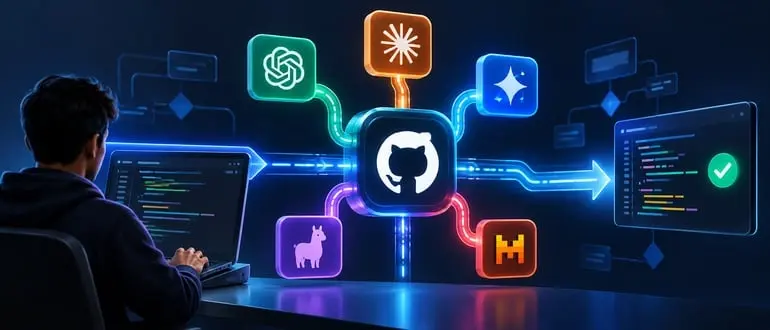
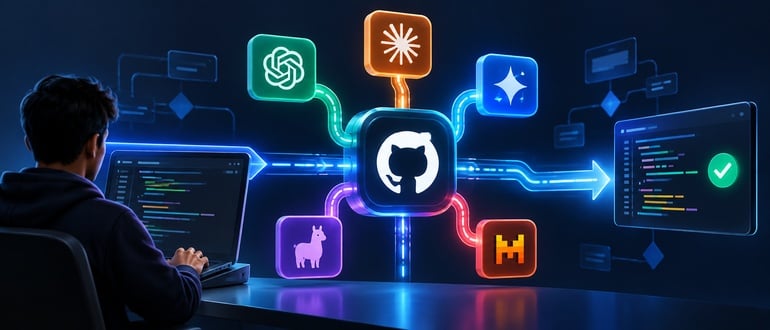
GitHub believes it has engineered a way out of this paradigm. The company recently introduced Project HydraFusion, a research preview integrated directly into GitHub Copilot. Instead of forcing developers to weigh the trade-offs of speed, capability, and cost for every single prompt, HydraFusion evaluates incoming requests dynamically, selects the optimal AI model or models, and constructs an automated execution workflow entirely on its own.
By treating model selection as an algorithmic optimization problem rather than a matter of developer intuition, HydraFusion points toward a major shift in how engineering organizations will manage, govern, and budget for generative AI tools. As agentic systems take over multi-step workflows, the infrastructure that routes tasks between models may ultimately matter far more than any single frontier model itself.
Detailed Chronology: The Evolution from Manual Selection to Agentic Orchestration
To understand why Project HydraFusion represents a significant milestone, it is necessary to examine how developers have interacted with AI coding tools over successive generations.
Phase 1: Single-Model Dependence (2022–2023)
In the early days of generative AI coding assistants, platforms typically offered a single model integrated into an IDE extension. Developers had virtually no choice; whatever model powered the extension handled every task, from auto-completing a variable name to attempting complex architectural refactoring. This approach suffered from glaring performance disparities. The model was often either too slow and expensive for trivial edits, or insufficiently intelligent for deep debugging tasks.
Phase 2: The Multi-Model Menu (2024–2025)
As the AI ecosystem exploded with open-source and proprietary alternatives—ranging from ultra-fast edge models to heavyweight reasoning engines—platforms pivoted toward a "menu" approach. Developers were given dropdown menus or command-line toggles allowing them to switch between models manually. While this provided flexibility, it introduced a new friction point: context fragmentation and decision fatigue. Developers found themselves constantly second-guessing whether they were using the most cost-effective and capable model for the task at hand.
Phase 3: Automated Orchestration and HydraFusion (Present)
Project HydraFusion represents the transition from a human-managed menu to automated, system-level orchestration. Rather than treating models as isolated silos, HydraFusion views them as interchangeable components of a flexible pipeline.
When a developer submits a prompt or task within GitHub Copilot, HydraFusion intercepts the request and extracts specific capability signals:
- Reasoning demands: Does the task require deep logical deduction, mathematical modeling, or architectural planning?
- Code-generation complexity: Is the output a simple script, or does it require modifying cross-file dependencies and imports?
- Debugging depth: Does the prompt involve analyzing stack traces, profiling memory leaks, or resolving concurrency bugs?
- Tool use: Does the model need to invoke terminal commands, search documentation, or query internal APIs?
Based on these signals, HydraFusion selects the least complex execution pattern capable of delivering a reliable result. The system relies on three distinct execution archetypes:
- Single Mode: The request is routed to a single, appropriately sized model that handles the task outright from generation to completion.
- Cascade Mode: An efficient, highly optimized, and inexpensive model drafts an initial solution. The system evaluates the output against an automated quality gate. If the draft fails to meet the threshold, the task is automatically escalated to a stronger, more expensive frontier model.
- Critique Mode: A primary model drafts the response, after which a second, independent model reviews the code for logic flaws, security vulnerabilities, or edge cases. The original model then performs a single, targeted revision based on that architectural feedback.
By automating this selection process, GitHub is shifting the responsibility of cost and performance optimization away from the individual developer and embedding it directly into the development infrastructure.
Supporting Context & Metrics: Balancing Accuracy and Cost
For platform engineering and FinOps teams, the most compelling aspect of Project HydraFusion is not just its architectural elegance, but its explicit focus on cost control. In an enterprise environment where AI token consumption can quickly scale into a significant line item, defaulting every query to the largest, most expensive model is financially unsustainable.
GitHub’s early benchmark data reveals that automated orchestration can achieve superior performance while slashing inference costs dramatically. Evaluated against industry benchmarks like Claude Opus 5 and GPT-5.6 Sol (both tested at medium reasoning levels), HydraFusion demonstrated striking efficiency:
- TerminalBench 2.1: HydraFusion delivered a 4.9 percentage-point quality improvement over Claude Opus 5, while operating at an estimated 67% lower cost.
- CheckpointBench: The system cut inference costs by 65% while holding code quality virtually flat, recording a negligible dip of just 0.1 points.
- DeepSWE: The efficiency gains were narrower, cutting costs by 36% alongside a minor 1.5-point quality dip.
These figures illustrate the core thesis behind HydraFusion: by reserving heavy-duty reasoning models exclusively for tasks that genuinely require them—and relying on cascading or single efficient models for routine operations—organizations can achieve frontier-level output without paying a frontier-level premium across the board.
However, GitHub is careful to frame HydraFusion as a research preview. Real-world codebases are messier, more modular, and more idiosyncratic than standardized benchmarks. Whether these exact cost-to-performance ratios will hold across diverse enterprise codebases remains to be seen.
Official Statements and Industry Perspectives
The introduction of HydraFusion reflects a broader, industry-wide transition in how software engineering leaders view artificial intelligence. The conversation has moved firmly past simple code completion and into the realm of autonomous agents.
Mitch Ashley, Vice President and Practice Lead for CIO & Technology Buyers and Software Lifecycle Engineering at The Futurum Group, has closely tracked this evolution. Discussing the rise of agentic development tools, Ashley noted:
"This new wave of agentic AI development tools represents a shift from AI-augmented tools, which support developers in writing code, to agentic AI, which actively performs multi-step development tasks."
Project HydraFusion serves as a literal manifestation of that transition. The orchestration decisions, the escalation pathways, and the automated critique loops require zero active steering from the human developer.
Early internal testing yields similarly bullish observations. A Microsoft principal software engineer participating in the private evaluation noted: "So far, the reasoning and task-solving capability [of HydraFusion] is at or better than Opus." While such endorsements reflect a single internal viewpoint rather than a universal industry verdict, they signal that multi-model orchestration can match or exceed the output quality of standalone flagship models.
Future Outlook: Infrastructure, Governance, and Control
As Project HydraFusion and similar orchestration layers mature from research previews into generally available enterprise features, they will introduce significant operational considerations for DevOps and platform engineering teams.
1. From Feature to Infrastructure
Historically, AI assistants have been treated as peripheral productivity add-ons. An orchestration layer that dynamically routes production code through varying models, however, functions much more like core enterprise infrastructure. This transformation brings immediate governance questions:
- Cost Governance: Finance teams will need granular visibility into how often tasks escalate to expensive frontier models versus cheap single-mode models.
- Security & Compliance: Enterprises require strict audit trails. Security teams will need to know which models touched specific segments of proprietary source code, particularly in regulated industries like finance, healthcare, and defense.
2. The Demand for Explainable Orchestration
While automation removes the cognitive load of manual routing, it risks creating a "black box" problem. If an automated cascade or critique loop generates flawed code or introduces a subtle bug, engineering teams will demand visibility into the decision-making process.
Platform teams will require answers to specific questions during incident reviews or compliance audits:
- Which model drafted the initial code?
- Which independent model performed the critique?
- What specific capability signals triggered an escalation to an expensive frontier model?
Trust in agentic development systems will ultimately depend on transparent observability. Developers and managers alike will want to inspect how the orchestration layer decided to act, not just review the resulting pull request.
Conclusion
Project HydraFusion is an important signpost for the future of software development. By treating model selection as an algorithmic optimization problem rather than a manual developer chore, GitHub is addressing one of the most persistent friction points in modern AI tooling.
While the system is still in its early research phases, the foundational philosophy is clear: the most effective use of artificial intelligence in software engineering is not finding a single model to rule them all, but intelligently orchestrating a heterogeneous fleet of models to work in concert. As agentic tools take on deeper, multi-step development duties, the orchestration layer managing them will inevitably become just as critical as the models themselves.