







Executive Overview
The global broadcast and media industries are navigating one of the most complex transitional phases in their history. As audiences demand pristine Ultra High Definition (UHD) High Dynamic Range (HDR) content, broadcasters find themselves caught in a multi-front technological migration. They must simultaneously manage the transition from High Definition (HD) to UHD, shift from legacy Serial Digital Interface (SDI) infrastructures to IP-based SMPTE ST 2110 networks, and balance on-premises hardware with cloud-native software-defined architectures.
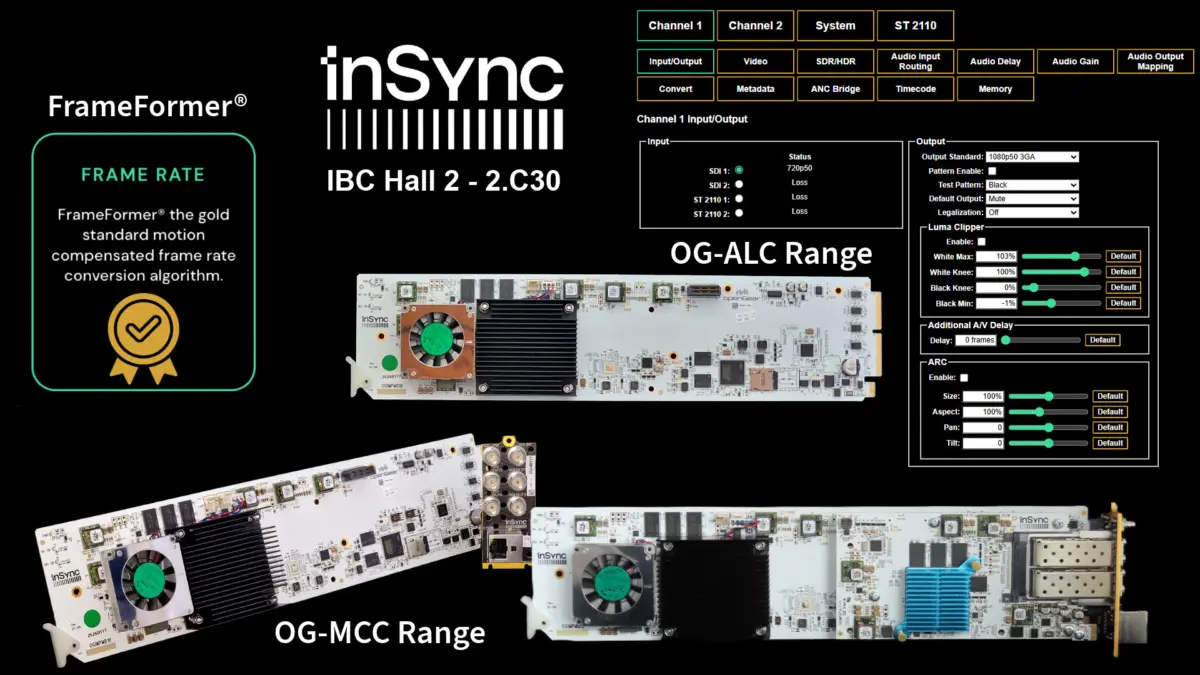
At the upcoming IBC2026 exhibition in Amsterdam, InSync Technology will address these pressing challenges. Located in Hall 2, Booth 2.C30, the company is set to showcase a comprehensive suite of hardware and software solutions designed to bridge the gaps between disparate broadcast formats, signal types, and delivery networks.
By introducing UHD capabilities to its highly regarded openGear Modular Camera Converter (MCC) and Adaptive Linear Converter (ALC) ranges, alongside a newly tiered software-defined FrameFormer SDK, InSync is targeting the critical point of conversion. These solutions enable broadcasters to maintain high-quality video standards, preserve creative intent, and achieve operational efficiency without requiring a complete, cost-prohibitive overhaul of their existing infrastructure.
Detailed Technical Breakdown: InSync’s Next-Generation Conversion Portfolio
The core of InSync’s showcase at IBC2026 lies in the expansion of its openGear-compatible modular cards. By leveraging the open-standard openGear platform, InSync provides high-density, hot-swappable processing modules that integrate seamlessly into existing terminal equipment frames.
                  +--------------------------------------------------+
                  |               InSync openGear 2RU Frame          |
                  |  +--------------------------------------------+  |
                  |  |  Processing Modules (Up to 10 or 20 Cards)  |  |
                  |  |  [OG-MCC11] [OG-MCC21] [OG-ALC10] [OG-ALC20] |  |
                  |  +--------------------------------------------+  |
                  +------------------------+-------------------------+
                                           |
                  +------------------------v-------------------------+
                  |              Dual-Path Signal Processing         |
                  |  - Motion-Compensated Frame Rate Conversion     |
                  |  - UHD-to-HD Downconversion & Scaling            |
                  |  - Hybrid SDI (12G/3G) & IP (ST 2110) Routing    |
                  +--------------------------------------------------+
The OG-MCC Range: High-Fidelity UHD Downconversion and Motion Compensation
The transition to UHD production often outpaces the transmission capabilities of traditional distribution networks. To resolve this discrepancy, InSync is introducing the OG-MCC11 and OG-MCC21 modules. These cards combine high-quality downconversion with advanced motion-compensated frame rate conversion within a single openGear slot.
OG-MCC11: High-Density SDI UHD Downconverter
The OG-MCC11 is engineered specifically for SDI-centric environments, providing a bridge for high-end UHD content to be distributed over existing 3G/HD infrastructures.
- Channel Density: It can process up to ten independent channels of UHD-to-HD conversion within a standard 2RU openGear frame, offering an exceptionally small physical footprint for Master Control Rooms (MCRs) and Outside Broadcast (OB) vans.
- Format Flexibility: The card converts UHD source formats down to 1080p, 1080i, or 720p.
- Motion-Compensated Frame Rate Conversion: Crucially, the module performs real-time motion-compensated frame rate conversion between 23.98Hz and 60Hz. By calculating motion vectors on a pixel-by-pixel basis, the OG-MCC11 eliminates the judder, ghosting, and motion artifacts commonly associated with simpler linear conversions. This makes it ideal for fast-paced international sports programming and live news exchange.
OG-MCC21: The Hybrid SDI & IP Bridge
For facilities migrating toward IP-centric workflows, the OG-MCC21 extends the capabilities of the OG-MCC11 into hybrid and pure IP environments.
- Connectivity: The card supports traditional HD/3G-SDI alongside ST 2110 10/25GbE IP connectivity directly on the board.
- Integrated Gateway Functionality: By combining UHD downconversion, frame rate conversion, and SDI/IP gateway capabilities onto a single card, the OG-MCC21 removes the need for separate, costly external gateway equipment. This reduces latency, simplifies cabling, and lowers the overall cost of ownership.
- Standards Compliance: It features comprehensive support for 12G, 6G, 3G, and HD-SDI, alongside SMPTE ST 2110, ST 2022-7 (Seamless Protection Switching for hitless IP failover), Precision Time Protocol (PTP IEEE 1588), Forward Error Correction (FEC), and NMOS (IS-04/IS-05) for automated discovery and connection management.
The OG-ALC Range: Cost-Effective Linear Conversion and Density
While motion-compensated conversion is necessary for high-motion content, many broadcast workflows—such as talk shows, studio productions, and secondary distribution feeds—can be served efficiently using high-quality linear conversion. InSync’s OG-ALC10 and OG-ALC20 modules are designed to address these high-density, cost-sensitive requirements.
OG-ALC10: Dual-Channel 3G-SDI Linear Converter
- High Density: The OG-ALC10 is a dual-channel module, allowing up to 20 independent processing channels to be housed within a single 2RU openGear chassis.
- Processing Capabilities: It provides linear frame rate conversion, interlacing, de-interlacing, and high-quality scaling for 720p, 1080p, and 1080i signals. This high-density processing makes it an ideal workhorse card for multi-feed regional distribution centers.
OG-ALC20: Dual-Hybrid Linear Converter & Processor
- IP Migration: The OG-ALC20 adds hybrid SDI and SMPTE ST 2110 IP connectivity to the linear conversion range.
- Independent Dual-Path Processing: With two entirely independent video and audio processing channels per card, the OG-ALC20 allows broadcasters to mix and match inputs and outputs across SDI and IP domains, maximizing rack-space efficiency and lowering power-consumption metrics per channel.
Supporting Context & Industry Metrics: The Reality of Hybrid Workflows
The broadcast engineering landscape in 2026 is defined by pragmatism. While the industry has long championed the wholesale transition to SMPTE ST 2110 IP networks, the reality on the ground is highly fragmented.
According to recent industry surveys, over 65% of mid-tier to major broadcasters still operate "hybrid" facilities, where legacy HD-SDI routers sit alongside newly deployed IP cores. Upgrading an entire facility to native ST 2110 requires massive capital expenditure (CapEx), specialized engineering expertise, and significant network design considerations.
Furthermore, the coexistence of UHD and HD standards remains a operational challenge:
| Parameter | UHD (2160p) | HD (1080p) | HD (1080i/720p) |
|---|---|---|---|
| Uncompressed Bandwidth | ~12 Gbps | ~3 Gbps | ~1.5 Gbps / 270 Mbps |
| Primary Distribution Method | IP / Fiber / SRT | Satellite / Cable / IP | Terrestrial / Legacy Cable |
| Primary Challenge | High Bandwidth, High Cost | Compression & Latency | Bandwidth Limitations, Aliasing |
| Conversion Requirement | Downconversion to HD | Frame Rate Alignment | De-interlacing & Scaling |
Because the majority of consumer delivery endpoints still rely on HD (SDR or HDR), high-fidelity downconversion is a critical link in the broadcast chain. If a broadcaster captures a live event in UHD but downconverts it using sub-standard algorithms, the resulting HD feed can suffer from aliasing, soft images, or motion judder, compromising the viewing experience for the majority of their audience.
By integrating high-quality downconversion with frame rate conversion on a single, high-density modular card, InSync directly addresses the physical and financial constraints of modern broadcast facilities.
Reducing the equipment footprint from multiple discrete 1RU units to a few shared slots in an openGear frame yields tangible savings in power, cooling, and rack space—metrics that are increasingly scrutinized as broadcasters push for greener, more sustainable operations.
Official Statements and Industry Impact
Reflecting on the industry’s current evolutionary state, James Taylor, CEO of InSync Technology, emphasized the necessity of supporting diverse, coexisting technologies:
"The broadcast industry is not moving from one technology generation to another overnight. New workflows are being adopted alongside established formats and media infrastructures that remain essential to global content delivery. At InSync, we are enabling our customers to respond to this constant change, while continuing to deliver the exceptional quality, reliability, and interoperability their workflows demand."
Taylor’s statement underscores a major shift in the vendor-broadcaster relationship. Rather than forcing clients into a premature technology refresh, technology providers must design agile, bridge-building solutions. By offering hardware that supports both 12G-SDI and ST 2110 IP on the same module, InSync provides a migration path that allows broadcasters to transition to IP at their own pace, protecting their initial capital investments.
Future Outlook: Software-Defined Workflows and Strategic Partnerships
Beyond hardware, the future of broadcast infrastructure is increasingly software-defined. At IBC2026, InSync will demonstrate how its core conversion algorithms are being decoupled from dedicated hardware to run on virtualized, cloud-native, and edge-compute environments.
The Tiered FrameFormer SDK
At the center of InSync’s software strategy is the FrameFormer motion-compensated frame rate conversion technology. To cater to a wider variety of use cases and budget levels, InSync has structured its FrameFormer Software Development Kit (SDK) into three distinct, tiered packages:
                  +--------------------------------------------+
                  |             FrameFormer SDK                |
                  +---------------------+----------------------+
                                        |
         +------------------------------+------------------------------+
         |                              |                              |
+--------v--------+            +--------v--------+            +--------v--------+
|  Base Package   |            |   Performance   |            | Premium Package |
|  - Standard motion  |        |  - Balanced speed/  |        |  - Maximum precision|
|    handling     |            |    quality ratio    |        |  - Complex vector   |
|  - Offline / non-   |        |  - Real-time cloud  |        |    estimation       |
|    critical files |          |    workflows        |        |  - Premium live     |
+-----------------+            +-----------------+            |    sports & UHD     |
+-----------------+- Premium: Designed for high-end live sports and premium UHD movie distribution, offering the highest-precision motion-vector estimation and image-processing algorithms.
- Performance: Optimized for real-time cloud and edge processing, balancing high visual quality with lower CPU/GPU resource utilization.
- Base: Suitable for standard file-based conversion workflows where extreme motion compensation is not required, providing a cost-effective entry point for regional and local broadcasters.
This tiered approach allows software developers, cloud playout providers, and system integrators to select and pay for only the level of processing power required for their specific applications.
Key Partnerships: Reuters News Agency and TVU Networks
InSync’s presence at IBC2026 will also highlight its deep integration within the wider media ecosystem. The company will showcase its active partnerships with Reuters News Agency and TVU Networks.
In global newsgathering, content is ingested from an array of disparate sources—ranging from professional broadcast cameras operating at 50Hz to user-generated mobile video filmed at variable frame rates.
By integrating InSync’s FrameFormer technology directly into TVU’s cloud-based distribution platforms and Reuters’ global news dissemination pipelines, these organizations can automatically and transparently normalize incoming video feeds to standard broadcast formats in real-time. This ensures that breaking news can be delivered to global affiliates instantly, without manual conversion bottlenecks or visual degradation.
Conclusion
As broadcasters navigate the complex transition between legacy systems and next-generation IP and cloud workflows, InSync Technology’s offerings at IBC2026 present a practical, high-performance path forward.
By delivering high-density, hybrid hardware solutions like the OG-MCC and OG-ALC ranges, alongside flexible, software-defined tools like the tiered FrameFormer SDK, InSync ensures that quality and interoperability remain at the forefront of modern broadcast workflows. Visitors to Amsterdam can experience these innovations firsthand at Hall 2, Booth 2.C30.