Executive Overview
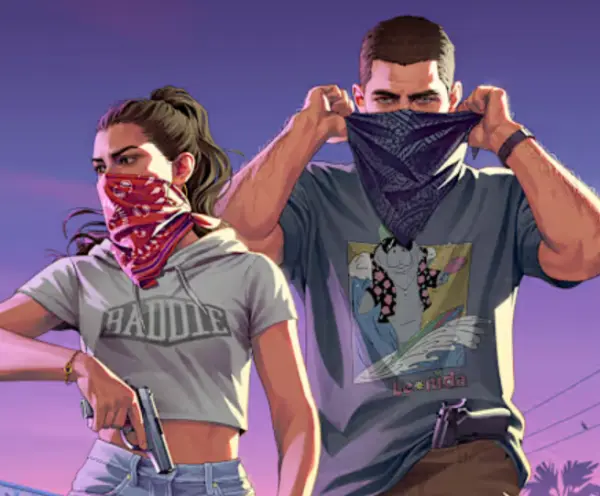
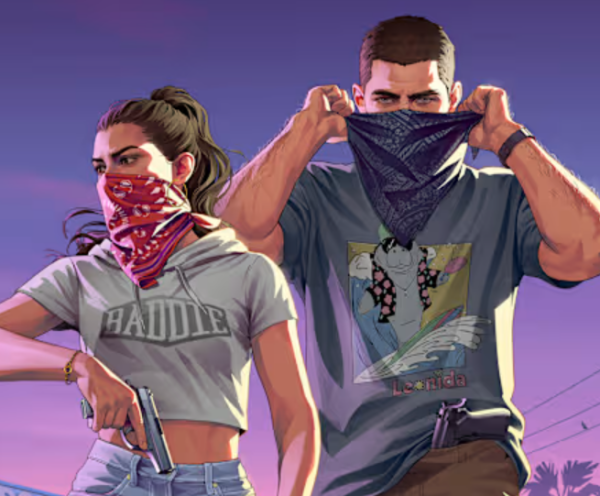
As the gaming industry approaches one of the most commercially significant and intensely anticipated releases in its history—Rockstar Games’ Grand Theft Auto VI—the title has found itself the target of illicit exposure. Scheduled for an official rollout this coming fall, GTA VI has been guarded with a level of corporate security and marketing secrecy befitting a multi-billion-dollar entertainment property. Rockstar Games and its parent company, Take-Two Interactive, have deliberately maintained a tightly controlled pipeline of promotional material, including a heavily anticipated "Extended Look" gameplay premiere slated to debut on Netflix later this month.
However, the fortress of corporate confidentiality suffered a breach on August 18, when an anonymous entity operating under the moniker "Cyberleek" disseminated unreleased, proprietary gameplay footage across multiple online platforms. The leaked clips went viral within hours, generating millions of views across social media channels despite an aggressive, continuous wave of automated and manual copyright takedown notices issued by Take-Two’s legal representatives.
What followed was not merely a standard exercise in digital content scrubbing, but a massive legal offensive. Take-Two launched a sweeping multi-pronged judicial campaign in the U.S. District Court for the Southern District of New York, utilizing Section 512(h) of the Digital Millennium Copyright Act (DMCA). The publisher filed applications for sweeping subpoenas targeting major technology and communication giants—including Discord, Microsoft, X Corp. (formerly Twitter), and Google/YouTube.
At the center of this legal battle is a profound tension between copyright enforcement and digital privacy rights. Take-Two’s aggressive subpoenas have sparked widespread concern among legal scholars, privacy advocates, and gaming communities alike. Notably, the Discord subpoena casts an extraordinarily wide net, demanding identifying data not just for suspected leakers, but for every single user who communicated within designated community servers over a multi-month period. This article provides an in-depth, investigative analysis of the GTA VI leak fallout, the mechanics of the DMCA subpoenas, the cryptographic promotional stunts attached to the leaks, and the broader implications for digital privacy in the age of high-stakes software development.
Detailed Chronology of the Leak and Legal Escalation
To understand the scale of Take-Two’s current legal counter-offensive, it is necessary to chart the precise sequence of events that transformed a routine internet leak into a federal court proceeding.

August 18: The "Cyberleek" Drop and Crypto-Promotion
On August 18, internet users across various gaming forums and social media networks encountered freshly leaked video files showcasing early-stage or unpolished Grand Theft Auto VI gameplay. The leaks were accompanied by an ideological manifesto that sharply criticized modern gaming trends—specifically targeting the industry’s gradual pivot away from physical optical discs in favor of purely digital distribution.
Compounding the corporate headache for Rockstar Games, the leaked video assets were heavily watermarked with promotional branding for a speculative "Solana token," reading variations of "BUY $CYBERLEEK ON SOLANA." This indicated that the leak was potentially driven not just by insider malice or community clout-chasing, but by opportunistic crypto-promotional actors looking to exploit the monumental hype surrounding the franchise.
August 19–20: The First Wave of Subpoenas (Discord and Microsoft)
Recognizing the rapid proliferation of the clips, Take-Two mobilized its primary legal counsel, the prominent firm Kirkland & Ellis, to seek immediate judicial intervention. On August 19 and 20, the publisher filed applications for DMCA subpoenas in the U.S. District Court for the Southern District of New York.
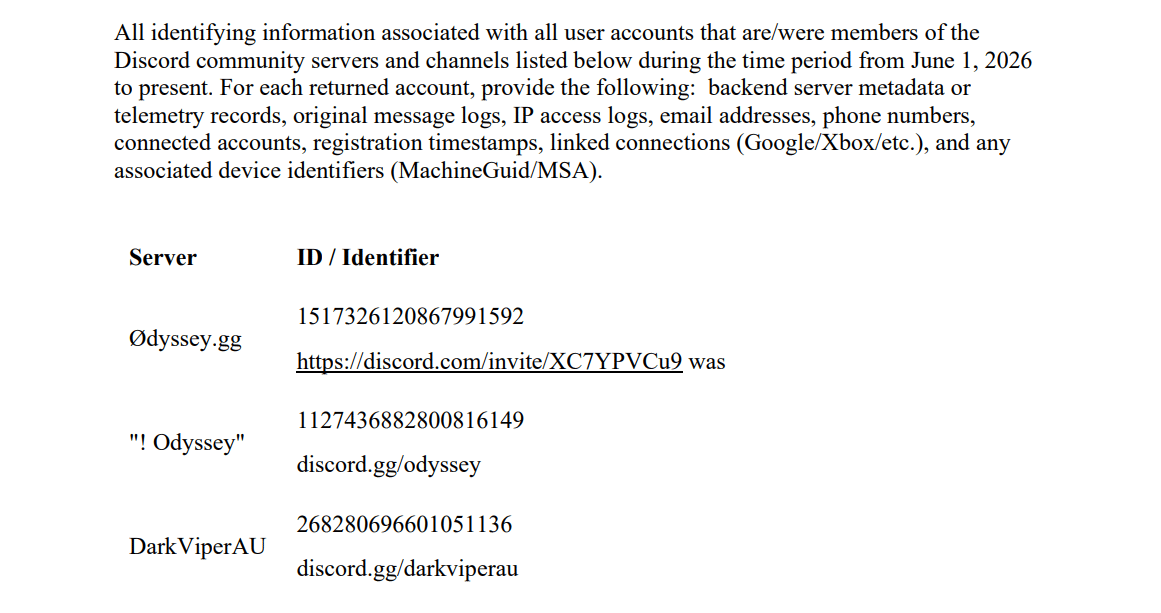
These initial filings targeted Discord and Microsoft. The Microsoft subpoena sought internal investigative logs, device identifiers, IP access logs, and OneDrive cloud content connected to the "cyberleek" handles and associated files. Simultaneously, the Discord subpoena targeted specific community servers where the leaked files had been shared or discussed. Legal watchdogs quickly noted the breathtaking breadth of the Discord request: it demanded the identification records, registration data, and communication logs of all users who had interacted within three designated Discord servers since June 1, regardless of whether those individual users had ever uploaded, shared, or even viewed the leaked content.
August 21–22: Broadening the Scope to X Corp. and Google
Realizing that the viral spread extended far beyond Discord and Microsoft ecosystems, Take-Two’s legal strategy expanded. A day after the initial filings, a secondary team of attorneys from Ruttenberg IP Law filed additional DMCA subpoena applications targeting X Corp. and Google.
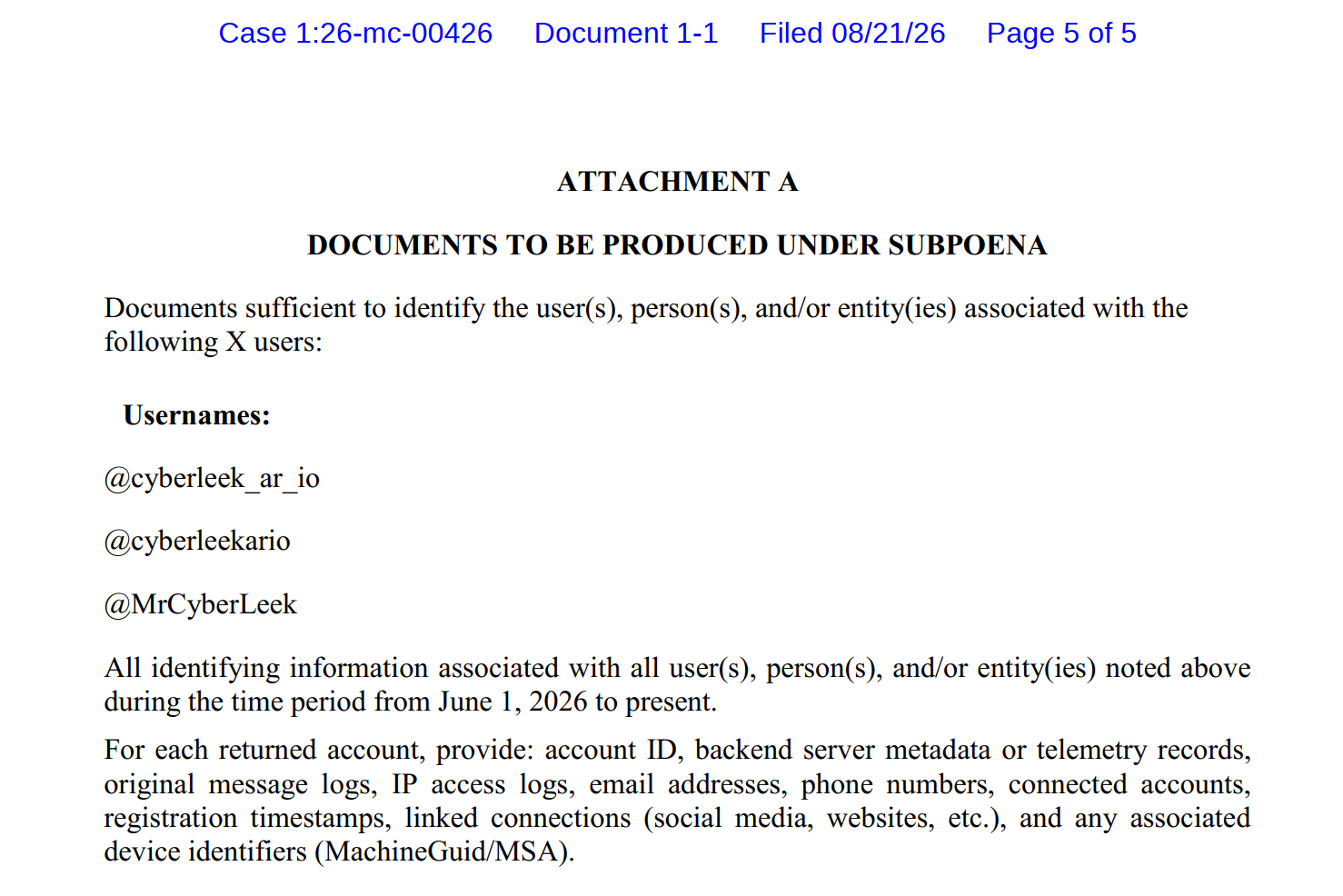
- The X (Twitter) Subpoena: This filing homed in on three specific user accounts:
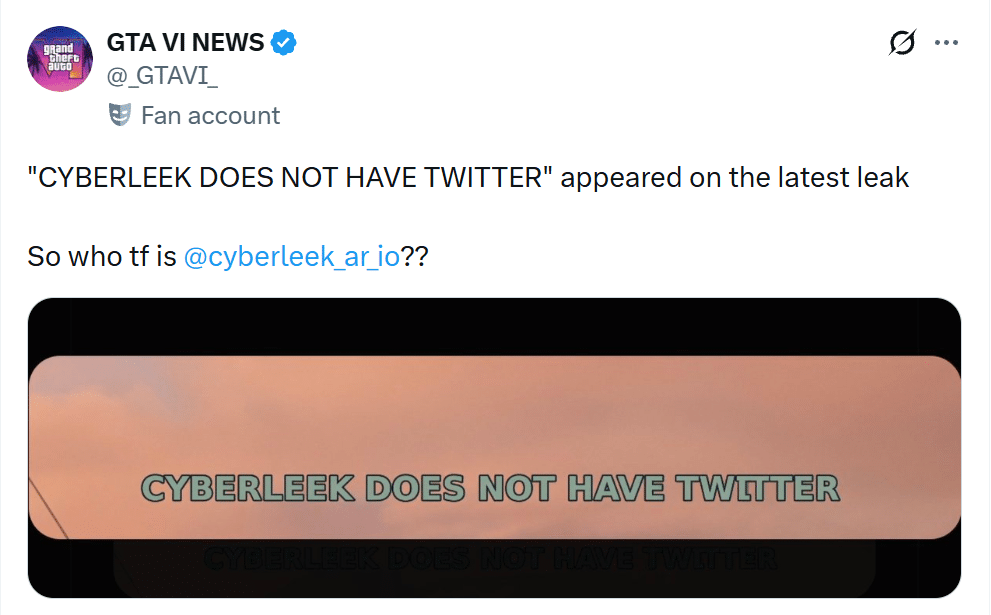
@cyberleek_ar_io,@cyberleekario, and@MrCyberLeek. For each account, Take-Two demanded account identifiers, registration emails, historical IP access logs, associated phone numbers, linked third-party accounts, and device fingerprints dating from June 1 onward. Interestingly, this move occurred even as the GTA fan community had already flagged these specific accounts as potential impostors. Furthermore, the true "Cyberleek" entity had begun watermarking subsequent videos with explicit disclaimers stating "CYBERLEEK DOES NOT HAVE TWITTER." At the time of the filings, all three targeted X accounts had already been suspended by the platform. - The Google/YouTube Subpoena: Narrower in scope than the Discord sweep, the Google application targeted a specific YouTube video identifier and three associated channels: CyberLeeks, Surfer24k, and Cyberleek_ar_io. Notably, the channel Surfer24k overlapped with the Discord servers named in the earlier Kirkland & Ellis filings. By cross-referencing records obtained from both Google and Discord for overlapping accounts, Take-Two’s investigators aimed to build a robust evidentiary bridge linking pseudonymous online handles to real-world identities.
Late August: Judicial Processing and the Service Controversy
The legal mechanics governing DMCA Section 512(h) subpoenas do not require a full civil trial or a substantive ruling on the merits of copyright infringement. Instead, they function as administrative court-issued orders compelling service providers to surrender identifying data once baseline statutory criteria are met.
Initially, court dockets showed that federal judges Andrew L. Carter Jr. and Jennifer L. Rochon had signed orders directing the court clerk to issue the subpoenas, but public docket entries did not immediately confirm execution by the clerk. This created a period of legal ambiguity regarding whether data had actually changed hands.
The narrative shifted on August 31, when Take-Two submitted a subsequent court filing asserting that the initial Discord subpoena had indeed been formally issued on August 21 and "promptly served on Discord." This assertion created a curious public contradiction: Take-Two’s legal declarations stood in direct opposition to statements made around August 24 by Discord’s marketing director, who publicly maintained that the platform had not yet been formally served. Because DMCA subpoenas can occasionally be processed and transmitted without triggering comprehensive docket updates, the exact timeline of data handoff remains a subject of ongoing scrutiny by digital rights organizations.
Supporting Context & Metrics: The Anatomy of a Leak
To appreciate the panic within Take-Two Interactive’s executive suites, one must examine the staggering commercial stakes of Grand Theft Auto VI. Its predecessor, Grand Theft Auto V, stands as one of the most profitable entertainment products in human history, generating billions of dollars in revenue and selling over 200 million copies worldwide. Every byte of GTA VI source code, design document, and gameplay rendering represents immense financial value.
Scale of the Subpoena Targets
| Target Platform | Legal Counsel | Scope of Request | Target Accounts / Entities |
|---|---|---|---|
| Discord | Kirkland & Ellis | Extremely Broad | Every user account active in three designated community servers since June 1. |
| Microsoft | Kirkland & Ellis | Targeted/Investigative | Internal cyberleek investigation logs, device IDs, IP logs, OneDrive contents. |
| X Corp. (Twitter) | Ruttenberg IP Law | Moderately Narrow | Specific handles (@cyberleek_ar_io, @cyberleekario, @MrCyberLeek). |
| Google / YouTube | Ruttenberg IP Law | Narrow | Specific video URLs and channels (CyberLeeks, Surfer24k, Cyberleek_ar_io). |
The Mechanics of DMCA Section 512(h)
Under standard U.S. civil litigation, a plaintiff must file a formal lawsuit against a "John Doe" defendant and secure court permission to issue third-party subpoenas during discovery. However, Section 512(h) of the DMCA provides an expedited statutory shortcut. It allows copyright holders to file a straightforward request for a subpoena directly with a U.S. district court clerk.
To secure this, the copyright owner must provide:
- A copy of a formal DMCA notification of claimed infringement sent to the service provider.
- A proposed subpoena directed at the service provider.
- A sworn declaration affirming that the purpose of the subpoena is exclusively to obtain the identity of an alleged infringer to protect copyright interests.
Once these conditions are satisfied, the clerk is statutorily required to issue the subpoena, empowering the copyright holder to demand subscriber information without filing an actual lawsuit.
However, this mechanism was originally designed for peer-to-peer networks (such as BitTorrent file-sharing swarms) where individual uploaders could be isolated via IP addresses. Applying Section 512(h) to modern chat platforms like Discord—where thousands of innocent users converse in multi-user channels that happen to contain leaked material—stretches the statutory language to its absolute limits, drawing sharp criticism from civil liberties experts.
Official Statements and Industry Reactions
As the legal documents circulated through tech and gaming news outlets, reactions from industry insiders, legal analysts, and platform representatives highlighted the contentious nature of Take-Two’s dragnet.
Take-Two’s Legal Justification
In their court filings, attorneys representing Take-Two Interactive maintained a rigid, unyielding stance regarding intellectual property protection. Counsel formally declared that the sole purpose of the subpoenas is:
“…to obtain the identity of an alleged infringer or infringers, and that such information will only be used for the purpose of protecting Take-Two’s rights.”
While corporate communications from Rockstar Games and Take-Two have remained publicly silent regarding the specifics of the ongoing investigation, the aggressive legal posture signals that the company is prepared to pursue civil litigation—and potentially coordinate with criminal law enforcement authorities—against anyone determined to have stolen or distributed proprietary development builds.
The Discord Community and Platform Pushback
The gaming community reacted with alarm to the breadth of the Discord subpoena. Legal commentators, including tech journalists from Tom’s Hardware and Kotaku, pointed out that sweeping up the identifying information of every user in targeted servers creates a dangerous precedent.
In digital privacy terms, this constitutes a digital "fishing expedition." Many users who joined these servers did so for general gaming discussions, news updates, or socializing, having never downloaded, viewed, or redistributed the leaked GTA VI clips. Compelling Discord to surrender personal data, email addresses, and connection logs for thousands of uninvolved citizens has drawn comparisons to unconstitutional general warrants of the pre-digital era.
Furthermore, public statements from platform representatives—such as Discord’s marketing leadership expressing bewilderment over service claims—hint at institutional friction between tech platforms tasked with user privacy preservation and aggressive corporate copyright holders armed with statutory legal tools.
Future Outlook: Legal Precedents and the Road to Release
As the autumn launch window for Grand Theft Auto VI rapidly approaches, the legal battle playing out in the Southern District of New York serves as a bellwether for how massive media conglomerates will handle digital leaks in the era of decentralized social media and cryptocurrency-incentivized trolling.
Motions to Quash and Privacy Challenges
Legal experts anticipate that the targets of these subpoenas—or the technology platforms themselves—may fight back. Service providers and privacy advocacy organizations (such as the Electronic Frontier Foundation) frequently challenge DMCA subpoenas that cross the line from targeted enforcement into overbroad surveillance.
Furthermore, individual users whose personal data is swept up in the Discord or Microsoft dragnets retain the legal right to file motions to quash in federal court. If a judge determines that Take-Two’s requests violate the statutory boundaries of Section 512(h)—specifically by demanding records of non-infringing third parties—portions of the subpoenas could be set aside, or the gathered data ordered destroyed.
The Broader Impact on Software Development Security
Beyond the courtroom drama, the Cyberleek incident underscores the extreme vulnerability of modern game development pipelines. With hundreds of remote developers, contractors, and QA testers collaborating across global networks, absolute corporate lockdown is virtually impossible.
For Take-Two Interactive, the immediate objective remains singular: identify the leak’s origin, silence unauthorized distribution channels, and ensure that the official rollout of Grand Theft Auto VI maintains maximum commercial momentum. Whether the publisher’s aggressive judicial dragnet successfully unmasks the true culprits or simply alienates segments of its loyal player base remains one of the most compelling subplots of the 2026 gaming calendar. As the courts evaluate the legality of these sweeping subpoenas, the outcome will undoubtedly shape the legal boundaries of digital copyright enforcement for years to come.