





Executive Overview
In the high-pressure arena of live broadcast, arena-scale entertainment, and complex commercial AV installations, the boundary between an flawless, immersive presentation and a catastrophic technical failure is razor-thin. Technical directors and systems integrators operate in an environment where a single dropped packet, a microsecond of latency, or a degraded video feed can derail a multi-million-dollar production. As resolutions push past 4K and routing requirements grow to encompass hundreds of endpoints, traditional point-to-point copper architectures are collapsing under their own physical and financial weight.
To survive in this landscape, modern media environments require an infrastructure that is both bulletproof and infinitely scalable. This operational demand has driven a industry-wide migration toward AV over IP (Audio-Visual over Internet Protocol) technologies. At the forefront of this paradigm shift is MuxLab, a pioneer in signal distribution solutions.
Distributed through Pacific Radio Electronics (PacRad), a trusted partner for broadcast and AV professionals, MuxLab’s suite of AV over IP hardware, signal extenders, and matrix solutions serves as the quiet, robust backbone of modern control rooms, live venues, and corporate enterprises. This report explores how MuxLab’s technology addresses the critical bottlenecks of signal distribution, workstation virtualization, and unified system control, signaling a new era of software-defined media routing.
Detailed Chronology: The Evolution of Signal Distribution
To understand the disruptive nature of MuxLab’s AV over IP ecosystem, it is necessary to trace the technological timeline of signal routing in professional environments. The industry’s evolution over the past three decades reveals a steady march toward convergence, flexibility, and the elimination of physical distance barriers.
+-----------------------------------------------------------------------------+
|                                 TIMELINE                                    |
+-----------------------------------------------------------------------------+
|                                                                             |
|  [Late 1990s - Early 2000s]                                                 |
|  The Analog & Early Digital Era                                             |
|  * Heavy, expensive point-to-point coaxial and SDI cabling.                 |
|  * Rapid signal degradation over long distances.                            |
|  * High physical footprint and zero routing flexibility.                    |
|                                                                             |
|  [2010s]                                                                    |
|  The Hardware Matrix Switcher Era                                           |
|  * Fixed-I/O hardware frames (e.g., 16x16, 32x32).                          |
|  * Extremely high capital expenditure for proprietary hardware.              |
|  * Scalability bottlenecks; expansion required replacing entire frames.     |
|                                                                             |
|  [Mid-2010s - Present]                                                      |
|  The AV over IP Revolution                                                  |
|  * Shift to standard, off-the-shelf Ethernet switches and Cat5e/6 cabling.  |
|  * Decentralized architectures replacing centralized hardware matrices.     |
|  * Software-defined routing allows infinite, modular expansion.             |
|                                                                             |
|  [The Next Frontier]                                                        |
|  Unified Convergence                                                        |
|  * Integration of 4K video, multi-channel audio, KVM, and control (RS-232). |
|  * Power over Ethernet (PoE) eliminates localized power infrastructure.     |
|  * Virtualized control rooms and remote broadcast workflows.                |
+-----------------------------------------------------------------------------+
Phase 1: The Analog and Early Digital Era (Late 1990s – Early 2000s)
In the early days of professional video distribution, routing was defined by dedicated, heavy, and expensive coaxial and SDI (Serial Digital Interface) cabling. Every source required a physical, point-to-point run to its destination. Signal degradation over long distances was a constant battle, requiring inline amplifiers, re-clockers, and bulky patch bays. System flexibility was virtually non-existent; rerouting a feed meant manually unplugging and running new physical lines, creating immense labor costs and sprawling, heavy cable runs in broadcast trucks and facilities.
Phase 2: The Hardware Matrix Switcher Era (2010s)
The introduction of digital video standards like HDMI and DVI brought higher resolutions but introduced severe distance limitations (often capped at 15 to 30 feet without active extension). To manage this, the industry turned to centralized hardware matrix switchers. While these devices allowed digital routing via remote control, they were bound by rigid physical frames (e.g., 8×8, 16×16, or 32×32 ports). If a production outgrew its 32-port matrix by a single input, the facility was forced to purchase an expensive 64-port frame, leading to massive capital expenditure bottlenecks and wasted capacity.
Phase 3: The AV over IP Revolution (Mid-2010s – Present)
The current era is defined by the convergence of AV and IT. By packetizing audio, video, and control data, AV over IP allows standard, off-the-shelf Ethernet switches to replace proprietary hardware matrix switchers. This transition has democratized signal routing, replacing costly proprietary copper infrastructures with standard Cat5e/Cat6 cabling. MuxLab emerged as an early champion of this transition, developing transmitters and receivers that convert high-bandwidth HDMI and SDI signals into IP packets that can be routed, split, and managed using standard network protocols.
Phase 4: Unified Convergence (The Next Frontier)
Today, signal distribution is no longer just about moving video from Point A to Point B. Modern workflows demand the simultaneous transmission of visually lossless 4K video, multi-channel digital audio, high-speed USB for Keyboard-Video-Mouse (KVM) control, and serial commands (RS-232/IR) over a single network cable. Through its partnership with PacRad, MuxLab has made this unified, converged network architecture accessible to production teams of all scales, turning what was once a highly complex engineering challenge into a plug-and-play reality.
Technical Analysis: Supporting Context & Performance Metrics
MuxLab’s market success is anchored in its rigorous engineering standards. To understand why broadcast engineers and AV integrators rely on these devices, we must examine the technical parameters and performance metrics of their flagship product lines.
AV over IP and the Power of Scalability
Traditional HDBaseT and point-to-point extenders, while reliable, cannot scale dynamically. MuxLab’s AV over IP products, such as the MuxLab HDMI over IP PoE Transmitter (Model 500759-TX), break these physical limits by operating over standard Gigabit Ethernet local area networks (LANs).
| Technical Parameter | Specification / Metric |
|---|---|
| Video Resolution | Up to 4K @ 30Hz (4:4:4) or 4K @ 60Hz (4:2:0) |
| Transmission Distance | 330 feet (100 meters) over Cat5e/6; infinite via network switches |
| Bandwidth Consumption | Dynamic compression, typically averaging 15 to 40 Mbps per stream |
| Latency | Sub-frame latency (typically < 1 frame, ~33ms), imperceptible to human operators |
| Network Protocol | Multicast/Unicast via IGMP (Internet Group Management Protocol) |
| Power Supply | Power over Ethernet (PoE) IEEE 802.3af |
By utilizing IGMP snooping on Layer 2 or Layer 3 network switches, MuxLab transmitters can broadcast a single video feed to hundreds of receivers simultaneously without flooding the network. This multicast efficiency is critical for multi-display video walls, overflow rooms, and massive digital signage arrays.
       +----------------------------+
       |   HDMI Source (Camera/PC)  |
       +--------------+-------------+
                      |
                      v HDMI Cable
       +--------------+-------------+
       |  MuxLab 500759-TX (PoE)    |  <-- Powered via Network Switch
       +--------------+-------------+
                      |
                      v Cat5e/6 Cable (Up to 100m)
       +--------------+-------------+
       | Standard Gigabit Ethernet  |
       |  Switch (with IGMP/PoE)    |
       +-------+--------------+-----+
               |              |
     Cat5e/6   |              |   Cat5e/6
     (To Rx 1) |              |   (To Rx 2)
               v              v
       +-------+-----+  +-----+-------+
       |  MuxLab Rx  |  |  MuxLab Rx  |
       +-------+-----+  +-----+-------+
               |              |
          HDMI |              | HDMI
               v              v
       +-------+-----+  +-----+-------+
       |  Display 1  |  |  Display 2  |
       +-------------+  +-------------+
Remote Workstation Control via KVM over IP
In modern broadcast control rooms and post-production suites, physical access to workstations is often restricted. Rendering engines, media servers, and graphics workstations are loud, generate intense heat, and represent security vulnerabilities if left in the open.
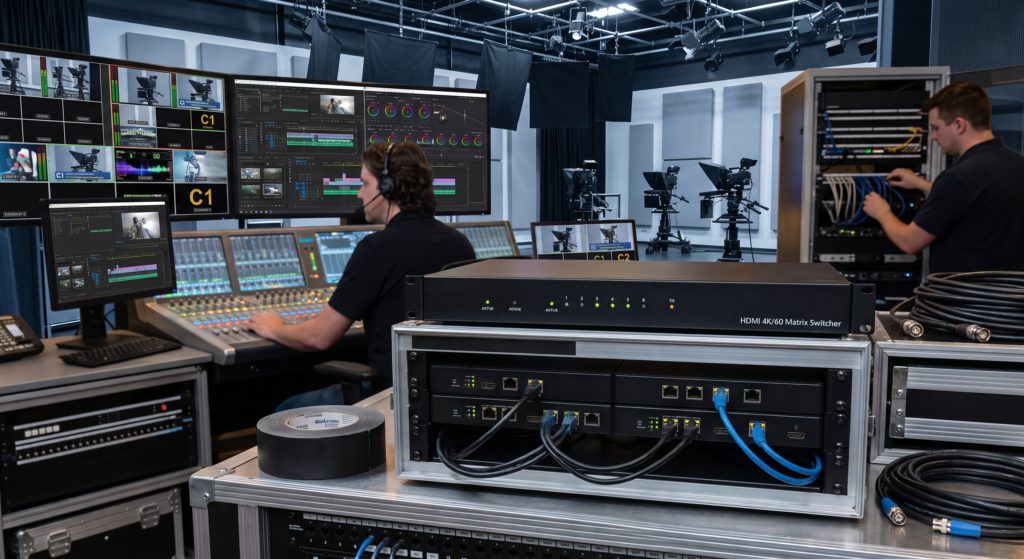
The MuxLab KVM HDMI over IP Receiver (Model 500770-RX) addresses this challenge by allowing operators to control remote servers over the network.
- Zero-Lag Input Response: For video editors and live replay operators, input lag is unacceptable. MuxLab’s KVM solution optimizes USB packet transmission alongside the video stream, delivering instantaneous mouse and keyboard tracking that mimics a direct local connection.
- Integrated USB Topology: The receiver features built-in multi-port USB hubs, supporting not just basic keyboards and mice, but also specialized control surfaces, flash drives, and security dongles.
- Improved Facility Ergonomics: By relocating loud server chassis to a centralized, climate-controlled server room, production areas become significantly quieter, cooler, and more spacious, directly improving operator focus and equipment lifespan.
Unified Control and Audio Distribution
Modern AV environments require more than just video routing; they need comprehensive device management. The MuxLab Audio/RS-232 over IP PoE Transceiver (Model 500755) acts as a multi-format bridge across local networks.
                  +-----------------------------------+
                  |  MuxLab 500755 Transceiver (PoE)  |
                  +-----------------+-----------------+
                                    |
         +--------------------------+--------------------------+
         |                          |                          |
         v                          v                          v
+--------+--------+        +--------+--------+        +--------+--------+
|  Analog Audio   |        |  Digital Audio  |        | RS-232 Control  |
|  Inputs/Outputs |        |   (Optical)     |        |   (Bi-dir)      |
+-----------------+ +-----------------+ +-----------------+- Bidirectional Audio Bridging: This transceiver simultaneously manages two-channel analog inputs and outputs alongside digital audio channels. It allows operators to extract audio from a video stream, route independent audio channels across the facility, or insert local microphone feeds into a network-wide distribution system.
- Integrated RS-232 and IR Pass-Through: Instead of running dedicated control cables to turn displays on/off or adjust camera parameters, operators can route RS-232 serial commands and Infrared (IR) signals over the exact same network infrastructure. This makes it simple to manage PTZ (Pan-Tilt-Zoom) cameras and adjust digital processors from a single control room.
Official Statements & Industry Perspectives
The practical value of MuxLab’s ecosystem is best understood through the eyes of the integration engineers and distributors who deploy these systems in high-stakes environments.
A senior systems design engineer specializing in live sports broadcasting highlights the practical advantages of transitioning to an AV over IP workflow:
"In temporary live events, every minute of setup time matters. Before we adopted MuxLab’s AV over IP gear, rigging a stadium meant running heavy, fragile SDI bundles that took hours to deploy and troubleshoot. Now, we run lightweight, inexpensive Cat6 cables. The inclusion of Power over Ethernet (PoE) on MuxLab’s transmitters and receivers is a major advantage. It eliminates dozens of local power bricks behind our monitors, cleaning up our setups and dramatically accelerating our teardown times."
The partnership between MuxLab and Pacific Radio Electronics (PacRad) plays a key role in ensuring these solutions are readily available to professionals. A technical procurement representative from PacRad discusses this synergy:
"Our broadcast and commercial AV clients don’t just buy hardware; they buy reliability. When an integration firm is building out a corporate headquarters or a live broadcast truck, they cannot afford supply chain delays or unverified compatibility. Stocking MuxLab’s full ecosystem allows us to provide complete, end-to-end signal chains. If a client needs a custom matrix that can scale from 10 to 200 screens, we can instantly supply the exact transmitters, receivers, and transceivers required, backed by the technical support that professional environments demand."
Future Outlook: The Next Frontier of AV Infrastructure
As the professional AV and broadcast industries continue to evolve, several key trends are shaping the future of signal distribution. MuxLab’s architecture is uniquely positioned to adapt to these shifts, ensuring long-term viability for facilities investing in this technology today.
1. The Transition to 10-Gigabit Networks and Beyond
While 1GbE networks remain the standard for cost-effective AV over IP deployments, the demand for uncompressed 4K at 60Hz (4:4:4) and early-stage 8K workflows is driving a migration toward 10GbE network infrastructures. MuxLab continues to expand its portfolio to support these high-bandwidth standards, ensuring that as network speeds increase, the software-defined control interfaces remain familiar and backward-compatible.
2. Standardized Interoperability (SDVoE and SMPTE ST 2110)
The future of AV over IP lies in interoperability. The industry is moving away from proprietary closed ecosystems and toward open standards like SDVoE (Software Defined Video over Ethernet) for commercial AV and SMPTE ST 2110 for high-end broadcast. MuxLab’s commitment to open standards ensures its hardware can easily integrate into broader, multi-vendor ecosystems, protecting customers from vendor lock-in.
3. AI-Driven Network Management and Diagnostics
As AV networks grow to encompass thousands of endpoints across corporate campuses and university networks, manual monitoring becomes impossible. The next generation of AV over IP systems will leverage machine learning and AI-driven diagnostics to monitor network health, predict bandwidth bottlenecks, and automatically reroute signals in the event of hardware or cable failures. MuxLab’s centralized management software is laying the groundwork for these automated, self-healing network infrastructures.
Conclusion
In an industry where signal integrity is paramount, MuxLab’s AV over IP ecosystem—supported by the distribution expertise of PacRad—provides a scalable, reliable, and high-performance alternative to traditional hardware-bound routing. By converting complex video, audio, control, and KVM signals into manageable network packets, MuxLab has transformed the way production teams approach system design, ensuring that today’s installations are fully equipped to meet the technological demands of tomorrow.