Executive Overview
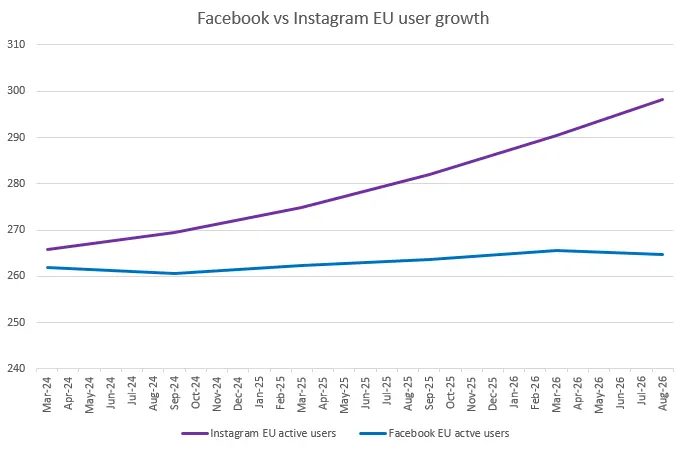
The digital landscape within the European Union is undergoing a profound structural evolution, one vividly illuminated by Meta’s latest regulatory disclosures under the European Union’s landmark Digital Services Act (DSA). Released in mid-2026, the tech giant’s biannual compliance metrics offer an unprecedented window into the shifting behavioral patterns of hundreds of millions of European internet users. At the center of this dynamic is a historic divergence between Meta’s twin pillars: while Facebook’s growth in the EU has plateaued—and in some historic periods, receded—Instagram has surged ahead with remarkable velocity, cementing its status as the undisputed flagship for consumer engagement in the region.
According to the new reporting data, Instagram commanded 297 million active users in the European Union during the first half of 2026, comfortably outstripping Facebook, which sat at 264 million active users. This thirty-three-million-user gap represents more than a simple demographic quirk; it is a clear indicator that Instagram is on a steady trajectory to eclipse the 300 million user threshold in the bloc by next year. For global brands, enterprise marketers, and digital strategists, these figures demand a recalibration of resource allocation. The data confirms that Instagram is capturing the lion’s share of European attention, driven by the explosive popularity of short-form video formats, interactive stories, and algorithmic discovery engines.
Simultaneously, Meta’s compliance report sheds light on internal operational shifts that carry massive implications for platform safety, regulatory compliance, and the future of labor in the tech sector. Most notably, the company reported a steep contraction in its human content moderation workforce across the EU, plummeting from approximately 7,700 moderators in March to roughly 5,900 by the close of the reporting period. This reduction aligns with Meta’s broader strategic pivot toward artificial intelligence-driven safety systems, sparking intense debate among civil society organizations and regulatory bodies regarding the efficacy of automated oversight. Coupled with divergent trends in content violation reports—such as rising flags for terror-related material and child exploitation on Instagram versus double-digit declines in hate speech and spam flags on Facebook—Meta’s latest transparency filing tells the story of a tech behemoth in transition.
This comprehensive report examines the multifaceted implications of Meta’s 2026 EU DSA disclosures, tracing the data chronologically, contextualizing the marketing and strategic shifts, analyzing the safety and labor dynamics, and casting a discerning eye toward the future of social media governance in Europe.
Detailed Chronology: The Regulatory Milestones and Reporting Evolution
To understand the weight of Meta’s 2026 disclosures, one must trace the regulatory apparatus that forced them into the open. The European Union’s Digital Services Act, which reached full implementation for designated Very Large Online Platforms (VLOPs) in 2023, fundamentally transformed how technology companies operate within the European market. By legally mandating biannual transparency reports detailing user counts, algorithmic architecture, and content moderation performance, the DSA stripped away the proprietary secrecy that tech conglomerates historically relied upon.
The Run-Up to 2026: Setting the Regulatory Baseline
When Meta first began publishing comprehensive user metrics under the DSA framework, the underlying narrative was already pointing toward a generational handover. Throughout 2024 and 2025, Facebook’s user metrics in the 27 EU member states exhibited classic signs of maturity: horizontal flatlining punctuated by occasional downward corrections. While Facebook remained a ubiquitous utility for communication and local community organization, it struggled to capture the imaginations and daily habits of younger digital natives, who increasingly migrated toward alternative entertainment ecosystems like TikTok, Snapchat, and, crucially, Meta’s own Instagram.
Conversely, Instagram experienced consistent, compounding growth throughout 2024 and 2025. Fueled by the global and regional dominance of Reels—Meta’s direct competitor to TikTok—and refined personalization algorithms, Instagram became the primary cultural town square for European youth and millennial demographics.
The First Half of 2026: A Definitive Crossover
The release of the H1 2026 transparency data marked a watershed moment. For the first time in a major regulatory filing, the gap between the two platforms widened into a clear chasm:
- Instagram Active Users (EU, H1 2026): 297 million
- Facebook Active Users (EU, H1 2026): 264 million
This data verified what industry analysts had long suspected: Facebook is no longer the undisputed king of active engagement in Europe. While 264 million active users remains an astonishingly massive footprint, the trajectory is decisive. While Facebook fights to retain its user base against attrition and demographic aging, Instagram is marching briskly toward the 300-million-user mark, an achievement expected to be unlocked in mid-2027.
Concurrently, Meta’s newer challenger, Threads, registered 41 million active users within the EU during this period. While this figure represents a modest fraction of Threads’ global footprint—which crossed the 500 million monthly active user milestone earlier in the year—it demonstrates steady, albeit cautious, adoption in a region characterized by rigorous privacy expectations and entrenched incumbent platforms.
Supporting Context & Metrics: Analyzing the Marketing and Behavioral Shifts
The macroeconomic and digital marketing implications of Meta’s H1 2026 report cannot be overstated. For digital marketers, brand architects, and media agencies operating within the European Union, the data serves as both a validation of current trends and a warning against complacency.
The Death of the One-Size-Fits-All Social Strategy
For over a decade, digital advertising playbooks treated Meta’s ecosystem as a monolithic entity. Advertisers routinely deployed cross-network campaigns that treated Facebook and Instagram as interchangeable delivery mechanisms for the same creative assets. The 2026 DSA metrics make this strategy obsolete.
With Instagram boasting a 33-million-user advantage in the EU, brands aiming to maximize upper-funnel reach, brand resonance, and cultural relevance must prioritize Instagram-first creative workflows. The platform’s dominance among high-value consumer demographics means that marketing budgets failing to reflect this usage reality risk diminished returns.
Facebook’s Pivot: From Universal Network to Niche Utility
Does Facebook’s plateau mean the platform is dead? Absolutely not. A network harboring 264 million active Europeans remains an economic titan. However, the nature of Facebook’s utility has fundamentally shifted.
Data indicates that while total time spent per user on Facebook has softened—superseded by TikTok, YouTube, and Instagram—the platform retains immense strength in specific verticals: local commerce (Facebook Marketplace), community-building (Groups), and older demographic connectivity. For brands targeting mature cohorts, local service providers, and community-driven commerce, Facebook remains vital. Nevertheless, its loss of generalist cultural relevance signals a broader usage shift across European society: consumers are fragmenting into specialized, entertainment-heavy feeds rather than generalized social connection hubs.
The Rise of Threads in a Skeptical Market
Threads’ accumulation of 41 million EU users warrants nuanced analysis. Launched amidst significant regulatory scrutiny regarding data interoperability and privacy under the EU’s General Data Protection Regulation (GDPR) and the Digital Markets Act (DMA), Threads’ growth in Europe has been more measured compared to its explosive global trajectory.
European consumers are notoriously discerning regarding data harvesting and platform consolidation. The fact that 41 million users have integrated Threads into their daily information diets proves that a market appetite exists for text-based conversational microblogging that operates outside the X (formerly Twitter) ecosystem. However, Threads’ relatively small share of Meta’s global 500-million-plus user base highlights the friction major tech platforms face when launching new products in heavily regulated jurisdictions.
Official Statements and the Automated Frontier: Moderation and AI
Perhaps the most startling revelation embedded within Meta’s H1 2026 transparency report concerns not user growth, but internal corporate restructuring surrounding content moderation. The numbers tell a story of rapid workforce reduction offset by an aggressive bet on artificial intelligence.
The Downsizing of Meta’s Human Moderation Workforce
According to the compliance data submitted to the European Commission, Meta’s human moderation staff dedicated to the EU market experienced a dramatic contraction. In March of the reporting year, Meta maintained approximately 7,700 human moderators focused on the region. By the close of the H1 2026 reporting cycle, that number had fallen to roughly 5,900—a reduction of nearly 23% in a matter of months.
This reduction is not an accidental administrative fluctuation; it is the direct execution of a long-term corporate strategy. Meta has repeatedly signaled its intention to transition away from heavy reliance on outsourced human moderation teams, pivoting instead toward automated, AI-powered content moderation systems. The company has increasingly rolled out advanced large language models (LLMs) and computer vision tools designed to detect, flag, and remove violative content at scale and with minimal human intervention.
The Safety Paradox: Rising Flags vs. Falling Metrics
The intersection of reduced human oversight and changing platform demographics has yielded complex, and in some cases alarming, shifts in reported safety metrics:
- Instagram’s Upward Violation Ticks: Meta reported an alarming 38% surge in reports of terror-related content on Instagram compared to the second half of 2025. Concurrently, reports concerning child sexual exploitation (CSE) material on the platform rose by approximately 22% over the same timeframe.
- Facebook’s Downward Violation Ticks: In stark contrast, Facebook experienced double-digit reductions across nearly all major violation categories between H2 2025 and H1 2026. Reports of hate speech dropped by roughly 19%, spam fell by 27%, bullying and harassment decreased by 30%, and child exploitation material reports dipped by 17%.
Interpreting the Safety Data
Industry analysts and digital safety watchdogs are divided on how to interpret these contrasting figures. On one hand, the spikes on Instagram may reflect the platform’s surging user base and intensified algorithmic recommendation loops, which can occasionally surface harmful or extremist content to wider audiences before automated filters catch it. Furthermore, the reduction in human moderation staff may temporarily impair the nuanced contextual review required to intercept sophisticated violations.
On the other hand, Facebook’s sweeping declines in reported infractions—hate speech, spam, and harassment—must be viewed through the lens of platform usage. As time spent on Facebook flattens and total active engagement stagnates relative to younger platforms, the sheer volume of user-generated interactions naturally decreases, resulting in fewer reported violations.
However, civil society groups have raised profound concerns regarding whether AI-driven moderation systems are adequately equipped to catch sophisticated, localized forms of hate speech and abuse without the cultural context provided by human moderators. As the European Commission reviews Meta’s compliance under the DSA, the efficacy and safety of this AI-first pivot will undoubtedly face intense regulatory scrutiny.
Future Outlook: Navigating the Post-Facebook Era in Europe
As we look beyond the horizon of Meta’s 2026 disclosures, the trajectory of digital media in the European Union points toward a more fragmented, intensely regulated, and technologically automated future.
The Regulatory Horizon
The European Commission holds powerful enforcement tools under the Digital Services Act, including the authority to levy fines of up to 6% of a company’s global annual turnover for systemic non-compliance. As Meta continues to reduce its human moderation workforce in favor of AI solutions, European regulators will closely monitor whether automated systems maintain the rigorous safety standards required to protect vulnerable users. If AI-driven moderation leads to spikes in unaddressed harmful content—particularly regarding child safety and violent extremism—Meta should anticipate aggressive regulatory inquiries, formal audits, and potential enforcement actions.
The Strategic Imperative for Brands and Creators
For the commercial ecosystem operating within Europe, the writing is on the wall. The era of treating Facebook as the default anchor of a digital marketing strategy is officially closed. By 2027, Instagram is projected to comfortably surpass the 300 million active user mark in the EU, securing its position as the premier visual and video-first discovery engine in the region.
Brands must adapt by developing agile, platform-specific content strategies. Success in the European market will depend on mastering short-form video production, leveraging creator partnerships, and understanding the distinct behavioral motivations driving users to platforms like Instagram versus the specialized, community-centric spaces of Facebook. Meanwhile, early adopters willing to experiment with emerging spaces like Threads will find a loyal, albeit smaller, audience receptive to conversational engagement.
Conclusion
Meta’s H1 2026 EU DSA reporting numbers are far more than dry regulatory compliance documents; they are a diagnostic scan of digital culture in transition. They capture a generational changing of the guard from Facebook to Instagram, document a high-stakes corporate gamble on artificial intelligence over human labor, and highlight the persistent challenges of maintaining digital safety at global scale. For marketers, regulators, and consumers alike, understanding these numbers is essential to navigating the rapidly shifting realities of the modern digital world.