Executive Overview
For nearly a quarter of a century, the name GoPro has been synonymous with a very specific style of filmmaking: ultra-wide, fixed-lens, highly durable action capture. From extreme sports to drone-mounted POV shots, the brand’s rugged ecosystem established a global standard. However, the official lifting of the embargo on the highly anticipated GoPro Mission 1 Pro ILS (Interchangeable Lens System) marks the most significant architectural divergence in the company’s 24-year history.
The Mission 1 Pro ILS is not an action camera. It is not waterproof, it lacks the shock-absorbing chassis of its standard action-oriented siblings, and depending on the lens mounted to its front, it is highly sensitive to rapid physical movement. Instead, GoPro has engineered what it positions as the world’s smallest cinema camera—a modular, 1-inch sensor powerhouse designed for controlled environments, tripod setups, and compact cinema rigs. By embracing the Micro Four Thirds (MFT) mount, GoPro is targeting indie filmmakers, B-camera operators, and industrial creators who demand cinematic flexibility, manual optical control, and high-fidelity imaging formats without the bulk of traditional cinema bodies.
Detailed Chronology: The Evolution of a Micro-Cinema Powerhouse
Breaking a 24-Year Tradition
Since its founding, GoPro has relied on fixed-focus, wide-angle optics paired with software-based digital lenses to correct distortion. This architecture prioritized durability and ease of use over optical versatility. The development of the Mission 1 Pro ILS represents a multi-year engineering pivot. Recognizing that professional creators were increasingly voiding warranties to modify GoPros with third-party ribcage mods and manual lens mounts, GoPro chose to build a dedicated, factory-supported interchangeable lens platform.
Under the Hood: Sensor, Processor, and Codec Architecture
At the heart of this micro-cinema system is a 1-inch Type sensor (approximately 13mm x 10mm). This sensor provides a substantial upgrade in dynamic range and low-light performance compared to traditional 1/1.9-inch or 1/2.3-inch action camera sensors.

+---------------------------------------------------------+
|                  GoPro Mission 1 Pro ILS                 |
|                     Core Architecture                   |
+---------------------------------------------------------+
|  Sensor: 1-Inch Type (approx. 13mm x 10mm)              |
|  Processor: Next-Generation GP3 Engine                  |
|  Max Video Resolution: 8K up to 60 fps / 8K Open Gate   |
|  High-Speed Video: 4K at 240 fps (8x Slow Motion)       |
|  Color Pipeline: HLG HDR, 10-bit Color, GP-Log2         |
|  Audio: Support for 32-bit Float Audio capture          |
|  Stills Resolution: 50 Megapixel RAW & JPEG             |
|  Max Video Bitrate: 240 Mbps                            |
+---------------------------------------------------------+
To process the massive data footprint generated by this larger sensor, GoPro integrated its next-generation GP3 processor. This silicon enables a suite of high-end acquisition formats:
- 8K Video up to 60 fps and 8K Open Gate formats for maximum reframing flexibility.
- 4K at 240 fps for buttery-smooth 8x slow motion.
- Professional color-grading pipelines, including HLG HDR, 10-bit color depth, and GP-Log2 encoding at high bit rates reaching 240 Mbps.
- High-fidelity audio workflows supporting 32-bit float audio to prevent digital clipping in dynamic acoustic environments.
- 50-megapixel still-image capture for high-resolution plate photography and architectural integration.
Technical Specifications: Lens Compatibility & Optical Mechanics
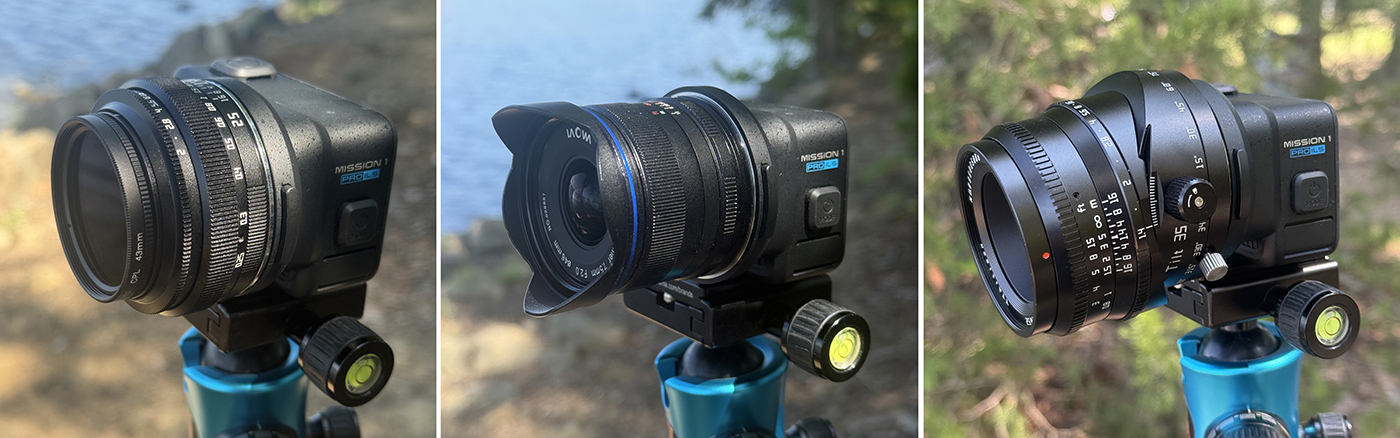
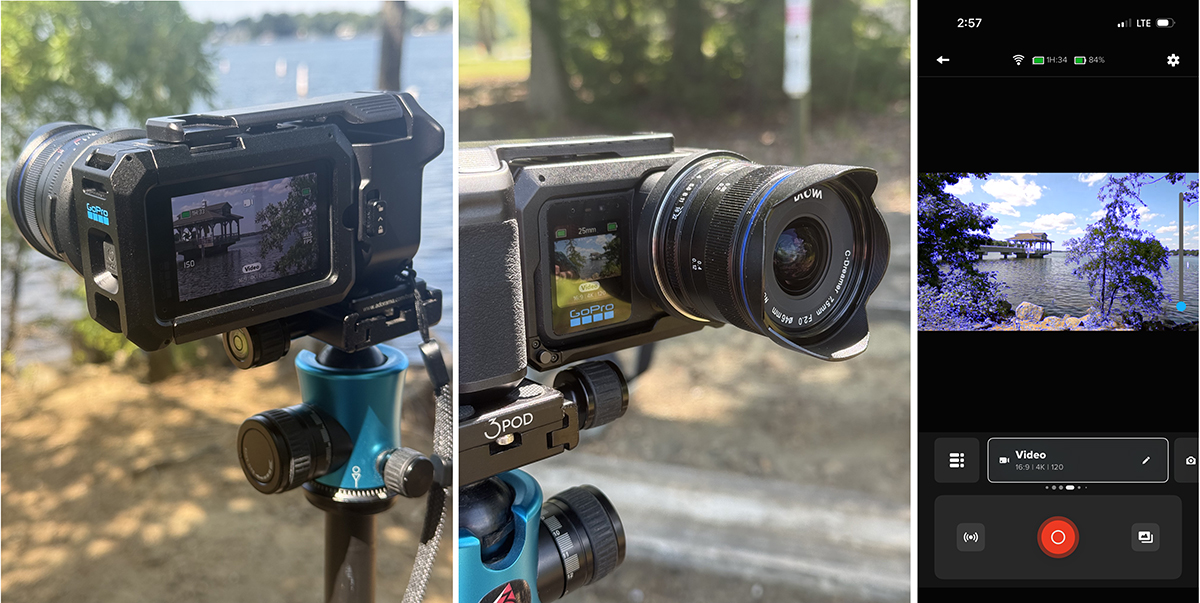
The defining feature of the Mission 1 Pro ILS is its manual Micro Four Thirds (MFT) mount. However, filmmakers must understand the mechanical realities of this system before integrating it into their production packages.
       [ MFT Lens (Image Circle: >21mm Diagonal) ]
                          |
                          v  (Light Path)
            +---------------------------+
            |  GoPro 1" Sensor Area     |  <-- Center "Sweet Spot" Captured
            |  (13mm x 10mm, ~16.4mm d) |      (Edges/Vignetting Discarded)
            +---------------------------+
The Lack of Electronic Contacts
The Mission 1 Pro ILS mount is purely mechanical. It does not feature electronic contacts on the camera body. Consequently, the camera cannot communicate with electronic lenses. Lenses that rely on "focus-by-wire" (where the manual focus ring electronically drives an internal motor) or those that require electronic signal transmission to adjust the aperture will not function. Creators must use purely manual-focus and manual-aperture lenses.
The Center-Cut Advantage
An MFT lens is typically designed to project an image circle covering a diagonal of over 21mm. Because the Mission 1 Pro ILS utilizes a 1-inch sensor (with a diagonal of approximately 16.4mm), the sensor only captures the central portion of the lens’s projected image. This "center-cut" approach means the camera utilizes the sharpest part of the glass, effectively discarding the softer edges, chromatic aberration, and vignetting that often plague manual lenses at their outer boundaries. Conversely, legacy 16mm and Super16mm cinema lenses, which project image circles smaller than 13mm and 15mm respectively, may cause severe vignetting unless the operator crops or scales the image in post-production.
Focal Length Conversion & Crop Factors
Due to the physical size of the 1-inch sensor relative to a 35mm full-frame sensor, the camera features a significant crop factor. This crop factor varies depending on whether GoPro’s electronic image stabilization (HyperSmooth) is active:
- HyperSmooth ON: ~3.0x Crop Factor
- HyperSmooth OFF: ~2.7x Crop Factor
Focal Length Equivalence Table
The table below illustrates how standard manual MFT focal lengths translate to 35mm full-frame equivalency on the Mission 1 Pro ILS:

| MFT Focal Length | 35mm Equivalent (HyperSmooth ON) | 35mm Equivalent (HyperSmooth OFF) |
|---|---|---|
| 6mm | 18 mm | ~16mm |
| 7.5mm | ~23mm | ~20mm |
| 9mm | 27mm | ~24mm |
| 10mm | 30mm | 27mm |
| 17mm | 51mm | ~46mm |
| 25mm | 75mm | ~68mm |
| 35mm | 105mm | ~95mm |
| 50mm | 150mm | 135mm |
Weight Limits and Structural Integrity
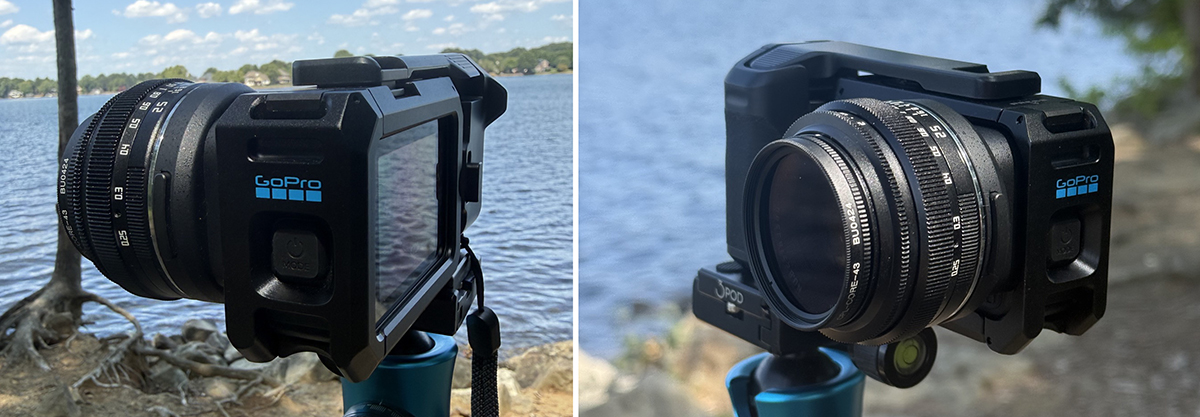
Because the camera body is lightweight and compact, the physical strain on the MFT mount is a critical consideration. Lenses weighing less than 250g are ideal for direct mounting. For lenses exceeding 250g—or when shooting in highly dynamic environments—GoPro strongly recommends utilizing a dedicated lens support system tied to a 15mm rod rail rig to prevent damaging the camera’s internal mount structure. Furthermore, users should select lenses with a maximum aperture no tighter than f/4.5 to avoid diffraction-limited softness, which degrades fine details on high-density sensors.
Optical Ecosystem: Supported and Profiled Lenses
While any manual MFT lens can technically be mounted, GoPro has certified and profiled a select group of lenses to guarantee performance and enable advanced features like customized in-camera stabilization.

Profiled Fisheye Lenses (In-Camera HyperSmooth Support)
Fisheye lenses exhibit extreme barrel distortion, which typically breaks standard electronic image stabilization algorithms. GoPro has specifically mapped and profiled five manual fisheye lenses, allowing the internal GP3 processor to apply real-time HyperSmooth stabilization:
- Laowa 4mm f/2.8 Fisheye (MFT)
- 7Artisans 6mm f/2 Fisheye Lens (MFT)
- 7Artisans 7.5mm f/2.8 Fisheye Lens (MFT)
- Brightin Star 7.5mm f/2.8 Fisheye Lens (MFT)
- Meike 7.5mm f/2.8 Fisheye Lens (MFT)
Rectilinear Lens Compatibility
For standard, non-fisheye (rectilinear) lenses ranging from 6mm to 500mm, users must manually enter the focal length into the camera’s menu system to calibrate the HyperSmooth algorithm. GoPro guarantees optimal stabilization performance for rectilinear lenses up to 50mm. Lenses exceeding 50mm (150mm equivalent) can be used, but stabilization performance may vary due to the extreme magnification of high-frequency micro-shakes.
Comprehensive Manual Lens Compatibility List
Below is a verified list of manual MFT lenses evaluated for physical and optical compatibility with the Mission 1 Pro ILS system:
| Lens Brand | Focal Length & Maximum Aperture | Physical Weight | Notes / Guidelines |
|---|---|---|---|
| Venus Optics Laowa | 4mm f/2.8 Fisheye | 135g | Fully profiled for HyperSmooth |
| Venus Optics Laowa | 4.5-10mm f/2.8 Zoom Fisheye | 338g | Use as variable prime; update focal length entry manually |
| Venus Optics Laowa | 6mm T2.1 Cine | 180g | Ultra-wide, ideal for compact gimbal work |
| Venus Optics Laowa | 7.5mm f/2 | 170g | Compact, excellent low-light option |
| Venus Optics Laowa | 9mm f/2.8 | 215g | Lightweight, minimal distortion |
| Venus Optics Laowa | 17mm f/1.8 | 175g | Normal focal length equivalent |
| Venus Optics Laowa | 50mm T2.9 | 289g | Telephoto; requires lens support under dynamic use |
| 7Artisans | 10mm f/3.5 | 125.5g | Very lightweight landscape lens |
| 7Artisans | 25mm f/1.8 | 143g | Budget-friendly portrait lens |
| 7Artisans | 35mm f/1.4 | 228g | Extremely fast aperture; shallow depth-of-field |
| 7Artisans | 35mm f/1.2 | 218g | Fast prime, distinct bokeh characteristics |
| 7Artisans | 50mm f/1.4 | 410g | Requires lens support system |
| 7Artisans | 60mm f/2.8 Macro | 339g | Requires lens support system |
| TTArtisan | 7.5mm f/2 | 370g | Heavy build; use with support on gimbals |
| TTArtisan | 10mm f/2 | 345g | Wide angle, solid metal construction |
| TTArtisan | 17mm f/1.4 | 248g | Fast street-style lens |
| TTArtisan | 25mm f/2 | 189g | Compact walk-around lens |
| TTArtisan | 35mm f/1.4 | 180g | Classic portrait prime |
| TTArtisan | 35mm f/1.4 Tilt | 345g | Specialized creative tilt effects |
| TTArtisan | 40mm f/2.8 Macro | 371g | Macro work; best suited for tripods |
| TTArtisan | 50mm f/1.2 | 336g | Extremely shallow DOF portrait lens |
| Rokinon | 7.5mm T3.8 Cine | 195g | De-clicked gears for cine follow-focus |
| Rokinon | 12mm T2.2 Cine | 260g | De-clicked gears, excellent optical performance |
| Rokinon | 50mm T1.3 Cine | 385g | High-speed cine prime; requires support |
| Meike | 7.5mm f/2.8 Fisheye | 260g | Fully profiled for HyperSmooth |
| Meike | 25mm f/1.8 | 190g | Lightweight and highly affordable |
| Meike | 35mm f/1.7 | 176g | Compact manual prime |
| AstrHori | 9mm f/2.8 | 307g | Robust wide-angle prime |
| AstrHori | 14mm f/4.5 | 120g | Ultra-lightweight pancake-style lens |
| Mitakon Zhongyi | 20mm f/2 | 230g | Specialized super-macro lens |
| Mitakon Zhongyi | 25mm f/0.95 | 230g | Ultra-fast aperture; extreme low-light performance |
| Mitakon Zhongyi | 42.5mm f/1.2 | 310g | Portrait prime; close to weight limits |
| Meyer-Optik Görlitz | 30mm f/3.5 | 270g | Boutique vintage rendering |
| Meyer-Optik Görlitz | 35mm f/2.8 | 300g | Classic German optical design |
| Meyer-Optik Görlitz | 50mm f/2.8 | 240g | Sharp, lightweight retro rendering |
| Meyer-Optik Görlitz | 58mm f/1.9 | 270g | Swirly bokeh character |
| Meyer-Optik Görlitz | 75mm f/2.8 | 360g | Telephoto; best on tripod configurations |
| ArtraLab Oculilumen | 7.5mm f/2.8 | 320g | Heavy retro-styled lens |
| ArtraLab Latalumen | 12mm f/2 | 275g | Wide-angle prime |
| Brightin Star | 12mm f/2 | 268g | Compact landscape lens |
| SLR Magic | 8mm f/4 | 110g | Extremely lightweight; ideal for drone/gimbal use |
| Opteka | 35mm f/1.7 | 204g | Lightweight budget option |
| Lensbaby | 28mm f/3.5 | 140g | Creative focus-bending optic |
| Lensbaby | 56mm f/1.6 | 400g | Portrait effect lens; requires support |
Hands-on Investigative Analysis: Field Usability & Testing
Initial hands-on field testing of the Mission 1 Pro ILS reveals a steep learning curve for those accustomed to standard action cameras. This is an ecosystem that rewards deliberation and punishes the "run-and-gun" assumptions of traditional GoPro users.

The Ergonomics of the Shutter Release: A Mechanical Misstep
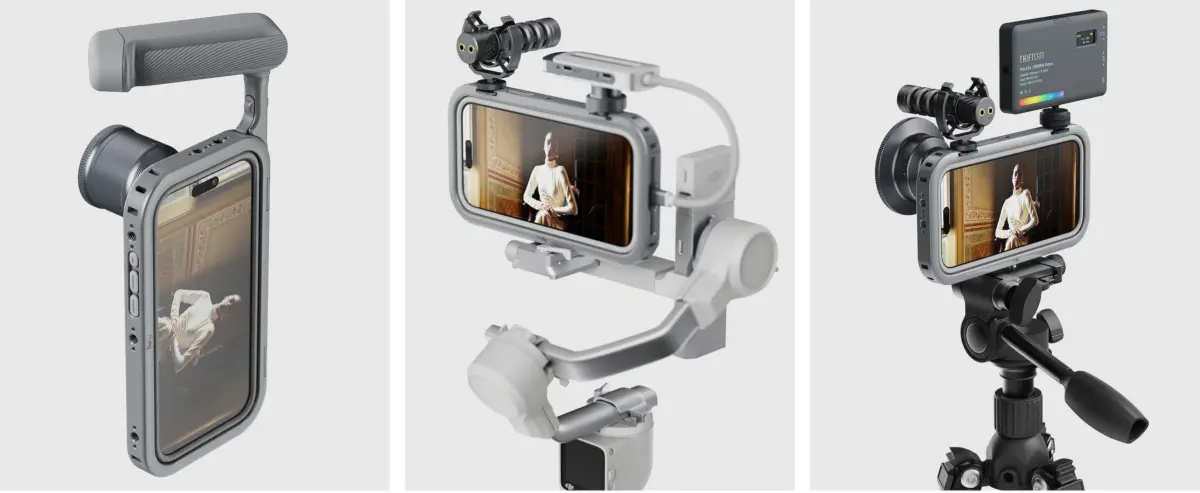
One of the most controversial elements of the physical kit is the optional GoPro Grip, which utilizes a mechanical "diving board" linkage to physically press the top shutter button of the camera.
   [Mechanical Shutter Linkage / "Diving Board"]  ==> Creates Micro-Vibrations
                       |
                       v
         +---------------------------+
         |   GoPro Mission 1 Pro     |
         |         ILS Body          |
         +---------------------------+
                       |
                       v
         [High-Resolution 50MP Image]  ==> Results in Motion Blur / Soft Focus
In practice, this mechanical linkage is awkward and counterproductive. When shooting high-resolution 50-megapixel stills, the physical force required to depress the diving-board lever transfers micro-vibrations directly through the camera body, even when mounted on a sturdy tripod. This structural movement causes noticeable motion blur and soft focus at the pixel level.

To bypass this ergonomic flaw, filmmakers should operate the camera remotely via the GoPro Mobile App. By using a smartphone as a wireless monitor and remote trigger, operators can zoom in on the digital feed to verify critical focus, execute the shot, and prevent any physical contact with the camera body.
Focus Assist and Peaking Limitations
To aid manual focusing, GoPro integrated two tools:

- Focus Assist: Magnifies the live-view image up to 8x on the rear touchscreen before recording commences.
- Focus Peaking: Overlays contrasting color highlights on in-focus edges, featuring a "High Sensitivity" toggle for low-contrast or dimly lit scenes.
Our investigative field tests reveal that relying solely on Focus Peaking can be deceptive, especially when shooting wide-open on fast primes (such as the Mitakon 25mm f/0.95) where the depth of field is razor-thin. Due to the limited resolution of the rear touchscreen, the peaking algorithm sometimes highlights areas that are slightly forward or behind the true focal plane. This discrepancy is particularly noticeable in high-resolution photo modes. For critical focus, operators should utilize Focus Assist (8x magnification) to manually inspect the plane of focus before hitting record.
Stabilization and Gimbal Dynamics
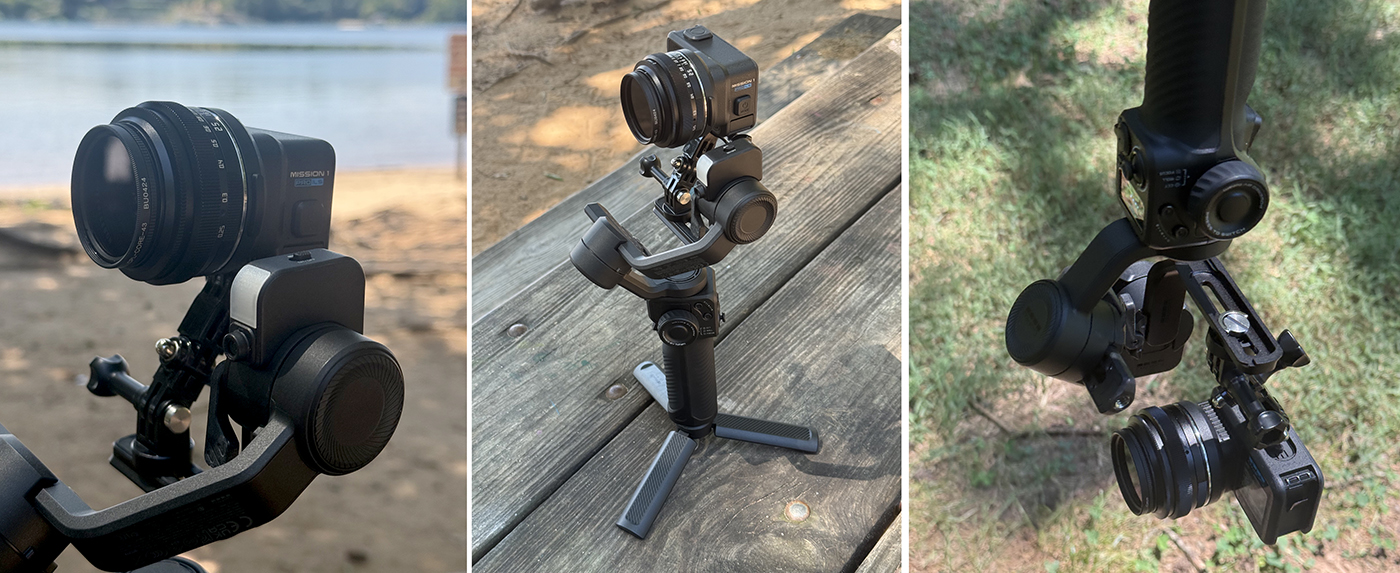
While GoPro’s Emmy-winning HyperSmooth technology is present, it is far less forgiving on the Mission 1 Pro ILS than on standard GoPros. Because manual lenses lack optical image stabilization (OIS) communication, HyperSmooth relies entirely on the user’s manual focal length input and internal gyro sensors.

During testing on the GoPro Fluid Pro stabilizer, balancing the camera in a traditional upright position proved challenging due to the shifting center of gravity introduced by heavier manual lenses. However, mounting the camera in an inverted, low-slung (hanging) configuration vastly improved stability, allowing the gimbal to compensate more fluidly for the physical inertia of the glass.
Market Positioning & Official Philosophy
GoPro’s strategic entry into the interchangeable lens market is a calculated play to capture the mid-tier cinematic market, currently occupied by cameras like the Blackmagic Micro Studio Camera, Z Cam E2, and various mirrorless rigs.

By stripping away electronic lens mounts, autofocus motors, and internal ND filters, GoPro has minimized the camera’s physical footprint and price point. The company’s official philosophy positions the Mission 1 Pro ILS as a specialized, modular tool. It is designed to live on cinema rigs, car mounts, compact gimbals, and macro stands where traditional cinema cameras are too heavy or expensive to risk, but where standard action cameras cannot deliver the shallow depth of field, optical compression, and professional color codecs required for high-end productions.
Future Outlook
The GoPro Mission 1 Pro ILS represents a fascinating, albeit polarizing, leap forward. By delivering a 1-inch sensor, 8K raw capabilities, 32-bit float audio support, and a manual MFT mount, GoPro has built a highly capable micro-cinema camera. Yet, it demands a disciplined cinematography workflow.

The true test of this platform will unfold over the coming months as filmmakers push the limits of the Media Mod accessory ecosystem. Integrating the camera with external HDMI monitors, professional XLR audio recorders, and wireless follow-focus systems will determine whether the Mission 1 Pro ILS can truly establish itself as a mainstay on professional film sets, or if it will remain a niche tool for specialized optical experiments. For now, it stands as a bold, uncompromising declaration that GoPro is ready to step out of the action camera box and enter the world of cinema.