The rapid integration of generative artificial intelligence into software development has fundamentally altered the economics of code creation. What once took human engineers days—writing, boilerplate generation, refactoring, and initial pull request (PR) creation—can now be executed by AI agents in mere seconds. While this surge in developer productivity has been widely celebrated, it has introduced a severe operational crisis further down the delivery pipeline: the modern source code repository and its associated review workflows are breaking under the weight of machine-speed output.
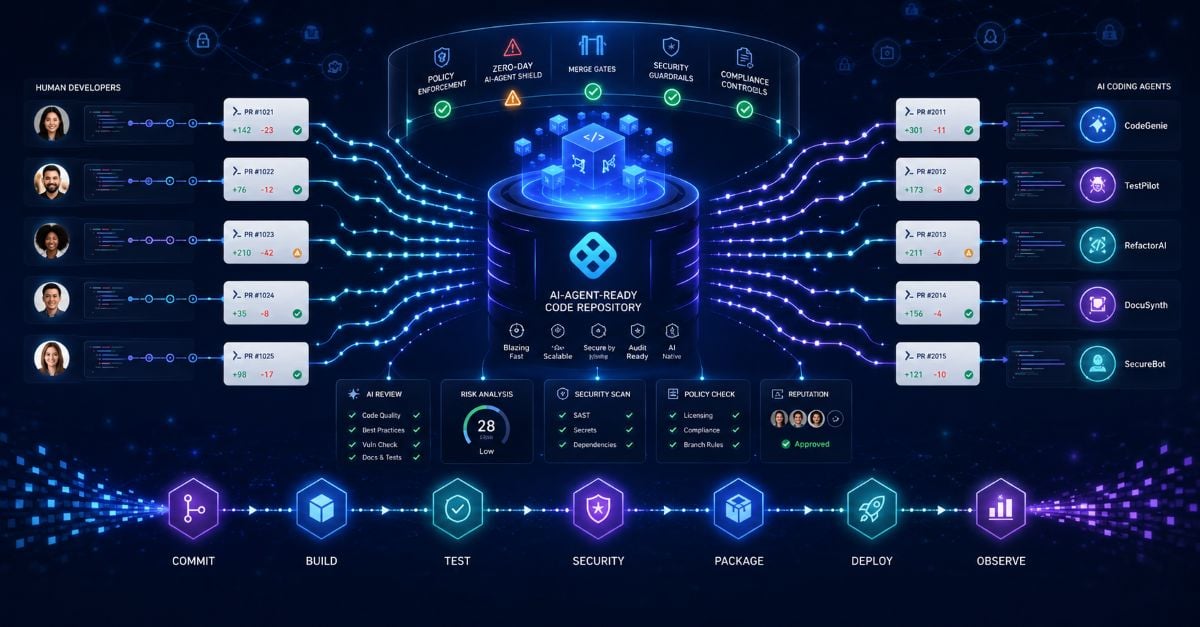
Recognizing this seismic shift, Harness has officially launched the Agent-Ready Harness Code Repository and AI Code Review service. Purpose-built for DevOps and platform engineering teams relying on autonomous AI agents to generate code, the new platform provides a scalable alternative to legacy source code management (SCM) tools like GitHub, GitLab, Bitbucket, and Azure DevOps. According to Harness, traditional repositories were architected on the fundamental assumption that code is written by humans at a human pace. Consequently, when confronted with thousands of simultaneous AI-generated commits and pull requests, legacy systems experience severe performance degradation, indexing lag, crippled file-history searches, and unprecedented review bottlenecks.
The launch of the Harness Code Repository marks a watershed moment in the evolution of developer tools. It signals a transition from human-centric SCM platforms to high-throughput, AI-native infrastructure designed to handle automated pipelines from commit to production. By combining native Model Context Protocol (MCP) support, risk-based code reviews, Open Policy Agent (OPA) integration, and a unified SDLC Knowledge Graph, Harness is aiming to eliminate the verification debt that currently threatens to choke modern software engineering organizations.
Detailed Chronology: The Evolution from Human-Speed to Machine-Speed Development
The Legacy Assumptions of Software Configuration Management
For over two decades, source code management platforms have operated under a remarkably consistent set of assumptions. Version control systems were designed to track human contributions. Developers would check out code locally, write features or bug fixes over the course of hours or days, open a single pull request, and wait for peer review from a colleague.
In this legacy ecosystem, permissions were tied to user profiles, identity management systems assumed a one-to-one relationship between a human and an active session, and repositories rarely had to process more than a few dozen pull requests concurrently across a handful of active branches. Search indexing, diff generation, and history tracking were optimized for incremental updates rather than massive, concurrent bursts of autonomous code generation.
The Rise of Agentic AI and the SCM Breaking Point
The introduction of LLM-powered coding assistants and autonomous AI agents shattered these foundational assumptions. Organizations rapidly moved past basic autocomplete tools toward agentic frameworks capable of autonomously investigating bug reports, writing multi-file patches, running local test suites, and opening pull requests at scale.
This machine-speed output immediately exposed structural limitations in incumbent SCM solutions:
The Pull Request Deluge: AI agents began generating hundreds, and in some cases thousands, of daily pull requests. Human reviewers quickly found themselves buried under an insurmountable mountain of updates, making thorough code reviews practically impossible.
Indexing and Search Failures: As repositories ingested massive volumes of automated commits, search capabilities degraded. File history searches slowed to a crawl as database indexing mechanisms fell critically behind real-time updates.
Identity and Access Blind Spots: Legacy permission systems, built around static developer lists and personal access tokens, proved incapable of uniquely identifying, tracking, and sandboxing autonomous AI agents that were merging code independently.
System Outages: The sheer volume of concurrent API calls, webhooks, and git operations frequently overwhelmed legacy platform architectures, leading to unexpected outages and deployment stalls.
The Harness Intervention: Building for the Machine Era
To address these compounding failures, Harness engineered a code repository built from the ground up to handle high-concurrency, multi-source environments. Rather than patching legacy monoliths, the Harness Code Repository was tested rigorously to process thousands of simultaneous pull requests and commits originating from both human engineers and autonomous AI agents.
By ensuring that search, history, and diff mechanisms continue to function seamlessly across massive repositories with tens of thousands of active branches, Harness has effectively established a new benchmark for enterprise-grade, agent-ready SCM infrastructure.
Architecture and Technical Deep Dive
Harness Model Context Protocol (MCP) and Command Line Interface Integration
Modern engineering teams require deep integration between their development tooling and AI frameworks. To facilitate this, Harness has designed its Code Repository and AI Code Review services to be fully accessible via the Harness Model Context Protocol (MCP) server or a streamlined command line interface (CLI).
This architecture allows developers and autonomous agents to interact with the repository programmatically without getting bogged down by browser-based UI latency. DevOps engineers can:
Review incoming pull requests sorted by the author’s verified email rather than obscure internal system IDs.
Aggregate and view every open pull request across disparate repositories simultaneously.
Create, reply to, and resolve comment threads directly through terminal or MCP interactions, completely bypassing the traditional browser workflow.
Granular Governance and Role-Based Access Control (RBAC)
Allowing AI agents to write and merge code introduces severe security vectors. Unrestricted agents could inadvertently introduce vulnerabilities, overwrite critical production configurations, or violate compliance standards.
To mitigate these risks, Harness incorporates advanced governance mechanisms:
Agent-Specific Permissions: Organizations can provision unique access credentials specifically for AI agents, or allow them to inherit permissions strictly scoped to the application development teams that deployed them.
Dynamic Access Boundaries: Using role-based access controls (RBACs) modeled after standard human engineering policies, teams can precisely define what an AI agent is permitted to read, modify, merge, or deploy.
Open Policy Agent (OPA) Integration: Utilizing native policies based on the CNCF’s Open Policy Agent framework, organizations can enforce automated compliance gates that inspect every AI-generated contribution before it touches core codebases.
Risk-Based AI Code Review and Automated Gating
Traditional code reviews rely on line-by-line diff analyses, which become entirely unmanageable when an AI agent refactors thousands of lines across dozens of files simultaneously.
The Harness AI Code Review engine fundamentally changes how changes are evaluated:
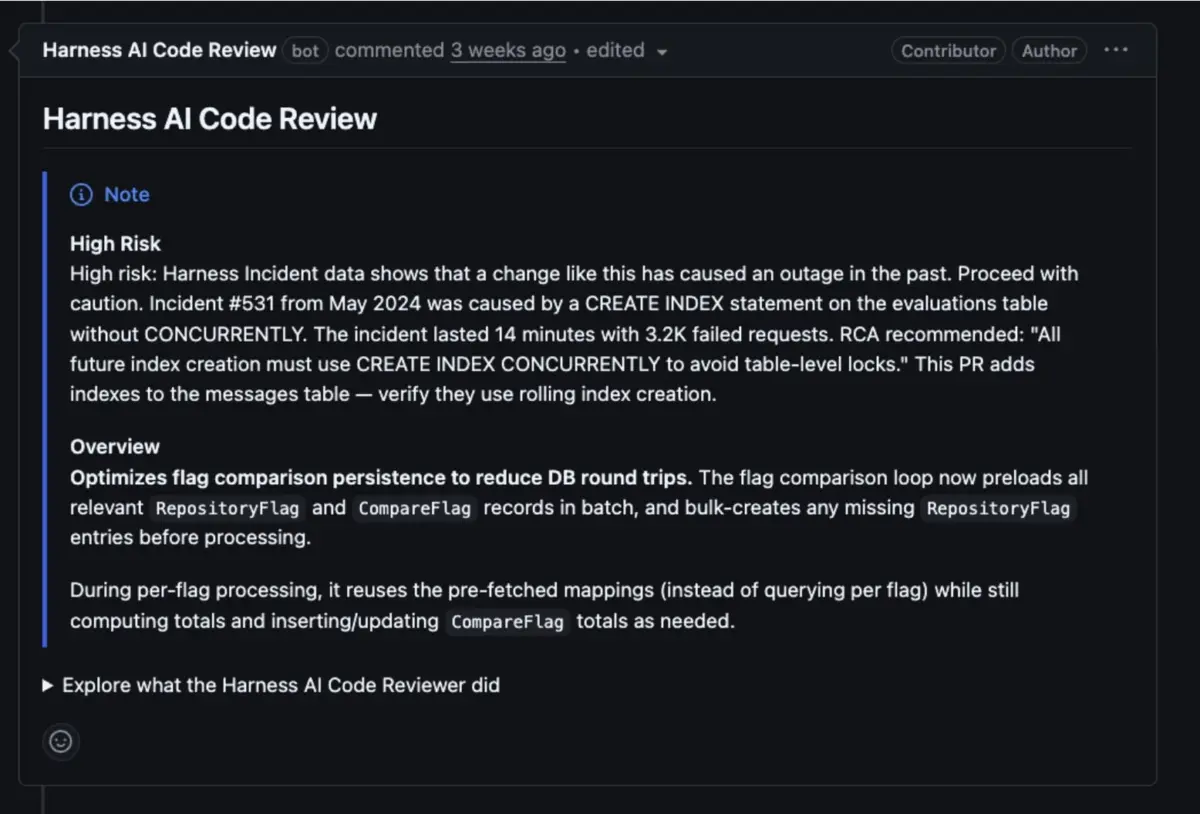
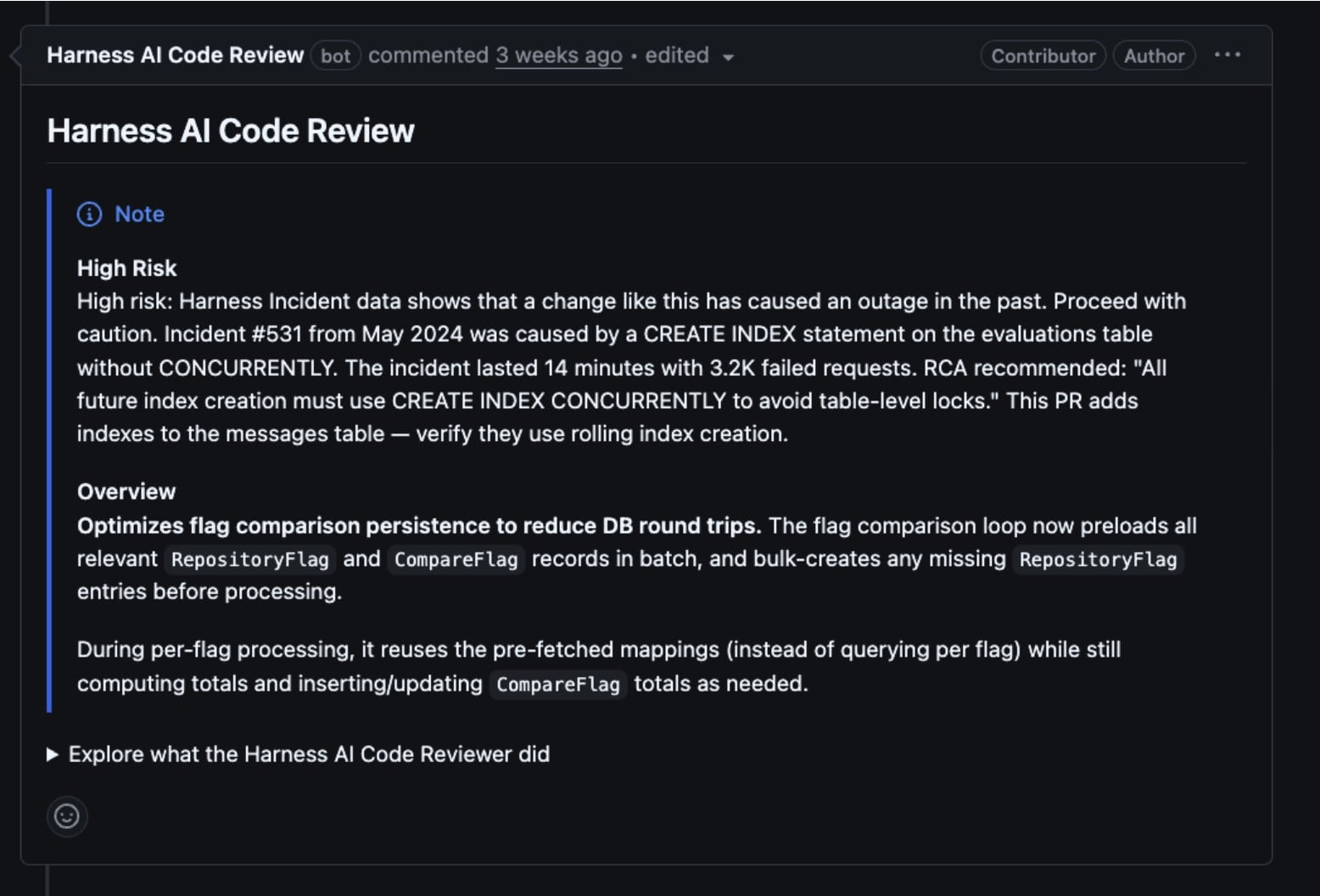
Risk-Based Grouping: Instead of organizing code differences by file path, the engine groups changes by risk level. High-risk modifications that alter core software behavior or application logic are immediately isolated and highlighted, preventing critical changes from getting lost amid mass renames or automated dependency updates.
Impact-Driven Feedback: Rather than merely noting that a line of code has moved or changed, the review system provides contextual descriptions explaining what a particular change puts at stake. If the AI-generated feedback is verified as valid, adjustments can be approved and merged with a single click.
Automated Guardrails: The review engine cross-references every pull request against mandatory organizational gates. Any request that fails security, compliance, or structural checks is automatically blocked from being merged into production branches.
Supporting Context, Metrics, and Expert Analysis
Overcoming the Verification Debt
Industry experts have been quick to point out that code generation is no longer the primary bottleneck in software engineering; verification is.
Mitch Ashley, Vice President and Practice Lead for the Futurum Group, highlighted the shifting economics of software development:
"The bottleneck in AI-assisted development has moved to review and approval. Agents produce code faster than teams can verify it, and verification debt builds faster than anyone can hire reviewers. The key here is still accountability."
As Ashley notes, generating code with artificial intelligence is essentially frictionless. Verifying that the generated code is secure, performant, and logically sound, however, requires rigorous oversight. Platforms like the Harness Code Repository attempt to bridge this gap by automating the heavy lifting of triage and risk assessment.
The Unified SDLC Re-Engineering
According to Martin Reynolds, Field CTO for Harness, organizations are rapidly discovering that piecemeal approaches to agentic AI engineering are unsustainable. Adopting an isolated AI coding assistant while maintaining legacy CI/CD pipelines and repositories creates massive operational friction.
Instead, the entire software development lifecycle (SDLC) must be comprehensively re-engineered. In the Harness ecosystem, this holistic transformation is manifested through a unified pipeline where commits, code reviews, builds, tests, security scans, and deployments stem from a single, unbroken sequence.
Key components of this unified approach include:
Harness Software Delivery Agent: Executes end-to-end workflows from initial commit to production deployment using policies generated from a single, common engine.
SDLC Knowledge Graph: Maps all active workflows to supply the deep contextual intelligence required for accurate AI and human code reviews.
Proven Efficiency Gains: Based on early enterprise testing, Harness reports that organizations utilizing its integrated agentic workflows have realized staggering productivity gains, saving upwards of 10,000 hours in manual engineering and review time over a single month.
Frictionless Migration and Availability
To encourage rapid adoption, Harness has made its Code Repository available for teams to start using completely free of charge. Furthermore, recognizing that enterprise migration away from incumbent platforms is historically painful, Reynolds noted that migrations from existing SCM platforms—including GitHub, GitLab, Bitbucket, and Azure DevOps—can be completed in just a few clicks.
Future Outlook: The Autonomous Enterprise
The launch of the Harness Code Repository and AI Code Review service represents a foundational milestone in the maturation of agentic software engineering. As artificial intelligence models grow increasingly autonomous, the tools used to govern them must evolve in lockstep.
Looking ahead, the software industry is moving decisively toward an era where human engineers transition from direct code authors to architectural supervisors and policy arbiters. In this future state, development teams will no longer manage individual files or manually shepherd pull requests through stagnant review queues. Instead, they will manage fleets of specialized AI agents governed by centralized policy engines, automated risk-scoring frameworks, and high-throughput repositories.
While the exact timeline for the total re-engineering of enterprise DevOps workflows remains variable, the trajectory is clear. Platforms that fail to adapt to machine-speed output will inevitably buckle under the weight of AI-generated code. With its agent-ready SCM platform, Harness has staked an early claim on the future of enterprise software delivery, providing the vital infrastructure needed to turn the promise of generative AI into secure, scalable production reality.