Executive Overview
The conversation surrounding artificial intelligence in the enterprise has undergone a massive paradigm shift. Organizations are no longer content with chat-based proof-of-concepts, isolated prompt engineering experiments, or simple request-response interfaces. Leaders want operational leverage—autonomous and semi-autonomous AI agents capable of resolving IT change requests, adjudicating complex insurance claims, and triaging real-time security alerts.
However, a yawning chasm exists between a successful prototype and a resilient production system. While large language models (LLMs) excel at generating text, reasoning through context, and orchestrating tool calls within a matter of milliseconds, enterprise workflows operate on entirely different scales. They take minutes, hours, or even days. They span multiple microservices, require third-party API integrations, encounter unpredictable network latency, and frequently demand human sign-offs before critical actions can execute.
When these multi-step agentic workflows encounter a timeout, an external outage, or a delayed human approval, traditional stateless architectures collapse. Developer teams find themselves drowning in custom queues, ad-hoc status tables, complex error-handling blocks, and fragile retry logic.
This article explores why the future of enterprise AI depends less on the raw intelligence of the underlying model and much more on the resilience of the execution environment. By treating the workflow—rather than the model—as the core application, and by integrating durable orchestrators like Azure Durable Functions with intelligence layers like Azure AI Foundry, engineering teams can build production-grade agentic systems that survive failures, coordinate parallel subtasks, incorporate human-in-the-loop governance safely, and scale reliably.
Detailed Chronology: The Evolution from Demos to Distributed Systems
To understand why enterprise AI is hitting a structural wall, it is necessary to trace how these systems have evolved and where traditional architectural patterns break down.
Phase 1: The Illusion of the Stateless API
When teams first begin building with generative AI, they rely heavily on synchronous, request-response application programming interfaces. A user sends a prompt; the application routes it to an LLM; the model streams back an answer. This model is exceptionally well-suited for web-search experiences, document summarization, and interactive Q&A.
However, engineers inevitably attempt to apply this same stateless design to complex enterprise processes. For example, consider an automated procurement review agent tasked with parsing a multi-page contract, comparing its indemnity clauses against standard corporate templates, querying vendor risk databases, and executing a sanctions check.
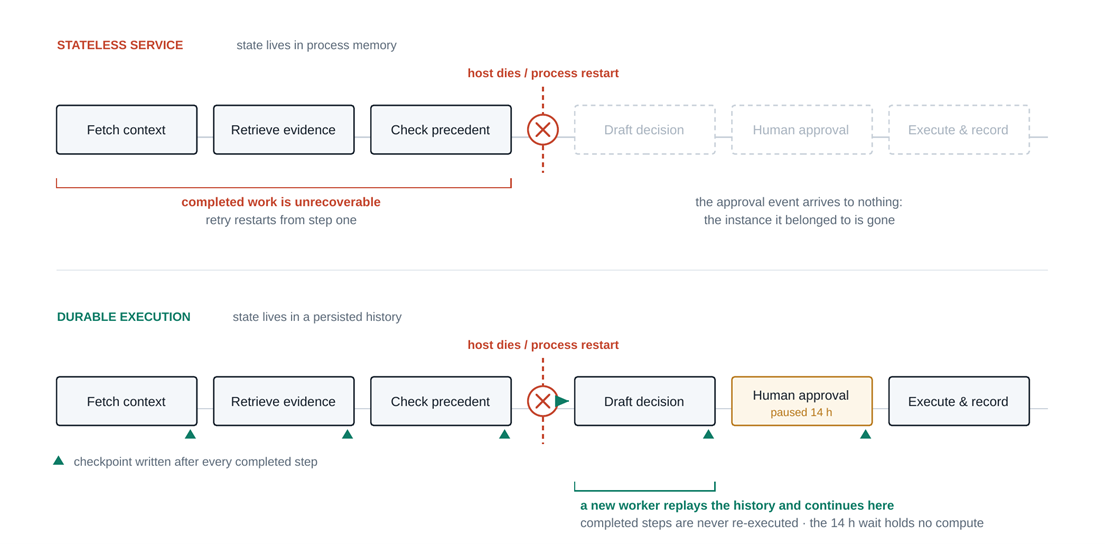
In a stateless API architecture, if an HTTP timeout occurs during the sanctions screening, or if the external verification service goes down momentarily, the entire request fails. The system holds progress in ephemeral process memory. Consequently, a single host failure obliterates all completed work, forcing the system to restart from square one.
Phase 2: The Hidden Costs of Custom Orchestration
Realizing that stateless APIs cannot handle multi-minute or multi-hour workflows, development teams often attempt to build home-grown state management layers. They deploy custom message queues, write relational database tables to track instance states, and inject ad-hoc retry loops into their backend code.
While this approach can get a prototype across the finish line, it introduces staggering technical debt. Operating a custom, state-tracking distributed system requires solving notoriously difficult computer science problems: managing race conditions, ensuring deterministic execution during replays, handling out-of-order event delivery, and managing orphaned background tasks. The hidden cost of an enterprise AI initiative is rarely the price of model tokens or prompt engineering; it is the immense operational burden of maintaining custom infrastructure designed to glue brittle API calls together.
Phase 3: The Rise of Durable Runtimes and Workflow-Centric Design
The industry is currently transitioning into a mature operational phase characterized by the adoption of durable runtimes. Rather than viewing the LLM as the central application, visionary enterprise architects now recognize that the workflow is the application, and the AI model is merely a specialized activity within a broader execution graph.
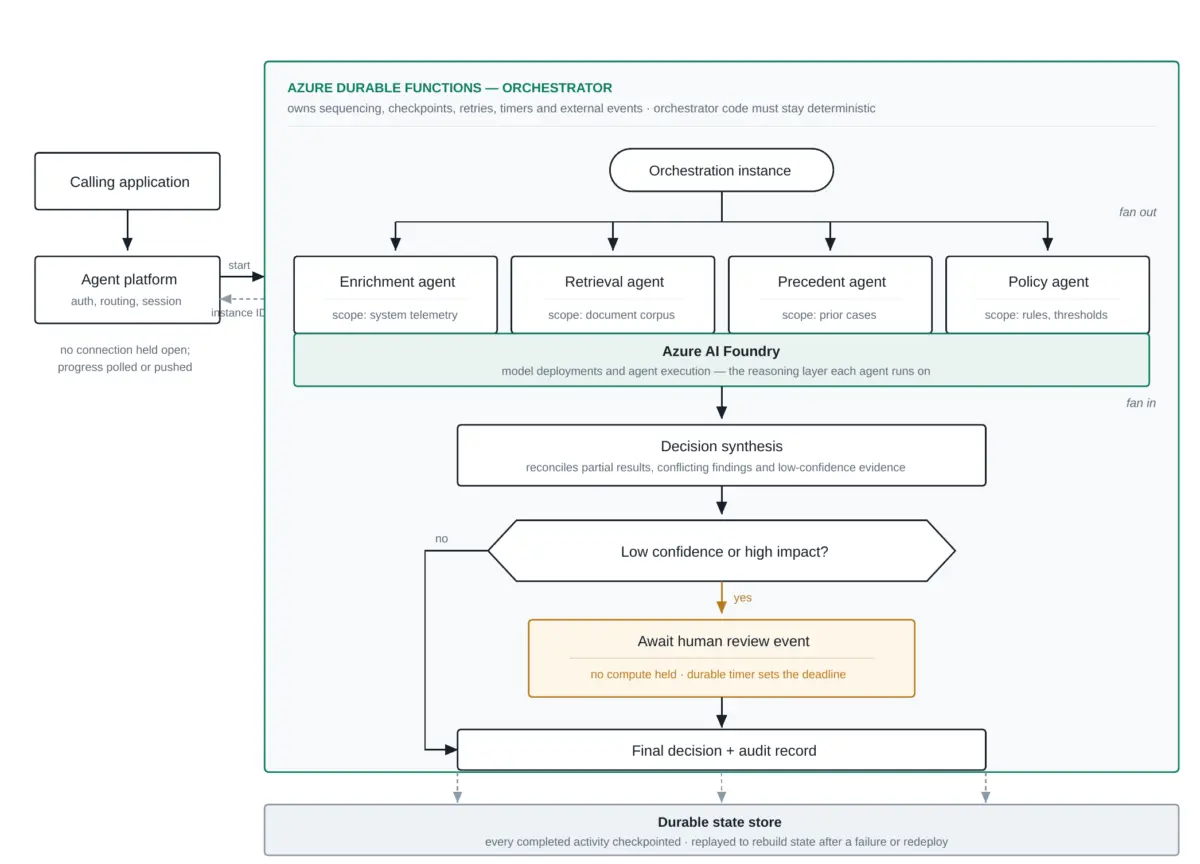
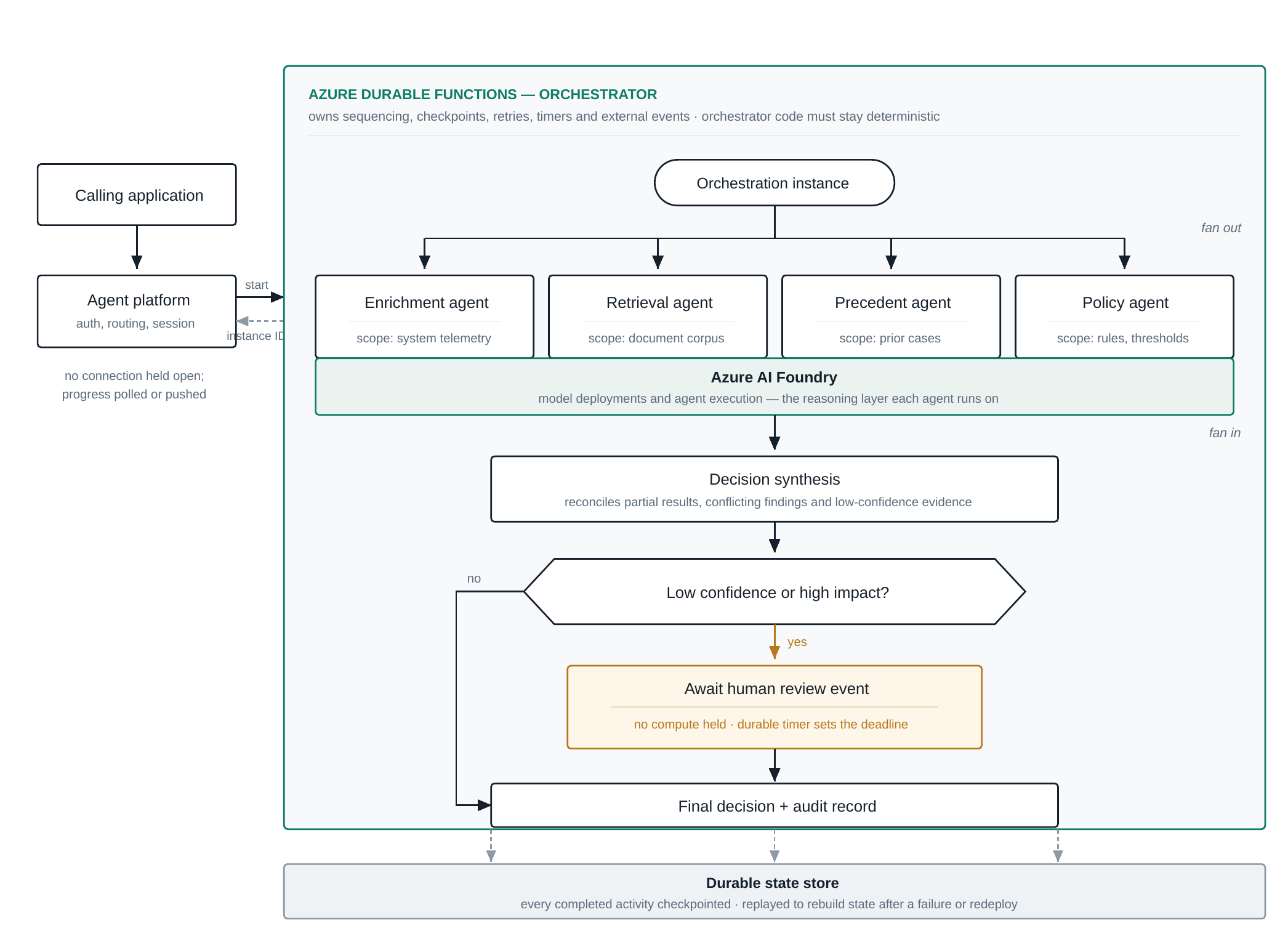
In this architecture, a durable workflow engine sits squarely between the client application and the reasoning layer. When a user or system initiates a process, the orchestrator immediately returns an instance identifier, taking over full responsibility for sequencing, state persistence, checkpointing, and error recovery. If a worker node crashes mid-execution, a replacement worker replays the execution history up to the last known checkpoint and continues seamlessly. This mirrors the architectural evolution seen years ago during the microservices boom, where monolithic applications gave way to resilient, observable distributed systems backed by robust service meshes and workflow engines.
Supporting Context & Metrics: Anatomy of an Enterprise Agentic Workflow
To appreciate the necessity of durable runtimes, one must examine the common architectural shape shared by disparate enterprise workflows. Whether an agent is evaluating an IT change request, processing an insurance claim, or triaging a security incident, its operational structure remains remarkably consistent.
[Calling Application]
       │
       ▼
[Durable Orchestration Runtime] ◄─── State Checkpoints & Timers
 ├── Fan-Out: Enrichment Agent
 ├── Fan-Out: Reference Retrieval Agent
 └── Fan-Out: Precedent Analysis Agent
       │
       ▼
[Fan-In & Synthesis Layer]
       │
       ▼
[Human-in-the-Loop Review Gate] (Parked State / No Compute Cost)
       │
       ▼
[Final Disposition Execution]
The Power of Fan-Out/Fan-In Patterns
Enterprise investigations are rarely linear. In a security alert triage workflow, for instance, multiple subtasks can execute simultaneously without interfering with one another:
- Enrichment Agent: Gathers raw signal data and assesses asset criticality.
- Retrieval Agent: Pulls relevant internal compliance policies and reference documents.
- Precedent Agent: Searches historical incident logs for similar prior occurrences.
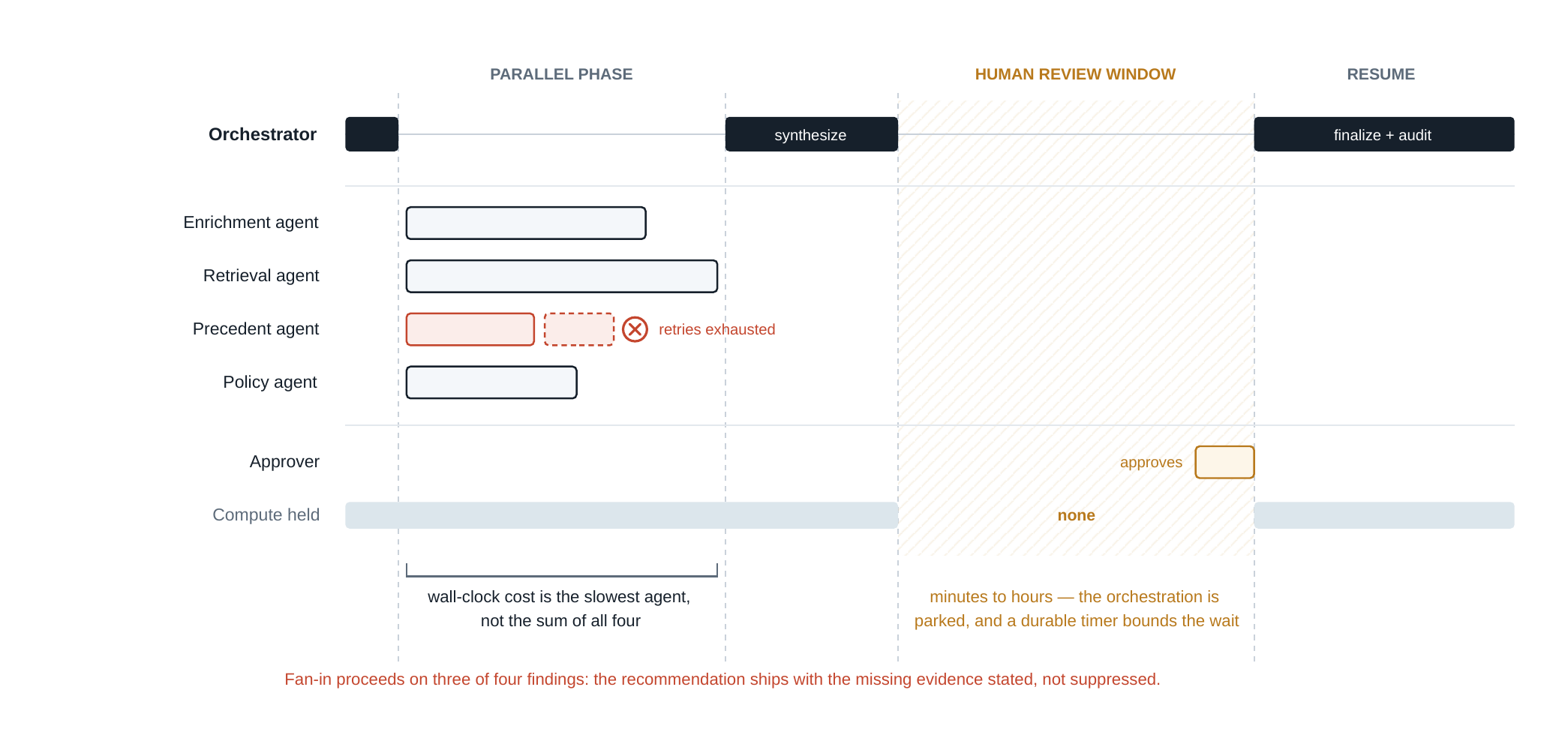
Because these subtasks have zero dependencies on each other, a durable orchestration layer can leverage a fan-out/fan-in pattern. The orchestrator dispatches these tasks in parallel, significantly reducing wall-clock latency. Instead of waiting for a monolithic prompt to sequentially process every data point, the system relies on specialized, narrowly scoped agents.
The subsequent fan-in step is where true systems engineering takes place. Rather than assuming every specialized agent will succeed 100% of the time, a production-grade workflow anticipates partial failures. If the precedent agent times out or returns low-confidence results while the enrichment and retrieval agents succeed, the system can still synthesize a valuable recommendation accompanied by clear caveats, rather than failing the entire job.
Determinism and the Rules of the Orchestrator
Implementing durable orchestration requires strict adherence to software engineering disciplines. For example, orchestrator code must remain completely deterministic. Because recovery is achieved by replaying the execution history, operations that introduce non-determinism—such as reading wall-clock time, generating random identifiers, or executing direct I/O—must be strictly isolated inside activity functions rather than placed within the core orchestrator logic.
Furthermore, every waiting state requires a firm deadline. If an agent pauses to wait for a human review event and fails to pair it with a durable timer, an un-actioned approval request can leave an instance stranded in a "Running" state indefinitely, consuming resources and muddying operational visibility.
Official Statements & Architectural Perspectives
Industry leaders and cloud architects emphasize that enterprise AI adoption requires moving beyond conversational paradigms into robust systems engineering.
According to enterprise cloud architects specializing in distributed applications:
"The bottleneck in production-grade AI is no longer the intelligence of the model; it is the reliability of the execution environment. When an AI agent moves past answering questions and begins modifying infrastructure, approving financial transactions, or altering records, it ceases to be a chatbot. It becomes a distributed system that demands state management, strict boundaries, and fault tolerance."
Platform engineering advocates also stress the importance of isolating agent privileges to minimize security blast radiuses:
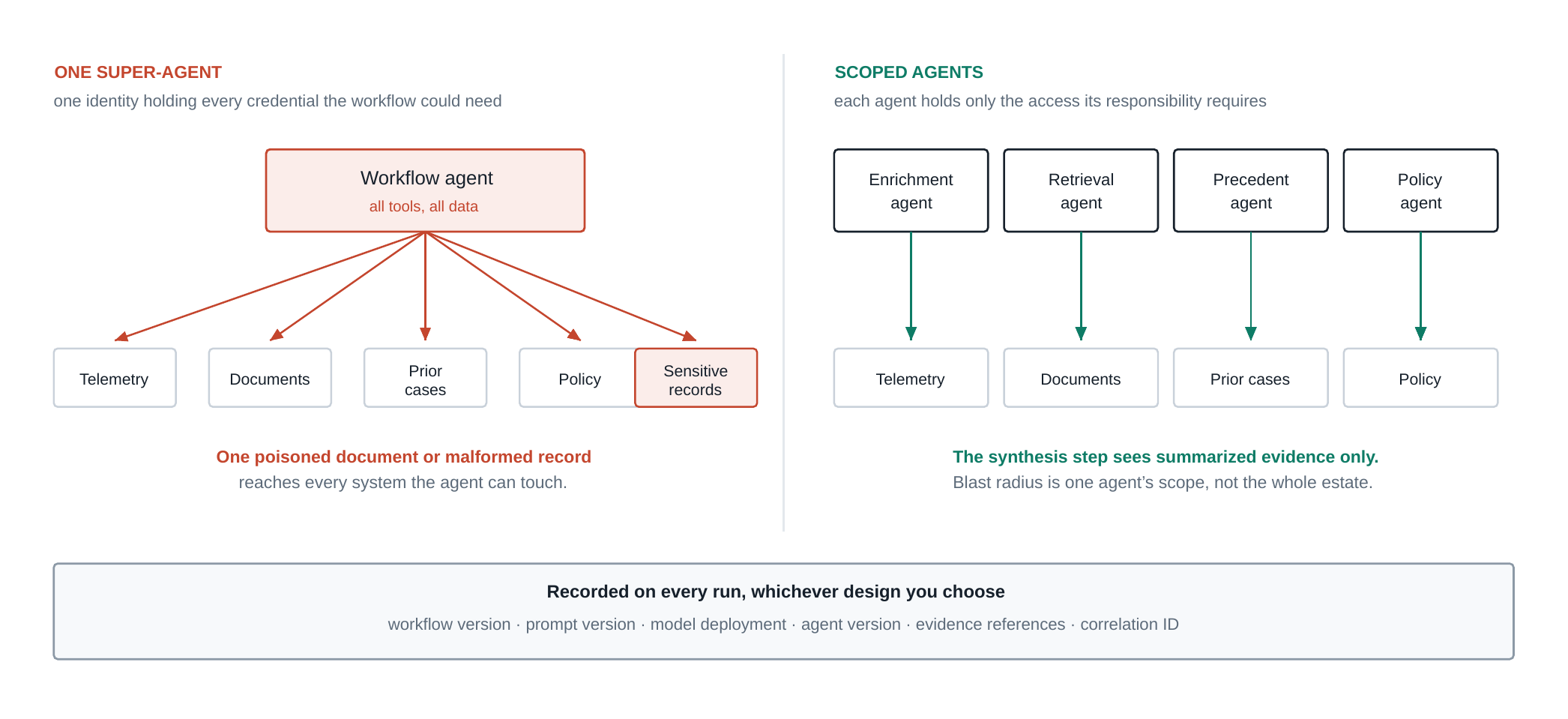
"Treating an AI agent as an over-permissioned monolith with access to every corporate tool is an invitation for disaster. Security and governance cannot be bolted on as an afterthought. Just as microservices adhere to the principle of least privilege, specialized agents must be strictly scoped—giving retrieval agents access only to corpora, enrichment agents access only to telemetry, and leaving the final synthesis to a tightly governed coordinator."
Future Outlook: The Intersection of DevOps, Platform Engineering, and AI
As artificial intelligence matures from experimental novelty to core enterprise infrastructure, the responsibilities of DevOps and platform engineering teams are expanding rapidly.
1. Operational Observability for AI Workflows
Organizations can no longer rely on simple logging to debug agent behavior. Production systems demand comprehensive workflow telemetry that answers granular operational questions:
- Which specific stage of the agent graph is currently executing?
- Which specialized agent activity triggered a retry loop, and why?
- How many cumulative hours did a human-in-the-loop review take?
- What exact evidentiary references and prompt versions supported a model’s final recommendation?
2. Versioning Long-Running Instances
Because enterprise workflows can span days or weeks, engineering teams must solve the challenge of workflow versioning. If an agent is halfway through a 14-day procurement review when platform engineers push updated orchestrator code to production, the system must gracefully handle in-flight instances without corrupting state or crashing the application runtime.
3. The Synergy of Specialized Runtimes
Practical implementations—such as pairing Azure Durable Functions for stateful, long-running orchestration with Azure AI Foundry for high-performance model reasoning—illustrate the optimal blueprint for enterprise AI. By separating concerns so that AI services handle reasoning, activity functions perform raw work, and durable orchestrators govern execution semantics, enterprises can finally bridge the gap between fragile pilot projects and unbreakable production realities.
Conclusion
The ultimate takeaway for enterprise technology leaders is clear: Intelligence is only half of the system. Execution is the other half.
While access to powerful foundation models is now ubiquitous, the organizations that successfully deploy AI at scale will be those that invest in durable execution environments. By combining specialized multi-agent architectures with robust state management, resilient fan-out/fan-in coordination, and proactive governance, engineering teams can build intelligent systems that enterprises can truly trust to run their most critical operations.