Executive Overview
Ask any modern platform engineer how much of their Terraform, Kubernetes manifests, or CI/CD YAML files were originally drafted by an artificial intelligence assistant, and the honest answer is almost universally: "Most of it."
Now, ask that same engineer how much of that code underwent a rigorous, line-by-line security review before it was pushed to production, and the conversation grows noticeably quieter.
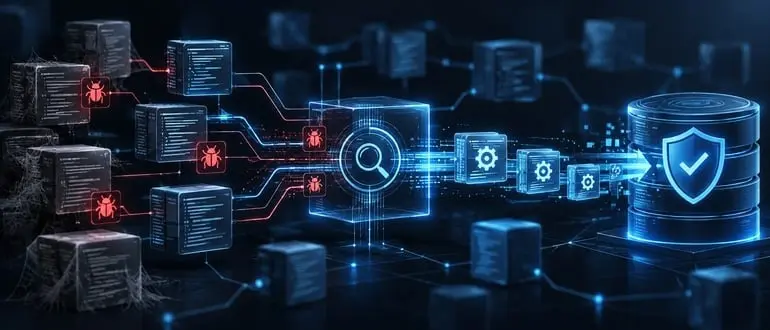
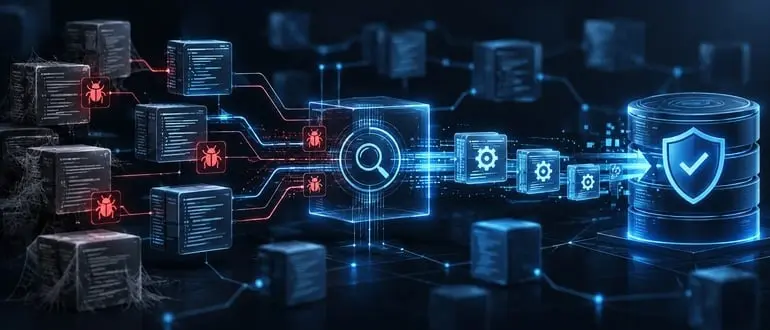
This widening chasm—the velocity at which AI writes cloud infrastructure versus the care with which security teams audit it—has transitioned from a theoretical thought experiment into an urgent operational crisis. It is surfacing in production outages, compliance audit failures, and an escalating public record of Common Vulnerabilities and Exposures (CVEs).
This is not a debate over whether AI coding assistants are fundamentally beneficial. They are undeniably powerful, save countless hours of boilerplate drafting, and are firmly entrenched in the modern software development lifecycle. Rather, this is about a specific, highly measurable failure mode that standard CI/CD pipelines were never architected to catch. As organizations race to adopt agentic workflows and automated code generation, the underlying infrastructure powering these applications is quietly becoming a massive attack surface.
To prevent widespread compromises, platform teams must fundamentally redesign their security posture. They can no longer afford to treat AI-generated code like a minor autocomplete convenience. Instead, they must treat it with the same rigorous skepticism traditionally reserved for an unvetted contractor or a brand-new hire on their very first day.
Detailed Chronology: From Experimental Benchmarks to Production CVEs
The journey of AI code generation from a helpful novelty to a critical enterprise vulnerability vector has unfolded rapidly over the past few years, highlighted by key research milestones and real-world incidents.
May 2025: Establishing the Baseline of Real-World Risk
The reality of AI security debt began to take shape publicly when Georgia Tech’s Systems Software & Security Lab launched the Vibe Security Radar project in May 2025. Headed by researcher Hanqing Zhao, the initiative set out to answer a question that standard lab benchmarks routinely missed: Not what AI models might generate under sterile testing conditions, but what they were actually producing in live software running across the open-source ecosystem.
Using an auditable methodology, the research team began pulling fix commits from CVE.org, the National Vulnerability Database (NVD), the GitHub Advisory Database, and OSV. By tracing those bugs backward through Git history to identify the exact commit that introduced the vulnerability, the team looked for clear signatures of AI tooling—such as specific bot email addresses, co-author tags, or distinct structural patterns. Where metadata fell short, specialized AI agents were deployed to investigate repository histories for causality.
Spring 2026: The Landmark Studies
By the spring of 2026, empirical data caught up with anecdotal warnings. In April 2026, IOActive published its landmark whitepaper, The Security Gap in AI-Generated Code. It remains the most rigorous test of its kind, evaluating 27 leading AI models using 730 real-world prompts across 27 programming languages. The prompts were intentionally designed not to mention security considerations—mirroring how everyday developers prompt their assistants for quick functional solutions.
The findings were stark: the average security performance across all models languished at 59%, with nearly one-third of all generated code samples turning out to be fully exploitable. Not a single model configuration tested clean. Even the best-performing setup yielded 90 distinct vulnerabilities across the sample pool.
Shortly thereafter, Veracode released its Spring 2026 GenAI Code Security Update. Testing over 100 large language models against common threats like SQL injection, cross-site scripting (XSS), log injection, and insecure cryptography, Veracode discovered that only about 55% of AI-generated code tasks produced secure code out of the box.
Crucially, this metric had remained virtually stagnant for two years, even as syntax correctness skyrocketed past 95%. Models had learned to write code that compiles and runs flawlessly; they simply hadn’t learned to write code that is safe to execute.
March 2026: The CVE Surge
The theoretical risks identified in labs translated directly into public software vulnerabilities by early 2026. The Vibe Security Radar confirmed 74 CVEs directly traceable to AI-generated code across roughly 50 distinct AI coding tools.
The trajectory of these discoveries proved alarming:
- January 2026: 6 confirmed cases.
- February 2026: 15 confirmed cases.
- March 2026: 35 confirmed cases in a single month—surpassing the total confirmed cases from the entire second half of 2025.
Researchers noted that this data represents a floor rather than a ceiling. Because many AI-assisted commits lack explicit metadata trails, the true prevalence of AI-linked vulnerabilities across the global open-source landscape is estimated to be five to ten times higher than official figures suggest.
Supporting Context & Metrics: The Infrastructure Blind Spot
While application code vulnerabilities (such as improper input validation or memory corruption) are widely understood, the IOActive study revealed a terrifying truth for platform engineers: deployment infrastructure is significantly more vulnerable than general application code.
The IaC and Container Deficit
According to IOActive’s dataset, deployment infrastructure—encompassing container definitions, CI/CD pipeline configurations, and serverless architectures—came back 57.5% vulnerable on average, performing notably worse than standard application code.
Among all evaluated artifacts, Dockerfiles stood out as the single worst-performing category, exhibiting near-universal failure rates. Why? Researchers concluded that public AI training datasets are heavily skewed toward traditional application programming languages. Infrastructure-as-Code (IaC) remains a genuine blind spot in the training material, leaving models ill-equipped to write secure container setups, Kubernetes RBAC policies, or Terraform modules.
While memory-safe languages like Rust and Go offered some protection for general application logic, that advantage largely evaporated the moment cryptographic operations or infrastructure configurations were introduced.
Exposed Secrets and "Vibe-Coding" Pitfalls
Parallel research from cloud security firm Wiz underscored a related crisis: the proliferation of exposed secrets and hardcoded credentials. Scanning thousands of applications built using rapid AI generation ("vibe-coding"), Wiz uncovered widespread API keys, database credentials, and authentication tokens baked directly into source code and deployment configurations. This was not merely the result of a few careless junior developers; it pointed to a systemic pattern in how AI tools autocomplete context-free environment variables and mock configuration files.
Official Statements and Industry Perspectives
Security leaders and academic researchers have begun sounding the alarm, urging organizations to overhaul their governance models before automated infrastructure deployments lead to catastrophic cloud breaches.
"The data shows a clear disconnect between syntactic correctness and security hygiene," noted lead researchers behind the Vibe Security Radar. "When developers rely on AI to spin up complex container environments and pipeline configurations in seconds, they are frequently importing legacy anti-patterns and unvetted default permissions at an unprecedented scale."
Security analysts emphasize that traditional perimeter defenses are ill-equipped for this wave of threats. Because AI-generated infrastructure often looks syntactically valid and passes native parsing tools (such as terraform validate), it slips past human reviewers who assume the machine-written code has already been vetted.
Furthermore, organizations like the Cloud Security Alliance (CSA) have highlighted that standard vulnerability management tools must evolve. Security tooling can no longer operate solely at the application layer; it must intercept and interrogate every automated commit that interacts with cloud provisioning layers, identity and access management (IAM), and network topologies.
Designing a Resilient Pipeline: Trust, Verify, and Restrict
For years, the DevOps mantra of "shifting security left" implied embedding static analysis into integrated development environments (IDEs) and pull requests, operating under the assumption that a human was designing the architecture while an AI merely autocompleted individual lines.
That paradigm is obsolete. Modern AI agents draft entire multi-file Terraform modules, intricate Kubernetes cluster roles, and complete CI/CD pipelines in a single prompt execution.
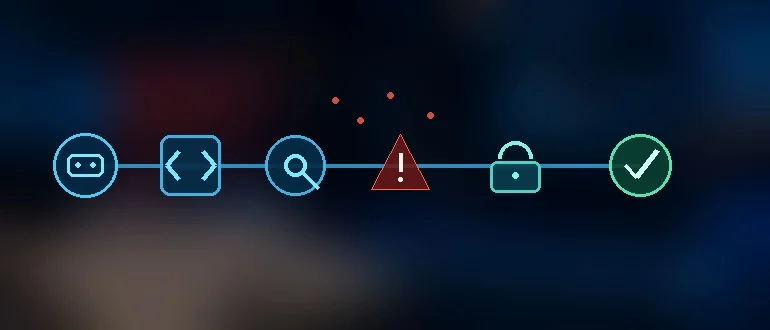
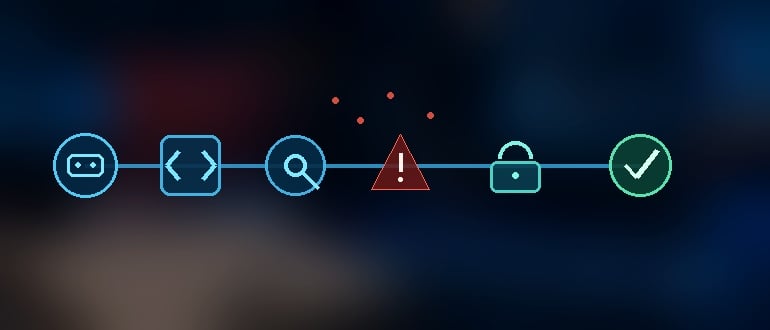
To counter this, platform teams must architect pipelines that treat AI-authored infrastructure changes as higher-risk by default, subjecting them to automated layers of scrutiny before a human ever lays eyes on the pull request:
[Developer (AI-Assisted) Commits Code]
                 │
                 ▼
[Pre-commit Policy Check (Block Obvious Anti-Patterns)]
                 │
                 ▼
[Terraform Validate / Helm Lint (Syntax & Parsing Verification)]
                 │
                 ▼
[IaC Misconfiguration Scan (Checkov, tfsec, or equivalent)]
                 │
                 ▼
[Container & Dependency Scan (Trivy or equivalent)]
                 │
                 ▼
[Policy as Code Enforcement (OPA / Conftest - Org Rules)]
                 │
                 ▼
[Secret Detection (TruffleHog or equivalent)]
                 │
                 ▼
[Provenance-Flagged Human Review]
                 │
                 ▼
       [Merge ──► Deploy]
Implementing Automated Infrastructure Gates
To operationalize this workflow, teams can integrate standard open-source security scanners into their version control pipelines. Below is a minimal GitHub Actions configuration designed to ensure that infrastructure code—especially AI-authored changes—cannot bypass automated safety checks:
name: infra-security-gate

on:
  pull_request:
    paths:
      - '**/*.tf'
      - '**/Dockerfile'
      - '.github/workflows/**'

jobs:
  scan:
    runs-on: ubuntu-latest
    steps:
      - name: Checkout Repository
        uses: actions/checkout@v4

      - name: Validate Terraform Syntax
        run: terraform validate

      - name: Scan IaC for Misconfigurations
        uses: bridgecrewio/checkov-action@master
        with:
          directory: .
          soft_fail: false

      - name: Scan Container Images and Dependencies
        uses: aquasecurity/trivy-action@master
        with:
          scan-type: 'fs'
          severity: 'CRITICAL,HIGH'
          exit-code: '1'

      - name: Check Org Policy Compliance
        uses: open-policy-agent/conftest-action@main
        with:
          policy: ./policy
          files: '**/*.tf'

      - name: Scan for Exposed Secrets
        uses: trufflesecurity/trufflehog@main
        with:
          extra_args: '--fail'
A Maturity Model for Governing AI-Generated Infrastructure
Organizations vary widely in their readiness to manage AI code generation. Platform engineering groups typically fall into one of four maturity tiers:
- Level 1: Manual Trust — AI writes infrastructure code, and humans review it using standard pull request workflows without accounting for its AI origins. This represents the most vulnerable and prevalent baseline in the industry today.
- Level 2: Automated Gates — Basic IaC scanners, container analyzers, and secret detection tools run against all infrastructure changes prior to merging, catching mechanical errors like exposed keys or overly permissive security groups.
- Level 3: Provenance Tracking — AI-drafted code is explicitly tagged via commit metadata, PR labels, or CI indicators, ensuring that human reviewers know beforehand that the change requires deeper scrutiny. This represents the highest-leverage, most cost-effective target for most teams today.
- Level 4: Continuous Infrastructure Security Scoring — Infrastructure maintains a dynamic security posture score that updates continuously as models, prompts, and organizational policies evolve, moving beyond a single pass/fail gate at merge time.
Future Outlook: What Platform Teams Must Do This Week
As foundational AI models continue to evolve throughout 2026 and beyond, the underlying security landscape will remain dynamic. Ignoring the risks of AI-generated infrastructure is no longer an option. Platform engineering groups should take immediate, actionable steps this week:
- Tag AI-Assisted PRs: Implement mandatory labeling for pull requests containing AI-generated Terraform, Helm charts, Dockerfiles, or pipeline YAML so they follow a distinct, rigorous review path.
- Enforce Automated Scans: Deploy dedicated IaC misconfiguration scanners and secret detectors against those tagged workflows immediately.
- Lock Down Agent Permissions: Set AI agent tokens, IDE plugins, and automated service accounts to read-only by default. Elevate access privileges only through deliberate, logged authorization—never as an out-of-the-box setting.
- Audit Regularly: Revisit and update these security controls quarterly to keep pace with shifting model behaviors and emerging threat vectors.
Conclusion
Embracing AI-assisted infrastructure is essential for maintaining engineering velocity, and the productivity benefits are here to stay. However, treating AI-generated code with blind trust is a recipe for disaster.
The most successful platform teams will treat AI assistants the same way they treat a brilliant, fast-moving junior engineer in their first week on the job: capable of producing incredible work, but never permitted to push code to production without thorough oversight from someone who fully understands the security implications of every single line. The next era of platform engineering will not be defined by how fast AI can spin up cloud resources, but by how confidently an organization can prove that those resources are secure enough to withstand real-world attacks.
Frequently Asked Questions
Why is AI-generated infrastructure code riskier than application code?
Infrastructure code directly controls cloud permissions, network boundaries, container runtimes, and deployment pipelines. Because public training datasets are heavily skewed toward traditional application programming languages, AI models frequently treat Infrastructure-as-Code (IaC) as a blind spot, generating outdated configurations, overly permissive access rules, and vulnerable container definitions.
What specific automated checks should AI-authored IaC undergo?
AI-authored infrastructure code should pass through a comprehensive pipeline including syntax validation, IaC misconfiguration scanning (e.g., Checkov, tfsec), container and dependency checks, policy-as-code enforcement (e.g., Open Policy Agent), aggressive secret detection, and provenance-aware human review.
What are the first steps platform teams should take to mitigate this risk?
Teams should immediately begin tagging AI-generated infrastructure changes in their version control systems, routing those changes through dedicated misconfiguration and secret scanners, and ensuring that all AI agent credentials and developer tools operate under read-only permissions by default unless explicitly granted broader access.