Executive Overview
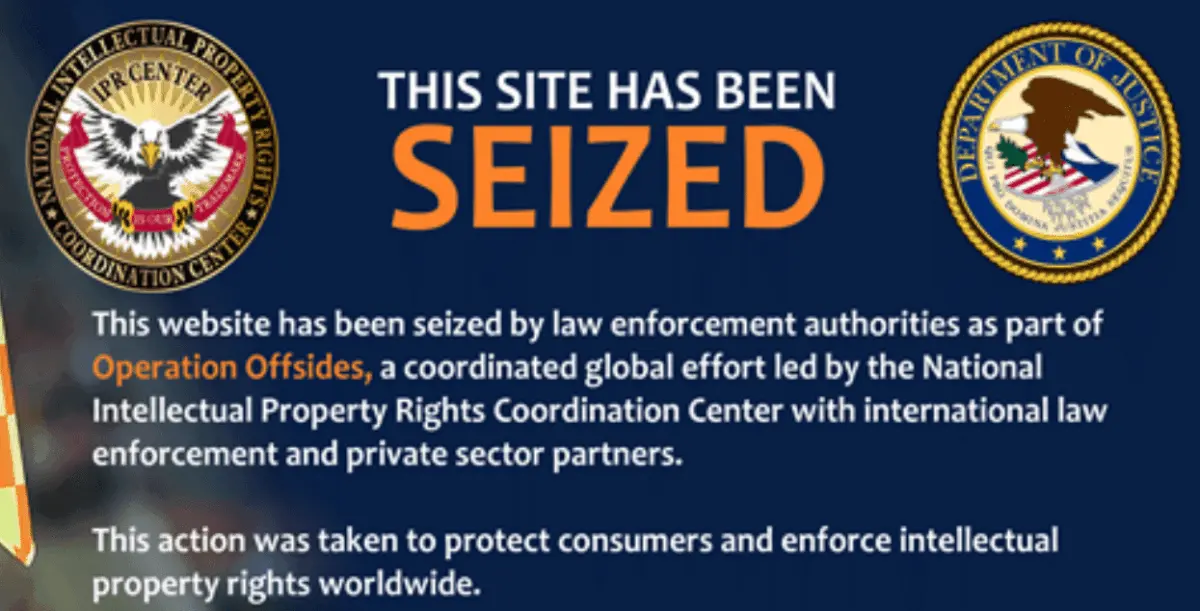
In the wake of what law enforcement hailed as the largest sports piracy crackdown in history, the enforcement apparatus driving the effort has delivered a surprisingly candid assessment of its own limitations. "Operation Offsides," a coordinated global enforcement blitz executed during the FIFA World Cup, successfully seized more than 1,000 pirate streaming domains, while international partners blocked nearly 2,000 additional URLs across Latin America. Yet, despite disrupting platforms that collectively drew over 156 million visits in July alone, key figures behind the operation admit that domain seizures alone are no silver bullet.
In a recent op-ed published by RealClearMarkets, Motion Picture Association (MPA) Chairman and CEO Charles Rivkin and National Intellectual Property Rights Coordination Center (IPR Center) Director Ivan Arvelo laid bare the structural limitations of traditional domain takedowns. While acknowledging that these interventions successfully interrupt consumer access, the co-authors conceded a stark reality: "A takedown is essential, and it can interrupt access for a moment. But it does not dismantle the business behind it."
This high-level admission serves a dual purpose. On one hand, it corroborates investigative findings regarding the resilience of pirate infrastructure, which often utilizes geopolitical blind spots—such as Iranian and Soviet-era top-level domains—to evade U.S. law enforcement. On the other hand, it acts as a calculated policy push for a renewed legislative agenda. The MPA and IPR Center are using the post-World Cup analysis to spearhead a resurgent campaign for judicial site-blocking legislation in the United States, positioning it as the missing linchpin in America’s intellectual property enforcement toolkit.
Detailed Chronology: Operation Offsides and the World Cup Crackdown
The enforcement narrative surrounding Operation Offsides began long before the first whistle of the FIFA World Cup blew. Recognizing the immense global viewership and advertising revenue associated with the tournament, copyright holders and federal agencies prepared an unprecedented, multi-jurisdictional defense of live sports broadcasting rights.
Phase 1: Pre-Tournament Mobilization and Strike
As the tournament kicked off, the Alliance for Creativity and Entertainment (ACE)—the anti-piracy coalition operated by the MPA—alongside U.S. federal agencies and global law enforcement bodies, initiated a sweeping offensive. The primary objective was to target the infrastructure of major illegal sports streaming aggregators before they could capitalize on peak match-day traffic.
Throughout the tournament, U.S. authorities systematically targeted and seized domain names associated with high-profile streaming operations. Concurrently, regional partners in Latin America enacted automated and judicial blocks against roughly 2,000 mirror sites. By the time the tournament concluded, Operation Offsides had claimed over 1,000 pirate domains in the United States alone.
Phase 2: The Evasion and the Fallback Strategy
Despite the scale of the disruption, the underground streaming economy proved remarkably agile. Within weeks of the initial wave of seizures, investigative reporting revealed that several prominent pirate sports brands—including household names in the illicit streaming community such as Buffstreams, Footybite, Totalsportek, and Nflbite—had successfully re-established operations using fallback domains.
Rather than relying on registrars susceptible to U.S. subpoenas, these operators migrated their infrastructure to Iran’s country-code top-level domain (ccTLD), .ir. Operating within the Iranian registry provides a layer of geopolitical immunity; Iranian authorities have little incentive to cooperate with U.S. law enforcement or respect American copyright judgments.
While .ir domains carry distinct commercial disadvantages—most notably complications with mainstream Western advertising networks and payment processors—they offered a functional harbor for operators determined to stay online. Consequently, despite losing their primary U.S.-backed domains, these networks remained accessible to millions of global viewers.
Phase 3: The Geopolitical Blind Spot and Mega-Sites
Compounding the challenge for enforcement agencies was the sheer volume of traffic absorbed by operations that never relied on Western infrastructure in the first place. For instance, the popular streaming brand Futbol-libres continued operating on the .su registry—a legacy Soviet Union top-level domain managed outside traditional Western regulatory frameworks.
According to data analytics from Similarweb, the Futbol-libres .su domain alone drew more than 200 million visits in July. To put that figure in perspective, it eclipsed the combined traffic of all 1,000-plus domains seized by U.S. authorities during the same period (which accounted for 156 million visits). This stark metric underscored a fundamental vulnerability in current enforcement models: domain seizures primarily punish compliance-adjacent operators while leaving entrenched, geopolitically insulated syndicates untouched.
Supporting Context & Metrics: The Anatomy of Modern Live Sports Piracy
To understand why the MPA and IPR Center are pivoting toward a more aggressive legislative strategy, one must examine the economics and metrics driving the modern live sports piracy ecosystem.
The Scale of the Enterprise
Live sports piracy is no longer the domain of casual hobbyists running servers out of college dormitories. It has evolved into a sophisticated, multi-million-dollar illicit industry fueled by programmatic advertising, cryptocurrency donations, and subscription-based access models.
During major international events like the World Cup, the velocity of traffic is staggering. Millions of viewers, priced out of escalating cable subscriptions, pay-per-view fees, or fragmented streaming packages, turn immediately to aggregator sites. These platforms monetize their user base through intrusive pop-up ads, malware vectors, and betting affiliate links.
Infrastructure Fragmentation
Modern pirate operations utilize a decentralized web of services to protect themselves against single points of failure. As outlined by enforcement experts, a typical pirate streaming network relies on:
- Domain Names: The user-friendly web addresses easily targeted by seizures.
- Hosting Providers: Often based in offshore, "bulletproof" hosting jurisdictions that ignore DMCA takedown notices.
- Content Delivery Networks (CDNs): Used to distribute video streams efficiently without overloading origin servers.
- Payment Systems: Ranging from legacy credit card processors using shell companies to decentralized cryptocurrencies like Bitcoin and Monero.
Because domain names represent only the outermost layer of this complex architecture, simply seizing a URL is akin to changing the lock on a front door while leaving the windows wide open. The operators retain their content, their database of users, and their revenue channels; they merely point a new domain to the same underlying server infrastructure.
Official Statements and Industry Perspectives
The realization that domain seizures are merely a speed bump for sophisticated criminal networks has prompted a frank reassessment from key industry and law enforcement leaders.

Charles Rivkin and Ivan Arvelo: The RealClearMarkets Op-Ed
In their joint op-ed, Blowing the Whistle on World Cup Piracy, MPA CEO Charles Rivkin and IPR Center Director Ivan Arvelo pulled back the curtain on the limits of current enforcement capabilities. They wrote:
"A takedown is essential, and it can interrupt access for a moment. But it does not dismantle the business behind it."
The co-authors emphasized that protecting the intellectual property of creators, broadcast partners, and sports leagues requires an evolution in strategy. While praising Operation Offsides as a landmark achievement that disrupted millions of illicit visits, they stressed that law enforcement cannot simply seize its way to victory against a hydra-headed adversary.
Larissa Knapp: Targeting the Broader Ecosystem
Expanding on these sentiments, MPA Executive Vice President and Chief Content Protection Officer Larissa Knapp offered detailed insights into how ACE and its global partners are adapting their methodologies. Speaking with TorrentFreak, Knapp acknowledged the persistent game of whack-a-mole defining modern digital enforcement:
"Piracy operators regularly move domains and infrastructure in an effort to evade enforcement. The migration to .ir domains is another example of that tactic, but changing a domain does not put an illegal operation beyond reach," Knapp stated.
She emphasized that effective enforcement demands a holistic approach that targets every link in the criminal supply chain:
"These services still depend on identifiable operators, hosting, distribution, payment systems, and other technical and commercial infrastructure. That is why ACE works closely with law enforcement and industry partners around the world to identify and disrupt the people and infrastructure that keep these criminal networks operating."
Future Outlook: The Push for U.S. Site-Blocking Legislation
The convergence of operational limitations, geopolitical workarounds like Iranian and Soviet-domain migrations, and massive traffic flows on untouched mega-sites has created an acute sense of urgency among copyright holders. The definitive policy solution being championed by the MPA, the IPR Center, and their legislative allies is clear: judicial site blocking in the United States.
What is Site Blocking?
Unlike domain seizures—which require registries to revoke or transfer ownership of a web address—judicial site blocking empowers or compels Internet Service Providers (ISPs) to block domestic consumer access to designated copyright-infringing domains at the network level.
Proponents point out that this mechanism is hardly radical; it is already utilized in nearly 60 countries worldwide, including the United Kingdom, Australia, and much of the European Union. In these jurisdictions, rightsholders can secure expedited court orders requiring ISPs to prevent users from reaching flagrant piracy hubs, regardless of whether those domains are hosted on domestic registries, Iranian .ir servers, or Soviet .su architectures.
Momentum on Capitol Hill
The call for U.S. site-blocking legislation is gaining renewed traction within American political circles. On June 30, the House Intellectual Property Subcommittee convened a high-profile hearing on online copyright enforcement. During the session, Subcommittee Chairman Rep. Darrell Issa signaled that bipartisan and bicameral consensus regarding enhanced enforcement tools was closer than ever before.
While a unified federal site-blocking bill has yet to be formally introduced, political analysts agree that its arrival is likely only a matter of time. However, the path forward will not be without friction.
Anticipated Hurdles and Overblocking Concerns
The prospect of implementing mandatory ISP-level site blocking in the United States immediately raises significant legal, technical, and free-speech concerns. Critics, including major tech coalitions and digital civil liberties organizations, have long warned against the risks of "overblocking"—a phenomenon where legitimate websites, blogs, or cloud services are inadvertently rendered inaccessible due to overly broad court orders or shared IP infrastructure.
Furthermore, even if U.S. site-blocking legislation passes, it will face the immutable laws of technological escalation. Just as operators adapted to domain seizures by migrating to .ir and .su domains, sophisticated pirate networks are already preparing countermeasures, such as decentralized peer-to-peer streaming protocols, encrypted DNS configurations, and VPN-reliant user bases designed to bypass ISP-level filters entirely.
Conclusion
Operation Offsides proved that global law enforcement agencies can coordinate massive, high-impact disruptions against digital piracy networks when properly mobilized. Yet, as the architects of the crackdown themselves admit, seizing domains is akin to bailing water out of a sinking ship without plugging the leak.
As the MPA and the IPR Center pivot their advocacy toward judicial site-blocking legislation, the debate over the future of the internet enters a critical new phase. Balancing the legitimate economic interests of creators and broadcasters against the preservation of an open, accessible internet will test lawmakers, technologists, and courts alike as the technological arms race between copyright enforcement and digital piracy continues to evolve.