Executive Overview
For startup founders and early-stage CEOs, hiring executive leadership is one of the highest-stakes gambles in business. Wait too long to bring on a Vice President, and the company’s growth stalls out under the weight of operational bottlenecks. Underhire by bringing in someone junior who lacks true ownership, and you remain the de facto manager of a department you should have delegated months ago. Overhire, and you risk burning through your capital runway on an expensive executive who fails to deliver ROI.
Getting a VP hire wrong is more than just an expensive mistake—it can set a startup back an entire year. Worse yet, founders often compound the damage by hesitating to take corrective action, paralyzed by the sunk cost of the recruitment process and the disruption of another vacancy.
To cut through the ambiguity of executive evaluation, SaaS industry veteran and SaaStr founder Jason Lemkin has proposed a definitive framework. According to Lemkin, evaluating whether you have hired a "good enough" VP comes down to a rigorous, no-nonsense four-part test. If a newly appointed executive cannot clear these four hurdles within their first 30 to 60 days on the job, the data suggests they are not up to the task—and founders must act decisively rather than falling back on excuses.
Detailed Chronology: The First 60 Days of Executive Evaluation
Evaluating an executive cannot be left to gut feeling or a vague sense of "cultural fit." To protect the startup’s trajectory, founders must track concrete milestones across a disciplined 60-day timeline.
Days 1 to 30: The Inception of Trust and Momentum
During the first month, a true VP does not spend their time exclusively listening, learning, or commissioning endless internal audits. While onboarding is necessary, a high-caliber executive hits the ground running by establishing credibility with the existing team.
- Building Internal Confidence: By day 30, the team should exhibit a palpable shift in morale and trust. Employees who work on the front lines every day know immediately whether a new leader possesses the acumen to drive results. If the team’s confidence fails to build, or if skepticism deepens, it serves as an early warning indicator.
- Initial Operational Diagnostics: A real VP assesses operational friction points immediately, identifying low-hanging fruit and formulating rapid execution plans without waiting for permission or ideal conditions.
Days 31 to 60: The Delivery of Tangible Results
By the end of the second month, the honeymoon phase officially ends. This period requires observable, measurable movement across specific operational domains.
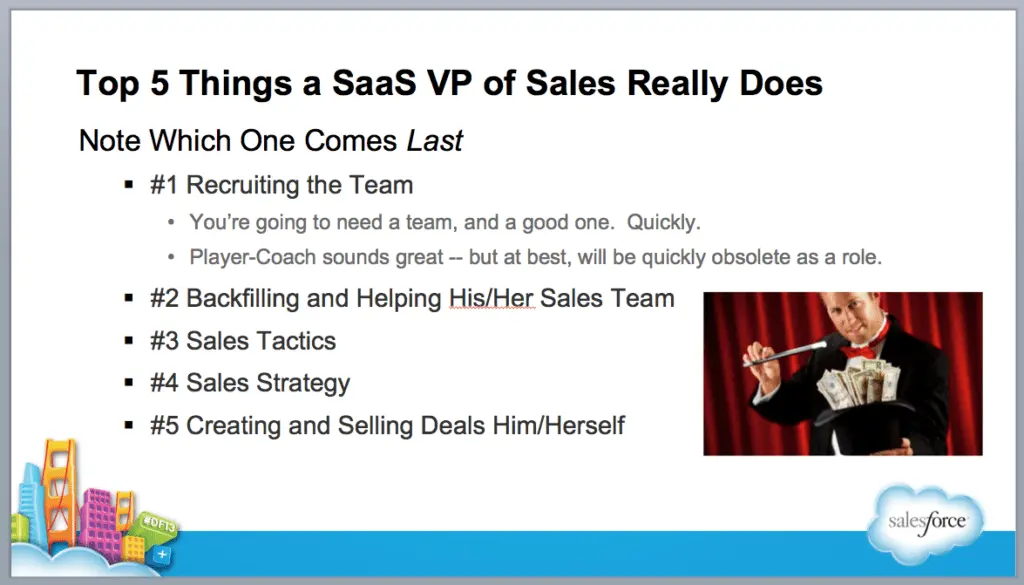
- Talent Attraction: True VPs recognize that recruiting is not a side responsibility; it is half of their job. Within 60 days, they should have successfully onboarded—or at least brought deep into the pipeline—at least one high-caliber hire, leveraging their professional network to upgrade the team.
- Metric Inflection: The primary key performance indicator (KPI) tied to their functional role must show measurable improvement. Whether it is accelerating sales velocity, increasing lead quality, reducing churn, or boosting product delivery speed, excuses regarding why progress is impossible are red flags.
- Delegation Realization: Founders should feel a tangible weight lifted off their shoulders as functional ownership transitions smoothly to the new executive.
Supporting Context & Metrics: The Four-Part VP Stress-Test
To operationalize this evaluation framework, Lemkin breaks down the assessment into four distinct criteria. Founders must apply these tests objectively, free from emotional bias or Stockholm syndrome toward their own hiring choices.
Criterion #1: Did they hire someone great in the first 60 days?
Great leaders are talent magnets. A common trap for founders is viewing recruiting as an HR function rather than a core executive duty. In reality, 50% of a real VP’s job is recruiting—first by bringing in a handful of exceptional individual contributors, and later by scaling entire departments.
The best VPs always keep one or two extraordinary candidates in their back pocket, ready to pull the trigger once they find the right home. If an executive reaches the 30- to 60-day mark without having brought a stellar hire through the door, it is a strong indicator that they lack the network, the persuasive pull, or the discerning eye required of true leadership. When this happens, founders must accept that they are dealing with a manager, not a VP.
Criterion #2: Did their primary key metric improve?
Founders cannot expect miracles overnight, but they can expect forward movement on key operational metrics within the first 60 days. The metric depends entirely on the functional domain:
- VP of Sales: Increased conversion rates, shortened sales cycles, or accelerated revenue growth.
- VP of Marketing: Higher volume and quality of inbound leads and marketing-qualified opportunities.
- VP of Customer Success: Improvements in CSAT (Customer Satisfaction), NPS (Net Promoter Score), or a reduction in gross logo churn.
- VP of Engineering / Product: Measurable increases in product release velocity and deployment stability.
A capable VP makes genuine headway on Job #1 almost immediately. Conversely, a poor fit invariably arrives bearing excuses, explaining at length why macroeconomic conditions, legacy code, or poor upstream processes prevent them from making progress so early.
Navigating Tough Economic Climates
A critical nuance in this evaluation is performance during challenging market cycles or company downturns. Counterintuitively, it is often harder to discern quick impact when a business is riding a high-growth wave, as tailwinds can mask mediocre leadership.

In tougher economic climates, however, a great VP shines immediately. They take whatever leads are available, work with the existing customer base, and optimize performance to squeeze out better results. While a VP of Sales cannot magically turn 20% stagnant growth into 100% hypergrowth overnight during a downturn, they can optimize the sales motion to lift growth to 30% or 35% through sheer execution, better discovery calls, and tighter pipeline discipline. If they accept stagnation as the status quo, they are not the right fit.
Criterion #3: Did they take part of the job off your plate?
Early-stage founders are serial delegators out of necessity, holding onto product, sales, and marketing functions long after they should have handed them over. When a startup hires its first VPs, those executives are stepping directly into functions previously owned by the co-founders.
While a founder may still need to stay close to the sales motion—especially when onboarding a new VP of Sales—they should no longer carry the full emotional and operational weight of owning that function. If, after several weeks, the founder is still doing all the heavy lifting, managing the day-to-day firefighting, and driving the strategy single-handedly, the executive has failed to provide relief. If the job does not come off the founder’s plate, a true VP has not been successfully integrated.
Criterion #4: Does the team believe?
In organizational dynamics, employees possess an unmatched radar for competence. Team members who have spent months in the trenches know their startup’s pain points intimately. They can tell almost instantly whether a newly appointed executive is driving meaningful improvements or simply hiding behind corporate jargon and strategy decks.
When an executive is pulling their weight, employee confidence rises visibly. Cross-functional collaboration improves, and morale stabilizes. If the team’s confidence does not build noticeably within the first 30 days, the writing is on the wall. The team knows the truth long before the board or the founder admits it to themselves.
Expert Perspectives & Industry Insights
The dilemma of executive mishires is one of the most frequently discussed topics in the venture capital and startup ecosystem. Industry veterans consistently emphasize that delaying a termination out of optimism is lethal to early-stage companies.
"If they don’t pass the 4-part test, they aren’t good enough. No excuses, no thinking meeting 3/4 or 2/4 of the points is OK for now. Especially no giving them more time." — Jason Lemkin, Founder of SaaStr
Venture capitalists note that founders often fall into the trap of the "stretch candidate." Hiring someone who has only performed a subset of the VP role—such as a high-performing Director stepping up to their first VP position—is a common and frequently successful strategy, provided it is done early enough in the company’s lifecycle. Stretch candidates bring hunger, adaptability, and high motivation. However, even stretch candidates must clear the core hurdles of the four-part test. If they cannot recruit talent, move core metrics, relieve founder pressure, or inspire the team, the stretch has failed.
Furthermore, management experts stress that the cost of inaction compounds daily. Every week a mismanaged department is left under underperforming leadership, top-tier individual contributors grow frustrated and begin updating their resumes. Consequently, a bad executive hire often triggers a secondary wave of attrition among the company’s best builders.
Future Outlook: Protecting Startup Momentum in 2025 and Beyond
As the startup landscape continues to evolve under tighter capital constraints and heightened expectations for capital efficiency, the margin for error in executive hiring is shrinking rapidly. Founders can no longer afford the luxury of a six-month evaluation window for C-level or VP-level talent.
Looking ahead, the best-performing startups will adopt a hyper-disciplined approach to talent acquisition and performance management. This includes:
- Front-Loading Expectations: Explicitly communicating the four-part test to candidates during the interview process, aligning expectations around the deliverables expected in the first 30 to 60 days.
- Shortening Feedback Loops: Establishing rigorous, weekly metric tracking rather than relying on sluggish quarterly reviews.
- Embracing Swift Corrective Action: Cultivating the organizational courage to part ways with executive mishires quickly, cutting losses before cultural and financial damage spreads across the enterprise.
Ultimately, the success of an early-stage startup is dictated not just by the brilliance of its founders, but by the caliber of the team they assemble around them. By applying a strict, unforgiving evaluation framework like the four-part VP test, founders can remove emotion from executive management, protect their runway, and ensure their leadership team is genuinely equipped to scale the business to new heights.