Executive Overview
In a sweeping and aggressive anti-piracy campaign, Nintendo has once again demonstrated its uncompromising stance on intellectual property protection within the digital sphere. The gaming titan recently filed seven distinct Digital Millennium Copyright Act (DMCA) anti-circumvention notices with software development platform GitHub in a single day, effectively sweeping away more than 400 Nintendo Switch emulator repositories.
The targeted digital assets represent a sprawling ecosystem of unauthorized software development, including direct copies of the controversial suyu emulator, numerous community-driven forks of the now-defunct Yuzu, and even the independent Android-based Skyline project—an initiative that voluntarily ceased development years ago. While GitHub’s automated and manual processing swiftly rendered these repositories offline, the sheer volume and speed of Nintendo’s coordinated strike highlight a persistent game of digital whack-a-mole.
This latest escalation underscores a broader industry reality: while rightsholders can efficiently scrub centralized code hosting platforms using statutory copyright frameworks, the decentralized and open-source nature of software engineering ensures that banned code has a stubborn habit of resurfacing. As Nintendo ramps up its legal and technical pressure, the battle lines between open-source preservationists and corporate copyright enforcement are sharper than ever.
Detailed Chronology: The Anatomy of a Single-Day Takedown Blitz
The friction between Nintendo and the Switch emulation community is not a sudden development; rather, it is the latest chapter in a multi-year war of attrition. To understand the gravity of this week’s seven-notice onslaught, one must examine the timeline of Nintendo’s systematic dismantling of the Switch emulation landscape.
The Fall of Giants: Yuzu and Ryujinx
The turning point in modern console emulation occurred in February 2024, when Nintendo struck a devastating legal blow against Tropic Haze, the development group behind the prominent Switch emulator Yuzu. Rather than dragging out a protracted courtroom battle that could have set sweeping legal precedents for software preservation, Tropic Haze settled with Nintendo. The terms were staggering: a $2.4 million judgment and an immediate, permanent cessation of development, distribution, and support for Yuzu and its associated tools.
With Yuzu neutralized, the vacuum was immediately filled by successors and independent developers eager to keep the technology alive. However, Nintendo’s legal apparatus kept pace. By October 2024, the pressure caught up to Ryujinx, another leading multi-platform Switch emulator. Under intense corporate scrutiny, Ryujinx abruptly shut down its operations, leaving the emulation community scrambling.
The Seven-Notice Blitz
Recognizing that individual project closures were insufficient to stop the proliferation of modified codebases, Nintendo pivoted to a broader systemic cleanup. Earlier this week, the company unleashed seven separate DMCA anti-circumvention notices at GitHub within a 24-hour window.

The scope of this maneuver was breathtaking:
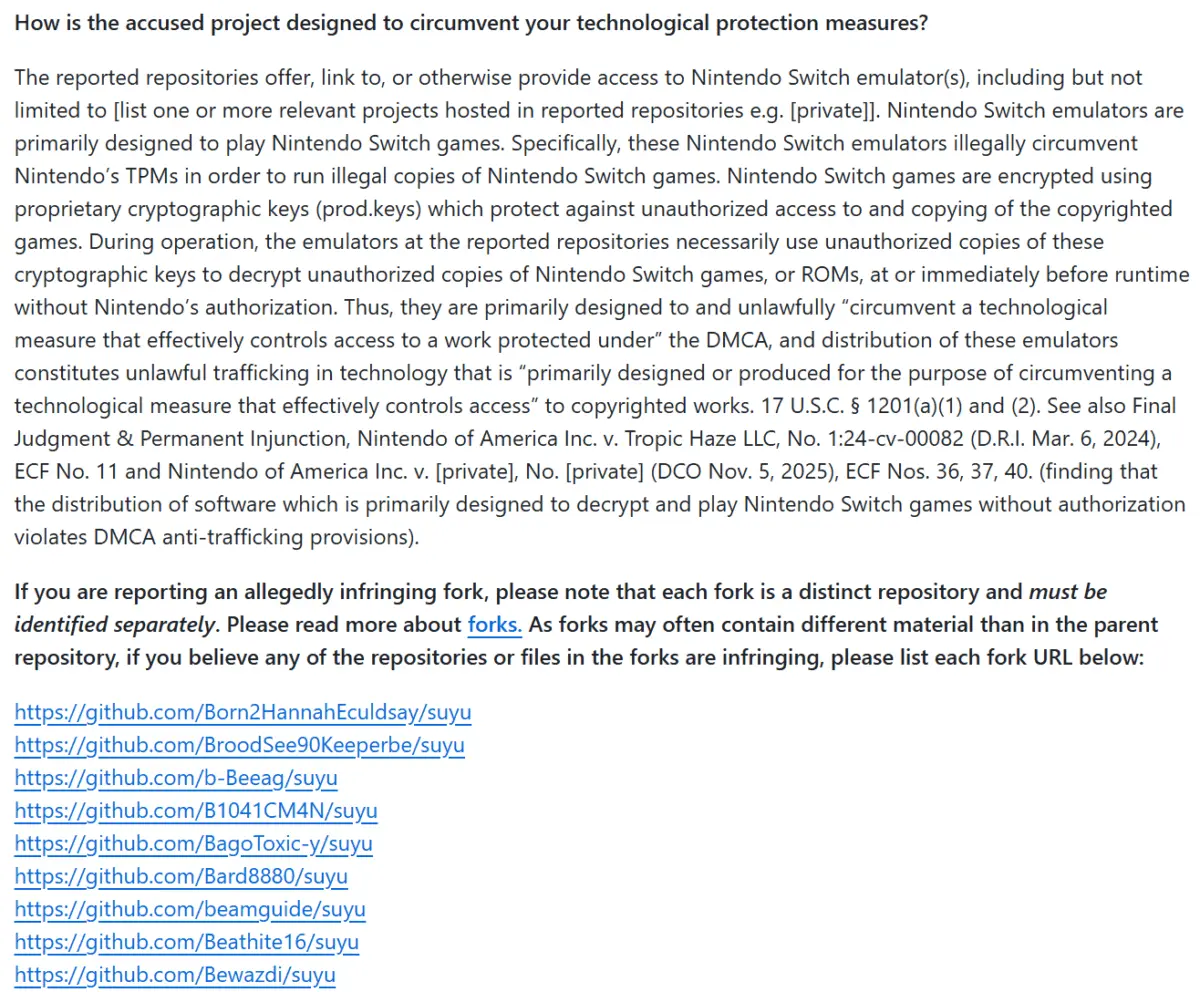
- The Suyu Network: The most extensive notice targeted vstyler96/suyu, a popular successor to Yuzu. Because the connected network of forks and mirrors exceeded 100 repositories, GitHub invoked its network-wide processing policy, wiping out an astonishing 311 repositories in a single stroke.
- The Skyline Android Project: Independent of the Yuzu ecosystem, the Skyline project—an Android-native Switch emulator that developers voluntarily shelved in 2023—was hit via its parent repository (
skyline-emu/skyline), taking down a network of 29 associated repositories. - Yuzu Forks and Ports: Additional notices targeted various iterations of the Yuzu codebase, including NicolasArvani/yuzu (14 repos), liushuyu/yuzu-android (8 repos), exverge-0/yuzu-EA4176 (21 listed forks), and IpwnedU/yuzu-master (parent repo).
- Alternative Architectures: The C#-based MonoNX project was also targeted, with 17 specific forks highlighted for removal.
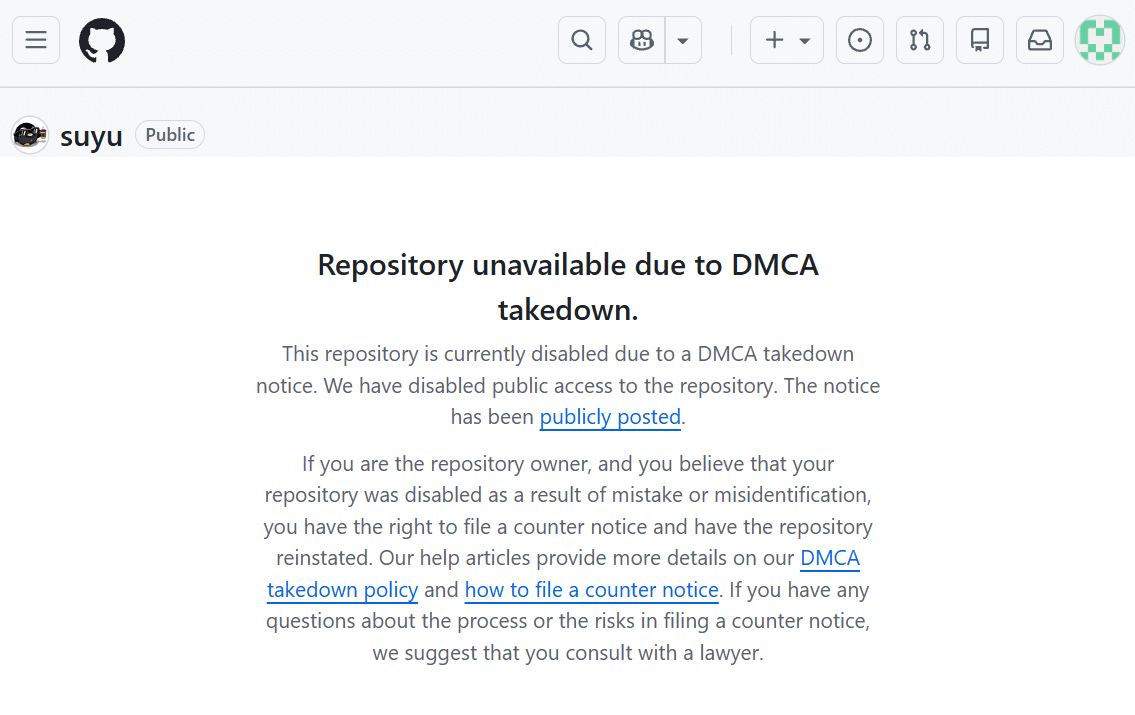
In total, over 400 repositories vanished from public view, replaced either by GitHub’s standard takedown notification or 404 error pages as developers voluntarily preempted further enforcement action.
Supporting Context & Metrics: The Mechanics of DMCA Anti-Circumvention
Nintendo’s legal strategy relies heavily on the anti-circumvention provisions of the Digital Millennium Copyright Act, shifting the narrative away from traditional copyright infringement (which often involves complex debates over fair use and reverse engineering) and focusing instead on technological protection measures (TPMs).
The Legal Argument: Cryptographic Keys and ROM Decryption
In all seven notices filed this week, Nintendo’s legal rationale remained identical: the emulators in question exist primarily to bypass the robust encryption architectures engineered into the Nintendo Switch hardware and software.
According to Nintendo’s filings:
"During operation, the emulators at the reported repositories necessarily use unauthorized copies of these cryptographic keys to decrypt unauthorized copies of Nintendo Switch games, or ROMs, at or immediately before runtime without Nintendo’s authorization."
By framing the software as tools designed to traffic in or bypass cryptographic measures, Nintendo bypasses the nuances of whether emulation itself is legal. Historically, clean-room reverse engineering for interoperability has enjoyed a protected status under U.S. law (as established in landmark cases like Sega Enterprises v. Accolade, Inc.). However, Nintendo argues that modern console emulators are inextricably linked to the extraction and use of proprietary cryptographic keys (such as title keys and prod.keys) and firmware files, rendering the emulators actionable under anti-circumvention statutes.

Precedents Without a Trial
To reinforce its legal posture at the administrative level, Nintendo’s notices consistently cite two key precedents—neither of which actually established binding case law via a contested trial:
- The Tropic Haze/Yuzu Settlement (2024): Resulted in a $2.4 million consent judgment without a judicial ruling on the merits of emulator circumvention.
- The EveryGameGuru Judgment (2024): A default judgment entered against defiant streamer Jesse Keighin in a Colorado federal court, resulting in a $17,500 penalty after the defendant ceased responding and allegedly destroyed evidence.
Because GitHub processes these notices administratively rather than judicially, rightsholders do not need to prove their case in front of a judge to achieve their immediate objective. GitHub evaluates claims against its internal policies, aiming to balance developer rights with copyright holder demands, but routinely complies when notices explicitly cite anti-circumvention violations supported by recent enforcement history.
The Resiliency of Open Source: The Whack-a-Mole Problem
Despite the unprecedented scale of Nintendo’s purge, industry observers note a fundamental limitation to this strategy: the decentralized nature of open-source software.
The Zombie Code of Defunct Projects
The inclusion of the Skyline emulator in this week’s takedowns illustrates the unique challenges of modern code governance. Skyline’s core team made the conscious decision to halt development years ago to avoid legal confrontation. Yet, because the project was open source, its historical source code remained accessible to the public, waiting to be forked, studied, and built upon by independent developers worldwide.
When Nintendo targets a dormant project like Skyline, it is essentially trying to erase digital footprints that have already been copied across countless local machines, alternative code repositories, and decentralized peer-to-peer networks.
The Speed of Reproduction
For GitHub, processing DMCA notices is a streamlined administrative function. For Nintendo, drafting and submitting notices is becoming a routine operational expenditure. However, the economic asymmetry heavily favors the software’s creators and distributors.
- Creation Time: Minutes (via automated git-forking tools).
- Removal Time: Days (dependent on GitHub processing queues and legal review).
- Resurgence Time: Seconds.
As long as the underlying intellectual property of the Nintendo Switch—and its anticipated successor hardware—remains intensely desired by global gaming enthusiasts, the demand for emulation will persist. Consequently, developers will continue to experiment, write, and share code across alternative platforms that may not be as responsive to DMCA notices as GitHub.
Official Statements and Industry Impact
While GitHub maintains a neutral platform stance, its transparency reports frequently highlight the surging volume of anti-circumvention claims. GitHub representatives have previously noted that while they carefully review every claim to protect developers from overreaching censorship, clear-cut invocations of anti-circumvention law tied to known proprietary cryptographic keys leave little room for administrative pushback.
Legal scholars specializing in digital rights point out that Nintendo’s aggressive posture is effectively creating a de facto legal standard through settlement pressure rather than judicial scrutiny. By securing massive monetary judgments and default orders against defendants who lack the financial stamina to fight a multinational conglomerate, Nintendo avoids the risk of a court ruling that might formally legitimize clean-room emulation.
Meanwhile, the emulation community has grown increasingly underground. Publicly searchable repositories on mainstream platforms are being replaced by private servers, decentralized version-control systems (such as self-hosted Gitea instances), and encrypted communication channels.
Future Outlook: The Horizon of Console Emulation
As the gaming industry transitions toward next-generation hardware—with rumors and official announcements swirling around Nintendo’s upcoming console hardware—the lessons learned from the Switch emulation wars will undoubtedly shape the future of digital preservation.
- Stricter Platform Policies: Expect major code-hosting platforms to implement proactive detection tools that scan repositories for known cryptographic key structures or unauthorized hardware definitions, automating the takedown process even before rightsholders file notices.
- Increased Legal Scrutiny on Streamers and Content Creators: Nintendo will likely continue its dual-pronged approach, targeting both the software developers who write emulation code and the content creators (such as YouTubers and streamers) who demonstrate and monetize unauthorized gameplay.
- The Shift Toward Decentralization: As centralized repositories like GitHub become hostile territory for emulator projects, developers will likely migrate toward distributed, censorship-resistant architectures that cannot be easily scrubbed with a single administrative request.
Nintendo’s massive seven-notice takedown on GitHub is a masterclass in corporate copyright enforcement. By wiping out over 400 repositories in a single day, Nintendo has sent an unmistakable message to the developer community: unauthorized access to its cryptographic ecosystems will be aggressively pursued and relentlessly suppressed. Yet, as history has repeatedly shown in the digital realm, code is remarkably resilient. While Nintendo has won this particular battle on GitHub, the war for the preservation and emulation of digital entertainment is far from over.