Executive Overview
The days of development teams tethering themselves to a single proprietary AI model are officially over. Modern software engineering requires agility, context-shifting, and hyper-specific task execution, meaning developers naturally gravitate toward different foundational models depending on the problem at hand—whether it is raw reasoning, multi-turn instruction following, or low-latency code completion.
GitHub’s expansive round of updates for Copilot—unveiled in its weekly changelog covering the week of August 10—cements a monumental philosophical shift. Rather than attempting to convince the developer ecosystem that any single AI model is a silver bullet, GitHub is positioning Copilot as the ultimate orchestration layer. The goal is no longer to be the smartest model in the room; the goal is to be the most fluid environment to manage, switch, and deploy whichever models a team already trusts, spanning cloud endpoints and local hardware alike.
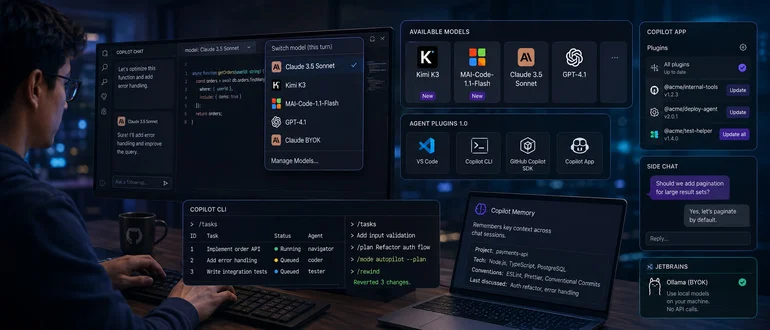
This philosophy manifests in several headline additions: the rollout of the Kimi K3 model across multiple tiers, the introduction of MAI-Code-1.1-Flash with native image understanding, per-turn model switching in Visual Studio Code 1.133, a unified Agent Plugins 1.0 ecosystem, and heavy-duty CLI automation features.
However, this unprecedented flexibility introduces significant operational and compliance hurdles. Industry experts warn that seamless, dynamic model-switching risks creating a "governance blind spot." When code is co-authored by multiple invisible AI agents within a single conversational turn without a concrete build record, tracing the provenance of a production bug becomes an arduous forensic exercise. As engineering departments standardize on multi-model workflows, platform teams are forced to balance the euphoria of frictionless AI collaboration against the sober realities of auditing, compliance, and code traceability.
Detailed Chronology & Feature Breakdown
The August updates released by GitHub reflect a relentless, weekly cadence of improvements aimed at reducing operational friction. Across IDEs, terminal interfaces, and desktop apps, the platform is evolving from a straightforward code assistant into a comprehensive, multi-model agentic workspace.
1. New Model Integrations: Kimi K3 and MAI-Code-1.1-Flash
GitHub’s multi-model strategy expands with the inclusion of two powerful additions that sit alongside existing choices rather than replacing them:
- Kimi K3: Now rolling out comprehensively across Copilot Pro, Pro+, Max, Business, and Enterprise plans, Kimi K3 brings alternative reasoning capabilities to users who need specialized handling of complex logic strings and expansive codebases.
- MAI-Code-1.1-Flash: Designed for speed and accuracy, this model arrives with native image understanding capabilities. GitHub highlights distinct performance gains in coding quality, instruction adherence, and tool execution, giving developers a rapid-fire option for lightweight tasks.
2. Per-Turn Model Switching in Visual Studio Code 1.133
One of the most technically ambitious additions in this release cycle lives inside VS Code 1.133. Developers can now switch models mid-session on a per-turn basis within a single Claude session.
- Context Preservation: Users can transition seamlessly between Claude Bring-Your-Own-Key (BYOK) configurations and built-in Copilot models without restarting their session, clearing their prompt history, or losing context.
- Workflow Continuity: A developer can initiate a architectural design phase with one model, hand off a rigorous refactoring step to a second, and execute the final debugging pass with a third, maintaining an unbroken stream of consciousness.
3. Ecosystem Consolidation: Agent Plugins 1.0
Fragmented tooling has long plagued development teams building extensions for internal workflows. Agent Plugins 1.0 has reached general availability, providing a unified architecture that operates identically across Visual Studio Code, the Copilot CLI, the GitHub Copilot SDK, and the standalone Copilot app.
- Teams that previously had to rebuild or adapt internal plugins for each surface can now deploy a single version universally.
- The Copilot app has also received dedicated plugin management features, enabling developers to monitor versions and execute individual or bulk updates straight from the Settings menu rather than hunting across multiple surfaces.
4. Advanced Terminal Automation via Copilot CLI
The Copilot CLI received the most comprehensive set of updates in this cycle, targeting terminal-bound developers who want to minimize context switching:
/tasksCommand: Allows developers to manage subagents and inspect their operational status directly from the terminal without breaking their command-line flow.- Asynchronous Queuing: Prompts, commands, and slash commands can now be queued while an agent is actively executing a task. Developers no longer need to sit idle waiting for a single step to finish before lining up the next instruction.
- Headless Mode Automations: The
--planand--mode autopilotflags can now be combined in headless mode. This automates both architectural planning and code implementation in a single, unattended pass—a boon for continuous integration (CI) pipelines and scheduled background maintenance jobs. /rewindCommand: Provides a granular safety net by letting developers reverse Copilot’s changes locally without relying directly on Git, protecting workflows where pristine commit histories are difficult to maintain during experimental phases.
5. JetBrains Enhancements and Local Ollama Support
JetBrains users saw two notable upgrades addressing state management and local execution:
- Copilot Memory: Retains critical project context across chat sessions, eradicating the tedious requirement to re-explain project structure, dependencies, and coding conventions every time a new chat window is opened.
- Local Ollama BYOK Support: JetBrains environments can now leverage Ollama as a bring-your-own-key provider. This brings local, privacy-first models running directly on a developer’s local machine into the Copilot fold, requiring zero external API calls.
Supporting Context & Metrics: The Shifting Developer Landscape
The architectural trajectory of GitHub Copilot reflects a broader, industry-wide acknowledgment: developers do not operate in monoliths. According to recent engineering surveys, upwards of 70% of professional developers utilize multiple generative AI tools or switch between various underlying LLMs depending on the specific phase of the software development lifecycle (SDLC).
| Development Phase | Preferred AI Capability | Primary Operational Bottleneck |
|---|---|---|
| Ideation & Architecture | Deep reasoning & contextual memory | High token latency, loss of project scoping |
| Active Coding & Refactoring | Low-latency completion, syntax precision | Model hallucination, incorrect API usage |
| Testing & Debugging | Tool use, image understanding, CLI agents | Context window degradation, mid-task interruptions |
| CI/CD & Maintenance | Headless execution, automated planning | Lack of build auditing and model provenance |
As platforms race to accommodate this multi-model reality, they are fundamentally redefining what an "IDE assistant" is. It is no longer a localized autocomplete plugin; it is a distributed operating system layer that coordinates disparate neural networks to execute complex, multi-step software engineering tasks. However, this convenience introduces a profound architectural tension between developer velocity and enterprise governance.
Official Statements & Expert Analysis
While the developer community has largely celebrated the elimination of artificial boundaries between models, industry analysts are urging caution regarding the long-term governance implications.
Mitch Ashley, Vice President and Practice Lead for Software Lifecycle Engineering and AI-Native Software Engineering at The Futurum Group, offered a sobering perspective on the hidden costs of frictionless convenience:
"Developers already run two or three models and pick by task. Per-turn switching removes the restart and the record of which model wrote which line. The next engineer reviewing that code cannot reconstruct it."
Ashley emphasized that model selection has transformed from a static configuration choice into an ephemeral runtime dependency:
"Model choice is now a runtime dependency with no field in the build record. By the time something breaks in production, that choice is invisible."
From an enterprise risk management standpoint, this opacity is concerning. When a security vulnerability or critical performance regression makes its way into a production codebase, understanding why a particular piece of logic was generated is just as important as knowing who committed it. If three different AI models contributed to a single function over the course of an interactive session—without leaving metadata markers in the commit history or build logs—debugging turns into an exercise in architectural archaeology.
GitHub’s product leadership, meanwhile, maintains that the platform’s value proposition lies in meeting developers where they are. By abstracting the underlying model infrastructure and providing robust orchestration frameworks like Agent Plugins 1.0 and side-chat management, GitHub is betting that the productivity gains of an unconstrained, multi-model environment vastly outweigh the auditing complexities—at least until standardized model-provenance telemetry catches up.
Future Outlook: Closing the Governance Gap
The rapid evolution of GitHub Copilot from a single-model coding companion into a flexible multi-model agent platform points toward a clear horizon for enterprise software development. The barriers separating IDEs, command-line interfaces, and local hardware are dissolving, replaced by an integrated, agentic fabric where developers orchestrate swarms of specialized AI models with minimal friction.
Yet, for this paradigm to achieve widespread adoption across highly regulated industries—such as finance, healthcare, and defense—the ecosystem must address the governance gap highlighted by analysts like Mitch Ashley.
Looking ahead to future iterations of Copilot and competing developer platforms, several critical milestones must be achieved:
- Metadata Tagging and Provenance Tracking: Development tools will need to introduce invisible, non-intrusive watermarking or metadata logging that records which model generated specific blocks of code, integrating this data directly into Git commit annotations and CI/CD build manifests.
- Granular Enterprise Policies: Platform administrators will require centralized controls to restrict which models can be used for specific repositories, ensuring that junior developers or automated pipelines do not inadvertently invoke unvetted external models on sensitive codebases.
- Standardized Audit Trails: As autonomous agents take on heavier workloads through features like headless mode and subagent task management, compliance frameworks must adapt to audit AI-generated pull requests with the same rigor applied to human contributions.
Ultimately, GitHub’s weekly cadence of updates demonstrates an acute understanding of modern developer workflows. By prioritizing flexibility, local execution, and seamless agent management, Copilot is successfully positioning itself as the central nervous system for AI-assisted engineering. But to secure its place in the enterprise of tomorrow, the industry must ensure that the freedom to choose your model does not come at the cost of knowing how your software was built.