As generative AI fundamentally shifts how millions discover products and services, groundbreaking research reveals an unexpected powerhouse behind AI search citations: employee and executive LinkedIn profiles.
Executive Overview
The traditional playbook for digital visibility is undergoing a seismic, structural transformation. For decades, corporate search engine optimization (SEO) focused heavily on keyword-stuffed web pages, backlink campaigns, and polished, top-down brand messaging hosted on official corporate domains. Today, however, as millions of users bypass traditional search engines in favor of conversational AI tools like ChatGPT, Claude, and Google AI Overviews, the rules of discovery have been entirely rewritten.
According to a comprehensive new study conducted jointly by media intelligence leader Meltwater and professional networking titan LinkedIn, the secret to capturing prime real estate in generative AI answers does not lie strictly within a brand’s official website or corporate social media channel. Instead, it rests firmly in the personal networks of the organization’s workforce.
Analyzing a massive dataset of 9.5 million AI-generated citations across various B2B categories and major AI search platforms, the research uncovered a striking reality: LinkedIn is one of the leading external sources cited by AI engines, and a staggering 75% of those citations originate from individual member profiles, leaving corporate pages to account for the remaining 25%.
This paradigm shift forces marketing, communications, and public relations leaders to fundamentally rethink their digital strategies. Brand authority in the age of artificial intelligence is no longer dictated solely by corporate PR statements; it is anchored in distributed subject-matter expertise, authentic human experiences, and structured thought leadership shared directly by the people executing the work every day.
Detailed Chronology: How Human Expertise Became the Ultimate AI Currency
To understand how individual LinkedIn posts evolved into an AI goldmine, it is helpful to trace the rapid evolution of digital information retrieval over the past several years.
Phase 1: The Keyword Era and the Rise of the Corporate Gatekeeper
For the better part of twenty years, search engines indexed the internet based on exact-match keywords, metadata, and algorithmic backlinks. During this era, corporate websites served as the ultimate gatekeepers of brand reputation. Companies invested heavily in publishing white papers, optimized blog posts, and press releases designed to appease search engine crawlers. Individual employee voices were viewed largely through the lens of traditional HR policies—often restricted, monitored, or kept entirely separate from public-facing marketing efforts.
Phase 2: The Generative AI Disruption
The introduction and hyper-adoption of large language models (LLMs) fundamentally altered user behavior. Consumers and business buyers alike moved away from scanning long lists of blue links, choosing instead to ask conversational, complex queries to AI engines. These systems were built to synthesize the "best available" information across the web, filtering out generic marketing fluff in favor of specific, contextual, and actionable insights.
As AI models matured, their underlying algorithms developed a sophisticated appetite for trust, credibility, and real-world utility. Polished brand messaging, while useful for corporate alignment, often lacked the granular, day-to-day operational details that users—and by extension, AI search algorithms—were desperately seeking.
Phase 3: The Discovery of the LinkedIn Ecosystem
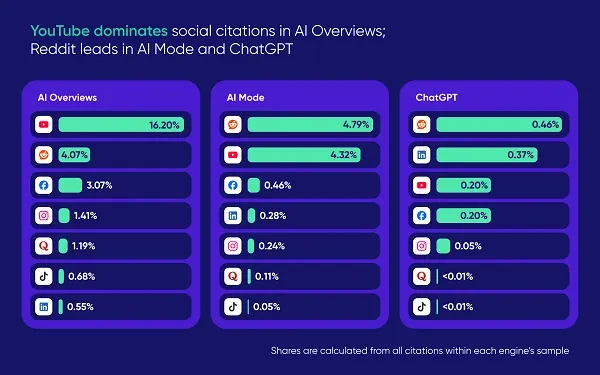
As Meltwater and LinkedIn began tracking citations across 9.5 million data points, a clear pattern emerged. AI models were consistently pulling professional insights, frameworks, and data points from social networks, with LinkedIn emerging as a premier repository of high-trust professional knowledge.
Crucially, the data demonstrated that AI crawlers heavily favored personal accounts over corporate pages. Why? Because individual profiles inherently carry the signals of human experience—firsthand observations, nuanced industry analysis, and practical, peer-tested advice. The corporate gatekeeper was effectively bypassed, replaced by the decentralized network of the modern enterprise.
Supporting Context & Metrics: Decoding the Meltwater & LinkedIn Research
The numbers behind the Meltwater and LinkedIn study offer a definitive roadmap for modern digital marketers. Examining the mechanics of what makes content "AI-citable" reveals precisely why individual LinkedIn profiles are outperforming corporate channels in the race for AI visibility.
The 75/25 Rule of AI Citations
The most eye-opening metric from the research is the distribution of citations:

- 75% of LinkedIn citations in AI search engines originate from individual member profiles.
- 25% of citations originate from official company pages.
While company pages remain vital for top-of-funnel brand awareness, employer branding, and official announcements, they are fundamentally limited by their top-down nature. AI systems recognize that individual profiles managed by real practitioners—executives, product managers, engineers, strategists, and customer success leaders—offer a level of authenticity and specific contextual depth that corporate pages struggle to replicate.
Anatomy of an AI-Citable LinkedIn Post
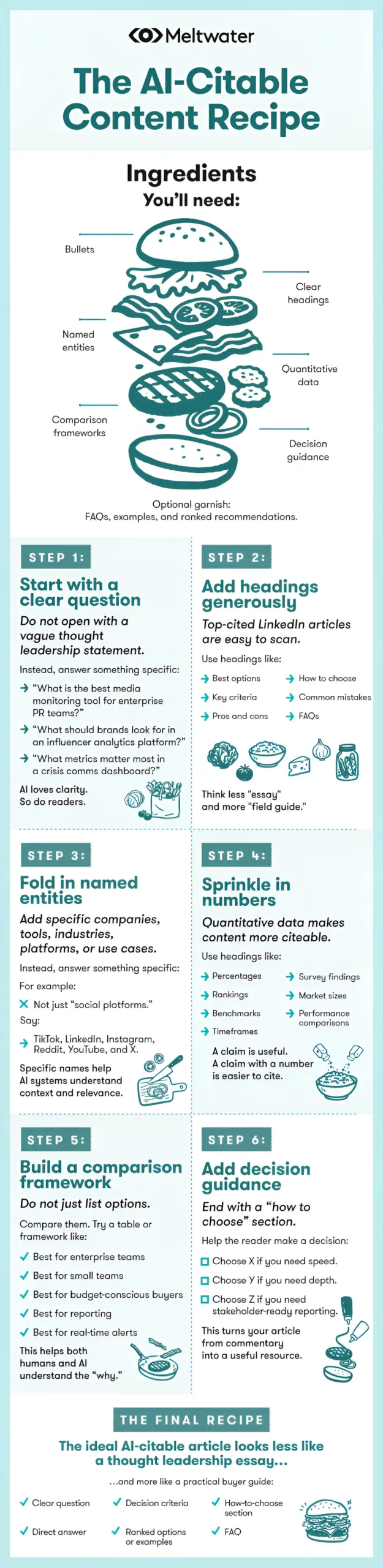
The research did not just look at who was posting; it deeply analyzed what structural elements made specific LinkedIn articles attractive to AI search engines. The findings debunk the myth that viral, emotional, or purely opinion-based thought leadership is enough to win in modern search.
Instead, AI-citable content demands rigorous structure and practical utility:
- 100% of top-cited articles in the study utilized bullet points or numbered lists. AI engines rely on structured lists to easily parse, extract, and summarize complex information for users.
- 92% of top-cited pieces featured a clear hierarchical structure utilizing H2/H3 equivalent formatting.
- 67% of top-cited posts explicitly included statistics, hard data, or empirical evidence.
Furthermore, the content formats that performed best were decidedly practical and decision-led. How-to guides, decision frameworks, comparison breakdowns, ranked lists, and buyer-focused explainers dominated the dataset. Purely opinion-driven thought leadership, while engaging for human readers looking for inspiration, frequently fell short when algorithms sought definitive, citable answers to specific professional queries.
Industry Perspectives and Expert Analysis
As these findings circulate through the marketing and communications communities, industry leaders are weighing in on what this means for organizational strategy.
"We are witnessing the democratization of brand authority," notes a prominent B2B digital strategist. "For decades, organizations tried to lock down their messaging through central communications teams. The AI search revolution proves that decentralization is no longer a risk to be managed—it is a competitive necessity. When your engineers, product leads, and executives share their raw expertise publicly, they are inadvertently building the foundational knowledge graph that AI models rely on to recommend your brand."
Content marketing experts emphasize that the traditional view of employee advocacy—often characterized by forcing employees to share corporate press releases or promotional links—is officially dead.
"Employees don’t want to act as digital billboards for corporate marketing, and AI algorithms certainly don’t care about corporate propaganda," explains a leading corporate communications director. "The new playbook requires brands to act less like broadcasting networks and more like editorial publishers. Our job is to empower our subject-matter experts, give them the data and structural frameworks they need, and get out of their way so their authentic voice can shine."
Future Outlook: The New AI Visibility Strategy
For businesses looking to future-proof their digital footprint, the Meltwater and LinkedIn research provides an actionable, step-by-step blueprint. Adapting to the AI search era requires a strategic pivot across three core pillars:
1. Shift from Corporate Broadcasting to Expert Activation
Organizations must audit their internal talent pool to identify individuals who possess deep domain expertise. This includes C-suite executives, heads of product, senior researchers, customer-facing strategists, and technical specialists. Once identified, marketing and communications teams must transition into an editorial support function—providing these experts with research, data, and structural toolkits to help them articulate their knowledge publicly.
2. Optimize Content for Algorithmic Parsability
Creating great ideas is no longer enough; those ideas must be formatted so that generative AI systems can easily ingest and cite them. Content creators should be trained to utilize clear headings, bulleted lists, comparative frameworks, and verifiable statistics. By answering specific, high-intent buyer questions clearly and concisely, experts make their content exponentially more attractive to AI crawlers.
3. Establish Measurement and Tracking Frameworks
Visibility in AI search cannot be managed blindly. Forward-thinking brands are beginning to track how their executives, employees, and core topics appear across major generative AI platforms over time. By monitoring these AI-generated citations, marketing teams can refine their thought leadership strategies, double down on high-performing formats, and ensure their brand remains a dominant source of truth in an increasingly automated digital landscape.
Ultimately, the rise of generative AI search has not dehumanized digital discovery—it has paradoxically made genuine human expertise more valuable than ever. By unlocking the collective voice of your employees on LinkedIn, your brand can secure its place at the forefront of the next generation of search.