Executive Overview
In modern hyperscale cloud computing, operational failure rarely stems from a lack of monitoring tools. Instead, it arises from a crisis of comprehension. As global cloud platforms expand across hundreds of physical datacenters and millions of connected nodes, the sheer volume of telemetry generated per second has far surpassed the human capacity to digest, analyze, and act upon it in real time.
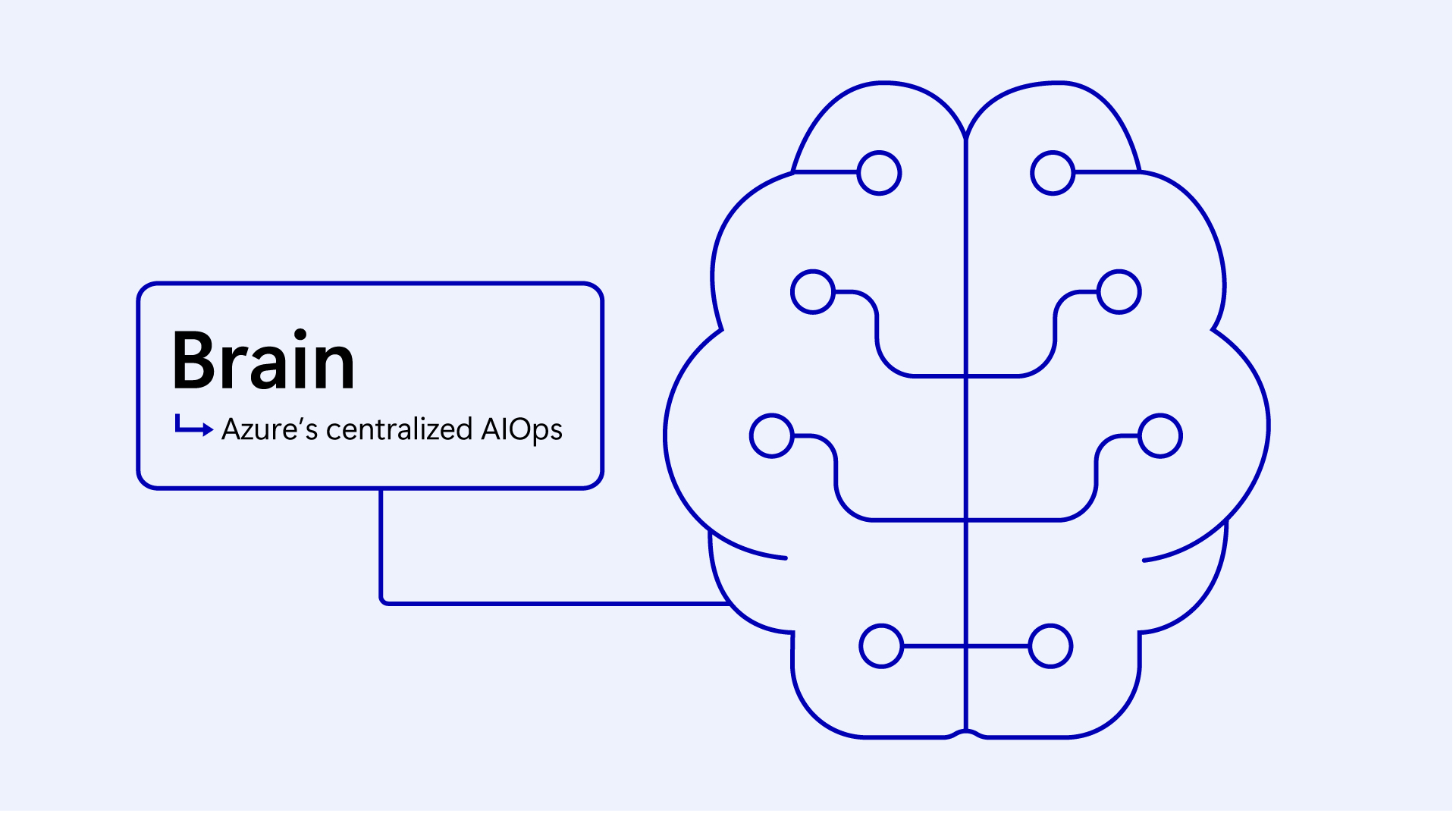
To overcome this operational ceiling, Microsoft has unveiled details on Brain, an artificial intelligence for IT operations (AIOps) intelligence system designed to act as the cognitive core of Microsoft Azure. Operating as a continuously reasoning engine integrated with the Azure Resource Graph (ARG), Brain functions as a real-time "digital twin" of Azure’s global platform health.
Rather than relying on conventional dashboard monitoring and human-managed alert thresholds, Brain continuously fuses low-level infrastructure telemetry, dynamic topology graphs, runtime deployment intent, and customer-side performance data into a unified representation of cloud health. The system currently powers core operational workflows across Azure, including automated deployment safeguards, instant resource health notifications, and automated outage declarations.
By shifting cloud operations from reactive human diagnosis to real-time machine reasoning, Brain provides the essential foundation for agentic AI across Microsoft’s global infrastructure, establishing a new architectural paradigm for cloud reliability at scale.
+-----------------------------------------------------------------------------------+
|                                  BRAIN AIOPS ENGINE                               |
|                                                                                   |
|  [ Ingested Signals ]         [ Standardized Outputs ]    [ Automated Actions ]   |
|  • Platform Telemetry         • Health State              • Deployment Safeguards |
|  • Service Dependencies   --> • Severity Level        --> • Auto-Communication    |
|  • Active Rollout Intent      • Blast Radius Impact       • Root-Cause Incident   |
|  • Customer Impact Signals    • Derived Reasoning               Routing           |
+-----------------------------------------------------------------------------------+
                                          |
                                          v
+-----------------------------------------------------------------------------------+
|                        AZURE RESOURCE GRAPH (DIGITAL TWIN)                        |
|           Continuous real-time representation of global infrastructure         |
+-----------------------------------------------------------------------------------+
Detailed Chronology: The Evolution of Cloud Reliability Architecture
The deployment of Brain marks a structural shift in how hyperscale cloud platforms manage platform health. To understand its technical necessity, one must examine the operational progression that forced a departure from traditional cloud management models.
   1. Static Alerting Era         2. Hyperscale Friction          3. The Digital Twin Era       4. Autonomous Operations
+-------------------------+    +--------------------------+    +------------------------+    +-------------------------+
| • Rule-based metrics    | -> | • Dashboard proliferation | -> | • Brain AIOps layer    | -> | • Agentic AI control    |
| • Human-led triage      |    | • Telemetry saturation   |    | • Unified health schema|    | • Self-healing platform |
| • High manual latency   |    | • "Comprehension gap"    |    | • Azure Resource Graph |    | • Predictive mitigation |
+-------------------------+    +--------------------------+    +------------------------+    +-------------------------+
Phase 1: The Static Threshold Era
In the early architecture of public cloud computing, platform health relied on threshold-based alert systems. System engineers monitored isolated services using discrete metrics such as CPU utilization, memory pressure, and network packet drop rates. When a metric crossed a predefined numerical limit, an alert was fired, prompting human operators to open an incident bridge, manually query disparate telemetry databases, and deduce root causes through manual correlation.
Phase 2: Hyperscale Growth and the "Comprehension Gap"
As Azure expanded to encompass over 80 regions, more than 500 datacenters, and over 800,000 kilometers of terrestrial and subsea fiber, the traditional model buckled under operational complexity. The platform began generating millions of telemetry signals per second.
Under these conditions, a subtle degradation in a low-level dependency—such as an underlying storage driver or a regional network switch—could trigger an "alert storm" across hundreds of downstream microservices.
The primary failure mode in cloud operations shifted: operators were no longer starved for data, but overwhelmed by it. On-call engineering teams were forced to manually reconstruct platform state during active incidents by comparing dozens of disparate dashboards. Consequently, in complex degradation scenarios, cloud providers would occasionally learn about platform faults from customer service tickets before internal systems could isolate the root cause.
Phase 3: The Architecture and Rollout of Brain
Recognizing that human cognitive limits had become the primary bottleneck in cloud availability, Microsoft Research and Azure engineering teams developed Brain. Instead of introducing additional monitoring dashboards, the team built a centralized AIOps engine directly into the control plane via the Azure Resource Graph (ARG).
Brain was designed to systematically absorb every state change, active deployment, and dependency graph across the ecosystem, creating an operational model that updates continuously.
Phase 4: Production Integration and Operational Automation
Brain transitioned from passive observation to active control. The system was granted authoritative control over resource health states and deployment pipelines. Today, when Brain identifies that an active software rollout is correlating with localized micro-degradations, it autonomously executes deployment safeguards—pausing software rollouts globally or in specific deployment rings before human operators even join an incident bridge.
Architectural Mechanics: How Brain Operates
At its core, Brain transforms unstructured platform telemetry into deterministic operational actions. The architecture relies on three primary phases: multi-source signal ingestion, multi-variable context modeling, and canonical output execution.
  INPUT SIGNALS                 BRAIN REASONING ENGINE               CANONICAL OUTPUTS
+-------------------+        +----------------------------------+    +------------------------+
| Platform Metrics  | -----> |                                  | -> | Health State           |
+-------------------+        |  Topology & Dependency Mapping   |    +------------------------+
| Runtime Intent    | -----> |                 +                | -> | Severity Classification|
+-------------------+        | Historical Telemetry Evaluation  |    +------------------------+
| Customer Signals  | -----> |                 +                | -> | Impact Blast Radius    |
+-------------------+        |     Machine Learning Models      |    +------------------------+
| Dependency Graphs | -----> |                                  | -> | Explicit Reason Code   |
+-------------------+        +----------------------------------+    +------------------------+
1. Multi-Source Signal Ingestion
Brain continuously ingests operational data across four foundational pillars:
- Platform Infrastructure Telemetry: Low-level performance counters, hardware diagnostics, host logs, and network telemetry emitted directly from physical racks, host hypervisors, and core networking gear.
- Active Runtime Intent: Up-to-the-second data detailing planned and in-flight changes, including system updates, software rollouts, feature flag toggles, and infrastructure configuration changes.
- Dependency and Topology Mapping: Dynamic topological relationships maintained within the Azure Resource Graph, mapping how virtual machines, tenant containers, storage accounts, and regional infrastructure depend on one another.
- Customer-Side Performance Signals: Synthesized, privacy-preserving performance vectors measuring end-user error rates, latency drift, and API throttling experienced by customer workloads.
2. Multi-Variable Reasoning
When telemetry indicates an anomaly, Brain does not rely on a simple binary threshold. Instead, its machine learning models evaluate the anomaly against surrounding runtime variables:
- Is the service anomaly isolated to a single virtual machine host, or is it propagating through a shared network switch?
- Is there an active software rollout in flight within the affected deployment ring?
- Does the observed metric drift match historical patterns of transient performance fluctuations, or does it resemble the early signature of a critical failure?
By answering these questions within seconds, Brain formulates an accurate assessment of system state, isolating the exact failure domain.
3. Canonical Outputs
Regardless of the target resource—whether a single customer virtual machine, an entire Azure Region, or a global platform service—Brain standardizes its conclusions into four uniform schema attributes:
  "healthState": "Degraded",
  "severity": "Sev1",
  "impact":
    "scope": "Tenant_Level",
    "affectedResources": ["VM_Resource_ID_0921"],
    "region": "eastus2"
  ,
  "reason": "Upstream Network Path Latency correlated with active build rollout ID 88291"
This uniform vocabulary ensures that all downstream operational systems—from automated communications systems to deployment controllers—act on a single, authoritative source of truth.
Supporting Context & Operational Performance Metrics
The operational impact of implementing Brain across Microsoft Azure’s infrastructure is measurable across several core reliability dimensions.
| Metric / Operational Vector | Legacy Operational Paradigm | Brain-Integrated Architecture |
|---|---|---|
| Detection Method | Metric-threshold alerts & manual query | Continuous multi-variable machine reasoning |
| Operational State Model | Fragmented across independent dashboards | Single unified digital twin via Azure Resource Graph |
| Incident Triaging | Manual correlation by on-call engineers | Automated root-dependency identification |
| Rollout Safeguards | Delayed human intervention post-alert | Real-time automated deployment pausing |
| Time-to-Notification (TTN) | High variance (manual drafting & vetting) | Near real-time automated tenant notifications |
Contrast Analysis: Incident Resolution Scenarios
To illustrate the concrete difference in operational overhead, consider a scenario where a newly deployed microservice update introduces an intermittent latency bug in a regional storage layer.
SCENARIO: Intermittent Latency Bug in Regional Storage Layer

[ Legacy Paradigm ]
00:00 - Rollout starts
00:12 - Error rates drift upward
00:20 - Multiple alerts fire across 3 separate service teams (Compute, Storage, Networking)
00:25 - Three independent incident bridges opened; duplicate triaging begins
00:40 - Engineers correlate issue to rollout; manually halt deployment
00:55 - Manual customer notifications drafted and sent
Total Elapsed Time: ~55 Minutes

[ Brain-Integrated Architecture ]
00:00 - Rollout starts
00:12 - Error rates drift upward
00:12 - Brain correlates latency drift with dynamic topology and active rollout intent
00:13 - Brain automatically pauses rollout pipeline globally; creates single root-cause incident
00:14 - Automated plain-English notifications dispatched directly to affected tenant dashboards
Total Elapsed Time: ~2 Minutes
Measured Impact on Cloud Reliability
According to data disclosed by Microsoft regarding Brain’s integration into production:
- Detection Precision: Services operating with Brain-based resource health evaluations demonstrated a marked improvement in detection precision for service-impacting incidents, drastically reducing false positives.
- Notification Latency: Across a substantial majority of platform incidents managed by Brain over the past year, service health communications were auto-generated and dispatched directly to impacted customers, substantially reducing the average Time-to-Notification (TTN) compared to manually drafted operational notices.
- Incident Suppression: By unifying root-cause attribution into a single canonical determination, Brain eliminated incident duplication across downstream service teams, reducing administrative friction during high-severity events.
Official Statements & Perspective: AI Agents Require Unified Foundations
As the broader cloud industry pushes toward autonomous systems and agentic AI, Microsoft’s engineering leadership emphasizes that deploying autonomous operational agents without a unified intelligence model is fundamentally flawed.
"Agents need something to be agentic about. Build the agents first on top of fragmented data, and you get a federation of confident systems that disagree with each other in production. Build the model first, and the agents become composable: they reason from the same picture, and the picture is one you can audit."
— Microsoft Engineering Team, AIOps & Reliability Division
This engineering perspective highlights a critical vulnerability in modern AIOps adoption: deploying large language models (LLMs) or autonomous software agents across legacy monitoring setups often leads to conflicting operational actions.
By utilizing Brain as the underlying "digital twin," any operational agent deployed within Azure operates from the exact same contextual state as human site reliability engineers (SREs). The digital twin serves as a stable, auditable factual foundation that prevents automated agents from taking hallucinated or conflicting remediation paths.
Future Outlook: Redefining the Vocabulary of Cloud Health
The deployment of Brain represents the first phase of a broader effort to modernize how cloud reliability is modeled, measured, and maintained across the tech industry.
Moving Beyond Binary Health Metrics
Historically, cloud monitoring relied on simplistic binary states: a service was either "Healthy" or "Unhealthy." However, at hyperscale, platform health exists along a continuous spectrum. A cloud platform may experience localized latency degradation that impacts isolated edge workloads without causing a complete service outage.
Microsoft’s next milestone for Brain centers on fundamentally redefining the operational vocabulary of cloud health. Future developments will focus on establishing contextual, multi-dimensional health definitions that answer complex reliability questions:
- How does a platform quantify degradation when platform infrastructure remains functional, but customer application performance drifts?
- How can autonomous systems negotiate trade-offs between immediate rollout freezes and regional traffic failovers?
- How can predictive AI models anticipate degradation caused by cascading dependency failures before any performance metric shifts?
As cloud infrastructure grows more complex, intelligence systems like Brain will transition from administrative tools to essential operational layers. By establishing a real-time, self-reasoning digital twin of platform health, Azure is laying the groundwork for an era of fully autonomous, self-healing cloud infrastructure.