Executive Overview
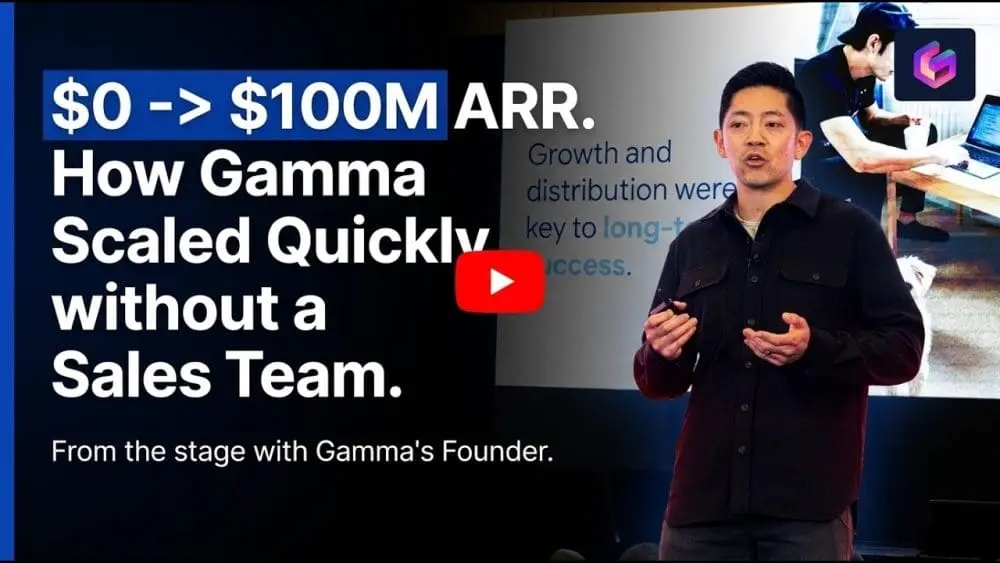
In the hyper-competitive landscape of software-as-a-service (SaaS), achieving a milestone of $100 million in Annual Recurring Revenue (ARR) is a rarified achievement. Doing so with a lean team of just 50 employees, operating profitably, and servicing an astronomical user base of 50 million people with 600,000 paying subscribers sounds like a modern tech fable. Even more startling? For the vast majority of that hyper-growth trajectory, Gamma operated without a single dedicated sales representative.
This translates to an astonishing $2 million in ARR per employee—an efficiency metric that makes traditional enterprise software business models look sluggish. At an average customer price point of roughly $167 per year, scaling to this magnitude through traditional outbound hiring is mathematically impossible. Gamma didn’t hire its way to success; its product simply sold itself.
However, behind these eye-popping financial metrics lies a profound operational paradox. Speaking candidly on the SaaStr AI stage, Gamma Co-founder and CEO Grant Lee offered a sobering retrospective on the company’s internal mechanics:
"We’ve always for better or worse been sort of reacting… I would advise maybe not do that."
While Gamma’s product-led growth (PLG) engine worked brilliantly, the cultural habit it fostered—letting the market dictate the company’s operational milestones rather than proactively designing them—carried a steep, hidden cost. This investigative report dissects how Gamma unlocked hyper-viral growth, the critical strategic missteps born from reactive management, and the invaluable lessons founders can draw from scaling an AI-native organization past the nine-figure mark.
Detailed Chronology: From False Starts to Viral Dominance
The Pivot from False Product-Market Fit
Gamma’s ascent was far from an overnight accident; it was forged through the fires of early failure. In its formative stages, the team spent two grueling years building toward a public beta. Looking back, Lee advises founders to compress that build-and-wait cycle by tenfold or more.
Initially, the team experienced a burst of validation: they captured Product Hunt’s Product of the Day, followed by Product of the Week, and eventually Product of the Month. Euphoria rippled through the team. But almost as quickly as signups spiked, they plateaued.
The underlying reality was harsh:
- There was no organic word-of-mouth momentum.
- Users weren’t naturally turning into advocates.
- Nobody was proactively telling their peers or colleagues.
The 30-Second Magic Standard
Realizing they had built a functional tool rather than a viral phenomenon, a core team of 12 people crammed themselves into a converted two-bedroom apartment in San Francisco. They gave themselves a strict three-month runway to completely rearchitect their onboarding flow around a single, uncompromising objective: make the first 30 seconds feel magical.
They understood that simply being "better than the incumbent" was a failing bar. The new standard required a user experience so shockingly delightful and frictionless within the first half-minute that users felt compelled to share it unprompted.
The Provocative Relaunch and Explosive Inbound
When Gamma finally stepped back into the public eye, they did so with calculated audacity. Their relaunch announcement on social media was deliberately provocative, spearheaded by a tweet declaring:
"The most valuable skill in business is about to become obsolete."
The statement sparked immediate industry debate—even drawing public pushback from tech luminary Paul Graham. But the friction generated attention. The tweet went viral, and with it, the product took off.
Signups surged: 5,000 a day, then 10,000, then 20,000, and eventually peaking at 50,000 daily activations. Remarkably, this entire hockey-stick curve was achieved with zero marketing spend and zero sales headcount.
Lee’s core takeaway from this phase is absolute: Word-of-mouth is the ultimate channel because it amplifies every other channel. Until a startup achieves true organic virality, spending capital on marketing is largely futile. Word-of-mouth cannot be purchased, nor can it be faked.
Supporting Context & Metrics: The Anatomy of a $100M PLG Engine
To truly grasp Gamma’s market position, it is vital to analyze the quantitative framework underpinning their business model:
- Annual Recurring Revenue (ARR): Crossed the $100M threshold.
- Headcount: Maintained a remarkably lean organization of approximately 50 employees.
- Capital Efficiency: Achieved profitability while generating roughly $2M in ARR per employee.
- User Adoption: Accumulated a massive total user base of 50 million individuals.
- Monetization Base: Converted 600,000 users into paying subscribers.
- Unit Economics: An accessible entry price point yielding an average customer value of approximately $167 annually.
These metrics place Gamma in an elite tier of high-velocity software companies. By eliminating sales cycles and relying on automated onboarding, they stripped away customer acquisition costs (CAC) during their initial expansion phase.
Yet, as Lee points out, relying entirely on self-serve dynamics creates structural blind spots. When demand scales faster than administrative infrastructure, cracks begin to show.
The Strategic Missteps: When Success Masks Strategy
Despite boasting a pristine financial report and industry-leading margins, Gamma’s journey exposes three major tactical vulnerabilities caused by a purely reactive posture.
1. Launching a Paid Product Without a Checkout System
During the height of their viral surge, Gamma shipped a credit-based system to monetize active users—without an actual billing mechanism attached to it.
Suddenly, customer support channels blew up with bewildered users asking how they could purchase more credits. Instead of capturing revenue seamlessly at the moment of peak intent, Gamma was forced to scramble. They spent critical weeks mid-surge frantically reverse-engineering pricing, packaging, and payment gateways under immense pressure.
Leaving high-intent buyers waiting at an imaginary cash register during a compounding signup surge carries an unquantifiable opportunity cost—one that highlights the danger of letting the market dictate operational readiness.
2. Treating Sales as an Emergency Cleanup Operation
Gamma did not implement a proactive sales strategy; they hired salespeople out of sheer administrative exhaustion.
The trigger wasn’t a strategic roadmap milestone, but rather the overwhelming sensation that revenue was leaking through their fingers. Inbound messages were piling up from larger organizations asking how to procure enterprise licenses for entire departments—and there was no one on the other end to answer them.
Consequently, Gamma’s sales division originated as a damage-control and cleanup operation rather than an intentional engine for expansion.
3. Leaving the Self-Serve Base Untapped
Even after scaling to 600,000 paying subscribers and a 50-million-user ecosystem, Gamma largely neglected its self-serve customer base for expansion opportunities. By Lee’s own admission, outbound initiatives remained an afterthought, with the nascent sales team primarily functioning as order-takers for inbound requests.
Consider the compounding math: If even 2% of those 600,000 paying subscribers are embedded inside enterprises that require multi-seat department packages (e.g., 50 seats per company), a massive, higher-value B2B enterprise business sits dormant within their existing database, entirely untouched.
Official Statements & Industry Reflections
The broader implications of Gamma’s journey point toward a fundamental truth about modern AI-native companies. Reflecting on their operational philosophy, Grant Lee emphasized the psychological trap of product-led growth:
"Product-led growth generates so much signal that it starts to feel like strategy. Signups climb, chat fills with feature requests, inbound piles up, and every decision arrives pre-justified by demand, so the company responds instead of choosing."
When a product experiences hyper-growth, leadership teams often mistake momentum for strategic clarity. They abandon proactive planning in favor of firefighting.
This comfortable reactive cycle persists unheeded—until market demand accelerates past the organization’s physical capacity to respond. At that point, founders find themselves building billing infrastructures in a fortnight or hastily recruiting enterprise account executives out of sheer operational guilt.
Future Outlook: The Next Phase for Gamma
As Gamma looks beyond its historic $100M ARR milestone, the roadmap ahead demands a cultural and structural evolution. The company has proven beyond doubt that it can build a world-class, frictionless, viral product. The challenge for the next chapter is moving from a posture of reaction to one of intentional design.
Key strategic horizons for Gamma include:
- Proactive Account Expansion: Transitioning their sales apparatus from passive inbound fulfillment to systematic, proactive outbound engagement within their existing database of 600,000 paying accounts.
- Enterprise-Grade Packaging: Structuring robust multi-seat pricing tiers designed to capture organizational and departmental budgets before customers demand them.
- Balancing Automation with Human Touch: Preserving the magical 30-second self-serve onboarding experience while building structured pathways to guide power users into higher-value enterprise contracts.
Conclusion: Self-Serve Buys Time, Not a Plan
Gamma’s extraordinary journey to $100 million ARR with just 50 employees will long serveas a masterclass in modern SaaS distribution. But its true value to the broader tech ecosystem lies in the candid vulnerability of its leadership.
A product fueled by genuine word-of-mouth virality gifts a startup something exceedingly rare in the B2B world: time to choose. Gamma’s ultimate lesson, delivered from the far side of nine-figure scale, is simple: once you earn that time, you must actively choose how to use it—before the market decides for you.