As global search habits undergo a tectonic shift from traditional query engines to conversational generative artificial intelligence, platforms are scrambling to secure their relevance in the new digital hierarchy. LinkedIn, the world’s preeminent professional networking platform, has officially stepped into the arena with a comprehensive new playbook designed to help brands and B2B marketers dominate AI search.
By detailing how organizations can optimize their digital footprints to capture lucrative artificial intelligence chatbot citations, LinkedIn is positioning itself not merely as a professional social network, but as an indispensable foundational engine for AI discovery. However, as marketers rush to adapt to frameworks like “The Credibility Stack,” questions loom over the risks of platform dependency versus the enduring value of establishing independent, authoritative brand equity.
Executive Overview
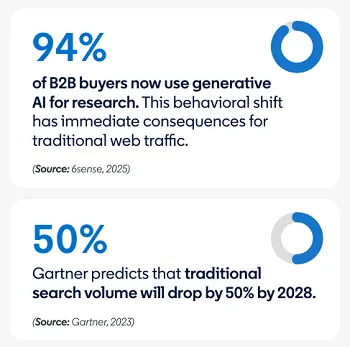
The landscape of online discovery is changing at a breathless pace. Users are no longer just browsing through pages of blue links; instead, they are turning directly to large language models (LLMs) and conversational chatbots for synthesized, direct answers. In this emerging ecosystem, visibility is dictated by citation. If an AI tool does not reference a brand, a product, or a piece of thought leadership in its generated response, that entity effectively ceases to exist for a growing segment of modern searchers.
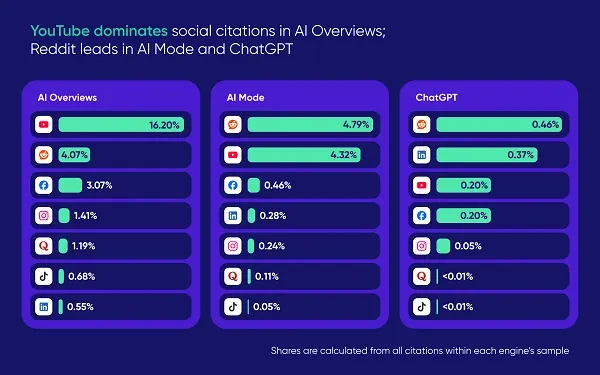
Recognizing this paradigm shift, LinkedIn published a strategic guide titled "How B2B Marketers Can Dominate AI Search on LinkedIn." The core thesis of the playbook is simple yet profound: because AI chatbots heavily weigh domain authority, verifiable expertise, and institutional trust when formulating answers, LinkedIn serves as an ideal launchpad. Third-party research indicates that LinkedIn has quietly emerged as one of the most frequently cited references in AI-driven responses.
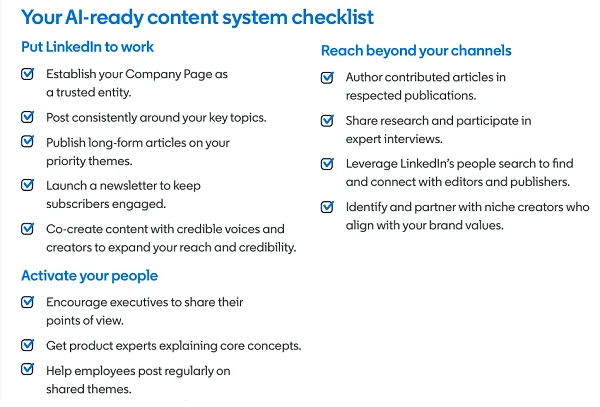
To capitalize on this momentum, LinkedIn’s new framework—dubbed “The Credibility Stack”—outlines a step-by-step roadmap. It teaches brands how to leverage the platform’s native authority algorithms, scale messaging through employee advocacy and industry creators, and structure long-form content to ensure maximum visibility among the algorithms shaping the future of search.
Detailed Chronology: The Evolution of LinkedIn’s AI Strategy
To understand the significance of the 2026 playbook, it is necessary to examine how LinkedIn has systematically transformed from a digital resume repository into a dominant content and search ecosystem.
Phase 1: The Transition to a Content-First Hub
For years, LinkedIn was viewed as a transactional space visited primarily during job hunts or periodic networking events. However, a multi-year pivot toward original content, newsletters, and native publishing fundamentally changed user behavior. By encouraging executives, subject matter experts, and independent creators to share deep insights directly on the feed, LinkedIn cultivated a massive repository of high-intent, professional discourse.
Phase 2: Recognition by Generative AI Models
As AI developers scraped the web for reliable, high-integrity training data and real-time retrieval-augmented generation (RAG) sources, consumer-generated social chatter often proved too noisy or unverified. In contrast, LinkedIn’s ecosystem—anchored by real identities, verifiable employment histories, and professional discourse—emerged as a goldmine of trustworthy B2B intelligence. Independent tracking studies soon revealed a surge in AI chatbot responses citing LinkedIn articles, company updates, and creator posts.
Phase 3: The Launch of the AI Search Playbook
Capitalizing on this empirical reality, LinkedIn formalized its observations into a structured enterprise playbook. Rather than leaving AI visibility to chance, the platform began educating brands on how to intentionally design their digital presence to align with the ingestion patterns of LLMs. This marked a strategic pivot: LinkedIn was no longer just a passive beneficiary of AI scraping; it was actively teaching organizations how to game, optimize, and dominate its ecosystem for algorithmic visibility.
Supporting Context & Metrics: Decoding "The Credibility Stack"
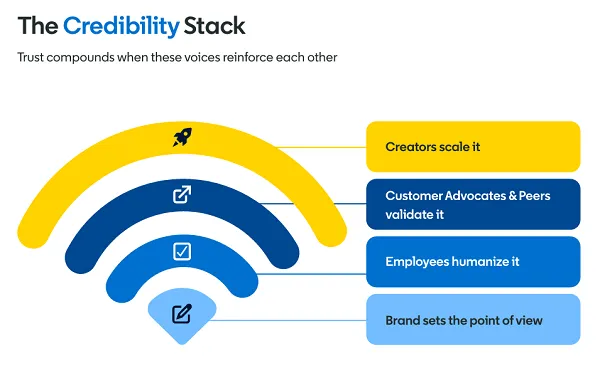
At the heart of LinkedIn’s guidance is a proprietary framework called “The Credibility Stack.” This model is designed to help brands systematically build trust signals that AI algorithms recognize, value, and prioritize.
The Anatomy of the Credibility Stack
AI chatbots do not evaluate content the way human readers do. They rely on semantic proximity, contextual consistency, and authority metrics. LinkedIn’s framework breaks this down into actionable tiers:
Foundational Brand Presence: Establishing a fully optimized company page with consistent messaging, verified credentials, and regular updates that serve as the baseline source of truth.
Employee Advocacy & Internal Networks: Extending the brand’s reach through the profiles of executives, engineers, sales leaders, and subject-matter experts. Because AI models value individual human expertise alongside corporate entities, decentralized employee posting acts as a powerful amplifier.
Creator Partnerships: Collaborating with established industry thought leaders and recognized platform creators whose personal domains carry high semantic weight within specific professional niches.
Content Types and Algorithmic Preferences
The playbook moves beyond high-level strategy to offer granular insights into what specific content formats actually trigger AI citations. According to LinkedIn’s data analysis:
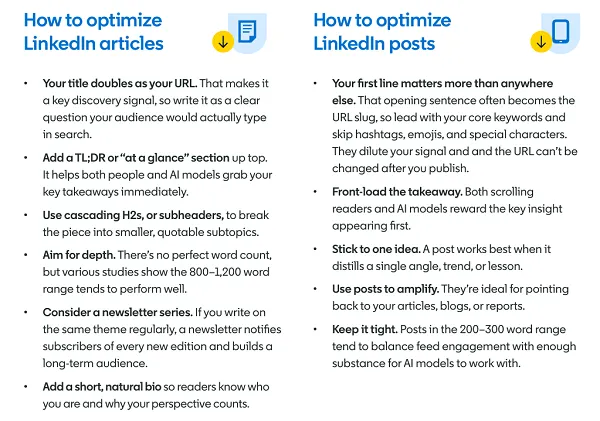
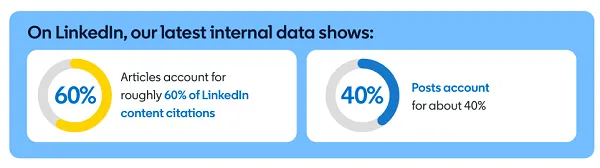
Long-Form Articles Triumph: While short, snappy feed posts are effective for immediate engagement and top-of-funnel brand awareness, they rarely capture AI citations. Long-form LinkedIn articles—which offer deep dives, structured arguments, and comprehensive industry analyses—are significantly more likely to be indexed and referenced by LLMs.
Content Freshness Matters: AI search engines prioritize up-to-date information. The playbook emphasizes that static, evergreen content must be periodically refreshed, updated with new data points, and re-circulated through professional networks to remain relevant to real-time retrieval systems.
Structural Optimization: The guide provides concrete templates on how to format headings, bullet points, and summaries within LinkedIn articles to make it frictionless for web scrapers and LLM parsers to extract key definitions and insights.
Official Perspectives and Strategic Implications
LinkedIn’s aggressive push into AI search optimization is driven by a clear commercial incentive. By positioning itself as the primary gateway to AI discovery, the platform aims to drive daily active usage, increase dwell time, and convince more enterprises to invest heavily in its native advertising and content-hosting infrastructure.
However, industry analysts and marketing veterans have responded with a mixture of enthusiasm and cautious skepticism.
"While LinkedIn offers an incredible shortcut to trust—thanks to its pre-existing domain authority and verified user base—tying a brand’s entire AI discovery strategy to a single walled garden introduces systemic vulnerabilities," notes one digital strategy analyst. "If platform algorithms shift, or if external LLM developers alter how they weigh third-party social data, brands that put all their eggs in the LinkedIn basket could find their visibility vanishing overnight."
Furthermore, modern B2B marketing leaders face a strategic dilemma. The principles outlined in LinkedIn’s playbook—such as authoritative long-form thought leadership, clear structuring, and continuous content refreshing—are universal SEO and AI optimization (AIO) best practices. Savvy marketers argue that these exact tactics should be deployed primarily on owned properties, such as a brand’s official website or corporate blog, rather than rented digital real estate.
Yet, bootstrapping trust on a brand-new corporate domain can take years of intensive link-building and domain authority cultivation. This is where LinkedIn’s value proposition shines: it offers an established trust scaffold. Forward-thinking brands are looking at a hybrid model—using LinkedIn as a high-velocity referral and authority-boosting engine to feed and validate their broader, owned digital ecosystems.
Future Outlook: The Next Frontier of B2B Discovery
As we look further into the decade, the line between social media marketing, traditional search engine optimization (SEO), and generative engine optimization (GEO) will continue to blur. Platforms like LinkedIn are transforming from networking tools into foundational infrastructure for the global knowledge graph.
For marketers navigating this transition, the playbook offers an invaluable roadmap, but it should be read as a tactical manual rather than a permanent doctrine. Success in the age of AI search will demand adaptability. Brands that master the art of building verifiable expertise—whether through LinkedIn’s Credibility Stack or across their own decentralized web properties—will ultimately control the narrative in tomorrow’s automated answers.
Ultimately, the rise of AI search does not diminish the value of great content; it simply raises the stakes. In a world where algorithms curate reality, credibility is the ultimate currency, and platforms like LinkedIn are currently holding the mint.