Executive Overview
The landscape of international digital copyright enforcement has shifted dramatically following the emergence of a landmark legal instrument from the United Kingdom. Originally detailed to the World Intellectual Property Organization (WIPO) by the Motion Picture Association (MPA) in May, a sweeping "omnibus" site-blocking order has finally been brought to light. Hand down by Mr. Justice Mellor on May 7, 2026, the High Court order represents an aggressive escalation in Hollywood’s ongoing crusade against digital piracy.
Requested by a coalition of major Hollywood studios—including Columbia Pictures, Disney, Netflix, Paramount, Universal, and Warner Bros.—the order targets the UK’s six largest Internet Service Providers (ISPs): BT, EE, Plusnet, Sky, TalkTalk, and Virgin Media. More importantly, however, it fundamentally alters how domain names and pirate infrastructure are added to national blocklists. By decoupling site additions from the traditional judicial review process, the order grants major entertainment conglomerates the unprecedented power to unilaterally expand censorship parameters.
For months, the exact terms, mechanisms, and legal thresholds of this powerful instrument remained shielded from public scrutiny. The judgment itself was absent from public legal repositories like BAILII and the National Archives, known only through corporate summaries and international legal citations, such as a recent, heavily influenced Canadian site-blocking decision.
However, a transparency filing recently surfaced in the Lumen Database, submitted by American infrastructure giant Cloudflare. This filing unexpectedly included the first public copy of the High Court’s "Public Version" omnibus order. The document reveals not only the mechanical realities of modern copyright enforcement but also exposes growing systemic concerns regarding the privatization of internet censorship, the opacity of administrative blocklists, and the shifting responsibilities of network intermediaries in the digital age.
Detailed Chronology: From WIPO Presentations to Cloudflare Disclosures
The timeline of how this unprecedented legal instrument materialized—and how it was accidentally brought into the open—highlights the opaque nature of modern digital injunctions.
The WIPO Revelation (May 2026)
The existence of the omnibus order first came to light during international IP discussions in May. Addressing WIPO, representatives from the MPA framed the order as a modern, necessary tool designed to combat the "fragmentation" of the internet piracy ecosystem. According to studio representatives, the legal framework was crafted to address a persistent game of architectural whack-a-mole: whenever authorities successfully block a domain, site operators instantly spawn dozens of mirrored clones and new domain names to bypass the restrictions.

The MPA described the mechanism as an instrument that would allow Hollywood studios to secure the blocking of any "structurally infringing audiovisual piracy services that meet defined criteria, without having to bring a fresh court application for each new domain or site name available in the future."
The Black Hole of Public Legal Records
Despite its massive implications for internet freedom, network architecture, and digital rights, the text of the order vanished into a procedural black hole. Investigative queries across legal databases—including BAILII and the UK National Archives—returned zero results. The targeted ISPs remained silent, leaving the MPA’s self-serving summaries as the sole public record of the High Court’s actions.
Despite its local UK origins, the invisible ruling immediately cast a global shadow. Last month, Canada’s Federal Court handed down an expanded-scope site-blocking order explicitly citing the UK’s unpublished omnibus decision as a foundational precedent. The Canadian court echoed the MPA’s concerns, arguing that proactive, sweeping legal measures are necessary to counteract the structural agility of modern piracy networks.
The Cloudflare Transparency Leak
The veil of secrecy was finally pierced this week when independent digital rights researchers monitoring transparency logs spotted a new filing uploaded to the Lumen Database by Cloudflare.
While Cloudflare is not a formal respondent in the High Court case, the Silicon Valley-based Content Delivery Network (CDN) voluntarily adopted the terms of the order to block targeted sites utilizing its infrastructure within the UK. Attached to this compliance filing was the long-sought-after "Public Version" of Mr. Justice Mellor’s May 7 ruling—complete with unredacted structural criteria, though missing a confidential schedule of specific URLs.
The Anatomy of an Omnibus Order: How It Works
The newly surfaced 2026 order breaks decisively from historical site-blocking paradigms. Traditional blocking injunctions required rightsholders to compile explicit lists of infringing domains, present them to a judge, secure a targeted injunction, and repeat the costly, time-consuming process every time new domains popped up.

The omnibus framework completely reorganizes this workflow into a two-tiered system: "Seeds" and "Open-Ended Categories."
[Hollywood Studios]
       │
       ▼ Identifies Infringing Sites
[Part 1: "Seed" Domains] (e.g., cineby.app, movies2watch.watch)
       │
       ▼ Establishes Mode of Operation
[Part 2: Open-Ended Category] (Structurally similar sites)
       │
       ├─────────────────────────┬─────────────────────────┐
       ▼                         ▼                         ▼
[UK ISPs (BT, Sky, etc.)]  [Cloudflare (CDN)]     [No Judge / No Court Hearing]
       │                         │                         │
       └─────────────────────────┴─────────────────────────┘
                                 │
                                 ▼
                     [UK Users Blocked (HTTP 451)]
Part 1: The "Seed" Targets
The first section of Schedule 1 explicitly names foundational streaming portals. Among the initial "seed" targets identified in the public document are URLs such as 345movie.nl, 456movie.nl, cineby.app, movies2watch.watch, and streamm4u.com.co. These sites serve as the operational archetypes for the entire enforcement action.
Part 2: The Open-Ended Structural Clones
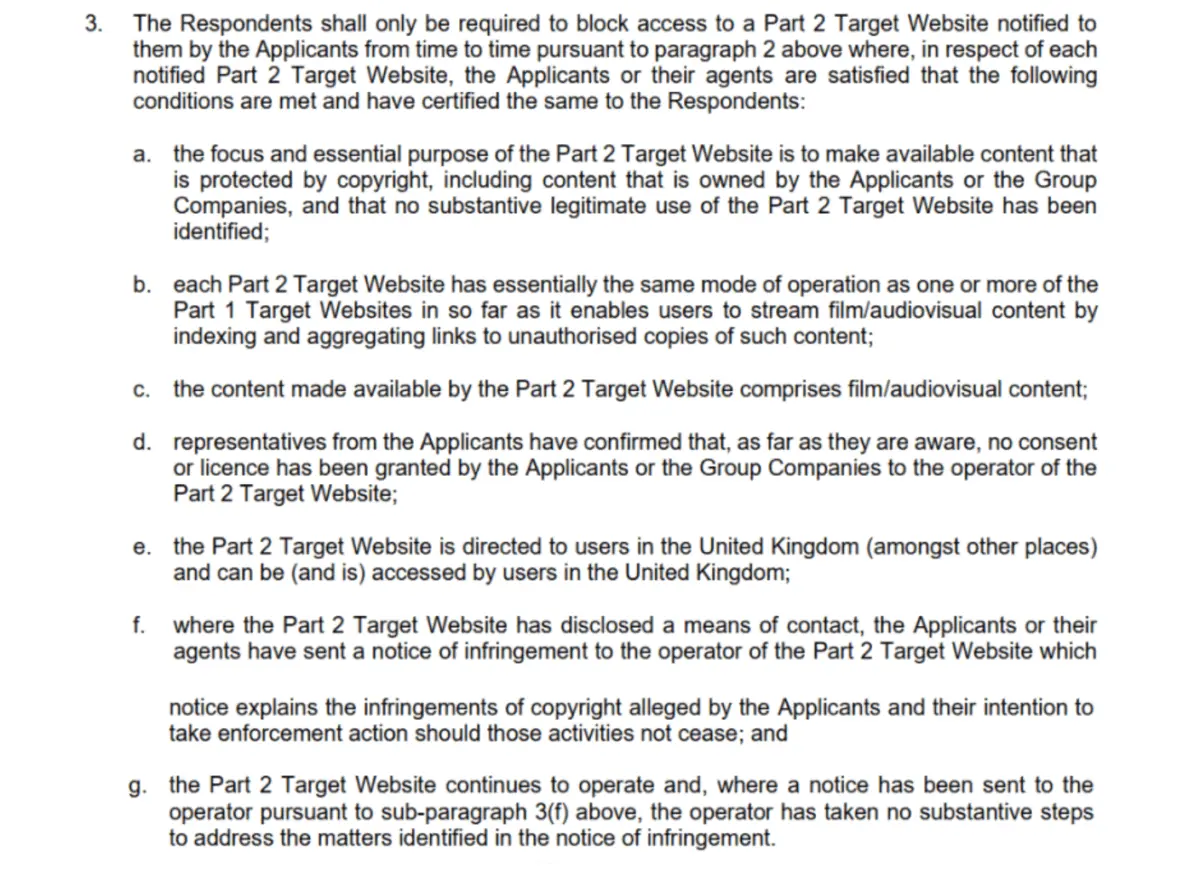
Once the seeds are established, Part 2 opens the floodgates. Under the terms of the order, any newly discovered website can be added to the national blocklist without judicial intervention, provided it mirrors the functionality of the seed sites.
The order outlines this operational standard clearly:
“[E]ach Part 2 Target Website has essentially the same mode of operation as one or more of the Part 1 Target Websites in so far as it enables users to stream film/audiovisual content by indexing and aggregating links to unauthorised copies of such content.”
To prevent infinite scope creep, the order establishes explicit threshold criteria that new sites must meet to be eligible for administrative addition. Broadly speaking, any pirate movie streaming site accessible in the UK that actively aggregates unauthorized audiovisual content and demonstrates unresponsiveness to legal takedown notices becomes fair game for immediate administrative blocking.

The Privatization of Censorship: No Judge, No Oversight
Perhaps the most controversial aspect of the omnibus order is the complete removal of judicial oversight from the day-to-day expansion of internet blacklists.
Unilateral Studio Expansion
Under traditional legal frameworks, adding a new website to a blocklist requires proving infringement before a neutral magistrate. Under the May 2026 omnibus order, this safeguard is bypassed entirely. When Hollywood studios identify a new Part 2 site that fits the predefined criteria, they simply send an administrative notice to the participating ISPs, instructing them to implement the block.
There is no formal court hearing, no independent legal review, and no adversarial testing of the evidence. The order explicitly acknowledges the hands-off approach of network operators, noting that ISPs are "wholly reliant on the Applicants accurately identifying" the URLs in question and have "no obligation to verify whether the Applicants’ or their agents’ determination is correct."
In practice, this effectively places multi-billion-dollar entertainment conglomerates in the dual role of prosecutor, judge, and executioner regarding network-level domain suppression.
Cloudflare’s Voluntary Compliance
The scope of this order extends far beyond traditional broadband providers. Cloudflare’s inclusion in the Lumen Database reveals that major infrastructure providers are voluntarily enforcing these High Court mandates outside the formal respondent circle.
When UK users attempt to navigate to blocked domains like movies2watch.watch via infrastructure routed through Cloudflare, they are no longer met with a standard browser timeout. Instead, they encounter an HTTP 451 Error ("Unavailable For Legal Reasons"), accompanied by a notice explaining that the content has been restricted to comply with UK legal mandates.

This voluntary alignment demonstrates how private infrastructure giants are increasingly willing to adopt aggressive judicial parameters globally, outsourcing the enforcement of local copyright laws directly to core web-routing layers.
Supporting Context, Metrics, and Safeguards
While the operational freedom granted to rightsholders is unprecedented, the High Court did incorporate several structural guardrails and technical limitations to prevent catastrophic overblocking and systemic abuse.
Technical and Legal Safeguards
- IP Address Protection: Rightsholders are strictly prohibited from demanding that ISPs block raw IP addresses if the underlying server hosts legitimate, non-infringing web properties. This limitation is designed to prevent "collateral damage"—the accidental taking offline of innocent websites, forums, or business services hosted on shared cloud infrastructure.
- Right to Object: Operators of targeted websites, as well as third parties mistakenly caught up in administrative overblocking actions, retain formal legal mechanisms to challenge and object to specific domain blacklisting.
- Six-Month Sunset Clause: The order features a strict operational expiration date. According to the text, the injunction "shall cease to have effect at 23:59pm on the date 6 months from the date of this Order, unless the Court orders otherwise."
Reality of the Sunset Clause
While critics of internet censorship might view the six-month limit as a valuable check on power, legal experts note that it functions primarily as a procedural checkpoint rather than a hard stop. In practice, Hollywood studios will simply return to the High Court every six months to request automatic renewals.
While these renewal hearings theoretically offer an opportunity for judicial review or public airing of grievances, the lack of mandatory transparency regarding the active blocklist makes independent auditing virtually impossible. Because the full list of blocked domains remains locked behind confidential legal schedules, journalists, civil liberties groups, and digital rights watchdogs cannot effectively verify whether the criteria are being strictly adhered to or if mission creep is quietly occurring behind closed doors.
Future Outlook: A Global Blueprint for Digital Suppression?
The publication of the Public Version of Mr. Justice Mellor’s May 2026 order sheds critical light on the evolving battleground of digital copyright enforcement. What began as a routine mechanism for targeting individual pirate domains has transformed into an agile, highly automated administrative apparatus capable of sweeping entire ecosystems offline with the stroke of a corporate pen.
As international courts—such as Canada’s Federal Court—actively look to the United Kingdom as a legal vanguard, the omnibus model threatens to become the global standard for copyright enforcement. By prioritizing administrative speed and corporate self-certification over traditional judicial oversight and public transparency, these orders streamline the suppression of unauthorized content at the cost of accountability.

For now, the balance of power in the UK digital landscape rests firmly in the hands of the MPA and its member studios. Armed with broad judicial backing, voluntary CDN compliance, and administrative autonomy, Hollywood has successfully weaponized network architecture to lock down the internet—leaving the public to rely on accidental transparency leaks to see what, exactly, is being kept off the screen.