Executive Overview
For software enterprises and public markets alike, the playbook for executing massive, multi-billion-dollar mergers has long been viewed with deep skepticism. Big-ticket acquisitions routinely trigger severe shareholder dilution, depressing GAAP earnings, spooking institutional investors, and plunging stock prices into extended consolidation phases. Yet, Palo Alto Networks (NASDAQ: PANW) has shattered this conventional wisdom, engineering one of the most stunning market recoveries and business model pivots in contemporary technology history.
Currently commanding a market capitalization hovering near $265 billion, Palo Alto Networks has seen its stock surge roughly 100% over the trailing twelve months, touching an all-time high of $368.80 in July. However, the true narrative lies not in the final destination, but in the harrowing and calculated journey required to reach it.
Over a tumultuous twelve-month window, CEO Nikesh Arora and his executive team deployed roughly $29 billion in aggressive acquisitions—anchored by the historic $25 billion buyout of identity security leader CyberArk and a $3.35 billion bolt-on for observability platform Chronosphere. These bold moves initially triggered a GAAP net loss, diluted existing shareholders by approximately 14%, forced management to cut earnings guidance, and sent the stock plummeting to a cyclical low of $139.57 in February.
Instead of retreating, management doubled down. Capitalizing on widespread market panic, leadership aggressively bought back $1 billion of their own stock near the absolute bottom. Simultaneously, the core business accelerated, newly integrated assets outperformed aggressive internal timelines, and the market violently re-rated the company. Today, Palo Alto Networks stands not merely as a legacy firewall vendor, but as a five-pillar cybersecurity behemoth generating an $11.4 billion revenue run rate across 70,000 customers. This deep-dive investigative analysis examines the mechanics behind Palo Alto Networks’ monumental re-rating, extracting critical strategic lessons for modern B2B operators, founders, and investors.
Detailed Chronology: From Dilution Panic to Market Triumph
To fully grasp the magnitude of Palo Alto Networks’ re-valuation, one must trace the precise sequence of events that unfolded between July 2025 and July 2026. The market’s visceral reaction to aggressive consolidation serves as a masterclass in the divergence between short-term announcement-day sentiment and long-term execution-driven value creation.
The Anatomy of a Market Sell-Off
- July 2025: Palo Alto Networks drops a bombshell on Wall Street, announcing plans to acquire identity and access management pioneer CyberArk for a staggering $25 billion—marking the largest transaction in the history of the enterprise cybersecurity sector. While strategically visionary, the sheer scale of the deal sparks immediate anxiety regarding integration risk and capital allocation. The market votes with its feet, sending the stock tumbling 12.5% over the subsequent month.
- November 2025: Undeterred by initial market friction, management expands its platform ambitions by acquiring Chronosphere for $3.35 billion, a valuation multiple translating to roughly 21x forward Annual Recurring Revenue (ARR).
- February 2026: The CyberArk transaction officially closes. On the exact same earnings call, management adjusts FY26 adjusted EPS guidance downward—moving from a range of $3.80–$3.90 down to $3.65–$3.70—to absorb immediate, near-term acquisition and restructuring costs. The market panics further. The stock sheds an additional 7%, bottoming out at an intraday low of $139.57 on February 24, 2026.
The Ultimate Insider Bet
Amidst the cascading sell-off and widespread institutional skepticism, Palo Alto Networks’ leadership executed a move that will be studied in business schools for decades. During Q3, the company deployed $1 billion of balance sheet capital to repurchase 6.8 million of its own common shares at a weighted average price of $147.69.
By capitalizing on the market’s overreaction to near-term dilution, management effectively secured a generational bottom just months before the underlying operational turnaround became undeniable. By mid-July, with the stock scaling past $368, those repurchased shares more than doubled in value, validating management’s conviction while partially offsetting the equity dilution caused by the M&A activity.
The Operational Inflection Point
- June 2026: Palo Alto Networks reports Q3 FY26 earnings (for the quarter ended April 30), obliterating consensus estimates across every monitored metric. Organic bookings accelerate significantly, Next-Generation Security (NGS) ARR surges past $8.13 billion against an already raised bar, and newly acquired assets demonstrate revenue velocities that render their initial purchase multiples deeply discounted in hindsight. By mid-summer, the equity price reaches its all-time high, completing a textbook 100%+ round-trip recovery.
Supporting Context & Metrics: The Five Pillars of Modern Cybersecurity
Founded in 2005 by Nir Zuk and publicly listed in 2012, Palo Alto Networks built its empire on next-generation firewalls—physical and virtual appliances sitting at the network perimeter to inspect incoming and outgoing data packets. While network security still accounts for roughly 70% of total revenue, the past eight years under Nikesh Arora’s leadership have transformed the enterprise into a diversified, five-pillar security platform.
Operating with roughly 16,000 employees and serving over 70,000 enterprise accounts, the company has successfully transitioned its business model. Hardware now accounts for only ~10% of total revenue (down from 20% in FY21), while high-margin subscription and support services drive the vast majority of top-line expansion.
Why AI is an Unprecedented Tailwind, Not a Threat
While most enterprise software categories face existential questions regarding whether Generative AI will compress their value propositions, cybersecurity is experiencing the exact opposite phenomenon. Arora articulated a powerful thesis during the Q3 earnings call: AI has structurally raised the terminal value of the entire cybersecurity industry.
This secular tailwind operates through four distinct, mathematically verifiable mechanics:
- Agents Generate Exponentially More Traffic to Inspect: Early enterprise AI was defined by simple conversational interactions—one prompt, one response, resulting in minimal network overhead. Autonomous agents executing multi-step enterprise workflows trigger hundreds of secondary, machine-to-machine API calls to internal tools and databases. This has sparked a massive surge in "east-west" data center traffic, all of which requires inline inspection. This underlying compute dynamic explains why Palo Alto’s "legacy" hardware segment just delivered its strongest quarter in a decade.
- The Attack Velocity Gap: Unit 42, Palo Alto’s elite threat intelligence and research division, simulated a full-scale ransomware campaign from initial entry to data exfiltration using autonomous AI tools. The entire breach was executed in 25 minutes. Because the typical enterprise still requires days or weeks to detect a compromise, human-led Security Operations Centers (SOCs) are fundamentally outmatched. Closing a days-to-minutes response gap requires hyper-automated, platform-wide orchestration—the core value proposition of XSIAM.
- Every Autonomous Agent is a New Identity: Traditional enterprise identity protocols were built to secure a few hundred human administrators. Autonomous AI agents wielding persistent credentials multiply enterprise attack surfaces by orders of magnitude. Because these agents operate at machine speed across production environments, securing them requires massive architectural intervention—providing the primary strategic rationale for the $25 billion CyberArk acquisition.
- AI Workloads Monetize Telemetry as a Byproduct: High-performance AI compute generates massive volumes of logs, metrics, and traces. Consequently, enterprise observability and logging expenditures scale directly with a customer’s GPU footprint rather than their headcount. This structural shift explains why Chronosphere nearly doubled its ARR within just two quarters post-acquisition.
Furthermore, Palo Alto has successfully birthed an entirely new product category: securing AI applications and agents themselves. Prisma AIRS, a platform that did not exist eighteen months ago, has scaled at a velocity previously unseen in the company’s history.
Official Statements & Financial Performance
Headline Numbers (Q3 FY26)
- Total Revenue Run Rate: Reaching $11.4 billion.
- Next-Generation Security (NGS) ARR: Climbed to $8.13 billion, propelled by accelerating organic bookings and high-performing integrations.
- Platformization Cohort Economics: Palo Alto’s 70,000+ customer base contains a highly lucrative subset of 2,280 "platformized" customers—enterprises that have consolidated multiple security point solutions into Palo Alto’s unified architecture.
- Net Revenue Retention (NRR): The platformized cohort boasts an elite 120% NRR alongside single-digit churn rates. Management has staked its long-term vision on scaling this cohort to 4,000 customers by FY2030, a milestone projected to drive NGS ARR to $20 billion.
- GAAP vs. Non-GAAP Realities: Q3 GAAP net loss stood at $177 million, heavily impacted by M&A amortization and stock-based compensation (SBC) running at roughly 17% of revenue, leading to a diluted share count of 801 million (up ~13% year-over-year). Conversely, non-GAAP net income reached a robust $684 million.
Future Outlook: The Data Moat and Upcoming Catalysts
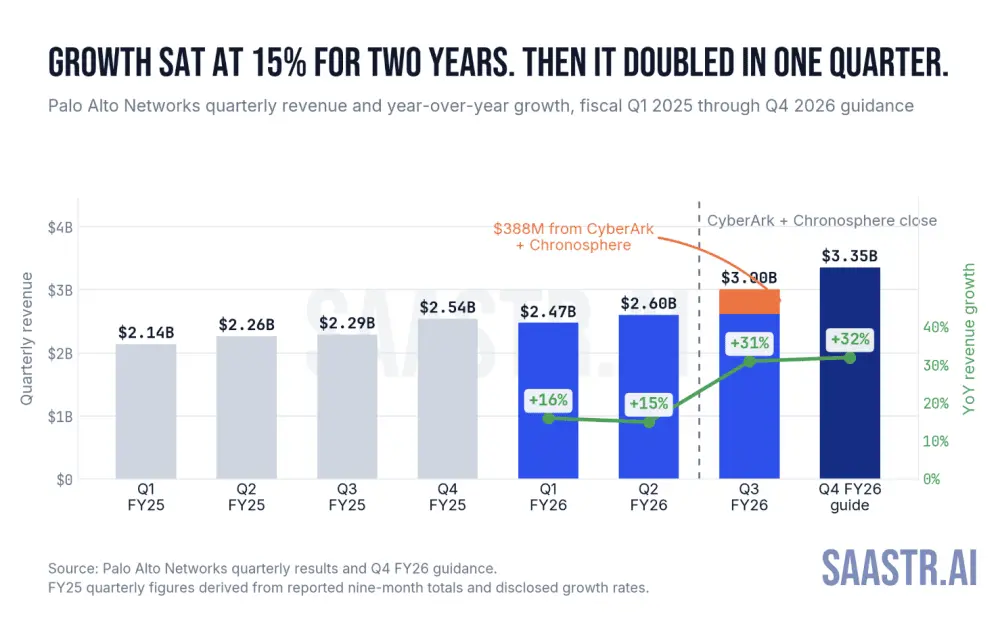
As Palo Alto Networks heads toward its fiscal Q4 and full-year results reporting on September 1, forward guidance underscores continued operational momentum. Management has guided full-year revenue to a range of $3.345 billion to $3.355 billion, with NGS ARR projected between $8.9 billion and $8.95 billion.
The Ultimate Competitive Moat
Beneath the headline financial metrics lies Arora’s foundational thesis regarding artificial intelligence in enterprise software. During recent earnings commentary, Arora offered a blunt assessment of standalone frontier AI models in production cybersecurity: raw error rates frequently reach 25%, necessitating manual interventions that destroy operational speed and risking catastrophic enforcement decisions in mission-critical environments.
Consequently, raw frontier models do not constitute a lasting corporate moat. In an era where advanced foundational models are universally accessible, competitive advantage shifts decisively to proprietary data layers.
Palo Alto Networks’ structural moat is anchored by 125 million active sensors ingesting 17 petabytes of daily telemetry. Every additional sensor deployed across its global install base makes the underlying platform smarter, which drives higher enterprise adoption, which in turn generates richer, more proprietary threat intelligence. Every acquisition executed over the past twelve months—from CyberArk to Chronosphere—ultimately served to ingest more sensors into this centralized data engine.
For B2B founders and technology investors navigating the post-2026 landscape, the takeaway is absolute: if your enterprise software advantage relies solely on the underlying AI model, you lack a durable moat. If your advantage is built upon proprietary data captured by sitting inline with mission-critical workflows, you command the keys to the kingdom.