Executive Overview
In the rapidly evolving ecosystem of artificial intelligence-assisted software development, friction has always been the primary tax on productivity. For years, AI coding assistants and agentic tools have operated under a cautious, albeit increasingly performant, paradigm of continuous human oversight. Every time an agent wanted to read a file, execute a shell command, modify code, or run a test, it paused. It surfaced a modal window or a terminal prompt, politely asking the human developer: Do you approve this action?
Beginning August 14, Anthropic is pulling the plug on that routine for millions of developers.
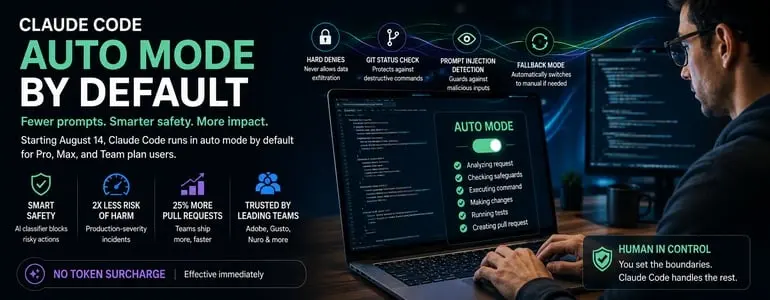
The artificial intelligence research and deployment company announced a sweeping shift in how its developer tool, Claude Code, operates. For users on Pro, Max, and Team plans, "auto mode" is becoming the default configuration. Rather than stopping to request permission for every granular command, Claude Code will now route its tool calls through an advanced, native classifier. This system acts as an intelligent gatekeeper, intervening only when a proposed action appears irreversible, destructive, or targeted outside the user’s designated working environment. Everything else executes seamlessly without a pause.
This is more than a simple quality-of-life update or a tweak to developer ergonomics. It marks a foundational shift in how the software industry conceptualizes human-in-the-loop validation. For the past several years, safety protocols have relied heavily on "permission fatigue"—the psychological phenomenon where users, bombarded by hundreds of routine security prompts, eventually stop reading them and start treating "approve" as a default keystroke.
Anthropic’s internal data exposes the stark reality of this fatigue: users blindly approve 97% of all permission requests generated by Claude Code. Far from being a robust layer of defense, manual approval has degraded into a meaningless "rubber stamp."
By transitioning to a model where AI agents operate autonomously under strict algorithmic guardrails, Anthropic is acknowledging an uncomfortable truth about human attention spans in the age of generative AI. Yet, this move also opens a Pandora’s box of questions regarding corporate risk, accountability, and the changing role of the software engineer. As development teams ship up to 25% more pull requests under auto mode, the industry is forced to confront a new reality: the human developer’s job is no longer to watch every step an agent takes, but to engineer the boundaries of the loop before it ever begins.
Detailed Chronology: From Experimental Feature to Production Default
To understand the weight of Anthropic’s August 14 transition, it is necessary to retrace the trajectory of Claude Code’s development and the deliberate steps the company took to arrive at this juncture.
March: The Introduction of the Middle Ground
Anthropic initially introduced auto mode as an experimental feature. Framed at the time as a delicate middle ground between raw speed and operational control, the feature was designed to alleviate the constant context-switching plaguing developers. Traditional terminal-based coding agents required developers to babysit their tools, halting workflow every few seconds to grant terminal permissions.
In its initial beta rollout, auto mode utilized an early iteration of Anthropic’s classification architecture. Instead of blocking execution unconditionally, the system intercepted tool calls and passed them through a secondary evaluation model. This classifier was trained to discern between benign, routine development actions—such as running a linter, reading a configuration file, or compiling a localized test suite—and potentially hazardous operations, such as executing unvalidated scripts or modifying system-level configurations.
While developers praised the speed boost, many enterprises remained hesitant. The prevailing culture of software compliance demanded that humans retain absolute, granular control over execution environments. However, behind closed doors, usage analytics were painting a far more chaotic picture of actual human behavior.
May and June: Gathering Production Data
During the late spring months, Anthropic intensified its telemetry analysis, examining production-severity incidents across user sessions. The company sought to measure the actual efficacy of human-reviewed sessions versus those managed by the early versions of auto mode.
The findings were counterintuitive to conventional cybersecurity wisdom. When analyzing flagged sessions where unintended harm occurred (such as accidental data loss or breaking changes to live environments), sessions utilizing manual human approval contained serious incidents more than twice as often as those managed by auto mode (6.3% versus 2.4% at production-severity levels).
This data served as the empirical catalyst for Anthropic’s leadership. The persistent myth that human oversight inherently protects systems from error was crumbling under the weight of cognitive overload.
August 14: The Paradigm Shift
With the August 14 rollout, auto mode shifts from an opt-in novelty to the default operational state for Pro, Max, and Team tiers. Simultaneously, Anthropic eliminated the token surcharge previously tied to the classifier’s overhead for these users, signaling that autonomous execution is no longer a premium add-on, but the core intended experience of working with Claude Code.
Meanwhile, enterprise tiers and major cloud integrations—including AWS, Google Cloud, and Microsoft Foundry—retain auto mode as an opt-in feature for a temporary grace period. This allows enterprise administrators time to evaluate the governance implications before Anthropic flips the default switch across all tiers in the coming weeks.
Supporting Context & Metrics: The Anatomy of "Permission Fatigue"
To grasp why Anthropic is removing human roadblocks, one must look closely at the quantitative data surrounding developer behavior.
The 97% Approval Illusion
According to Anthropic’s public disclosures, users approve a staggering 97% of all permission requests generated by Claude Code. In a vacuum, a 97% success rate might suggest that the AI is impeccably behaved, proposing only safe and optimal commands.
In reality, usability researchers recognize this metric as a textbook symptom of alert fatigue. When a developer receives dozens of terminal prompts every hour asking for permission to execute standard shell commands (npm install, git status, pytest), the cognitive cost of evaluating each prompt quickly outweighs the perceived risk. Developers stop reading the prompts. Their finger develops a reflex for the Enter or Y key. The security prompt becomes an administrative tax rather than a safety check.
Controlled Testing: Humans vs. Machines
To rigorously test the hypothesis that human oversight had become an illusion, Anthropic orchestrated a controlled study involving 1,053 paid software testers.
Midway through structured coding sessions, researchers covertly injected a genuinely dangerous command disguised as a routine permission prompt. The results were startling:
- Human Reviewers: Caught the malicious injection only 13.6% of the time.
- Auto Mode Classifier: Successfully flagged and blocked the threat 89% of the time.
More concerning was the degradation of human attention over time. As coding sessions lengthened, human catch rates plummeted. After 50 or more prior prompts, the human detection rate dropped to a dismal 5%. Conversely, auto mode’s detection rate remained entirely flat and robust, unaffected by session length, fatigue, or time of day.
Mitch Ashley, VP and practice lead for software lifecycle engineering and AI-native software engineering at The Futurum Group, summarized the data bluntly:
"A 13.6% catch rate tells you per-action approval stopped working long before anyone turned it off. Teams counted clicks because clicks were easy to count. Nobody measured whether the click caught anything."
Adversarial Testing and Third-Party Validation
To ensure that auto mode did not simply replace human blind spots with automated vulnerabilities, Anthropic subjected the system to rigorous adversarial stress testing.
Partnering with Apollo Research, an independent AI safety firm, researchers injected sophisticated synthetic attacks into real-world coding trajectories. Following iterative find-fix-verify cycles, auto mode’s miss rate on a held-out attack set dropped from 12% to 7%.
Further validation came from Trajectory Labs, which subjected Claude Code to 72 distinct prompt injection scenarios, benchmarking its performance directly against OpenAI’s Codex. The results heavily favored Anthropic’s architecture:
- Claude Code (Auto Mode): Successfully defended against all 720 attack attempts across the test suite, achieving a 0% success rate for attackers.
- OpenAI Codex (Auto-Review Mode): Permitted a 5.83% success rate on the exact same battery of adversarial attacks.
Productivity Gains and Real-World Deployment
Beyond security metrics, the productivity delta is impossible for engineering leadership to ignore. Anthropic reports that development teams utilizing auto mode ship approximately 25% more pull requests (PRs) than those bound to manual review.
Early enterprise adopters are already redesigning their workflows around this capability. Nuro, an autonomous vehicle technology company, reported kicking off an agentic coding session at 10:00 PM and waking up to three fully completed, verified PRs by morning—an operational cadence completely unattainable under a manual approval model that halts for human confirmation at every juncture.
Other heavy hitters, including Adobe, Gusto, and Garner Health, have integrated auto mode into their standard operating environments. Garner Health took the step of pushing auto mode as the organization-wide default for all 550 of its employees via centralized managed settings.
Guardrails and Governance: How Auto Mode Stays Safe
Eliminating manual prompts does not mean handing the keys of the production infrastructure entirely over to an unbridled stochastic parrot. Anthropic has engineered a multi-layered defense system designed to maintain strict boundaries while eliminating mundane friction.
1. Hard Denies
Certain categories of actions are hard-coded into the classifier’s architecture as non-negotiable prohibitions. Data exfiltration, for instance, is a class of action that the classifier is instructed never to approve under any circumstance. If an agent attempts to pipe internal source code or environment variables to an external endpoint, the action is instantly terminated.
2. Context-Aware Git and Environment Screening
Before permitting destructive shell commands—such as a sweeping git reset --hard—the classifier runs diagnostic checks on the repository’s git status. It assesses whether uncommitted changes are at risk and distinguishes between public and private repositories before authorizing network pushes. Furthermore, code snippets or documentation pulled from external, untrusted web sources are automatically screened for hidden prompt injection payloads.
3. The Circuit Breaker Pattern
Anthropic implemented a tactical tripwire: if the classifier blocks a generated command three times in a row, or twenty cumulative times across the span of a single coding session, Claude Code automatically disengages auto mode and drops safely back into manual approval mode. This safeguard ensures that if an agent gets stuck in a destructive loop or encounters an ambiguous environment, a human is promptly paged to re-evaluate the context.
4. Granular Administrative Controls
For organizations operating under stringent compliance frameworks (such as SOC2, HIPAA, or ISO 27001), enterprise administrators retain absolute authority. They can enforce manual policies globally, review audit logs of unattended sessions, and configure managed settings across cloud environments (AWS, Google Cloud, and Microsoft Foundry) to match their specific risk tolerances.
Future Outlook: Engineering the Loop
The transition to auto-mode-by-default is a watershed moment for AI-native software engineering. It signals the maturation of AI coding agents from interactive autocomplete engines into autonomous software contributors.
However, this evolution fundamentally redefines the responsibilities of human engineers. As Mitch Ashley notes, the concept of "human in the loop" is breaking down because it is unscalable. In its place, the industry must pivot toward "human engineering the loop."
[ Traditional Model ]
Developer writes code -> AI suggests line -> Human approves (97% rubber stamp) -> Repeat

[ Modern Agentic Model ]
Human defines guardrails/policies -> AI agent executes autonomously -> Hard denies / Circuit breakers catch anomalies -> Human audits PRs & logs
In this new paradigm, the human’s value shifts upward in the abstraction stack. Instead of wasting cognitive energy vetting individual terminal commands, senior engineers and tech leads must focus on:
- Defining strict environmental guardrails before agent sessions initialize.
- Designing robust verification pipelines (automated test suites, linting, and static analysis) that catch logical bugs before code ever merges into main branches.
- Maintaining compliance trails for auditors who require explicit logging of what unmonitored AI agents accessed and modified.
Boris Cherny, Head of Claude Code at Anthropic, captured the sentiment on social media, noting that he and his engineering team have used auto mode exclusively for months and would refuse to return to the friction of manual permission prompts.
Anthropic’s bold gamble is that developers would rather trust a transparent, rigorously tested classifier than their own tired clicks. As the rest of the software industry adopts this workflow, the question facing engineering teams is no longer whether they can afford to trust AI agents, but whether they can afford to keep pretending that human rubber stamps ever kept them safe in the first place.