Executive Overview
Deep within the sun-scorched, limestone-carved valleys of Egypt’s sprawling Theban necropolis—a vast archaeological archive containing over 400 distinct tombs—researchers have unlocked a new chapter in the shifting paradigms of ancient Egyptian death and commemoration. For decades, traditional Egyptological narratives assumed a rigid, linear progression of mortuary culture: elite individuals meticulously preserved, encased within increasingly elaborate nesting coffins, and consigned to exclusive, inviolable subterranean chambers for eternity.
However, a groundbreaking study published in the journal Frontiers in Environmental Archaeology shatters this monolithic view. By applying an advanced, multidisciplinary methodology known as an "integrated archaeothanatological approach" to a notoriously complex site—Theban Tomb 209 (TT 209)—an international team of researchers from Spain’s University of La Laguna has charted how burial practices fundamentally transformed over centuries.
The site reveals a striking historical migration from individual, highly insulated interments within elaborate coffins during the early 25th Dynasty (754–656 BCE) to a dense, communal "dynamic mortuary environment" by the Ptolemaic period (305–30 BCE). As available space dwindled and political, social, and economic structures shifted, ancient Egyptians routinely reused earlier burial sites. This spatial recycling resulted in high bone density, vertical body superposition, and the dismantling of decaying containers. Far from indicating a chaotic breakdown of sacred rituals, these layered interments reflect a sophisticated, adaptive "funerary memory." In this system, generations of mourners meticulously negotiated the physical remains of their ancestors to carve out resting places for the newly dead.
Detailed Chronology: The Life, Death, and Rebirth of Theban Tomb 209
To understand the macro-level transformation of Egyptian funerary culture, archaeologists must parse the micro-stratigraphy of individual tombs. TT 209 provided an ideal—if exceptionally challenging—case study. Located in the western necropolis within an active drainage channel of the Wadi Hatasun, the tomb was historically plagued by repeated flash floods. These environmental catastrophes introduced thick layers of accumulated silts, sands, gravels, limestone blocks, and displaced artifacts, creating a complex archaeological puzzle.
Originally commissioned during the early 25th Dynasty as the final resting place for Nisemro, a high-ranking official of Nubian origin, TT 209 remained in intermittent use for nearly seven centuries, finally being abandoned toward the end of the Ptolemaic era. By homing in on Side Chamber 3—one of the few secondary chambers within the complex that remained relatively undisturbed by modern looting—the researchers were able to establish a chronological sequence of human deposition that spans distinct cultural epochs.
Phase I: Elite Isolation (The 25th Dynasty)
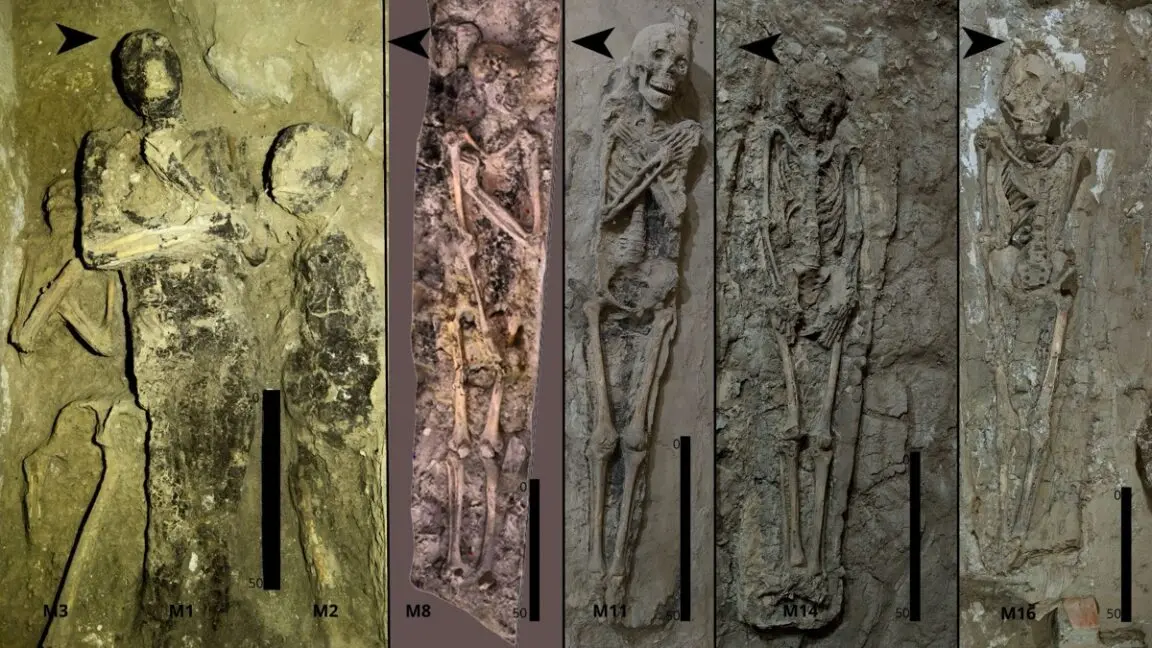
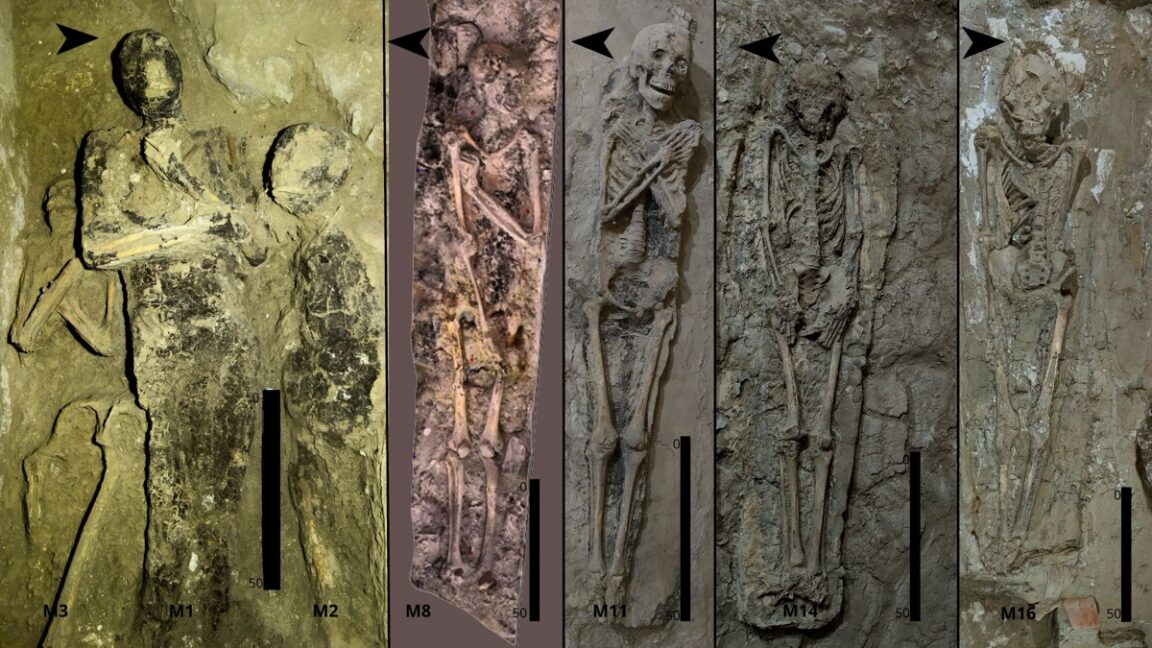
The earliest phase of utilization within Side Chamber 3 reflects the classic, idealized Pharaonic model of burial. Excavations revealed distinct individual interments (cataloged as mummies 13, 14, 15, 16, and 17) belonging to individuals of elevated social standing.
- Material Culture: These bodies were interred in robust, custom-fitted coffins, adorned with protective funerary nets, intricate amulets, and valuable grave goods. Notably, researchers recovered a high concentration of imported Phoenician amphorae, along with specialized incense cups and beads, suggesting that burial rites involved costly commodities and elaborate provisioning for the afterlife.
- Spatial Organization: Bodies were laid out horizontally with generous spatial allowances. Interestingly, early spatial patterning showed a tendency to separate male and female interments, though researchers urge caution against over-interpreting gender segregation based solely on this localized sample. Limbs during this foundational phase were typically arranged in a straight, extended posture.
Phase II: The Accumulative Shift (Late 25th Dynasty through the Persian Phase)
As centuries passed and the socio-political landscape of Egypt fractured and reformed under successive foreign dominations—including Kushite, Assyrian, and Persian rulers—the architectural capacity of the Theban necropolis began to reach its absolute saturation point.
Rather than commissioning entirely new, costly subterranean complexes in the crowded cliffs, later generations turned inward, systematically reoccupying existing sepulchers. TT 209 encapsulates this transition:
- The Rise of Superposition: Space limitations forced incoming mourners to place new bodies directly over or adjacent to earlier mummies. This vertical stacking created an intense spatial density, mirroring a broader regional trend observed across roughly 80 percent of first-millennium BCE tombs in Thebes.
- Decline of the Coffin: Elaborate, durable wooden coffins became increasingly scarce in later stages. Many earlier coffins were deliberately dismantled, cleared away, or allowed to degrade organically within the humid, sediment-laden chambers. Consequently, subsequent generations were interred without traditional outer containers, relying instead on high-quality mummification techniques to maintain bodily integrity.
- Postural and Ritual Evolutions: Osteological analysis revealed distinct shifts in corporeal presentation. In contrast to the outstretched limbs of the early 25th Dynasty, later mummies exhibited folded arm positions. Furthermore, the rich, dispersed artifact assemblages of the early period gave way to standardized ritual markers, such as upright ceramic jars placed near the newly deposited bodies—a specialized mortuary signature entirely absent from the tomb’s initial phase.
Phase III: Catastrophe and Transformation (The Ptolemaic Twilight)
By the time TT 209 was definitively abandoned during the Ptolemaic period, the internal topography of its chambers bore little resemblance to the pristine sepulcher originally designed for Nisemro.
In addition to water damage from recurrent flash floods, certain chambers showed evidence of severe thermal alteration. Notably, one secondary chamber yielded the disarticulated, highly fragmented remains of at least four individuals (totaling 1,775 bone fragments) that displayed clear markers of exposure to extreme heat—with temperatures reaching up to 550°C (1,022°F). Particularly affected were the crania and lower limbs, suggesting either an accidental underground fire or localized, deliberate ritual burning events, the exact mechanics of which remain under active investigation.
Supporting Context & Metrics: Quantitative Breakdown of Side Chamber 3
The empirical foundation of the La Laguna study rests upon rigorous osteological and archaeological quantification. By treating the tomb not merely as a container of artifacts, but as a stratified ecosystem of human remains and sedimentary layers, the research team mapped the physical footprint of centuries of ritual activity.
| Archaeological Metric | Recorded Data / Observation | Archaeological Significance |
|---|---|---|
| Total Human Remains (Intact) | 16 mummified individuals | Provides a detailed cross-section of corporeal preservation across multiple generational layers. |
| Total Skeletal Elements (Articulated) | 1,444 individual bones | Enables granular osteological, pathological, and demographic profiling. |
| Disarticulated Fragment Count | 1,775 bone fragments (minimum 4 individuals) | Highlights spatial disruption, secondary clearing, and thermal trauma in specific chambers. |
| Faunal Interments | 1 mummified dog | Demonstrates the inclusion of beloved animals or votive offerings within the elite mortuary matrix. |
| Chronological Span | c. 754–30 BCE (25th to Ptolemaic Dynasties) | Captures nearly 700 years of continuous cultural adaptation in a single tomb architecture. |
| Thermal Alteration Threshold | Up to 550°C (1,022°F) | Indicates localized catastrophic events, such as underground fires or intentional pyre activity. |
Official Statements and Expert Insights
The paradigm shift identified in TT 209 challenges modern assumptions about what constitutes "desecration" or "disrespect" in an ancient funerary context. To the modern observer, disturbing a grave to insert a new body feels sacrilegious; to the ancient Egyptians of the first millennium BCE, it was a pragmatic and deeply spiritual act of integration.
"The detailed study of the bodies indicates neither chaotic accumulation nor a loss of the original ritual over time," explained co-author Jared Carballo-Perez of the University of La Laguna. "Rather, there was a spatial logic in which each new deposition was adapted to the presence of previous bodies—a kind of funerary memory in the processes of reuse."
This "funerary memory" underscores an active dialogue between the living and the dead. Rather than erasing their ancestors, incoming generations engaged with them physically, shifting bones, dismantling rotted wood, and aligning new shrouds with older corpses to maintain cosmic and familial continuity within finite physical boundaries.

Co-author Miguel Ángel Molinero Polo elaborated on the socioeconomic stratification visible across the tomb’s layers: "The earliest individuals buried here appear to have been of high social standing, as they were interred in coffins, with funerary nets and amulets, and with an assemblage containing costly items, such as the contents held in Phoenician amphorae, a large number of which were found alongside them. The bodies buried in vertical superposition did not have coffins but were carefully mummified. They also can be associated with upright jars that point to a specific ritual not found in the earlier phases of the tomb’s use."
Ultimately, the authors characterize TT 209 not as a static resting place, but as an evolving cultural landscape:
"Overall, [this site] can be understood as a funerary space with an accumulative biography, in which reuse did not simply involve the addition of burials, but the progressive transformation of the organization, materiality, and meaning of the space itself. Rather than acting as a passive container, the chamber can be interpreted as a dynamic mortuary environment where bodies, objects, sediments, and architectural constraints shaped the material construction of funerary continuity over time."
Future Outlook: Re-Evaluating the Theban Necropolis
The findings from Theban Tomb 209 carry profound implications for future archaeological excavations across Egypt. For generations, field archaeologists frequently prioritized pristine, undisturbed burials containing intact coffins and luxury goods, often dismissing heavily disturbed, multi-layered tombs as compromised or "looted" sites of secondary value.
The methodological success of the University of La Laguna team demonstrates that "messy" tombs—those impacted by flooding, structural collapse, and centuries of deliberate reuse—are in fact goldmines of socio-historical data. By applying integrated archaeothanatological frameworks, researchers can extract granular timelines of community behavior, resource scarcity, and shifting religious ideologies that traditional artifact typologies miss entirely.
As archaeological projects across the Theban necropolis re-examine their archives and ongoing excavations in light of these conclusions, a clearer picture is emerging of ancient Egypt’s long-term resilience. Even as political empires rose and fell, and as economic constraints limited access to imported cedar wood for elaborate coffins, the fundamental human drive to honor the dead persisted. It adapted, shrank the physical container, discarded the outer shell, and relied instead on the eternal integrity of the mummified body and the collective memory of the living.