Executive Overview
For over a decade, the Holy Grail of B2B software-as-a-service (SaaS) sales was the multi-year contract. Securing a three-year commitment from a new logo was celebrated as the ultimate validation of product-market fit, guaranteeing predictable revenue streams, lowering customer acquisition cost (CAC) payback periods, and pleasing venture capital investors who prized top-line visibility above almost all else.
Today, that playbook is effectively obsolete.
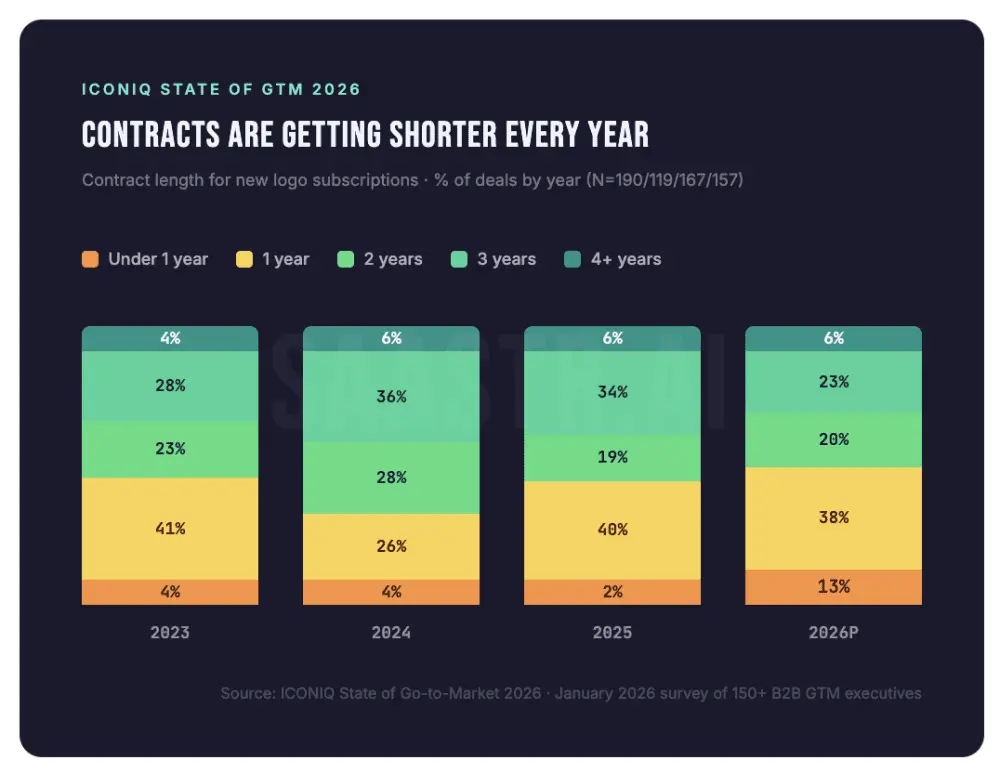
Driven by the explosive acceleration of the artificial intelligence era, the B2B market has undergone a structural shift. According to recent data from ICONIQ, three-year contracts for new logos have dropped precipitously from 28% in 2023 to 23% in 2026. Simultaneously, sub-one-year contracts have surged from 4% to 13% over the same timeframe.
Far from being a temporary market blip or a clever negotiating tactic by hesitant procurement teams, this trend represents rational buyer behavior in a hyper-accelerated technology landscape. With AI replacement cycles compressing every 18 months, locking into a multi-year agreement carries existential risk for enterprise buyers. A tool that represents state-of-the-art capability today risks becoming obsolete by year two, leaving companies tethered to legacy vendors while their competitors outpace them with next-generation solutions.
For SaaS founders, revenue leaders, and go-to-market executives, the message is clear: stop pushing for multi-year contracts. Fighting the macro-currents of the AI era costs more in stalled deal momentum and alienated prospects than any theoretical revenue security is worth. Instead, modern software companies must pivot toward optimizing Net Revenue Retention (NRR), accelerating time-to-value, and earning customer loyalty through undeniable, rapid return on investment (ROI).
Detailed Chronology: How the SaaS Commitment Paradigm Shifted
To understand how the industry arrived at this crossroads, it is necessary to examine the evolution of B2B software purchasing habits over the past decade.
The Era of Predictability (2014–2020)
During the peak of the zero-interest-rate policy (ZERP) era, enterprise software budgets expanded rapidly. In this environment, multi-year contracts were mutually beneficial. Buyers enjoyed locked-in pricing protection against annual inflation or user growth, while vendors secured long-term cash flow predictability. Sales compensation plans heavily favored multi-year agreements, often applying higher commission multipliers for deals spanning 24 to 36 months.
The Macroeconomic Reality Check (2022–2023)
As global economic conditions tightened and inflation forced enterprises to scrutinize software spend, the cracks in the multi-year model began to show. CFOs and procurement departments initiated massive software audits, seeking to trim redundant licenses. However, multi-year commitments prevented companies from cutting unused seats, leaving a bitter taste in the mouths of executive buyers who felt trapped by legacy agreements signed during flush times.
The AI Acceleration and Obsolescence Cycle (2024–2026)
The maturation of generative AI and verticalized machine learning models fundamentally changed the software lifecycle. Technology innovation is no longer measured in multi-year release cycles, but in quarterly—and sometimes weekly—leaps.
Buyers realized that committing to a three-year software contract in 2026 is akin to buying a physical infrastructure appliance that might be disrupted by an open-source model or an agile startup within 12 to 18 months. Consequently, enterprise software consumers began demanding structural flexibility. The dramatic drop in three-year agreements and the concurrent tripling of sub-one-year contracts mark the official end of the traditional SaaS lock-in model.
Supporting Context & Metrics: The Numbers Behind the Shift
Hard data from leading venture capital and market intelligence firms illustrates the depth of this transformation.
The ICONIQ 2026 Data Breakdown
- Three-Year Contracts: Dropped from 28% of new logos in 2023 to 23% in 2026.
- Sub-One-Year Contracts: Jumped from 4% of new logos in 2023 to 13% in 2026.
This statistical shift underscores a profound psychological and operational change in how enterprise buyers approach risk. When AI capabilities are evolving at a breakneck pace, the primary risk for a Chief Information Officer (CIO) is no longer implementation failure alone; it is technological obsolescence. Signing a 36-month contract with a vendor that fails to maintain market leadership over the next 10 to 12 months creates massive operational drag.
The NRR Benchmark: How Elite Companies Win
It is a misconception that long-term commitments have vanished entirely. Elite companies—such as top-quartile performers like Datadog, Figma, Databricks, and Snowflake—continue to command multi-year, high-value expansions. However, they achieve this not through aggressive sales pressure or steep multi-year discounts, but through exceptional product utility and Net Revenue Retention (NRR) metrics sitting comfortably between 110% and 123%.
These category leaders do not close multi-year deals on the back of a polished pitch deck. Their customers willingly sign extended commitments after experiencing undeniable value, often expanding their footprint organically before formal renewal conversations even take place.
For a company targeting a healthy Series B milestone, aiming for a 120% NRR changes the strategic calculus entirely. When NRR is strong, short initial contracts cease to be a threat. Instead, they serve as a low-friction entry point that allows the product to prove itself in the wild.
Official Industry Perspectives and Strategic Analysis
Industry experts and revenue strategists are increasingly vocal about the dangers of forcing outdated contracting mechanics onto modern buyers.
The Danger of Artificial Discounts
Many sales leaders attempt to rescue declining multi-year deal rates by offering aggressive financial incentives—such as deep percentage-off discounts—in exchange for a 36-month commitment. Analysts warn that this is a dangerous trap.
Discounting to force a multi-year deal accomplishes two negative outcomes:
- It artificially extends the sales cycle today, frustrating buyers who are already hesitant about how the B2B AI landscape will look in a year.
- It breeds resentment. By month 18 of a discounted multi-year agreement, if the customer feels the software has stagnated or if market alternatives have surpassed it, they will regret the commitment. This resentment almost invariably guarantees high churn at renewal, alongside a toxic relationship during the customer lifecycle.
Redefining Post-Sales and Implementation
Rather than deploying aggressive closing tactics, leading SaaS organizations are shifting capital and human resources into post-sales infrastructure.
The modern playbook relies heavily on Forward-Deployed Engineers (FDEs), seamless onboarding frameworks, and dedicated customer success workflows designed to drive measurable time-to-value within 60 to 90 days.
When a customer achieves tangible, quantifiable ROI in under three months, the renewal conversation transforms from a tense negotiation into an administrative formality. Making the renewal completely obvious through continuous value delivery is the definitive formula for securing long-term commitments in the current market environment.
Future Outlook: Navigating the Post-Multi-Year Era
As the B2B software market matures further into the AI era, the companies that thrive will be those that align their commercial models with buyer realities rather than fighting them.
1. The Rise of Flexible, Consumption-Based Pricing
Expect to see a continued decline in rigid, seat-based annual contracts. Consumption-based models, usage-tiered agreements, and dynamic pricing structures that scale directly with measurable business outcomes will become the standard. These models reduce buyer friction, lower initial barriers to entry, and align vendor success directly with customer usage and satisfaction.
2. Product-Led Growth (PLG) Meets Enterprise Sales
The dividing line between PLG and enterprise sales will continue to blur. Even massive enterprise buyers expect to trial, test, and validate AI-driven tools with minimal upfront friction. Vendors must build products that sell themselves through immediate utility, relying on product telemetry and usage data to trigger timely expansion conversations rather than relying on legacy contract enforcement.
3. Customer Success as the Primary Revenue Engine
In a market where short-term contracts are the baseline, the traditional "land-and-forget" sales motion is a fast track to failure. Sustainable growth requires treating every customer relationship as an ongoing subscription that must be won anew every single month or quarter. By investing heavily in deployment speed, customer support, and continuous product innovation, software companies can build resilient, high-NRR businesses that outlast any macro-economic or technological shift.
Conclusion
The era of strong-arming buyers into three-year software contracts is over. In the Age of AI, agility beats lock-in, and proven ROI outperforms contractual obligations every time. By letting go of outdated sales dogmas, embracing shorter initial commitments, and focusing relentlessly on customer success, modern software companies can build enduring enterprises designed for the realities of tomorrow.