Executive Overview
The landscape of sports broadcasting is undergoing a profound structural shift. While tier-one professional leagues continue to command multi-billion-dollar linear television contracts, a parallel revolution is taking place in the long-tail market. Niche sports—ranging from competitive pickleball and track-and-field meets to minor-league ice hockey and regional high school athletics—are experiencing an unprecedented surge in viewership. Driven by the proliferation of over-the-top (OTT) streaming platforms, dedicated digital networks, and hyper-targeted social media channels, sports that once struggled for local airtime now boast highly engaged, global audiences.
However, the democratization of sports distribution has not lowered the technical standards expected by modern viewers. Audiences accustomed to pristine, multi-camera, high-definition network broadcasts expect the same production values when tuning into a regional tournament or a niche sport. For independent mobile production companies, this creates a challenging operational paradox: they must deliver network-grade, zero-latency, multi-camera broadcasts under tight budgets, with lean crews, and in highly unpredictable, non-traditional venues.
To survive and thrive in this demanding sector, California-based Bantaray Mobile Sports Production has pioneered a highly adaptable, ultra-reliable mobile production pipeline. Founded in 2009 by broadcast veteran Steve Banta, the company has carved out a profitable niche by solving the most persistent headache in remote broadcasting: transporting high-bandwidth video and audio signals over extreme distances without degradation or latency. By standardizing its field operations on AJA Video Systems’ conversion and recording technology, particularly the FiDO series of SDI/Optical Fiber converters, Bantaray has proved that a lean, agile crew can deliver broadcast-grade reliability under any environmental conditions.
Detailed Chronology of Operations & Pipeline Evolution
2009–2018: The Genesis and the Copper Limitation Era
When Steve Banta founded Bantaray Mobile Sports Production in 2009, the remote broadcast landscape was vastly different. Standard definition was still transitioning to high-definition (HD-SDI), and streaming was in its infancy. In the early years, Bantaray primarily serviced local cable contracts and regional sports networks, relying heavily on traditional copper coaxial cabling (RG6/RG11) to link cameras to their Outside Broadcast (OB) trucks.
As production requirements grew from simple two-camera setups to complex multi-camera configurations, the physical and physical-distance limitations of copper became a severe bottleneck. High-definition SDI signals over copper suffer from rapid attenuation (signal loss) over long distances. While a 3G-SDI signal can reliably travel about 300 feet (approximately 90 meters) over high-quality copper coaxial cable, extending beyond that limit requires expensive inline distribution amplifiers, reclockers, or heavy, expensive, and inflexible triax or SMPTE hybrid cabling.
For Bantaray, which frequently operated in community parks, high school stadiums, and temporary municipal spaces, running thousands of feet of heavy copper cable was logistically impractical and economically unviable. The setup and wrap times alone devoured valuable man-hours, limiting the number of back-to-back events the company could book.
2019–Present: The Fiber-Optic Pivot and the Compact Booth Kit
Recognizing that the future of remote production lay in light, high-bandwidth glass fiber rather than heavy copper, Banta, alongside veteran freelance camera operator Jeff Highbaugh, overhauled the company’s signal transport architecture. The team designed and built a highly integrated, portable "booth kit" centered around optical fiber conversion.
[Field Cameras (SDI)] ---> [Portable Booth Kit (AJA FiDO Tx)] ---> [Tactical Fiber Optic Cable] ---> [OB Truck (AJA FiDO Rx)] ---> [Production Switcher]This evolution shifted Bantaray’s workflow from a traditional, point-to-point copper run to a multiplexed, fiber-optic distribution model. Instead of running individual heavy copper lines from every single camera back to the OB truck, Bantaray deployed localized hubs.
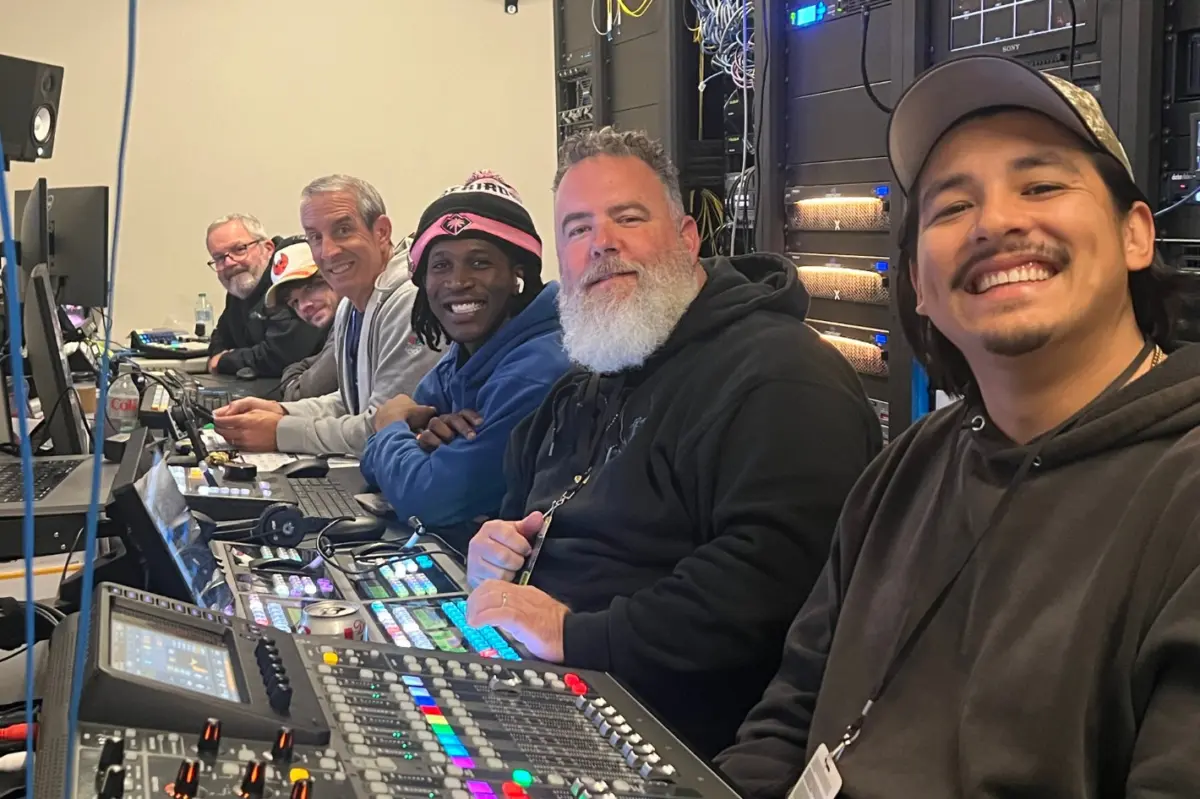
At the commentator’s booth—traditionally the area with the highest concentration of bidirectional signal paths—the team deployed a custom, flight-cased portable booth kit. This kit serves as a localized input/output (I/O) node. Multiple SDI camera feeds, commentator monitors, and audio channels are patched directly into this booth kit.
Inside the kit, a bank of AJA FiDO (Fiber Digital Optical) Mini-Converters converts the electrical SDI signals into optical signals. These optical signals are then multiplexed and sent back to the OB truck over a single, highly durable, four-pair tactical fiber-optic cable. At the truck, another bank of AJA FiDO receivers converts the optical signals back into native SDI for ingestion into the production switcher.
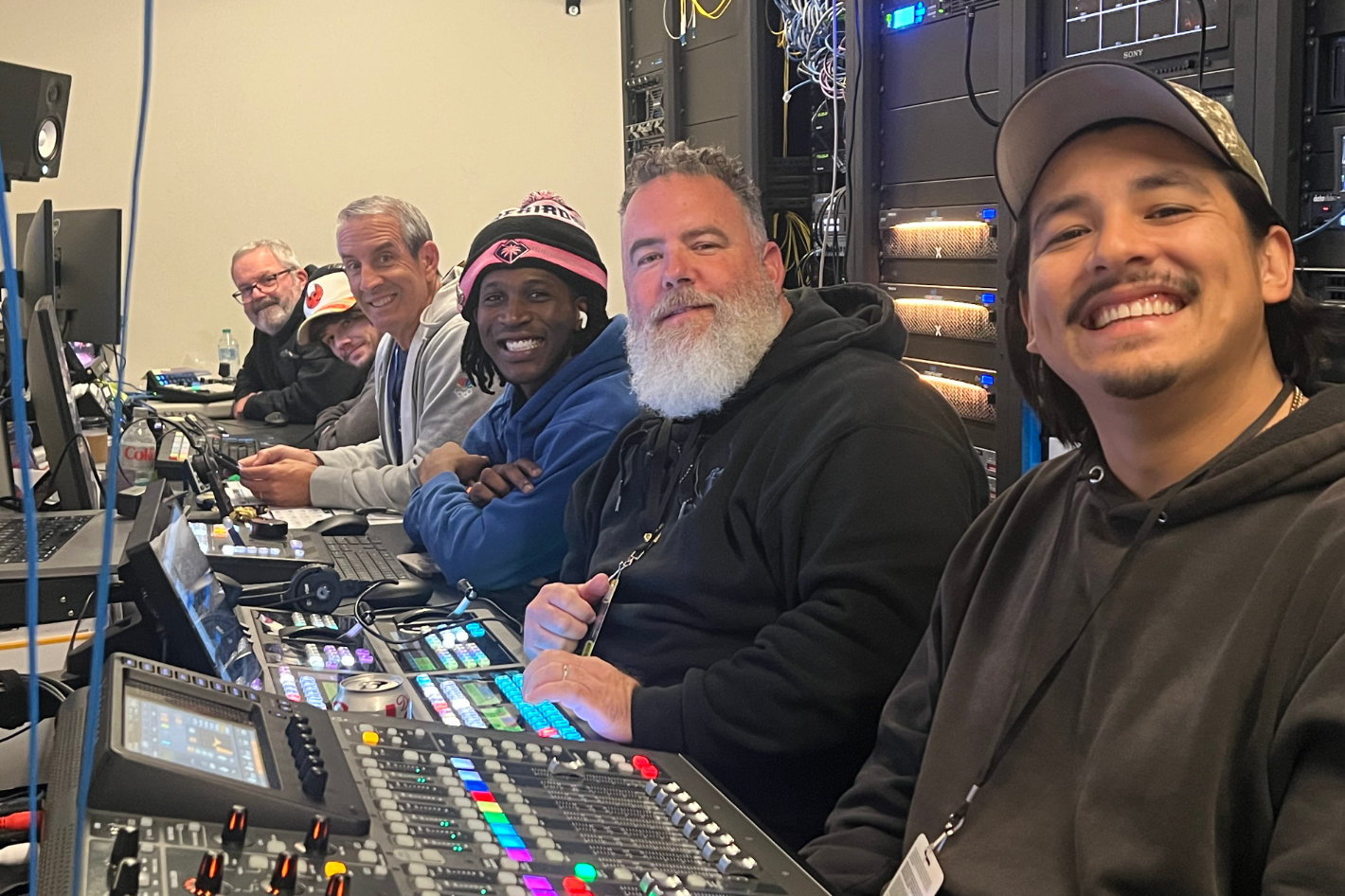
This architectural shift reduced setup times from hours to minutes, slashed the physical footprint of their cable runs by over 80%, and effectively eliminated the distance limitations that had previously dictated where they could park their OB production truck.
Supporting Context, Technical Deep-Dive & Metrics
To fully appreciate the operational efficiency of Bantaray’s modern workflow, it is necessary to examine the underlying physics of signal transport in live sports environments, as well as the economic realities of boutique production companies.
The Physics of Signal Loss: Copper vs. Fiber
In live sports broadcasting, signal integrity is non-negotiable. Dropped frames, digital artifacts, or latency can ruin a broadcast and violate service level agreements (SLAs) with broadcast partners like Spectrum.
| Metric / Parameter | Traditional Copper (3G-SDI / RG6) | Tactical Single-Mode Optical Fiber |
|---|---|---|
| Max Transmission Distance | ~100 meters (300 feet) before requiring reclocking | Up to 10,000+ meters (6+ miles) without signal loss |
| Weight per 1,000 Feet | ~30 to 45 lbs (depending on shielding) | ~5 to 8 lbs (Tactical polyurethane jacketed) |
| Electromagnetic Interference (EMI) | Highly susceptible (especially near stadium lighting/generators) | 100% Immune |
| Bandwidth Capacity | Restricted to single-channel SDI per cable | Virtually unlimited (supports multiplexing of dozens of channels) |
| Cable Diameter & Flexibility | Thick, stiff, difficult to route through tight spaces | Thin, highly flexible, easy to run overhead or underground |
By standardizing on single-mode optical fiber converted via AJA FiDO units, Bantaray bypassed the physical limitations of copper. A single-mode fiber-optic cable utilizes a tiny glass core (typically 9 micrometers in diameter) to transmit laser light. Because light experiences incredibly low attenuation when passing through high-purity silica glass, signals can travel miles without losing strength, completely eliminating the need for active signal boosters along the run.
Tactical Fiber Multiplexing in Action
Bantaray’s current inventory includes 24 AJA FiDO Mini-Converters, spanning single, dual, and quad-channel models (such as the FiDO-T, FiDO-R, FiDO-2T, FiDO-2R, and FiDO-4T/4R).
The use of multi-channel converters allows Bantaray to maximize the efficiency of their tactical fiber reels. A typical setup utilizes a four-pair (8-strand) tactical fiber-optic cable. By utilizing quad-channel AJA FiDO-4T transmitters at the camera/booth end and FiDO-4R receivers at the truck, Bantaray can transport four independent, uncompressed HD-SDI feeds over a single, ruggedized cable run.
This is particularly crucial for sports like pickleball or track and field, where cameras must be placed at extreme distances—such as high on light poles, at the finish line, or on opposite sides of a court—to capture wide angles and tight action shots.
Lean Crew Economics
Bantaray operates with a highly optimized crew. In boutique sports production, labor is the single largest variable cost.
- Traditional OB Crew (Large Format): Often requires dedicated utility personnel whose sole responsibility is pulling, securing, and wrapping heavy copper cabling.
- Bantaray’s Lean Crew Model: By utilizing lightweight fiber and highly reliable AJA conversion hardware, camera operators like Jeff Highbaugh and technical directors can handle the physical setup themselves.
Because the AJA FiDO converters are plug-and-play, requiring no complex software configuration, DIP-switch manipulation, or field calibration, they eliminate the need for a dedicated transmission engineer on-site. The cost savings realized by minimizing crew size can be reinvested into higher-quality camera packages, replay systems, and graphic engines, directly elevating the on-screen product.
Official Statements & Real-World Resilience
The harsh realities of remote sports production mean that equipment is constantly subjected to environmental extremes. In Southern California, where Bantaray is based, venues can range from dust-choked, wind-swept desert tracks to coastal arenas plagued by high humidity and salt spray, to inland stadiums where summer temperatures regularly exceed 100°F (38°C).
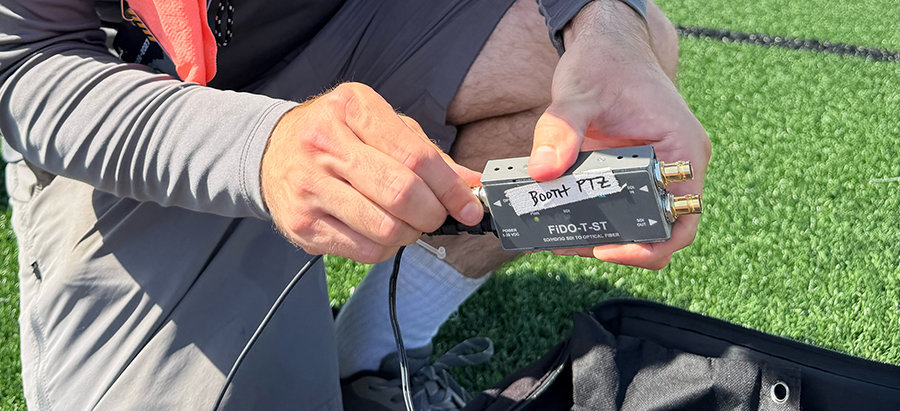
On-Site Reliability and Environmental Tolerance
Steve Banta, founder of Bantaray Mobile Sports Production, emphasizes that hardware reliability is the cornerstone of his business reputation:
"Every event is different, and each venue presents unique challenges. Sending signals across long distances is almost always a hurdle. We have to find simple ways to get reporter feeds back to the truck, send program feeds to in-venue LED displays, and route audio and video signals safely across the venue. Our AJA FiDO Mini-Converters support these needs and have been incredibly dependable through rain, extreme heat, and constant travel—they just keep working."
Banta further elaborates on the business value of investing in premium hardware over cheaper, consumer-grade alternatives:
"Reliability is everything in live production. When crews see professional gear like AJA on site, they know you’re top-notch. It’s better to invest in reliable equipment once than to frequently have to troubleshoot cheaper alternatives. We don’t have the luxury of downtime or technical rehearsals on most of our gigs. We arrive, we deploy, we broadcast, and we pack up. If a converter fails mid-game, the screen goes black for thousands of viewers. AJA gives us the peace of mind that that won’t happen."
Operational Flexibility in the Field
Jeff Highbaugh, a veteran freelance camera operator who frequently designs and executes Bantaray’s field setups, highlights the logistical freedom that fiber conversion provides, particularly when advance scouting of a venue is impossible:
"We are rarely given the luxury of scouting a location beforehand. We tap into Google Earth to preview the space before arriving, determine where the OB truck will park, and plan our cable runs. That’s the beauty of fiber; the truck can be parked anywhere on site, and we can still quickly deploy audio and video using our FiDOs and daisy chain as much length as we need. The setup is so fast, and we can run four cameras down one fiber line."
Highbaugh also points out that the benefits of standardizing on AJA extend beyond simple signal transport to the overall speed of the workflow:
"We don’t have a giant crew, and everyone is wearing multiple hats. So, we need gear that is reliable, consistent, and easy to use. Our AJA FiDO Mini-Converters provide reliable conversion between SDI and fiber, giving us additional flexibility to convert signals on the fly or extend them much farther than traditional SDI allows. We’ve put our FiDOs through just about every weather condition imaginable, and they’ve never let us down. That reliability gives everyone confidence because we know the gear will simply do its job."
Future Outlook: The IP Transition, Remote Workflows, and Beyond
As Bantaray Mobile Sports Production looks to the future, the company is positioning itself to capitalize on several emerging trends in the broadcast industry.
[Traditional Baseband Workflow (SDI/Fiber)]
       │
       ▼
[Hybrid Remote Workflows (REMI / SRT Streaming)]
       │
       ▼
[Next-Gen IP Infrastructure (SMPTE ST 2110 / NDI)]
The Rise of REMI and Remote Workflows
The COVID-19 pandemic permanently accelerated the adoption of Remote Integration Model (REMI) production workflows. In a REMI setup, cameras and microphones capture the live action on-site, but the actual switching, graphics insertion, and audio mixing are performed by a production crew located at a centralized studio miles—or even continents—away.
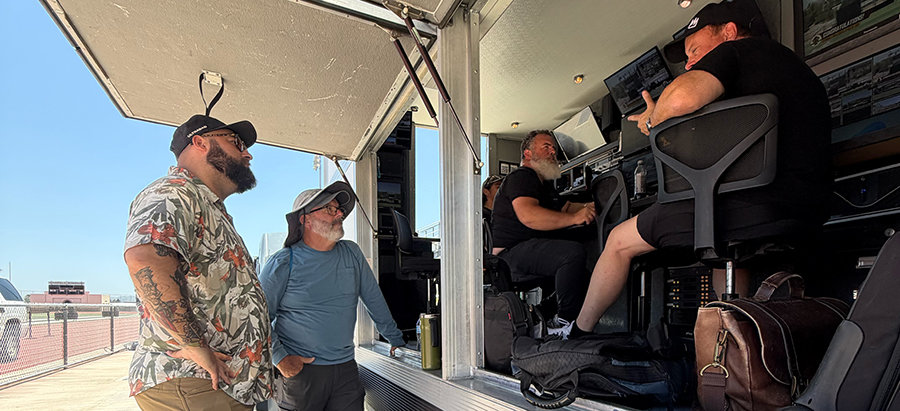
For Bantaray, this evolution means that their field-deployed pipeline must be capable of feeding low-latency encoders and streaming transceivers. By ensuring that their on-site physical transport layer (from camera to encoder) is ultra-low latency and highly stable via fiber, they provide a clean, jitter-free feed to high-efficiency video coding (HEVC) encoders. This allows for seamless transmission over public internet or dedicated cellular networks (5G) back to central production facilities.
Transitioning to IP-Based Production (SMPTE ST 2110)
While baseband SDI and traditional point-to-point fiber conversion remain the workhorses of the regional sports market, the broader broadcast industry is steadily transitioning to IP-based infrastructures, specifically the SMPTE ST 2110 suite of standards. ST 2110 splits video, audio, and ancillary data into separate, synchronized IP multicast streams, allowing for unprecedented routing flexibility over standard IT network switches.
Steve Banta is actively monitoring this transition:
"While many in the industry are focused on artificial intelligence right now, we’re much more interested in where remote workflows are heading. The pandemic accelerated the industry’s adoption of them, and they’ve just kept evolving since. As we transition toward IP-based environments, the fundamental challenge remains the same: you still need to capture a high-quality, uncompressed physical signal at the lens and transport it reliably to your network backbone. Our investment in robust fiber infrastructure ensures we are ready to bridge the gap between traditional SDI and future IP standards."
Expanding Venue Footprints: Acrisure Arena
The efficacy of Bantaray’s robust, AJA-driven workflow is being put to the test in larger, more permanent installations. The company is currently involved in building out and supporting the in-house entertainment, concert broadcast, and live sporting event production setups at the Acrisure Arena in Thousand Palms, California.
This state-of-the-art, multi-purpose 11,000-seat indoor arena—home to the Coachella Valley Firebirds of the American Hockey League (AHL)—requires a highly sophisticated, multi-tier routing system. In venue environments of this scale, the distance between the central control room, the camera decks, the press box, and the massive center-hung LED scoreboard can easily exceed the limits of traditional cabling.
By applying the same fiber-optic conversion principles perfected on their mobile sports shoots, Bantaray is helping to construct an adaptable, reliable, and future-proof signal distribution network. Whether routing a 3G-SDI broadcast camera feed to a high-definition replay server or sending an HDMI graphics feed to a giant scoreboard display, the integration of reliable conversion technology ensures that fans in the arena and viewers at home experience flawless, zero-latency visual entertainment.
Conclusion
As streaming platforms continue to proliferate and niche sports demand their share of the global spotlight, the role of specialized, agile mobile production companies like Bantaray will only grow in importance. By blending practical field experience, meticulous logistical planning (via tools like Google Earth), and a uncompromising commitment to hardware reliability through partnerships with technology leaders like AJA, Bantaray has established a blueprint for the future of localized sports broadcasting. In a world where "the screen must never go black," they have proven that with the right workflow, equipment failure is simply not an option.