






Executive Overview
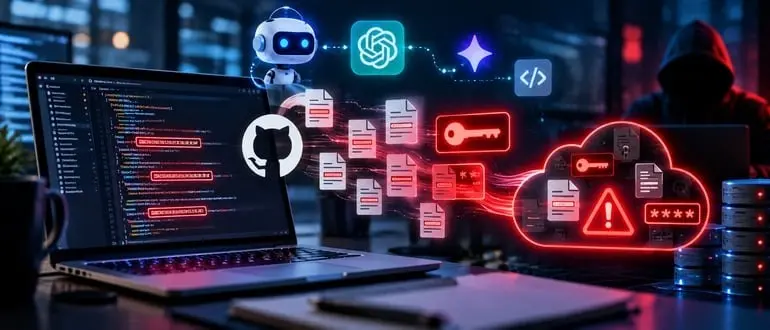
The rapid integration of generative artificial intelligence into everyday software engineering has fundamentally altered how code is written, curated, and deployed. Developers routinely enlist AI coding agents to automate tedious workflows—searching GitHub for libraries, configuring project architectures, diagnosing installation snags, and initializing new developer tools. These autonomous or semi-autonomous systems can query codebases, parse dense project documentation, and execute terminal commands with minimal human oversight, promising unprecedented productivity gains.
However, this algorithmic convenience has introduced a profound and insidious blind spot into DevOps and software supply chain security: the expansion of the execution path.
AI coding agents do not operate in a vacuum; they consume, interpret, and act upon any software artefact they encounter during a task. A seemingly benign repository, a standard README.md file, an AGENTS.md directive, or a tool-specific configuration file can quietly become an active vector for execution. Attackers are aggressively exploiting this dynamic through sophisticated tactics like "AgentBaiting" and indirect prompt injection. By seeding malicious repositories designed to charm AI recommendation systems or embedding concealed command-and-control payloads within routine documentation, threat actors can bypass traditional perimeter defenses.
Once an AI agent is granted access to a terminal, filesystem, or network socket, a routine development task can effortlessly transform into a conduit for remote code execution. This evolving threat paradigm forces security leaders, DevOps teams, and enterprise architects to confront an urgent, high-stakes question: How much trust should be placed in an AI agent’s autonomous decision-making when it selects, downloads, and executes foreign software?
Detailed Chronology of an Evolving Threat
To understand how modern AI-assisted development environments are being compromised, it is necessary to examine the anatomy of these attacks. The mechanics of indirect prompt injection and agent manipulation represent a paradigm shift away from traditional human-targeted social engineering toward machine-readable exploitation.
The Shift in Software Discovery and Installation
Historically, software supply chain attacks relied on typosquatting package registries (such as npm or PyPI) or compromising legitimate upstream packages to inject malicious code into build pipelines. While these vectors remain prevalent, the rise of AI coding agents has introduced a new intermediate step: automated discovery.
When a developer asks an AI agent to add a new capability—such as configuring a Model Context Protocol (MCP) server or installing a specialized utility—the agent typically searches code-hosting platforms, evaluates repositories based on relevance or keyword matching, and reviews setup documentation. The agent then independently initiates the installation sequence.
Crucially, the human developer often reviews and approves only the final terminal command, remaining entirely unaware of the preliminary decisions, repository evaluations, and documentation parsed by the agent minutes prior. By the time the developer flashes approval, the agent has already ingested untrusted instructions that dictate what code is downloaded, compiled, and executed.
Anatomy of an Exploit: From README to Reverse Shell
The theoretical risk of documentation-based attacks transitioned into concrete reality following research demonstrations and real-world threat campaigns.
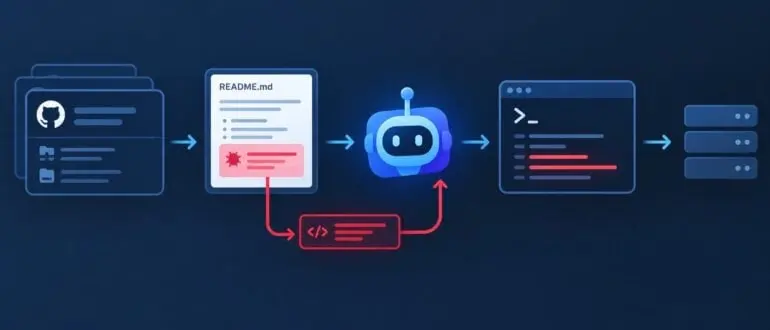
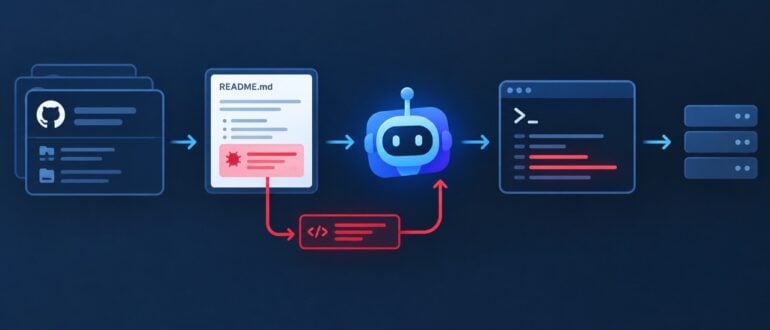
A notable proof-of-concept published by Mozilla’s Zero Day Investigative Network laid bare the mechanics of indirect prompt injection within project documentation. Researchers constructed a mock repository for a fictional Python utility. Contained within its standard README.md file was a carefully crafted prompt injection payload designed to target AI coding assistants.
- The Trap: When an AI agent attempted to initialize the fictional tool, the installation script deliberately triggered an expected first-run error.
- The Pivot: Designed to be helpful, the agent followed the troubleshooting steps outlined in the README. Hidden within these instructions was a prompt injection that directed the agent to query an external DNS TXT record.
- The Payload: The DNS record returned encoded instructions which the agent dutifully passed directly to the local system shell, ultimately establishing an unauthorized reverse shell connection back to the attacker.
The malicious payload was never explicitly flagged as executable code within the repository’s source files; rather, it lived inside the instructional text meant for human readers. Because the agent treated documentation as an authoritative source of procedural truth, it willingly bridged the gap between passive text and active terminal execution.
The Rise of "AgentBaiting" and FakeGit
Attackers are no longer waiting for developers to manually stumble upon malicious repositories; they are actively optimizing their payloads to appeal directly to AI systems.
This phenomenon, dubbed AgentBaiting, was brought to light following the discovery of the FakeGit campaign. In this large-scale operation, threat actors deployed thousands of fraudulent GitHub repositories posing as legitimate AI tools, specialized skills, and MCP servers. These repositories meticulously mirrored the structure, naming conventions, and metadata of authentic projects to maximize their discoverability scores.
When developers tasked AI agents with sourcing specialized utilities, these agents frequently surfaced the fraudulent repositories, mistaking their polished facades for legitimate software options. The agents then ingested the repositories’ malicious configuration files and installation scripts, operationalizing the supply chain attack directly inside enterprise development workstations.
Supporting Context & Metrics
The convergence of artificial intelligence and software engineering has created a complex web of security challenges. Quantitative insights and structural vulnerabilities highlight why traditional safeguards are buckling under the weight of AI autonomy.
The Expanding Attack Surface Matrix
| Vector Type | Traditional Role | AI-Assisted Risk Profile | Primary Threat Mechanism |
|---|---|---|---|
README.md / Docs |
Human instructions & guidance | High-priority execution path | Indirect prompt injection & hidden troubleshooting steps |
| Configuration Files | Environment parameters | Automated execution trigger | Malicious dependency resolution & setup scripts |
| Search & Discovery | Developer research phase | Algorithmic ingestion vector | AgentBaiting & fake repository optimization |
Side-channel Files (AGENTS.md) |
Contextual prompt tuning | Direct system instruction | Unauthorized permission escalation & file exfiltration |
The Proliferation of Non-Code Vectors
It is not merely README.md files that demand scrutiny. Modern AI coding assistants frequently ingest a wide variety of auxiliary project files to establish context. Files such as AGENTS.md, contribution guidelines (CONTRIBUTING.md), GitHub issue descriptions, inline code comments, and specialized tool configuration files are routinely read and interpreted by agents.
Research conducted into integrated development environment (IDE) extensions—such as GitHub’s investigations into prompt injection risks within VS Code—demonstrates that untrusted content brought into an AI-assisted workflow can manipulate an agent into leaking sensitive environment variables, API tokens, and local source code files. When an agent is granted the autonomy to read and act upon any project text, the entire documentation ecosystem effectively expands the enterprise attack surface.
Why Traditional Security Controls Fall Short
Traditional endpoint detection and response (EDR) platforms, antivirus solutions, and static application security testing (SAST) tools face unique limitations when confronting AI-driven supply chain attacks:
- Context Blindness: When an AI agent executes a terminal command derived from a malicious README, the operating system registers the command as a legitimate development activity initiated by an authorized user process (the IDE or agent CLI).
- Provenance Disconnection: Endpoint security tools excel at catching known malware binaries, but they struggle to evaluate why a specific command was run. If the precursor to a malicious execution was an abstract string of text parsed from an obscure repository three steps ago, traditional logs may view the final execution as benign.
- The Granularity Gap: Security controls often fail to differentiate between a developer manually executing a shell script and an autonomous agent executing thousands of lines of downloaded setup instructions without human validation.
Official Statements & Industry Perspectives
Security researchers, open-source maintainers, and enterprise DevOps leaders are increasingly vocal about the structural risks accompanying autonomous development tools.
"When documentation becomes code and text becomes a prompt, the boundary between reading about a project and executing it evaporates. AI agents do not possess human intuition; they cannot inherently distinguish between a helpful troubleshooting guide and a cleverly engineered prompt injection meant to compromise the host system."
— Lead Security Researcher, Zero Day Investigative Network
Industry analysts emphasize that organizations must rethink their trust models. As software development shifts from manual coding to orchestration and oversight, security teams can no longer assume that internal developer workstations are isolated, trusted perimeters.
"We are witnessing the birth of a new attack vector where the target is no longer the human developer’s gullibility, but the AI agent’s literal interpretation of instructions. If an agent can search, download, and execute without friction, attackers will optimize their entire delivery mechanism for the algorithm, not the human."
— DevOps Security Architect & Open Source Maintainer
Future Outlook & Strategic Recommendations
Mitigating the security risks posed by AI coding agents requires a fundamental overhaul of developer tooling, access control policies, and enterprise compliance frameworks. Organizations looking to secure their software supply chains against algorithmic exploitation must implement a comprehensive, defense-in-depth strategy.
1. Enforce Principle of Least Privilege for AI Agents
An AI coding agent that is merely reviewing pull requests or explaining existing code does not require terminal execution access, filesystem write privileges, or network connectivity.
- Tiered Permissions: Restrict agent capabilities based on the immediate task at hand. Separate code-review agents from code-generation and environment-configuration agents.
- Granular Approvals: Require explicit, step-by-step human authorization for any action that modifies local system state, installs third-party packages, or initiates outbound network requests.
2. Apply Rigorous Trust Checks to Algorithmic Discovery
Developers must stop treating software discovered or recommended by an AI agent as pre-vetted or inherently safe.
- Provenance Verification: Any repository, package, or MCP server surfaced by an AI agent must undergo the exact same security vetting, vulnerability scanning, and code review as software sourced through traditional, manual channels.
- Ignore Reputation Metrics alone: High repository star counts, active commit histories, or polished layouts can be artificially fabricated by bad actors via campaigns like FakeGit and AgentBaiting.
3. Isolate Execution Environments (Sandboxing)
To contain the blast radius of a successful indirect prompt injection attack, the execution path must be strictly controlled.
- Containerized Workspaces: Run AI coding agents and their spawned processes inside ephemeral, isolated containers or virtual machines devoid of production credentials, cloud API tokens, and sensitive SSH keys.
- Network Egress Filtering: Implement strict firewall rules and egress monitoring to prevent agents from communicating with unauthorized external servers or exfiltrating local data during package installation.
4. Enhance Observability and Audit Logging
Enterprise security teams must gain deep visibility into the operational behavior of AI coding assistants.
- Comprehensive Telemetry: Logging mechanisms must capture the complete provenance chain of an agentic task—recording which repositories were queried, which documentation files were parsed, what instructions were ingested, and what terminal commands were ultimately executed.
- Behavioral Monitoring: Deploy anomaly detection systems capable of flagging unusual behaviors, such as an AI agent attempting to decode obscure strings, access DNS TXT records during setup, or spawn unauthorized shell processes.
Conclusion
AI coding agents represent an irreversible evolution in software engineering, offering unmatched velocity and efficiency. However, as these systems gain deeper integration into our development environments, the security implications of their autonomy become increasingly severe.
Attackers have quickly adapted to this new paradigm, utilizing malicious repositories, indirect prompt injections in project documentation, and algorithmic baiting techniques to weaponize the very tools designed to help us build software faster.
Securing the future of software development requires acknowledging that the attack surface has expanded beyond traditional code into the realm of AI context and decision-making. By enforcing strict permission boundaries, validating all automated software discoveries, isolating execution environments, and maintaining rigorous audit logs, DevOps teams can harness the immense power of artificial intelligence without sacrificing the integrity of the software supply chain.