Executive Overview
Rust has long enjoyed a reputation as the darling of modern systems programming—a language that fundamentally changed how developers think about memory safety, concurrency, and compile-time guarantees. Its strict compiler and comprehensive type system have been marketed as a bulwark against entire classes of software bugs, catching logical and structural errors before a single line of code ever reaches production. Yet, when runtime issues inevitably strike in production environments, a surprising paradox emerges: most Rust developers do not use a debugger.
Instead of reaching for sophisticated debugging tools, the vast majority of the Rust ecosystem still relies on time-tested print statements, logs, and the ubiquitous dbg! macro. This is not merely a quirk of developer culture or a sign of technological reluctance; it is a rational, pragmatic response to systemic friction within Rust’s debugging ecosystem.
Data from the Rust compiler team’s first-ever dedicated debugging survey—conducted in February 2026—reveals deep-seated challenges in runtime inspection, particularly regarding how complex data structures, asynchronous code, and macro-heavy frameworks are rendered. As enterprises increasingly standardize on Rust for critical infrastructure, this tooling gap exposes an underlying "verification debt." While Rust’s compile-time safety nets have bought it immense enterprise credibility, its runtime tooling has yet to earn the same trust.
Detailed Chronology
February 2026: The Rust Compiler Team Surveys the Community
In February 2026, the Rust compiler team initiated a landmark effort to understand the state of runtime troubleshooting by launching its first dedicated debugging survey. Capturing responses from more than 2,300 developers, the survey provided an unprecedented, data-driven look at how professionals handle runtime failures in a language historically obsessed with compile-time correctness.
The demographics of the survey respondents immediately commanded attention: 80% of participants identified as advanced or intermediate Rust users. These were not novices struggling with basic syntax, but seasoned engineers building production systems.
The Revelation of Print Dominance
The survey’s headline finding shocked observers: only 46% of respondents reported actively using a debugger for their Rust work. Conversely, an overwhelming 81% stated that logs and print statements were simply faster, more intuitive, or more reliable than reaching for a dedicated debugger.
Rather than indicating a lack of industry sophistication, these numbers exposed systemic usability failures. When 74% of developers reported poor representation of values within debuggers—and 55% noted that they could not reliably print a variable at all—print debugging ceased to be a mere shortcut. It became the only reliable mechanism for inspecting code behavior. Enums, vectors (Vec), and hash maps (HashMap) emerged as primary pain points, frequently rendering as inscrutable raw memory dumps rather than readable, contextual types.
The Rise of Alternative Innovations
Recognizing the limitations of legacy tools, the broader community and ecosystem stakeholders began implementing grassroots fixes. Community-driven alternatives, such as the experimental BugStalker debugger, started exploring the use of Rust’s native Debug trait to render values accurately, bypassing many traditional representation hurdles. Simultaneously, Google Summer of Code projects initiated efforts to strengthen debug information testing, seeking to eliminate the silent regressions that historically eroded developer trust in Rust debugging sessions.
Supporting Context & Metrics
The Tooling Split and Polyglot Realities
Among the minority of developers who do incorporate debuggers into their workflows, the tooling landscape is fractured.
- IDE-Integrated LLDB dominates on Windows and macOS, winning by margins of six percentage points or more.
- GDB on Linux narrowly edges out IDE-based LLDB by less than half a percentage point, reflecting a preference for command-line utilities in native Linux environments.
Once developers successfully launch a debugger, their usage patterns remain remarkably basic. Approximately 87% use the tool to step line-by-line through synchronous code, while just over half rely on it to pull stack traces from crashed or hung processes.
However, modern systems rarely operate in a vacuum. The survey highlighted that 44% of respondents regularly debug programs that mix Rust with other languages. Within this polyglot cohort:
- 70% pair Rust with C.
- 43% pair Rust with C++.
For enterprise infrastructure teams maintaining complex, legacy-adjacent codebases, a debugger that understands Rust in total isolation fails to solve the broader engineering challenge of crossing Foreign Function Interface (FFI) boundaries safely.
The Async and Macro Bottlenecks
Asynchronous programming represents the breaking point for current debugging infrastructure. Only 25% of respondents successfully debug async code, marking the lowest adoption rate of any use case in the survey. Furthermore, 28% of those who attempt it report significant, recurring friction.
Stepping through a future or an async executor fundamentally differs from tracking sequential, synchronous execution. Today’s debuggers lack a mental model capable of visualizing complex, cooperative multitasking flows cleanly.
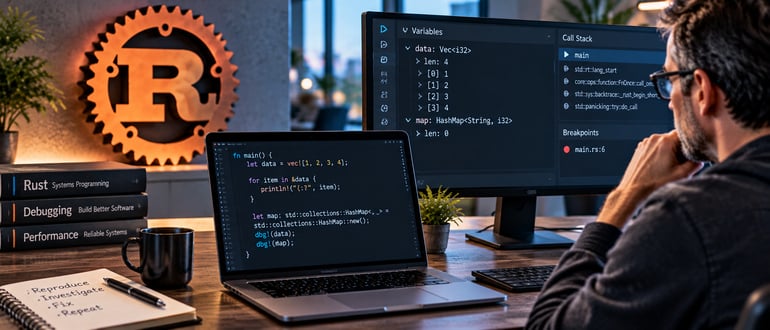
Similarly, macro-heavy code causes friction for 23% of respondents. Because idiomatic Rust relies heavily on macros for everything from boilerplate reduction and serialization to advanced error handling, macro expansion obscures line numbers and variable bindings, rendering traditional breakpoints ineffective.
The Awareness Gap: debugger_visualizer
Beneath the technical hurdles lies a quiet awareness gap. Fully 62% of library authors surveyed stated they had never heard of the debugger_visualizer attribute—a built-in feature allowing crates to ship explicit instructions on how debuggers should display their unique types.
Among the smaller subset of developers who knew about the attribute but had never utilized it, approximately half cited a lack of maintenance time, while the other half admitted they simply did not know how to write the configuration scripts. This discovery underscored that Rust’s debugging crisis is as much a documentation and discoverability challenge as it is a compiler engineering problem.
Official Statements
The disconnect between Rust’s stellar compile-time reputation and its fragile runtime tooling has drawn sharp commentary from industry analysts and architecture experts.
"Rust’s compile-time guarantees bought it enterprise credibility its runtime tooling has not earned. When a debugger cannot render a value legibly, print statements are the correct engineering call, and that call has hardened into culture,"
— Mitch Ashley, Vice President and Practice Lead for CIO & Technology Buyers and for Software Lifecycle Engineering at The Futurum Group.
Ashley emphasized that organizations adopting Rust are inadvertently taking on hidden liabilities:
"Platform teams standardizing on Rust for production infrastructure are inheriting verification debt they did not price. Value representation and async traces belong in the selection criteria alongside memory safety, and the people signing that standard have to say so."
Future Outlook
The Rust compiler team and core contributors are actively working to address the vulnerabilities exposed by the February 2026 survey. Their published roadmap prioritizes several key remediation efforts:
- Enhanced Value Rendering: Focusing heavily on improving how enums, strings, and standard library collections (
HashMap,Vec) are displayed within debugger interfaces, ensuring strings appear as readable text rather than raw memory addresses. - Async Trace Modernization: Redesigning stack trace mechanisms to better comprehend futures, tasks, and executors, bridging the gap between synchronous tooling and modern asynchronous paradigms.
- Comprehensive Documentation: Overhauling setup guides and documentation to demystify features like
debugger_visualizerand reduce the friction of initial debugger configuration. - Automated Testing: Expanding debug information regression testing to ensure that compiler updates do not silently break variable inspection over time.
Ultimately, this conversation transcends debuggers alone. It is a stress test for whether Rust’s tooling ecosystem can keep pace with its rapid adoption in mission-critical production infrastructure—where a 2:00 AM emergency troubleshooting session is never optional. A programming language engineered to eliminate compile-time errors must eventually provide robust, frictionless answers for the runtime failures that inevitably occur in the wild. For now, the venerable print statement remains the unsung hero filling that gap.
Frequently Asked Questions
Why do so many Rust developers prefer print debugging?
For the majority of developers, print statements (println!, eprintln!, and the dbg! macro) are simply faster, more predictable, and more reliable than configuring an external debugger. When debuggers fail to display complex data types, collections, or enums clearly, print statements provide immediate and unambiguous visibility into runtime behavior.
What are the biggest weaknesses in Rust debugging today?
Survey respondents highlighted several major pain points, including poor value representation (such as strings showing up as raw memory), unreliable variable inspection, severe difficulties when stepping through asynchronous (async/await) code, and obfuscation caused by macro-heavy codebases.
How is the Rust ecosystem trying to improve debugging?
The Rust core team and community are prioritizing targeted enhancements, including better rendering for enums and collections, readable string outputs, improved async stack traces, comprehensive setup documentation to eliminate configuration hurdles, and automated testing to prevent regressions in debug information.