Executive Overview
The global sports broadcasting sector is undergoing a quiet but profound technological revolution. Driven by the relentless demand for more camera angles, higher resolutions, and lower operating costs, production companies are moving away from traditional, resource-heavy Outside Broadcast (OB) infrastructures toward decentralized, agile, and IP-enabled remote workflows. At the center of this paradigm shift is the concept of "SWaP-C"—the optimization of Size, Weight, Power, and Cost.
At IBC2026, broadcast technology design and engineering pioneer BHV has marked a critical milestone in this transition, announcing that its highly anticipated SportsBox—the industry’s smallest remote vision mixer and format processor—has officially transitioned from its development phase into full commercial production.
First previewed as a conceptual prototype at IBC2025, SportsBox represents a structural leap forward for field-based multi-camera production. Weighing a mere 900 grams (approximately 2 lbs.) and featuring a ultra-compact footprint, this hardware-integrated solution solves one of the most persistent bottlenecks in live sports production: the complex, high-bandwidth, and costly task of backhauling multiple synchronized high-fidelity camera feeds from the field to the remote production gallery.
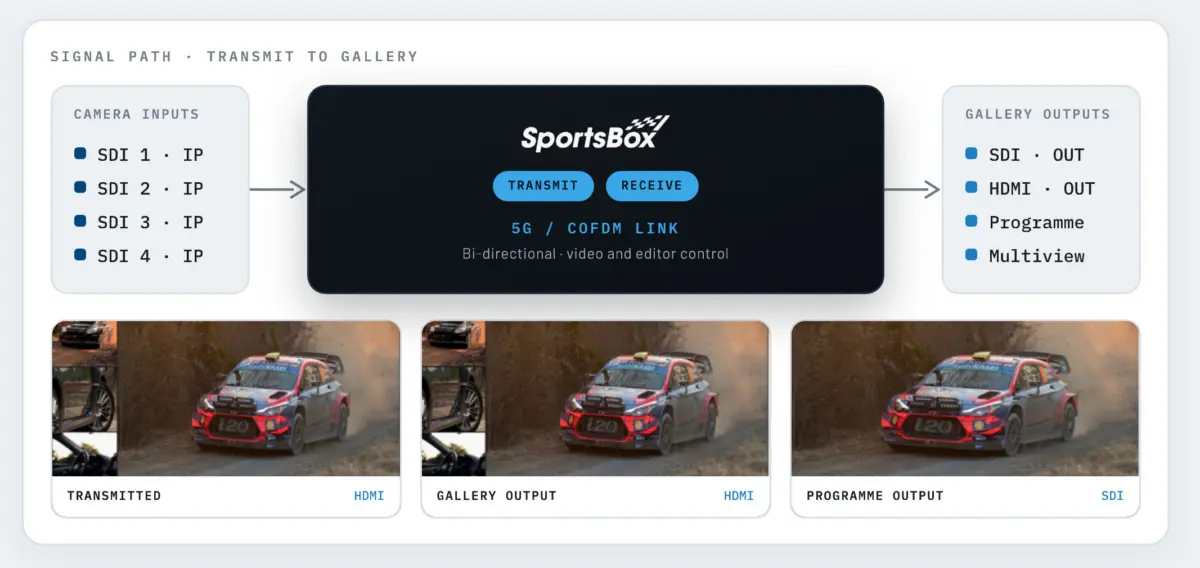
By integrating multi-channel scaling, frame synchronization, format processing, and vision mixing onto a single, highly durable piece of silicon, SportsBox enables production crews to multiplex four discrete 4K 60P 4:2:2 camera signals down a single wireless or cellular video path (such as 5G or COFDM).
This development is not merely an incremental hardware update; it is a fundamental reconfiguration of how tier-one and tier-two live sports events can be produced, offering unprecedented operational flexibility for high-velocity environments like motorsports, competitive sailing, and aerial racing.
Detailed Chronology: From Stealth OEM Engineering to Frontline Commercialization
The arrival of SportsBox at production-ready status at IBC2026 is the culmination of a multi-year strategic pivot for BHV. To fully understand the significance of this product launch, it is necessary to examine the chronological evolution of BHV and the development lifecycle of the SportsBox platform.
[Decades of OEM Engineering] ➔ [IBC2025: Concept Unveiled] ➔ [ISE 2026: Pro AV Integration] ➔ [IBC2026: Commercial Production & Launch]1. The Heritage of BHV: The Silent Engine of Broadcast Tech
For decades, BHV operated primarily behind the scenes. As a specialized broadcast technology design and engineering consultancy, the company was the intellectual and engineering force behind some of the industry’s most recognizable hardware brands. BHV’s engineers designed proprietary ASICs (Application-Specific Integrated Circuits), developed robust firmware architectures, and engineered video-processing pipelines that populated the gear racks of global broadcasters.
However, as remote production (often referred to as REMI—Remote Integration Model) accelerated post-pandemic, BHV identified a critical market gap that existing white-label clients were not addressing: the need for an ultra-miniaturized, ultra-rugged edge processor capable of handling high-end UHD video signals in extreme environments without the thermal and physical footprint of traditional rackmount gear.
2. IBC2025: The Conceptual Breakthrough
At IBC2025, BHV stepped out from the shadows of OEM development to showcase the SportsBox prototype. The industry preview was designed to gauge market interest in a radical proposition: could a device smaller than a standard tablet replace a multi-unit rack of format converters, frame synchronizers, and vision mixers?
The prototype demonstrated the basic viability of processing four independent UHD signals on a single chip. The feedback from tier-one sports broadcasters and OB van operators was immediate and clear: there was an urgent demand for such a device, provided it could meet the rigorous environmental and regulatory compliance standards of sports governing bodies.
3. ISE 2026: Expanding into the Pro AV Ecosystem
In early 2026, BHV introduced SportsBox to the professional audiovisual integration market at ISE 2026. This move demonstrated that the technology’s utility extended far beyond elite sports broadcasting.
Corporate event producers, live music venue operators, and high-end house of worship production teams recognized that the ability to stream and switch four synchronized cameras over a single network pipeline could dramatically simplify local AV infrastructures, cutting down installation times and reducing cabling costs.
4. IBC2026: The Production-Ready Reality
Returning to Amsterdam for IBC2026, BHV has officially closed the loop between development and commercial deployment. The SportsBox units on display are no longer pre-production engineering models; they are fully certified, commercially manufactured units ready for immediate deployment in the field.
To mark this transition, BHV has introduced aggressive, show-exclusive pricing structures for early adopters at the exhibition, signaling its readiness to capture market share and establish SportsBox as a standard component of modern remote production kits.
Supporting Context & Technical Metrics: Demystifying the Hardware
To understand how SportsBox achieves such a drastic reduction in size without compromising on signal integrity, it is necessary to analyze its physical, thermal, and electrical architecture.
+-----------------------------------------------------------------------------+
|                                  SPORTSBOX                                  |
|                                                                             |
|  [ Camera 1 ] ---                                                          |
|  [ Camera 2 ] ----    +-----------------------+    Single Path             |
|                    ==> |  Single Silicon Core  | =========================> |
|  [ Camera 3 ] ----/    +-----------------------+  (5G / COFDM Wireless Link)|
|  [ Camera 4 ] ---/     • Sync, Scale, Process                               |
|                        • 4K 60P 4:2:2                                       |
+-----------------------------------------------------------------------------+
Physical Dimensions and SWaP-C Optimization
Traditional outside broadcast workflows require extensive rack space inside air-conditioned production trucks. A typical setup to ingest, synchronize, scale, and compress four independent 4K camera feeds requires several rack units of hardware, weighing upwards of 15 to 20 kilograms, and consuming hundreds of watts of power.
SportsBox completely upends these logistics:
- Weight: 900 grams (2 lbs.)
- Dimensions: 225mm x 170mm x 30mm (8.8 x 6.7 x 1.2 inches)
- Form Factor: Highly ruggedized, compact chassis designed to be mounted directly to camera rigs, inside chase vehicles, or on airborne platforms.
This miniature form factor allows SportsBox to be deployed directly at the "first mile" of the production chain—right at the camera cluster—rather than in a centralized technical pavilion or OB truck.
The Single-Silicon Advantage
The core innovation of SportsBox is its highly integrated silicon design. Rather than relying on multiple off-the-shelf processing chips interconnected via internal buses—which introduces latency, increases power consumption, and creates multiple points of failure—BHV engineered a custom, highly integrated processing architecture.
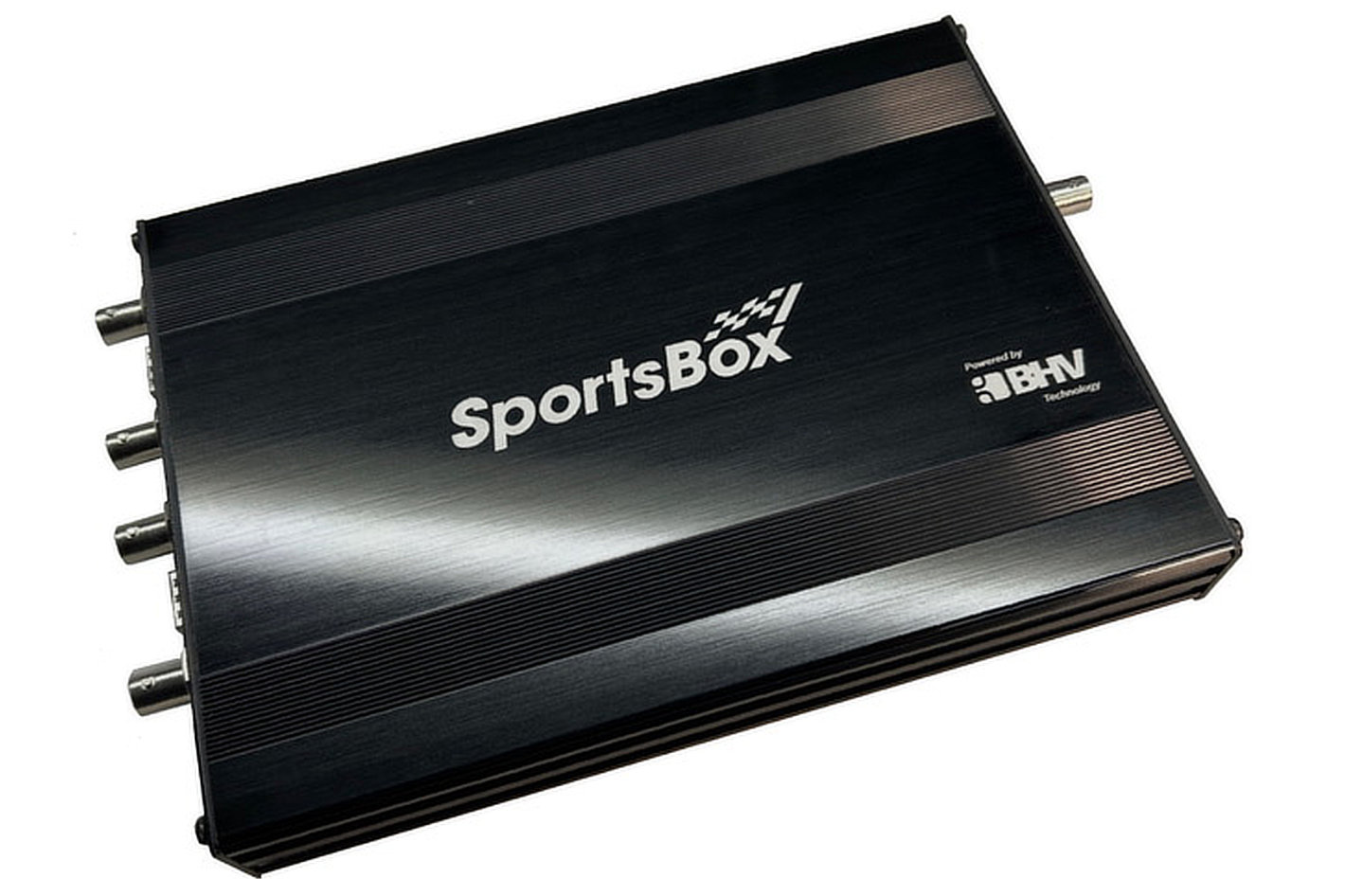
This single-silicon design manages:
- Multi-Format Synchronization: Instantly aligns four asynchronous camera inputs, resolving frame-rate discrepancies and phase offsets before transmission.
- High-Fidelity Scaling & Processing: Maintains a full 4K 60P 4:2:2 color depth throughout the entire processing pipeline, ensuring that there is no chroma subsampling degradation or loss of detail.
- Thermal Efficiency: Operating in extreme environments like a sun-baked MotoGP tarmac or a high-vibration powerboat hull requires a fanless, highly sealed design. The single-silicon architecture minimizes power draw, allowing for passive heat dissipation that protects the unit from dust, moisture, and extreme G-forces.
Redefining Transmission Efficiency: Single-Path Multiplexing
In remote broadcasting, RF spectrum and cellular bandwidth are premium, highly contested resources. Transmitting four independent 4K video feeds wirelessly from mobile cameras (such as onboard cameras on racing cars or drones) traditionally requires four separate transmitter units, four discrete RF frequencies (or four SIM cards), and complex frequency coordination to avoid intermodulation interference.
Traditional Wireless Setup:
[Camera 1] -> [TX 1] --(Freq A)-->
[Camera 2] -> [TX 2] --(Freq B)-->  |-> [Production Gallery] (High RF Congestion)
[Camera 3] -> [TX 3] --(Freq C)-->  |
[Camera 4] -> [TX 4] --(Freq D)--> /

SportsBox Remote Setup:
[Camera 1] -
[Camera 2] --+-> [SportsBox] -> [Single TX] --(Single Freq)--> [Production Gallery]
[Camera 3] --|   (Multiplexed)
[Camera 4] -/
SportsBox solves this by multiplexing the four signals before transmission. The unit ingests the four camera feeds, synchronizes them, scales them, and packages them into a unified, synchronized stream. This combined payload is then transmitted over a single video path, such as a single 5G cellular bonded link or a single COFDM (Coded Orthogonal Frequency Division Multiplexing) digital microwave channel.
This approach yields massive operational benefits:
- Spectral Efficiency: Reduces the required RF spectrum by 75%, allowing production teams to operate in highly congested RF environments (like crowded stadiums or urban race circuits).
- Bandwidth Cost Reduction: By utilizing a single 5G link instead of four, cellular data overhead and subscription costs are drastically cut.
- Absolute Synchronization: Because the four feeds are combined at the source into a single transport stream, they remain perfectly frame-locked throughout the transmission process, eliminating the common remote production issue of camera drift in the production gallery.
Official Statements and Industrial Analysis
The transition of SportsBox from a developmental prototype to a commercial product marks a milestone in BHV’s corporate evolution.
Bill Garrett, Chief Technology Officer of BHV, contextualized this release within the broader challenges of modern field production:
“At IBC2025 we showed SportsBox’s potential. At IBC2026 visitors will see full-blown capabilities that push the boundaries of field production. We developed SportsBox because we saw a very practical problem: getting multiple high-quality camera signals back to the gallery without a complex piece of equipment occupying real estate where space is at a premium. SportsBox delivers with a compact, deployable product.”
Deep-Dive Analysis of Garrett’s Statement
Garrett’s comments highlight a critical pain point in modern broadcasting: the premium on spatial real estate.
In high-action sports production, the most compelling camera angles are often the hardest to capture. Onboard cameras in motorsports, mast-mounted cameras on competitive yachts, and gimbal-mounted cameras on helicopters are severely constrained by weight and balance limitations. These limitations are dictated not just by physics, but also by the strict technical regulations imposed by sports governing bodies (such as the FIA, FIM, or America’s Cup authorities).
Traditionally, installing multi-camera setups in these tight environments required compromises: either using lower-quality, non-synchronized action cameras or installing heavy, complex encoding rigs that could upset the vehicle’s dynamics. By delivering a 900-gram unit that processes four broadcast-grade 4K feeds simultaneously, BHV has resolved this compromise. Production teams can now deploy multi-camera arrays on a single vehicle or structure, utilizing a single transmission link, without violating weight and space restrictions.
Furthermore, Garrett’s emphasis on moving from "potential" to "full-blown capabilities" highlights that SportsBox is launching with a mature, field-tested feature set. This includes full compliance with international broadcast standards, robust API integration for remote control, and a ruggedized build quality designed to withstand prolonged exposure to dust, water spray, and high vibrations.
Future Outlook: The Structural Shift in Remote Production
The commercial availability of BHV’s SportsBox arrives at a time when the economics of sports broadcasting are being completely rewritten. As networks seek to reduce their carbon footprints and operating budgets, the industry is rapidly transitioning away from the "all-on-site" model, where massive fleets of diesel-burning OB trucks and hundreds of crew members travel to every venue.
1. Accelerating the REMI / At-Home Production Model
By simplifying the edge infrastructure, SportsBox acts as a major catalyst for REMI workflows. Instead of sending a large production vehicle to a secondary or tertiary sports event, a broadcaster can ship a compact "flypack" containing a SportsBox, a few cameras, and a 5G transmitter.
The four synchronized camera feeds are sent back to a centralized production hub in another city or country, where a single director and technical crew can switch the show in real time. This lowers the cost of live production to such an extent that regional sports, collegiate athletics, and niche sporting disciplines can now afford high-quality, multi-camera UHD broadcasts that were previously financially unviable.
2. Environmental and Logistical Sustainability
The environmental impact of sports broadcasting is under intense scrutiny. Shifting from heavy, power-hungry rack equipment to highly integrated, low-power micro-processors like SportsBox directly correlates with a reduction in transport weight and power consumption.
A production kit built around SportsBox can be transported in standard airline luggage, eliminating the need for freight shipping and significantly lowering the carbon footprint of the production logistics.
3. BHV’s Evolving Role in the Broadcast Landscape
For BHV, the launch of SportsBox is a statement of intent. By bringing its engineering expertise directly to the market under its own brand name, BHV is positioning itself not just as an OEM supplier, but as a frontline innovator in the broadcast space.
As SportsBox establishes itself in the field, it is highly likely to serve as the foundation for a broader portfolio of ultra-compact, high-performance processing solutions designed to meet the evolving demands of an IP-centric, cloud-integrated broadcast ecosystem.
At IBC2026, the message from BHV is clear: the future of live sports production is no longer defined by the size of the OB truck, but by the sophistication of the silicon processing the signals at the edge. SportsBox is the embodiment of this transition—a tiny powerhouse that is set to leave a massive mark on the industry.