Executive Overview
Long before her dry, deadpan delivery made her a global internet phenomenon, Amelia Dimoldenberg was simply a teenager spending her afternoons at a North London youth club. Without that specific community space sixteen years ago, Chicken Shop Date—her viral celebrity talk show boasting nearly three million followers and holding a defining space in contemporary internet culture—might never have materialized. Recognizing how foundational those early formative environments were to her career, Dimoldenberg has spent recent years engineering a way to pay that foundational experience forward.
Enter the Dimz Inc. Academy, a comprehensive, free-of-charge creative incubator designed specifically for 18-to-24-year-olds hailing from underserved socioeconomic backgrounds. Developed in strategic partnership with the youth charity Spiral Skills and hosted within Young Creators U.K.’s (YCUK) South London production studio, the program serves as a direct counter-offensive to the staggering barriers facing contemporary youth trying to break into the creative industries.
Following a triumphant five-day pilot program last summer—which successfully launched graduates into roles at the BBC, Google, and YCUK—Dimoldenberg elevated the initiative for its latest iteration, expanding it into an intensive, month-long curriculum. By combining hands-on technical training, masterclasses from top-tier media professionals, and guaranteed paid work placements, the Dimz Inc. Academy is actively rewriting the recruitment playbook for an industry historically plagued by nepotism and geographical exclusivity.
Detailed Chronology: Inside the Four-Week Creative Incubator
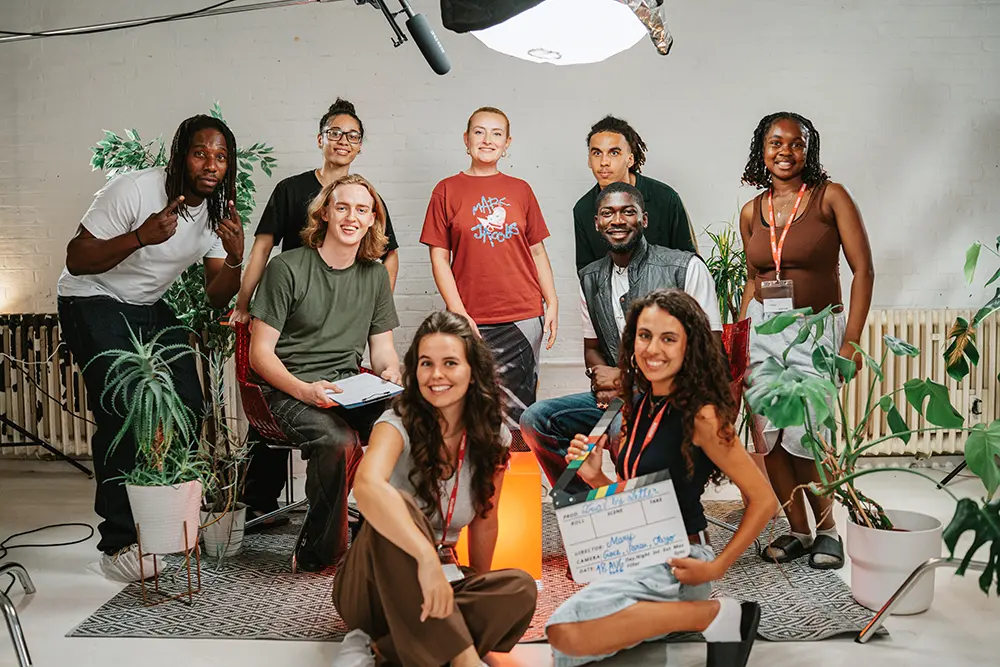
The evolution of the Dimz Inc. Academy from a localized, experimental workshop into a rigorous four-week professional fellowship represents a major milestone in creator-led philanthropy. When the doors of the YCUK studio opened for this year’s cohort, sixteen carefully selected participants stepped into a meticulously structured environment engineered to deconstruct the media production pipeline from every conceivable angle.
Week-by-Week Breakdown
- Weeks 1 & 2: Conceptualization and Collaborative Formation
The academy’s curriculum centers on a unifying theme: Love Letters. Participants are divided into three distinct teams, each tasked with developing a unique visual format: a classic sit-down interview (modeled after Chicken Shop Date), fast-paced person-on-the-street vox pops, and an immersive, documentary-style report. Rather than forcing participants into hyper-specialized silos, the program rotates and assigns definitive industry roles—presenter, director, producer, camera operator, sound engineer, and editor. -
Week 3: Production, Technical Mastery, and the Editing Crush
During Variety’s site visit, the studio was alive with the frantic, highly creative energy of editing week. Students worked alongside veteran editors drawn directly from Dimoldenberg’s personal network, mastering industry-standard software like Adobe Premiere Pro. Thanks to a new, official partnership with Adobe, every student walked away with a complimentary one-year subscription to the Adobe Creative Cloud suite.
The pressure was palpable as teams tried to distill hours of raw footage down to tightly paced five-minute cuts. Grace Bower, a 21-year-old participant from Rotherham, South Yorkshire, recounted the bittersweet struggle of trimming down a brilliant interview featuring internet personality Victor Kunda offering relationship advice. "We’re on seven and a half minutes because we’ve got too much good content!" she exclaimed.
- Week 4: The Southbank Centre Premiere
The month-long intensive culminated in a red-carpet-style screening event at London’s prestigious Southbank Centre. Surrounded by peers, family, mentors, and guest speakers, the students watched their completed projects on the big screen. The room erupted into cheers and prolonged applause, punctuated by emotional reflections on how deeply the four-week journey had transformed their self-confidence and career trajectories.
Supporting Context & Metrics: The UK’s NEET Crisis and Creative Industry Barriers
The necessity of initiatives like the Dimz Inc. Academy cannot be overstated. Across the United Kingdom and much of the industrialized world, a severe socioeconomic crisis is quietly unfolding among young adults.
The Scale of the NEET Crisis
According to a comprehensive interim report published by the U.K. Department for Work and Pensions, over one million young people in the United Kingdom are currently classified as NEET (Not in Education, Employment, or Training). This structural displacement is frequently exacerbated by compounding societal pressures, including rising rates of anxiety, mental health struggles, and neurodivergence.
Within the creative industries specifically, these socioeconomic hurdles are amplified exponentially. Aspiring talent outside of major metropolitan hubs face insurmountable barriers, including:
- The prohibitive cost of modern filmmaking equipment and post-production software licenses.
- A systemic lack of access to professional networks and industry "connections."
- Unpaid internships that systematically lock out working-class candidates who cannot afford to work for free.
- Geographical isolation, wherein opportunities are heavily centralized in cities like London, leaving regional talent without localized pathways to success.
Dimz Inc. Academy directly dismantles these obstacles by removing financial costs entirely, offering free equipment access, and actively sourcing regional talent from towns and cities traditionally ignored by legacy media scouting networks.

Official Statements and Industry Perspectives
The success of the academy relies heavily on a philosophy of trust, emotional safety, and community building. Stakeholders, mentors, and alumni emphasize that technical education is only half the battle; building resilience and psychological safety must come first.
"So often when we talk about the job NEET crisis, people talk about opportunity, which in Spiral’s view is just one part of it," explains Ben Kahn, CEO of Spiral Skills. "Young people from underserved communities are not turning up on our doorstep ready to go and just needing opportunity. They’re first needing to build those trusted relationships. So trust comes first for us—being with our youth workers in a safe space and building those skills to get them ready for opportunity."
For the participants, the shift in perspective has been life-changing. Lia Mistry, a 23-year-old participant who collaborated on the Brixton street-style documentary report, noted the unique camaraderie of the program:
"The whole program is hope. Everyone here is so supportive—the speakers and the guests, the team at YCUK as well. Here, it’s not like anyone’s competing; it’s like we’re a little family."
This sentiment is echoed by past alumni who have successfully transitioned into permanent creative careers. Siân Thandi, a 20-year-old producer who joined YCUK full-time after completing the initial five-day pilot last year, noted:

"Spaces like Spiral, Dimz, and YCUK really open young people up to not feel afraid to want to do that as a career. Coming here, I’ve never felt like I’m odd or different for wanting to go down this avenue."
Future Outlook: Scaling the Mission and Challenging Creators
As the Dimz Inc. Academy wraps its second and most ambitious year to date, Amelia Dimoldenberg is already looking toward the horizon. The immediate success of placing graduates into positions at major organizations like the BBC, Google, and YCUK proves the efficacy of the model. However, Dimoldenberg refuses to view the academy as a localized one-off project.
The Roadmap Ahead
- Regional Expansion: Dimoldenberg has voiced a strong ambition to take the academy on the road, scaling the program geographically to reach overlooked youth in the Midlands, the North of England, Scotland, and Wales.
- Lifetime Career Support: Through its permanent partnership with Spiral Skills, the academy guarantees every graduate a minimum of a one-week paid work placement, continuous mentorship, and ongoing access to professional studio facilities and equipment libraries.
- A Call to Action for Digital Creators: Beyond managing her own academy, Dimoldenberg is actively lobbying her peers in the digital creator economy to leverage their massive platforms for social good.
"People in my position: Can you open doors? Can you use your network? Can you be asking people to have internships?" Dimoldenberg urges fellow digital leaders. "Use your voice in that way."
By transforming viral internet success into tangible structural reform, Amelia Dimoldenberg is proving that the future of media is not built solely on algorithms and view counts, but on genuine community investment, shared resources, and unyielding belief in the next generation of storytellers.