In the shifting landscape of enterprise commerce, the traditional corporate pitch is rapidly losing ground to authenticity. Modern business-to-business (B2B) buyers—overwhelmed by corporate jargon, automated outreach, and glossy promotional campaigns—are increasingly turning away from brands and toward individuals. They seek validation, nuanced insights, and objective guidance from practitioners who have walked the walk.
Recognizing this fundamental shift in buyer behavior, LinkedIn is rolling out a suite of powerful new products and beta features designed to bridge the gap between B2B enterprises and influential subject matter experts. At the center of this strategy is a newly announced Creator Discovery tool within the LinkedIn Creator Marketplace, alongside high-performing advertising products like Thought Leader Ads and BrandLink promotions.
As trust becomes the ultimate currency in B2B transactions, LinkedIn’s latest ecosystem enhancements aim to make creator marketing scalable, measurable, and deeply integrated into enterprise go-to-market strategies. This comprehensive report explores the drivers behind this shift, the mechanics of LinkedIn’s new discovery features, the hard performance metrics backing up influencer-driven B2B campaigns, and what the future holds for marketers navigating this new frontier.
Executive Overview: The Rise of the B2B Creator Economy
For decades, creator marketing was viewed as the exclusive domain of business-to-consumer (B2C) brands—the realm of lifestyle influencers, unboxing videos, and sponsored lifestyle posts. B2B marketing, by contrast, relied on whitepapers, gated case studies, email marketing campaigns, and high-touch account-based marketing (ABM) spearheaded by enterprise sales teams.
However, the digitalization of the buying journey and the generational shift in corporate decision-makers have rewritten the rules of engagement. Millennials and younger professionals now occupy key decision-making and influencing roles within enterprise buying committees. These buyers consume information differently than their predecessors; they turn to social platforms, peer networks, and trusted industry practitioners to research solutions long before they ever talk to a salesperson.
According to proprietary data from LinkedIn, a staggering 63% of B2B buyers now rely on creators for research and insights early in their buying process. This statistic underscores a profound transformation: modern buyers do not want to be sold to; they want to be educated by credible third-party experts.
"Trust has become a critical driver of B2B buying decisions," LinkedIn notes in its strategic overview. "Buyers don’t just want product pitches, they want validation from credible subject matter experts and practitioners with real experience. This shift has made creator marketing essential for B2B strategies."
To help organizations capitalize on this dynamic, LinkedIn is expanding its infrastructure. By making it easier for brands to discover, vet, and partner with niche industry creators—and by amplifying those partnerships through advanced ad formats—LinkedIn is positioning itself as the undisputed operating system for modern B2B influence.
Detailed Chronology: Building the Infrastructure for B2B Influence
LinkedIn’s recent announcements are the culmination of a multi-year effort to formalize and professionalize creator partnerships on its platform. Understanding how the platform arrived at its current suite of discovery and promotional tools requires looking at the step-by-step evolution of its creator ecosystem.
Laying the Foundation: The Creator Marketplace
The journey began with the rollout of the LinkedIn Creator Marketplace, designed to serve as a digital talent agency matching brands with professional creators. While initially functional, early iterations of the marketplace left brands with a heavy manual burden. Marketers often struggled to sift through profiles to find creators whose specific industry expertise, audience demographics, and content styles aligned with complex, niche B2B enterprise needs—such as cloud architecture, enterprise cybersecurity, or global supply chain management.
Expanding the Toolkit: Thought Leader Ads and BrandLink
Recognizing that influencer content needed a reliable paid media vehicle to break through the noise, LinkedIn introduced Thought Leader Ads. This format allowed brands to sponsor organic posts written by executives or creators, placing trusted voices directly into target accounts’ feeds without requiring the content to live on the brand’s corporate page.
Shortly thereafter, LinkedIn rolled out BrandLink promotions, enabling advertisers to run pre-roll and mid-roll style placements alongside approved creator and publisher content. These products proved that when brand messages are delivered through the halo of a trusted creator, engagement metrics skyrocket.
The Next Frontier: Creator Discovery Beta
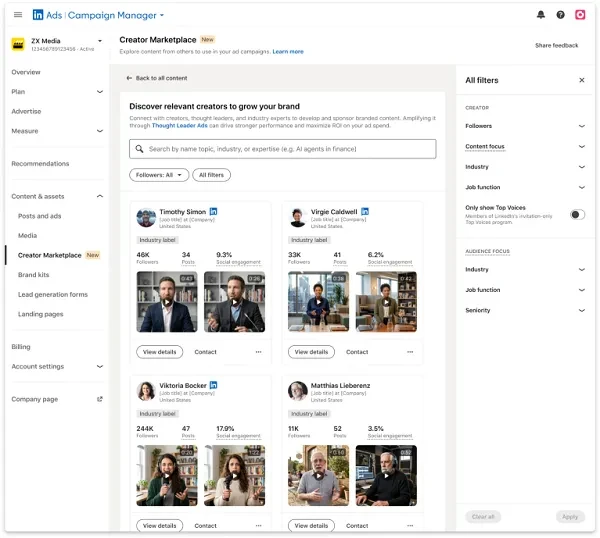
The latest chapter in this chronology is the announcement of the Creator Discovery beta, designed to solve the friction of sourcing and vetting talent. Moving beyond basic keyword searches, the new tool introduces granular filters that allow enterprise marketing teams to pinpoint exact practitioner profiles. While currently in its beta testing phase, LinkedIn has announced that full general availability for the Creator Discovery feature is anticipated in early 2027.
Deep Dive: Inside LinkedIn’s New Creator Discovery Features
Finding the right creator in the B2B space is vastly different from finding a lifestyle influencer. A B2B creator must possess authentic domain expertise, an engaged audience of relevant professionals (such as CFOs, CISOs, or DevOps engineers), and a communication style that resonates with discerning corporate buyers.
To streamline this complex vetting process, the upcoming Creator Discovery beta introduces a robust suite of advanced search filters within the Creator Marketplace. According to LinkedIn’s product documentation, the core filtering capabilities include:
- Content Type: Marketers can search for creators based on the primary format of their thought leadership—whether they specialize in long-form written articles, high-engagement video content, carousel infographics, or audio commentary.
- Creator Industry and Job Function: This filter ensures absolute alignment between the creator’s professional background and the brand’s target market. Brands can filter for practitioners working in specific verticals, such as fintech, health tech, SaaS, or industrial manufacturing, as well as specific functional roles like engineering, marketing, HR, or finance.
- Audience Demographics: Enterprise campaigns require precision targeting. The new filters allow brands to vet creators based on the composition of their followers, examining parameters like seniority level, company size, geographic region, and industry sector.
- Top Voices Integration: LinkedIn is leveraging its proprietary "Top Voices" badge system, allowing brands to instantly filter for recognized subject matter experts who have demonstrated sustained, high-quality contributions to specific professional conversations on the platform.
By combining these parameters into a unified dashboard, enterprise marketing teams can drastically reduce the time spent sourcing talent. What used to take weeks of manual outreach, spreadsheet tracking, and speculative vetting can now be accomplished in minutes, ensuring that partnership proposals are built on a foundation of data-driven relevance.
Supporting Context & Metrics: The Undeniable ROI of Creator-Led B2B Ads
Sourcing the right creator is only half the battle; proving the return on investment (ROI) to executive leadership is where B2B marketing programs ultimately succeed or fail. Fortunately, LinkedIn’s ecosystem offers hard performance metrics that validate the investment in creator-driven campaigns compared to traditional corporate advertising.
1. Thought Leader Ads Outperform Traditional Formats
Conventional B2B digital advertising has historically relied on single-image ads or text-based sponsored content published directly from a company page. While these formats have their place, they often struggle to capture attention in crowded feeds.
LinkedIn’s performance data reveals a dramatic efficiency gap when utilizing Thought Leader Ads (ads that sponsor posts originating from a person’s profile rather than a company page):
- Overall Click-Through Rate (CTR): Thought Leader Ads drive a 252% higher CTR when compared to conventional single-image ads targeted at B2B buyers.
- Awareness Stage Impact: Advertisers running Thought Leader Ads experienced a 45% higher CTR at the top-of-funnel awareness stage compared to brands relying solely on traditional formats during the same period.
- Conversion Stage Impact: The momentum continues down the funnel, with Thought Leader Ads generating a 48% higher CTR at the conversion stage.
These metrics demonstrate that humanizing a campaign through a recognized thought leader breaks through cognitive fatigue, driving curiosity and action at every stage of the buyer’s journey.

2. BrandLink Promotions and Video Completion Rates
As video content continues to dominate professional networks, LinkedIn’s BrandLink promotions—which allow brands to run placements alongside approved creator and publisher content—are yielding exceptional engagement.
According to platform data, BrandLink promotions achieve a 130% higher video completion rate on average compared to standard in-feed video ads. Because the audience is already tuned into content produced or endorsed by a trusted creator, they are significantly more likely to watch a brand message through to its conclusion, maximizing the impact of expensive video assets.
3. Top Voices 360° and Exclusive Shows
Beyond standard ad units, LinkedIn’s Top Voices 360° offering connects brands with exclusive-to-LinkedIn Shows and elite practitioners. By associating brand identities with dedicated, serialized professional programming, organizations can build long-term brand equity and sustained mindshare among enterprise buyers who tune in regularly for industry insights.
Strategic Implications: How B2B Marketers Must Adapt
The democratization of expertise on LinkedIn requires a fundamental rethinking of modern B2B marketing playbooks. Organizations can no longer rely exclusively on gated product whitepapers and corporate cheerleading. To win in this new environment, marketing leaders must integrate creator strategies into their core operational frameworks.
Moving From Brand Advocacy to Practitioner Partnerships
True B2B creator marketing is not about paying an influencer to read a script; it is about co-creating value. Brands must identify internal subject matter experts—such as chief technology officers, lead product architects, or customer success leaders—and empower them to build personal brands on LinkedIn. Simultaneously, external partnerships must be forged with independent practitioners who can offer unbiased, objective perspectives on industry challenges.
Integrating Creator Content Across the Funnel
Creator-generated assets should not exist in a silo. Forward-thinking marketing teams are weaving creator content into multi-channel campaigns:
- Top-of-Funnel (ToFu): Utilizing Thought Leader Ads featuring trusted industry voices to capture attention and drive initial profile visits.
- Middle-of-Funnel (MoFu): Deploying BrandLink video insights and expert commentary to educate buying committees during the evaluation phase.
- Bottom-of-Funnel (BoFu): Leveraging case studies, expert reviews, and peer validations sourced through creator networks to alleviate final-stage risk aversion among enterprise procurement teams.
Future Outlook: The Horizon Toward 2027 and Beyond
As LinkedIn rolls out the Creator Discovery beta ahead of its anticipated general availability in early 2027, the line between organic thought leadership and paid B2B media will continue to blur. Several key trends are expected to shape the future of the space:
- Rise of Micro-Niche B2B Creators: Just as consumer marketing shifted away from mega-influencers toward hyper-focused micro-influencers, B2B marketing will increasingly value specialized practitioners with smaller, highly qualified audiences of decision-makers over broad-reaching generalists.
- Stricter Compliance and Authenticity Standards: As corporate buyers grow more sophisticated, authenticity will be heavily scrutinized. Campaigns that feel overly scripted or transactional will fail, placing a premium on genuine, long-term partnerships built on shared industry values.
- AI-Enhanced Matching and Attribution: Future iterations of tools like Creator Discovery will likely incorporate advanced artificial intelligence to predict campaign performance, matching brands with creators based on predictive historical data, semantic content analysis, and granular attribution modeling.
Conclusion
The modern B2B buyer is autonomous, informed, and skeptical of corporate spin. By recognizing that trust is transacted between individuals rather than corporate entities, LinkedIn has built an ecosystem that empowers brands to rent and build credibility at scale.
With the introduction of advanced discovery tools, proven ad formats like Thought Leader Ads and BrandLink, and a clear shift in buyer behavior—where 63% of enterprise buyers actively seek creator insights—creator marketing has transitioned from an experimental tactic to a non-negotiable pillar of enterprise strategy. For B2B marketers willing to embrace this human-centric approach, the path to building enduring buyer trust has never been clearer.