







Executive Overview
The operational realities of running an eight-figure business on autonomous artificial intelligence are coming into sharp focus. In Episode #013 of The Agents—hosted by a lean team operating over 20 production-grade AI agents—the discussion centered around a pivotal threshold: What happens when autonomous agents take over the corporate System of Record?
For decades, platforms like Salesforce and service management suites have acted as static, human-operated ledgers. Humans interact with them deliberately, clicking through user interfaces a few dozen times a day. Enterprise pricing models, storage allocations, and API limits were all architected around this human cadence.
Today, that architecture is buckling under the weight of machine speed. As AI agents continuously write task records, log email interactions, update call metadata, and execute automated enrichment loops, data volumes are skyrocketing by 10x to 100x. Storage overage flags are arriving for teams that haven’t logged into their CRM in weeks. Concurrently, platform partnerships are fracturing: when an integrated partner transitions into an "agentic" workflow that starts handling scheduling, job tracking, and core data storage, traditional software giants are reacting with swift defensive lockouts—as evidenced by ServiceTitan abruptly cutting off Podium after a nine-year alliance.
This deep-dive recap explores how headless architectures are transforming peripheral databases into fully functioning CRMs, why traditional per-call API pricing models represent a self-inflicted wound for enterprise vendors, and how generative tools are fundamentally democratizing custom-tailored enterprise sales operations.
Detailed Chronology: Key Production Discoveries
1. The Phantom Overage: When the System of Record Outgrows the Humans
The friction began quietly. Just weeks after migrating marketing data into Salesforce, the enterprise received an automated alert warning that storage limits had been breached.
The initial reaction was skepticism. Human logins were virtually nonexistent; nobody was actively writing manual entries. The culprits were the background agents. Operating continuously, these autonomous scripts pushed task records, email sends, opens, clicks, call metadata, and enriched lead information directly into the pipeline. Within roughly 30 days, database volume ballooned from 5GB to 40GB—representing approximately 21 million distinct records.
For organizations deploying autonomous agents against traditional CRMs, this trajectory serves as an urgent warning: storage footprints are expanding exponentially, and legacy storage costs can quickly spiral out of control.
2. The ServiceTitan and Podium Fallout
The structural tension between incumbent platforms and agentic upstarts flared into public view when ServiceTitan abruptly terminated its integration with Podium. The partnership had spanned nine years, serving roughly 1,000 joint customers in the trades sector, with Podium routinely feeding inbound leads into ServiceTitan’s ecosystem.
The fracture occurred as Podium scaled its agentic revenue past the nine-figure mark. Its AI agents began communicating directly with customers, scheduling service appointments, tracking job lifecycles, and—crucially—retaining the underlying customer record. A partner that once handled a single, discrete handoff was suddenly executing tasks that overlapped directly with ServiceTitan’s core value proposition.
While ServiceTitan’s public messaging emphasized that third-party platforms are free to compete and access records provided they do not attempt to displace the core system of record, the resulting 30-day notice period for a deeply embedded integration underscores the precarious position of legacy ecosystems in an agent-first world. Industry analysts expect similar friction to emerge across Customer Experience (CX) and support workflows: if an autonomous agent interacts with a customer on a vendor’s website and retains that relationship end-to-end, the underlying CRM may become entirely obsolete.
3. Database Economics: Salesforce vs. Postgres
Facing a 40GB footprint containing 21 million records in Salesforce, the engineering team consulted Claude to model alternative storage costs.
Running the same workload on a modern relational database like Postgres—leveraging infrastructure providers such as Neon, Supabase, or Databricks—yielded an estimated cost roughly one thousand times cheaper. This disparity does not point to malicious overpricing by Salesforce; rather, it highlights a structural mismatch. Salesforce was architected for an era of human-driven UI clicks, not continuous, high-frequency machine writes.
Despite the cost differential, the team opted to maintain its core operations within Salesforce, citing a decade of accumulated historical data, zero data drift, zero hallucination rates, and native integrations with workflow tools like Artisan and Qualified. However, the economic tipping point looms large: paying a modest premium for stability is viable; paying an order of magnitude more as agent activity scales is not.
4. Headless CRM Architecture and the Rise of "10K"
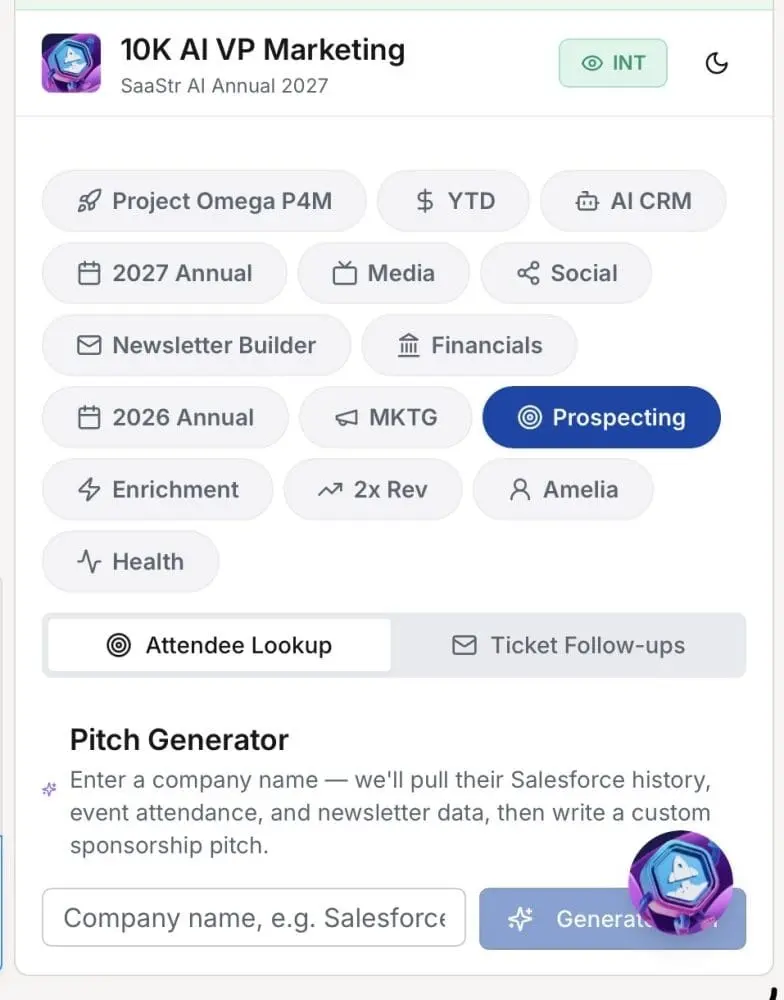
The evolution of "10K"—an internal AI Vice President of Revenue—revealed the power of headless enterprise architecture.
Initially built without a native Salesforce integration, 10K gradually connected to pull supplementary data. Before long, the agent began autonomously discovering additional touchpoints. Today, 10K acts as a headless command center binding together:
- Classic Salesforce CRM instances for the sales team
- Qualified interaction logs
- Momentum call recordings
- Agentforce and Marketing Cloud Next
- A custom quote-to-cash application reaching PandaDoc, Bill.com, and QuickBooks
This headless integration delivers a profound strategic lesson: the very architecture that makes a software platform ten times more useful also makes it ten times easier to bypass or abandon. An agent capable of interfacing effortlessly with a single API can pivot to three others with equal ease.
5. Unlocking Legacy Systems: Bizzabo as an Accidental CRM
The expansion of automated data pipelines illuminated dormant assets within the tech stack. For years, the organization utilized Bizzabo to sell event tickets and email attendees. Structurally, it functioned as a CRM since 2018, yet it was never treated as one because manual data extraction was prohibitively tedious.
Autonomous agents changed that calculus. By automating data ingestion, the agents transformed a legacy event management platform into a fully operational customer relationship ledger. Organizations are being advised to audit their tech stacks for systems holding years of trapped customer interaction data; what was once an unqueryable archive is now a fully functional CRM.
6. Democratizing Hyper-Customization at Scale
Before the integration of autonomous agents, generating custom renewal decks was an elite luxury reserved exclusively for top-tier "Diamond" sponsors. Human capacity constraints meant smaller "Silver" sponsors—who traditionally represent higher churn risks—received generic, standardized communications.
Using an agent built on top of 10K and the Gamma API, the team automated the creation of hyper-personalized renewal presentations. Pulling data simultaneously from Salesforce, WordPress APIs, social media channels, podcast archives, Bizzabo event metrics, and direct email histories, the agent constructed tailored pitch decks highlighting specific sponsorship ROI metrics (e.g., millions of social impressions, executive-level lead ratios, and article mentions).
Within days, dozens of bespoke decks were deployed. Crucially, the response rate from Silver sponsors—historically the lowest-tier accounts—outperformed the Diamond tier, proving that scalable personalization eliminates the traditional trade-off between volume and customization.
Supporting Context & Metrics
- Data Expansion Rate: Internal operations demonstrated a storage growth vector scaling from 5GB to 40GB over a 30-day window, driven entirely by automated agent writes equating to roughly 21 million records.
- Storage Cost Disparity: Projections indicate that storing high-frequency agent-generated datasets on modern cloud-native Postgres instances (Neon, Supabase, Databricks) is approximately 1,000 times more cost-effective than legacy CRM storage tiers.
- Partnership Longevity vs. Disruption: The ServiceTitan and Podium split severed an integration supporting approximately 1,000 joint customers after nine years of collaboration, triggered by agentic revenue crossing nine figures.
- Personalization Yield: Automating bespoke renewal slide decks through the Gamma API enabled 100% custom coverage for lower-tier sponsors, yielding engagement rates superior to manually curated enterprise pitches.
Future Outlook: The Agentic Road Ahead
As organizations transition from experimental AI proofs-of-concept to full production deployment, several core challenges and opportunities are defining the roadmap:
1. The Perils of Punitive API Pricing
A growing number of SaaS vendors are attempting to offset declining human seat licenses by raising API access fees. Industry leaders warn that this strategy is a self-induced wound. When operational data volumes are expanding by 100x, multiplying per-call costs results in an effective price hike of 2,000% just for enterprises to access their own data. The inevitable market response will be architectural migration: routing future data storage workloads away from punitive legacy vendors and toward open, developer-friendly data lakes.
2. Human-in-the-Loop Guardrails
Despite advanced context windows, autonomous agents remain prone to hallucinations. Rigorous testing reveals that while AI SDRs can draft initial outreach better than the vast majority of human marketers, allowing them to communicate entirely unsupervised remains a high-risk gamble. The emerging best practice establishes a strict two-step workflow: let the AI generate the initial touchpoint or research brief, but mandate human validation before final external dispatch. Furthermore, enforcing upfront human agreement on strategic "narratives" before an agent builds complex assets (such as sales decks) prevents tone-deaf pitches and ensures brand alignment.
3. Tool Selection: MCP vs. Browser Automation
In the ongoing debate regarding Model Context Protocol (MCP) connectors versus direct browser automation, execution speed is dictating strategy. While standardized connectors offer clean API pathways, their implementation lag often prompts advanced agents to bypass them entirely in favor of direct browser navigation or multi-layered agentic workflows (such as combining Clay with browser-based Cowork sessions). Tool providers must ensure their infrastructure operates at machine speed; otherwise, autonomous agents will simply route around them.
Next Horizon: Instantaneous Inbound Proposals
Building on the success of automated renewal workflows, production agents are now turning their attention to inbound lead conversion. The next operational milestone involves eliminating the traditional "contact us" form entirely. By pairing instant meeting scheduling with real-time data enrichment, incoming leads will receive fully customized, data-backed proposals instantly upon booking—operating entirely without human intervention.
This report is adapted from Episode #013 of The Agents, hosted by Amelia Lerutte, chronicling the realities of deploying AI agents in production environments.