
Executive Overview
The global retail and ecommerce technology landscape is undergoing a structural paradigm shift. As generative artificial intelligence transitions from an experimental novelty into an operational backbone, the boundaries between consumer discovery, automated transaction processing, and physical fulfillment are dissolving. This week’s product releases, platform updates, and infrastructure pilots highlight a singular overarching trend: the maturation of agentic commerce.
For merchants navigating an increasingly complex multichannel ecosystem, the latest round of software deployments offers both profound opportunities and steep operational learning curves. From OpenAI’s integration of sponsored conversational agents within ChatGPT Ads to Salesforce’s domain-specific CRM reasoning model, technology providers are racing to build autonomous workflows. Simultaneously, traditional financial and logistical pillars—exemplified by the European Central Bank’s digital euro pilot, Maersk’s North American logistics expansion, and FedEx’s secure QR-authenticated delivery mechanisms—are adapting to meet the demands of high-speed, high-value digital trade.
This comprehensive briefing examines the primary product releases, platform upgrades, and service rollouts introduced this week. By categorizing these developments into advertising technologies, operational intelligence, supply chain logistics, and agentic payments, merchants can better strategize their digital transformation roadmaps for the quarters ahead.
Detailed Chronology: Weekly Product Releases & Platform Updates
1. Advertising, Discovery, and Conversational Marketing
OpenAI Debuts Sponsored AI Agents in ChatGPT Ads
OpenAI has officially begun testing Sponsored Agents, transforming standard passive digital advertising into interactive, conversational commerce. When users interact with ads inside ChatGPT, they can now trigger a direct conversation with a business-sponsored AI agent. To lower the barrier to entry for brands, OpenAI has introduced prompt-based ad creation tools via ChatGPT Work alongside enhancements to its native Ads Manager.
Crucially, OpenAI has secured foundational enterprise partnerships with HubSpot (its first CRM integration partner) and Shopify (its first ecommerce integration partner). These alliances allow businesses to embed ChatGPT advertising mechanics directly into the existing customer relationship management and storefront tools they already rely on daily.

Pinterest Unveils Visual Search Performance Ads
Visual discovery platform Pinterest has introduced Visual Search Ads, a new advertising format engineered to capture consumer intent during the research phase. Positioned directly within Pinterest search results and pin closeups, these ads pair keyword relevance with visual matching as users browse, compare, and narrow down purchasing decisions. Fully compatible with Performance+, Pinterest’s proprietary AI-powered advertising suite, the ad format is slated for a broader rollout following an upcoming beta phase.
Google Ads Tests Product Value Optimization
Google Ads has initiated beta testing for Product Value Optimization, an advanced feature designed to inject granular product-level insights directly into automated bidding algorithms. Rather than applying broad account-level parameters, advertisers can now establish distinct product-level value adjustments. By leveraging specific product attributes, merchants can multiply conversion values for high-priority SKUs, giving automated bidding systems the precise context needed to maximize return on ad spend (ROAS).
2. CRM, Data Infrastructure, and Retail Intelligence
Salesforce Launches Koa: A CRM Reasoning Model
Salesforce has unveiled Koa, its first dedicated CRM reasoning model developed for the Agentforce platform through a technical collaboration with Nvidia. Built on a synthetic training corpus modeled after complex real-world workflows, Koa equips AI agents with advanced reasoning, tool-use, and decision-making capabilities. The model is engineered to autonomously manage end-to-end customer lifecycles—from lead generation and opportunity qualification to multi-channel service case resolution—strictly adhering to established enterprise operational policies.
Tulip Retail Introduces Integration Builder and Expanded Shopify Connector
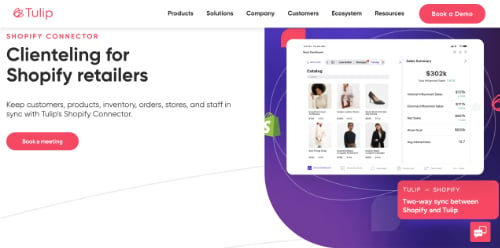
Retail customer engagement platform Tulip has rolled out Integration Builder alongside an upgraded Shopify Connector. Integration Builder connects fragmented multi-source retail environments directly to core application programming interfaces (APIs), flat files, and cloud data warehouses like Snowflake, Databricks, and BigQuery, intelligently adapting to unique retailer taxonomies. Meanwhile, the enhanced Shopify Connector allows multi-storefront brands to unify disparate regional presences under a single Tulip ecosystem while maintaining localized product catalogs, pricing structures, and language variants.
MikMak Releases AI Commerce Intelligence Suite
Ecommerce intelligence platform MikMak has launched a suite of AI-driven commerce capabilities focused on conversion forecasting and workflow automation. The release includes Aura (which combines point-of-sale data with first-party signals across more than 8,000 retailers), Datasembly (delivering store-level inventory intelligence), Build with Mak (enabling conversational AI customer experiences), and Analyze with Mak (an enhanced conversational analytics layer). Additionally, the introduction of Insights MCP brings MikMak’s intelligence natively into third-party AI assistants including OpenAI, Claude, and Microsoft Copilot.

Noibu Deploys Autonomous Conversion Optimization Agents
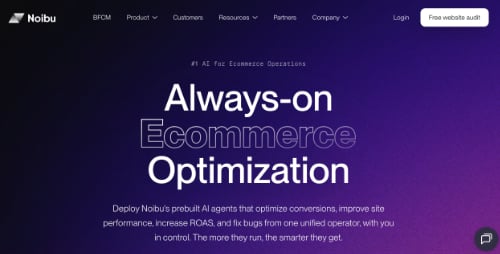
Conversion optimization platform Noibu has introduced six specialized AI agents designed to autonomously audit and improve ecommerce storefronts. These agents continuously monitor site data, diagnose technical glitches, draft code fixes, deploy changes upon human approval, and measure post-deployment impact. By treating shopper conversion metrics as a closed feedback loop, the agents systematically optimize site speed, resolve bugs, ensure ADA compliance, and protect ad return metrics.
3. Agentic Payments, Infrastructure, and Security
Alchemy Integrates Mastercard Agent Pay
Alchemy, an infrastructure developer for autonomous commerce, has announced that its AgentCard will natively support Mastercard payment credentials via Mastercard Agent Pay. This integration provides developers with secure frameworks to construct AI agents capable of executing transactions on behalf of human users. By merging Alchemy’s agent infrastructure with Mastercard’s established financial network, the system enforces user authorization protocols, issuer controls, and verifiable proofs of intent.
Worldline Adopts the Universal Commerce Protocol
European payments provider Worldline has integrated the Universal Commerce Protocol (UCP), an open-standard framework for agentic commerce co-developed by Google and various industry stakeholders. UCP establishes a standardized technical language that allows independent AI agents to discover products and execute transactions seamlessly. Through this integration, merchants can configure their payment setups once to accept card payments, mobile wallets, and alternative tenders across any UCP-enabled platform.
European Central Bank Launches Digital Euro Pilot
The Eurosystem—comprising the European Central Bank (ECB) and national central banks—has officially invited ecommerce merchants operating within the euro area to participate in the pilot phase of the digital euro. This initiative represents a foundational step toward establishing a unified, publicly backed digital currency infrastructure designed to reshape cross-border digital payments and reduce transaction friction across the European Union.
FedEx Launches Authenticated Delivery
To mitigate package theft and secure high-value transactions, FedEx Corp. has rolled out Authenticated Delivery for eligible residential and commercial shipments across North America. The service utilizes secure, dynamic QR code authentication to ensure packages are handed over exclusively to verified recipients. Delivery drivers must scan and validate the recipient’s secure QR code on-site before releasing the freight.
4. Loyalty, Customer Feedback, and Affiliate Marketing
Euka AI Expands Affiliate Marketing Integration to Instagram
Euka AI, an affiliate marketing platform native to TikTok Shop, has announced an expanded integration with Instagram paired with Shopify-connected fulfillment infrastructure. Brands can now discover and vet creators across both TikTok and Instagram using specific product, audience, and performance metrics. Furthermore, AI automates influencer outreach, invitation sequencing, and conversation management within a unified multi-platform dashboard.
Snipp Interactive Releases ChatGPT and Claude Plugins
Shopper marketing and loyalty technology provider Snipp Interactive has launched the $nipp ChatGPT plugin and the $nipp Connector for Claude. These tools allow brands to integrate promotional campaigns, digital rebates, and loyalty structures directly into conversational AI environments. Backed by Snipp’s core data intelligence platform, the plugins support receipt optical character recognition (OCR), SKU-level validation, fraud risk scoring, automated reward fulfillment, and compliance audit logging.
AIQ Introduces Astro AI Operating System
Retail platform AIQ has introduced Astro, an AI-driven operating system designed to unify retail marketing, customer loyalty, and analytics. Astro integrates campaign creation engines, shared business memory, and conversational onboarding into a single orchestration layer, drawing continuously on real-time customer, transactional, and operational data pools.
Marvin Introduces Live Intercept for AI-Moderated Research
Customer feedback platform Marvin has added Live Intercept to its suite of qualitative research tools. Utilizing an AI interviewer, Live Intercept conducts automated, real-time voice-to-voice and text-based interviews directly within the digital customer experience. The AI follows customizable discussion guides, asks intelligent follow-up questions, and dynamically adapts to respondent feedback across more than 40 languages.
Supporting Context & Metrics: The Macro Shift Toward Agentic Workflows
The rapid deployment of agentic commerce tools this week is underpinned by changing consumer habits and enterprise software expenditure patterns. Industry analysts estimate that conversational AI discovery channels—led by platforms like ChatGPT, Claude, and Google Gemini—will account for over 25% of initial product search queries by the end of the decade.

For merchants, the shift from traditional search engine optimization (SEO) to AI discoverability requires a complete rethink of product catalog architecture. Tools like OpenAI’s Sponsored Agents, Tulip’s schema-adapting Integration Builder, and MikMak’s MCP insights layer are critical because modern buyers (and the AI agents acting on their behalf) demand structured, API-accessible, and context-rich product data. Without clean first-party data and real-time inventory visibility (such as that provided by Datasembly and Maersk’s Shipstore integration), brands risk becoming invisible to autonomous shopping agents.
Furthermore, security and payment validation have emerged as primary bottlenecks for autonomous transactions. The integration of Mastercard Agent Pay with Alchemy’s AgentCard, alongside Worldline’s adoption of the Universal Commerce Protocol, signals an industry-wide push to solve the trust deficit inherent in non-human transactions. By establishing cryptographic proofs of intent and issuer-level controls, these systems ensure that agentic commerce can scale without exposing merchants or consumers to unprecedented financial fraud risks.
Official Statements and Industry Perspectives
Leadership teams across the technology and logistics sectors emphasized the transformational nature of this week’s announcements:
- On Conversational Advertising: OpenAI representatives noted that integrating sponsored agents into ChatGPT bridges the gap between passive brand awareness and active problem-solving, allowing merchants to "meet consumers at the exact moment of intent with fully contextualized brand representatives."
- On Enterprise Reasoning Models: Highlighting the collaboration with Nvidia on the Koa model, Salesforce executives stressed that general-purpose large language models are insufficient for enterprise workflows. "Businesses require reasoning engines grounded deeply in their operational policies, data taxonomies, and customer lifecycle histories," the company stated.
- On Secure Logistics: Commenting on the launch of Authenticated Delivery, FedEx logistics leads emphasized that rising consumer expectations for high-value e-commerce necessitate cryptographic certainty at the doorstep, stating that "secure QR validation transforms last-mile delivery from a point of vulnerability into a trusted brand touchpoint."
- On Agentic Payments: Financial technology stakeholders backing the Universal Commerce Protocol underscored the necessity of open standards, pointing out that "fragmented proprietary checkout flows cannot survive the age of autonomous shopping agents; open, secure protocols are the mandatory foundation of future digital commerce."
Future Outlook: What Merchants Must Do Next
As these technological building blocks converge, ecommerce merchants cannot afford to adopt a wait-and-see posture. The transformation from static web storefronts to dynamic, AI-navigated ecosystems is accelerating.
To capitalize on these developments, digital commerce leaders should consider the following strategic priorities over the next 12 to 18 months:
- Audit and Optimize Data Taxonomies: Ensure that product catalogs are meticulously structured, tagged with rich attribute data, and accessible via modern APIs. AI agents and LLM plugins cannot recommend products they cannot accurately parse.
- Prepare for Agentic Checkout: Monitor the rollout of open payment standards like UCP and agent-card infrastructures (such as Alchemy and Mastercard). Brands should evaluate their current payment gateways for compatibility with autonomous purchasing flows.
- Embrace Closed-Loop AI Optimization: Implement tools that automate site performance auditing and conversion rate optimization (such as Noibu’s autonomous agents), reducing latency between error detection and code deployment.
- Strengthen Last-Mile Trust: For merchants dealing in high-value or sensitive goods, integrating secure fulfillment protocols like FedEx’s Authenticated Delivery will become a key differentiator in customer retention and brand trust.
The week’s announcements make one reality crystal clear: the future belongs to merchants who can seamlessly synchronize their inventory, advertising, and logistics data into automated systems capable of serving both human shoppers and their digital agents.