








Executive Overview
The global conversation surrounding artificial intelligence and energy infrastructure is fundamentally misdirected. Public discourse, regulatory debates, and corporate boardrooms are overwhelmingly obsessed with generation: the urgent race to secure more turbines, expand solar arrays, construct nuclear plants, and build high-voltage transmission corridors. The prevailing narrative suggests that our primary crisis is a sheer deficit of electrons—that the grid is simply running out of power to feed the insatiable appetite of modern machine learning.
However, recent catastrophic grid events in major data center hubs reveal a different reality. The systemic failures plaguing regions like Northern Virginia are not, at their core, supply failures. They are architectural failures.
For decades, the data center industry has relied on a legacy power distribution stack designed for predictable, linear industrial loads. When a facility drew power for manufacturing or refining, it pulled smoothly, misbehaved rarely, and recovered gradually. The massive, hyper-scale AI campuses coming online today—and the colossal wave of multi-gigawatt interconnections planned for the near future—operate on entirely different physical principles. An AI cluster can swing up to 70% of its load within milliseconds during a heavy training run, then drop offline just as abruptly to protect billions of dollars in silicon assets when a minor upstream disturbance occurs.
When hundreds of these facilities aggregate at gigawatt scale, their synchronized reactions create violent transients that legacy grid protection schemes cannot parse. The result is massive, cascading load-shedding events that threaten regional grid stability.
Solving this crisis requires moving beyond the generation debate and confronting the structural vulnerabilities hiding inside the data center fence. By shifting power protection up the voltage stack from low-voltage systems to medium-voltage architectures, relocating backup infrastructure outside the primary building envelope, and integrating inline power management directly into the transmission path, the industry can transform AI data centers from a severe grid liability into a stabilizing grid asset. Recent full-scale testing at Department of Energy facilities proves that this architectural pivot not only resolves stability concerns but fundamentally alters permitting timelines, spatial density economics, and backup power profitability.
Detailed Chronology: Anatomy of a Regional Grid Crisis
To understand why the traditional power stack is failing, one must examine the fragility exposed in the nation’s densest data center markets. The vulnerability of modern regional grids to hyper-scale AI load behavior is punctuated by specific, high-stakes incidents that caught utility operators and engineers off guard.
The July 2026 Ashburn Incident
On July 22, 2026, a routine transmission line fault occurred in Ashburn, Virginia—the undisputed heart of the world’s largest data center cluster. Within seconds of the fault, more than 3 gigawatts of electrical load dropped off the regional PJM Interconnection grid. To put this figure in perspective, 3 gigawatts represents the entire electrical consumption of a major metropolitan area, vanishing into thin air in the blink of an eye.
The catastrophic load drop was not caused by a generating station tripping offline, nor was it a failure of utility-owned transformers. It was triggered by the automated protection logic embedded within the data centers themselves. As the transmission fault caused a momentary voltage sag, scores of individual facilities reacted simultaneously according to their internal safety programming: they disconnected from the grid to protect their downstream server farms. This coordinated, uniform rejection of load placed an unprecedented reactive shock on the surrounding transmission network, nearly triggering wider cascading blackouts across the Mid-Atlantic states.
The 2024 Precedent
This vulnerability was foreshadowed two years earlier, though the warning was largely underappreciated by the broader tech sector. A single failed surge arrester in Northern Virginia tripped roughly 60 data center facilities offline simultaneously, resulting in a sudden 1,500-megawatt load drop.
An investigation by the North American Electric Reliability Corporation (NERC) later revealed the underlying mechanical flaw: the vast majority of the disconnected load traced back to legacy protection schemes programmed to count voltage dips and automatically disconnect on the third sag. Designed decades ago when "large load" meant a 50-megawatt industrial plant, these protocols were operating exactly as engineered. They executed their safety algorithms faithfully, but in doing so, they demonstrated that the collective behavior of modern data centers had entirely outgrown the protective logic governing the grid. No one had anticipated that dozens of disparate corporate entities would respond to a minor grid transient with such uniform, herd-like behavior.
Supporting Context & Metrics: Where the Old Stack Breaks
The recurring instability in regions dense with server farms stems from a deep structural mismatch between modern compute loads and legacy electrical engineering. The standard data center power stack has remained fundamentally unchanged for decades. Medium-voltage power arrives from the utility substation, massive transformers step it down to low-voltage, low-voltage uninterruptible power supply (UPS) units condition the current, and the electricity finally reaches the server racks.
When pushed to the hyper-scale and ultra-dense requirements of modern AI training clusters, this legacy design fractures at three critical junctures.
[Legacy Stack vs. Modern Inline Medium-Voltage Architecture]

Legacy Stack (Vulnerable & Inefficient):
Grid (Medium Voltage) -> Transformers (Step-Down) -> Low-Voltage UPS (Deep Inside Building / Eco-Mode) -> Server Racks
* Vulnerable to sub-millisecond transients, slow battery response, and cascading protection dropouts.

Modern Inline Architecture (Resilient & Stabilized):
Grid (Medium Voltage) -> Modular Enclosure Outside (Inline Medium-Voltage UPS / Direct Energy Storage) -> Data Hall (Compute & Cooling Only)
* Flattens load profiles, absorbs AI training swings, and complies with stringent grid operator codes out of the box.
1. The Limitations of the Low-Voltage UPS
In the traditional architecture, the UPS sits deep inside the building, immediately adjacent to the data halls. However, its internal battery banks function essentially as an undersized spare tire. They are engineered to bridge a total utility outage for a brief window—typically a few minutes—to allow backup diesel generators to spin up. They are structurally incapable of absorbing the rapid, continuous, and massive load swings characteristic of modern AI workloads, which can surge or drop by 70% in milliseconds.
2. The Trap of Eco-Mode and Sub-Millisecond Transients
Because legacy power conversion electronics waste a significant amount of energy as heat, data center operators run their systems in "eco-mode" for the vast majority of their operational lives. In this configuration, a static bypass switch feeds the server racks directly from the utility grid, bypassing the power conditioning components entirely.
This creates a dangerous bidirectional vulnerability. On one hand, the violent, sub-millisecond power swings generated by high-performance compute clusters shoot straight out into the utility grid unfiltered. On the other hand, micro-transients and lightning-induced voltage spikes from the grid rush inward at speeds too fast for traditional mechanical or static switches to intercept, routinely damaging sensitive GPUs and server infrastructure.
3. Flawed Protection Logic at Gigawatt Scale
Protection relays and circuit breakers were historically calibrated to isolate industrial loads safely. When an AI data center campus draws hundreds of megawatts—and soon, gigawatts—its internal protection systems are effectively blind to the broader health of the transmission grid. Consequently, when minor upstream disturbances occur, these systems execute pre-programmed defense mechanisms that disconnect the load entirely. At gigawatt scale, this defensive isolation becomes a severe systemic hazard, converting localized grid hiccups into regional supply emergencies.
The Architectural Solution: Moving Up, Out, and In
Solving the AI infrastructure crisis does not require inventing new physics; it requires a radical reordering of the electrical architecture. Industry innovators and specialized energy engineering firms are advocating for a three-part structural overhaul:
- Move It Up: Elevate power protection from the vulnerable 480-volt low-voltage layer to medium-voltage infrastructure (13.8 kilovolt systems and higher). This matches the voltage tier at which large facilities originally draw power from the utility, eliminating unnecessary transformation steps.
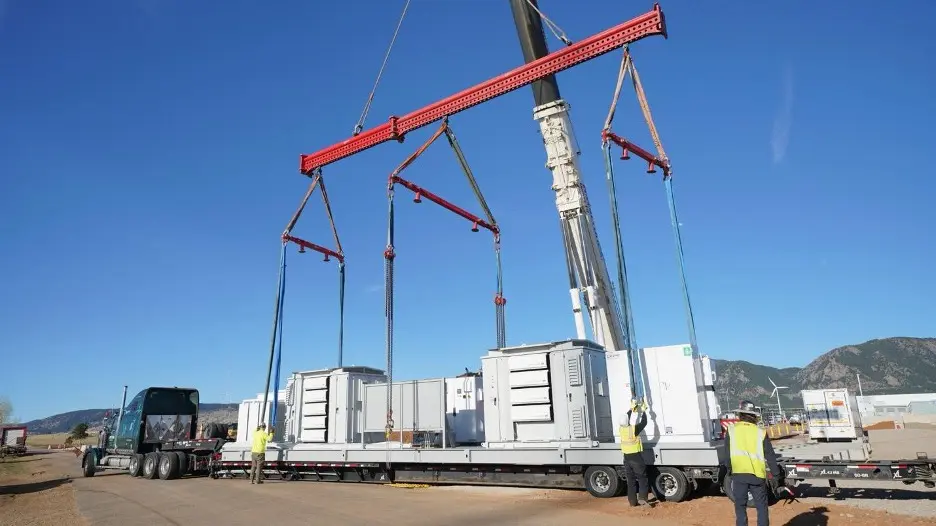
- Move It Out: Relocate the heavy power conditioning, storage, and switching equipment out of the core data hall and into modular enclosures positioned externally near the substation. By clearing this infrastructure out of the building, the primary facility space is reclaimed entirely for compute servers and the liquid-cooling systems required to keep them operational.
- Move It Into the Path: Abandon the reactive standby model of traditional batteries. Instead, deploy an inline medium-voltage system through which every single electron flows continuously. Because the system intercepts all power in real time, there is nothing to detect, nothing to calculate, and nothing to switch; power conditioning is continuous, proactive, and absolute.
When this architecture is deployed, the operational dynamics shift dramatically. When thousands of high-performance GPUs spin up simultaneously to process a massive dataset, the inline medium-voltage system absorbs the kinetic swing internally, presenting the external utility grid with a completely flat, predictable load profile. When a severe disturbance strikes the transmission network upstream, the sensitive compute hardware housed inside the facility remains entirely insulated, never registering the fluctuation. A notoriously difficult neighbor for utility providers is instantly converted into a stable, compliant, and supportive grid participant.
Official Testing & Verification: The National Laboratory of the Rockies
Theoretical engineering must be validated by empirical stress testing before utility operators will authorize widespread adoption. To that end, a full-scale medium-voltage inline system underwent rigorous validation testing at the National Laboratory of the Rockies—a premier U.S. Department of Energy research facility and the only installation in the Western Hemisphere capable of replicating real-world grid faults and AI-scale load swings simultaneously within a unified closed-loop testing environment.
During the evaluation, engineers subjected the system to extreme dual-vector stress testing. Real-world AI training load profiles were hammered against the compute side of the architecture at full medium voltage, while severe utility-side grid faults—including complete zero-voltage events—were simultaneously introduced from the transmission side.
The results validated the architectural thesis:
- The compute side did not flinch, maintaining uninterrupted operations through complete voltage collapses.
- The grid side observed a perfectly stabilized load profile, completely neutralizing the simulated AI workload spikes.
- The system successfully cleared the stringent large-load voltage ride-through requirements mandated by the Electric Reliability Council of Texas (ERCOT) with substantial performance margins to spare.
These compliance standards exist because regional grid operators no longer accept massive industrial load connections on blind faith. As regulatory bodies tighten interconnection rules across North America, traditional facilities treat compliance as an expensive, reactive engineering hurdle. The testing in Colorado demonstrated that an inline medium-voltage architecture satisfies these stringent grid codes natively, out of the box. Compliance ceases to be an added feature and becomes an intrinsic property of the design.
Future Outlook: Reshaping Permitting, Density, and Economics
The implementation of medium-voltage inline architectures extends far beyond technical stability; it fundamentally rewrites the economic and operational metrics of data center deployment.
Streamlined Interconnection and Permitting
Under legacy designs, utility interconnection is a notorious bottleneck. Regulators must meticulously review and certify an intricate labyrinth of downstream transformers, low-voltage UPS arrays, chillers, pumps, and switchgear assemblies. With a modular medium-voltage inline system, the utility evaluation process is vastly simplified: engineers certify a single, standardized medium-voltage enclosure rather than untangling thousands of individual low-voltage components. This standardization allows operators to upgrade internal chip generations and expand compute capacity without triggering exhaustive, multi-year re-study processes, shaving precious months off permitting timelines.
Maximizing Spatial Density and Capital Efficiency
Real estate and construction costs in major data center markets are astronomical. By moving power conditioning and energy storage outside the building envelope, legacy UPS rooms are eliminated. This reclaimed footprint can be repurposed entirely for high-density server racks or advanced liquid-cooling distribution units, significantly increasing revenue-generating compute density per square foot of construction capital.
The New Economics of Backup Power
Traditionally, data center backup power systems are treated purely as a capital-expense insurance policy—expensive assets that sit idle for 99% of their lifespan, waiting for an outage that may never arrive. By upgrading to medium-voltage, externally housed systems equipped with native energy storage, backup infrastructure transforms into a profit center. These systems can actively participate in lucrative grid monetization programs, such as peak shaving, frequency regulation, and demand response. Backup power transitions from a sunk operational cost to an active revenue generator that helps amortize the initial capital expenditure.
Conclusion: A Choice for the Future
As the global buildout of artificial intelligence infrastructure accelerates, the industry faces a defining architectural fork in the road. Much of what currently appears to be an insurmountable utility grid crisis is actually an artifact of outdated internal engineering—equipment meticulously sized for an industrial era that no longer exists.
By shifting power protection up the voltage stack, moving bulky infrastructure outside the building envelope, and embedding intelligence directly into the electrical path, developers can convert a dangerous grid liability into a stabilizing grid asset. The engineering has been proven in national laboratories, and the next generation of AI factories is already breaking ground on these principles.
The industry has yet to officially formalize a universal name for this foundational layer—some engineering teams refer to it simply as the medium-voltage AI UPS. However, the nomenclature matters far less than the strategic choice facing developers and utility executives today: AI factories can continue to arrive as an aggressive strain on an already overburdened electrical grid, or they can be engineered from the foundation up to serve as its ultimate reinforcement. The industry already possesses the blueprint for the latter; the imperative now is universal adoption.