Executive Overview
For years, the public conversation surrounding the artificial intelligence infrastructure boom has been overwhelmingly focused on generation. Energy pundits, utility executives, and policymakers have fixated on a singular, looming question: Where will the electrons come from? The proposed solutions have followed a predictable, carbon-heavy or capital-intensive trajectory—more natural gas turbines, renewed nuclear energy investments, vast solar arrays, and high-voltage transmission lines crisscrossing the continent.
Yet, as the summer of 2026 starkly demonstrated in Northern Virginia—the undisputed heart of the world’s data center ecosystem—the most critical vulnerabilities in our modern power matrix are not merely failures of supply. They are failures of architecture.
When a transmission line fault in Ashburn abruptly stripped more than 3 gigawatts of load off the regional grid in a matter of seconds, it exposed a glaring mismatch between twenty-first-century high-density computing and twentieth-century electrical infrastructure. This was not an isolated incident. Just two years prior, a single failed surge arrester cascaded through roughly 60 Virginia facilities, instantly dropping 1,500 megawatts of load and nearly forcing rolling blackouts across the PJM Interconnection territory.
These events reveal an uncomfortable truth for the power industry: traditional data center power stacks were engineered for predictable, stable industrial workloads like steel mills and oil refineries. They were never designed to accommodate hyper-scale artificial intelligence campuses capable of swinging 70% of their electrical load in milliseconds during training runs, only to trip offline just as rapidly to protect billions of dollars in silicon assets.
As a massive new wave of gigawatt-scale AI interconnection requests arrives on the doorsteps of utilities nationwide, maintaining the status quo is no longer an option. The solution does not lie solely in building more power plants, but in fundamentally reimagining what happens inside the fence. By moving power protection upstream to medium voltage, shifting infrastructure out of the data hall, and embedding protection directly into the continuous power path, the industry can transform data centers from a severe grid liability into an active grid asset.
Detailed Chronology: Anatomy of the Northern Virginia Shocks
To understand why the current data center power architecture is failing, one must examine the precise mechanics of how regional grids interact with modern AI campuses during catastrophic events. The vulnerability of the world’s densest data center hub—dubbed "Data Center Alley" in Loudoun County, Virginia—has been laid bare by two major successive stress tests.
The 2024 Surge Arrester Incident
In the autumn of 2024, a routine electrical anomaly began with the failure of a single surge arrester on the regional transmission grid. In a legacy power environment, such a localized fault should have been isolated cleanly by local substation breakers. However, because dozens of massive data center campuses in the area were operating on legacy low-voltage protection schemes—systems that count voltage dips and are programmed to disconnect defensively on the third consecutive sag—a cascading defensive reaction occurred.
Simultaneously, approximately 60 separate facilities interpreted the transient voltage dip as an existential threat to their internal infrastructure. Following their hard-coded safety logic, they dropped completely off the grid at the exact same moment. This resulted in an instantaneous 1,500-megawatt load drop. The sudden shedding of such a massive block of power sent a violent frequency shock back through the regional grid, narrowly averting widespread blackouts through automated load-shedding and emergency reserves.
The July 22, 2026, Transmission Line Fault
If the 2024 incident was a warning shot, the event on July 22, 2026, was a full-scale operational crisis. A major transmission line fault in Ashburn triggered a staggering 3-gigawatt load drop within seconds across the PJM Interconnection grid.
The root cause was not a lack of generating capacity, but a systemic coordination failure between grid operators and the uniform response profiles of hyper-scale data centers. Modern AI facilities, racing to maximize compute density, utilize low-voltage Uninterruptible Power Supply (UPS) systems that sit deep inside the building envelope. These systems are fundamentally disconnected from the broader realities of the high-voltage transmission system.
When upstream grid disturbances occur, these internal protection schemes act in isolation. Each facility makes a rational, localized decision to protect its internal IT hardware by tripping offline or engaging isolated battery backups. But when multiplied across dozens of gigawatt-scale AI campuses operating identical power topologies, these micro-decisions synchronize into a macro-disaster. The grid experiences massive, unnatural load swings that legacy automatic generation control (AGC) systems simply cannot track, threatening system stability and undermining the reliability guarantees demanded by modern society.
Supporting Context & Metrics: Why the Legacy Stack Breaks
The traditional data center power stack has remained largely unchanged for decades. It is a hierarchical, stepped-down model: medium-voltage power arrives from the utility, large transformers step it down to lower voltages, low-voltage UPS units condition the electricity through complex arrays of batteries, and the power finally reaches the server racks via low-voltage power distribution units (PDUs).
Pushing this legacy architecture to support modern, high-density AI clusters causes it to fracture across three distinct engineering dimensions:
1. The Undersized Reserve Problem
In a legacy setup, the UPS and its associated battery strings sit deep within the facility, adjacent to or integrated within the data halls. These batteries act essentially as an automotive spare tire—designed to sustain operations for a few short minutes while diesel generators spin up in the event of a total utility loss.
However, they were never engineered to absorb rapid, 24/7 power fluctuations. AI workloads are intensely dynamic; GPUs ramp up power consumption exponentially when executing complex neural network training routines, then drop off instantly when communication bottlenecks occur. Asking a conventional low-voltage battery plant to smooth out these sub-second, multi-megawatt load swings is akin to using a bicycle brake to stop a freight train. The batteries degrade prematurely, and the thermal management systems struggle to keep pace.
2. The Inefficiencies of Eco-Mode and Bypass
Because legacy power conversion electronics generate substantial heat and waste energy through continuous double-conversion, data center operators have long relied on "eco-mode" to hit aggressive Power Usage Effectiveness (PUE) targets. In eco-mode, a static bypass switch feeds the server racks directly from the utility grid, bypassing the active power conversion loop entirely unless an out-of-tolerance voltage event is detected.
This creates a dangerous blind spot. While operating in eco-mode, the raw, volatile power swings generated by high-density AI training runs shoot directly back out into the utility distribution network without filtration. Simultaneously, sub-millisecond grid transients—fleeting voltage spikes or micro-sags that occur thousands of times a year on public lines—slam into the facility’s internal transformers and power supplies before any static switch has time to react. The infrastructure is simultaneously polluting the grid and remaining vulnerable to its fluctuations.
3. Outdated Protection Logic
The automated protection logic governing most large commercial loads was written decades ago, during an era when a "large industrial load" meant a 50-megawatt manufacturing plant. These protection relays are blind to the holistic health of the modern grid. When a minor voltage disturbance propagates through the transmission network, these relays count voltage dips according to rigid, legacy algorithms.
When the threshold is met, the system executes its programming: it trips the main breakers and isolates the facility. As the National Renewable Energy Laboratory (NREL) and North American Electric Reliability Corporation (NERC) post-incident reviews have highlighted, this protective behavior is fundamentally counterproductive at gigawatt scale. The engineering is not sloppy; rather, it is meticulous engineering that has simply been outgrown by the sheer scale and speed of modern AI compute.
The Paradigm Shift: Moving Up, Out, and Into the Path
Resolving the AI grid crisis requires abandoning the traditional low-voltage, interior-focused power stack in favor of an architectural philosophy built on three foundational moves:
[Traditional Stack]                     [New Medium-Voltage Architecture]
Grid -> Transformer -> Low-Voltage UPS  -> Racks     Grid -> [MV Enclosure Outside Fence] -> Racks
(Vulnerable to transients, slow response)             (Direct inline protection, flat load profile)
1. Move It Up: Elevating to Medium Voltage
Instead of stepping power down immediately to 480 volts at the perimeter and processing it through low-voltage equipment, power protection must be elevated to medium voltage (13.8 kilovolt and higher)—the exact voltage tier at which large industrial sites draw power directly from utility transmission and distribution lines. By managing power at medium voltage, the current load is dramatically reduced, thermal losses are minimized, and the system gains the capacity to natively handle massive power blocks without stepping down prematurely.
2. Move It Out: Reclaiming the Data Hall
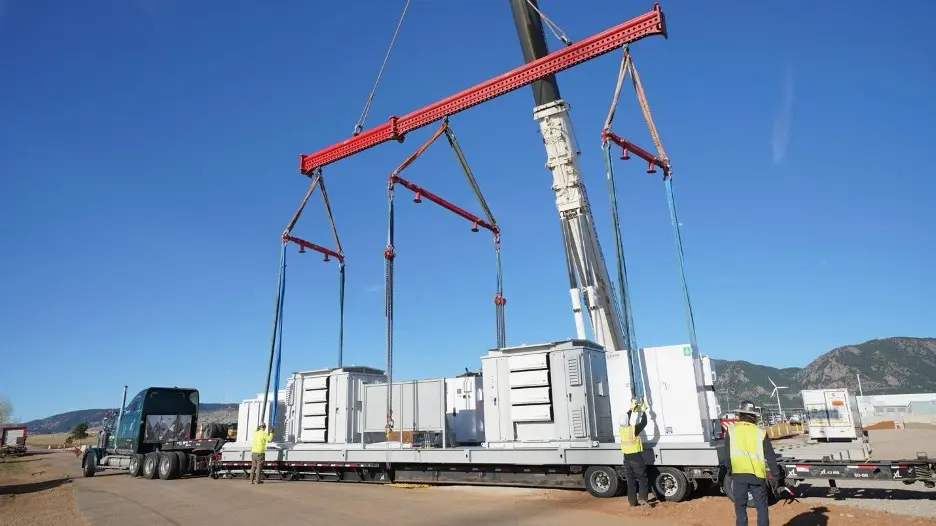
Legacy UPS rooms and sprawling low-voltage switchgear lineups occupy vast amounts of lucrative interior real estate within the data center facility—space that could otherwise be utilized for revenue-generating compute infrastructure or essential liquid-cooling distribution units. By packaging medium-voltage protection systems into modular, weather-resistant enclosures stationed outside the building near the substation, the interior footprint is streamlined. The data hall is left to do what it does best: house compute and keep it cool.
3. Move It Into the Path: Continuous Inline Architecture
Perhaps the most critical architectural innovation is shifting from a reactive standby model to an inline topological design. In a traditional setup, the UPS sits largely dormant or bypassed, waiting for a failure to occur before attempting to switch into action.
An inline medium-voltage system places energy storage and power conditioning directly in the primary power path. Every single electron consumed by the data center flows continuously through the system. Because the architecture is already fully engaged with the power stream, there is nothing to detect, nothing to calculate, and nothing to mechanically switch. If a grid fault occurs or an AI cluster initiates a sudden load swing, the inline system absorbs and dampens the transient instantly, transparently, and continuously.
Official Statements and Empirical Validation: Testing the New Paradigm
The theoretical viability of medium-voltage, inline data center architecture transitioned from paper to proven reality in early 2026. A consortium of energy innovators subjected a full-scale commercial medium-voltage system to rigorous stress testing at the National Renewable Energy Laboratory’s (NREL) National Laboratory of the Rockies—widely recognized as the premier facility in the Western Hemisphere capable of simultaneously replicating real-world grid faults and AI-scale load swings within a unified closed loop.
The testing protocol was designed to push the architecture to its absolute limits, applying bidirectional stress from both sides of the asset:
- The Compute Side: Full-scale, dynamic AI training load profiles—characterized by rapid, multi-megawatt load steps—were slammed into the system at full medium voltage.
- The Grid Side: Severe utility-side disturbances, including deep transmission sags and full zero-voltage ride-through (ZVRT) events, were injected into the upstream connection.
The Results
The medium-voltage inline system performed flawlessly. The compute side did not flinch, maintaining uninterrupted power delivery to simulated server racks without missing a single processing cycle. Simultaneously, the grid side experienced zero disruptive feedback; the system absorbed the violent internal load swings and presented the simulated utility grid with an impeccably flat, predictable load profile.
Crucially, the system successfully cleared the stringent large-load voltage ride-through compliance standards established by the Electric Reliability Council of Texas (ERCOT)—guidelines implemented specifically to prevent data centers from destabilizing regional grids during emergencies.
Speaking on the implications of these findings, independent grid modernization analysts noted that compliance is no longer an expensive, bolted-on regulatory afterthought. When power protection is engineered correctly at the medium-voltage architectural level, compliance with grid reliability standards is native and automatic.
Future Outlook: Transforming Liabilities into Grid Assets
As the global race toward artificial intelligence scaling accelerates, the choices made by data center developers over the next 24 to 36 months will determine whether the industry triggers widespread energy shortages or acts as a catalyst for grid modernization.
Adopting a medium-voltage, inline power architecture fundamentally alters the economics and permitting timelines of new data center construction:
- Streamlined Interconnection: Utilities are no longer forced to conduct exhaustive, time-consuming studies on dozens of disparate transformers, low-voltage UPS arrays, and internal switchgear lineups. Instead, they certify a single, standardized medium-voltage box at the property boundary. This can shave months or even years off protracted permitting timelines.
- Monetizing Backup Power: Because medium-voltage inline systems sit outside the building and manage large-scale energy storage natively, they qualify for favorable clean energy tax incentives and regulatory frameworks. Furthermore, they enable facilities to actively participate in lucrative grid services markets—such as peak shaving, frequency regulation, and demand response programs. Backup power transitions from an expensive insurance policy that sits idle 99% of the time into a revenue-generating operational asset.
- Enhanced Density: By eliminating interior low-voltage electrical rooms, operators can allocate significantly more square footage to high-density liquid-cooled server racks, dramatically improving revenue per square foot of construction capital.
Conclusion
The narrative that the AI infrastructure boom is fundamentally incompatible with grid stability is built on an outdated premise. The bottlenecks and blackout risks observed in regions like Northern Virginia are artifacts of an aging internal power architecture, not an inherent impossibility of powering advanced computing.
By moving power protection up to medium voltage, shifting infrastructure out of the data hall, and embedding resilience directly into the power path, the industry can resolve the Ashburn paradox. The next generation of AI factories does not need to arrive as an existential strain on public utilities; through forward-thinking architectural design, they can be built to fortify and stabilize the electrical grid of tomorrow.