









Executive Overview
In a single trading session following its Q2 2026 earnings release, Shopify’s stock surged roughly 18%, single-handedly erasing the vast majority of its 25% year-to-date decline. Wall Street and Silicon Valley alike had spent much of the prior year questioning whether legacy software giants would be unseated by the burgeoning wave of artificial intelligence. Shopify answered that question with an emphatic no.
Rather than being disrupted or marginalized by AI, Shopify is accelerating because of it, pioneering what can only be described as "agentic e-commerce infrastructure."
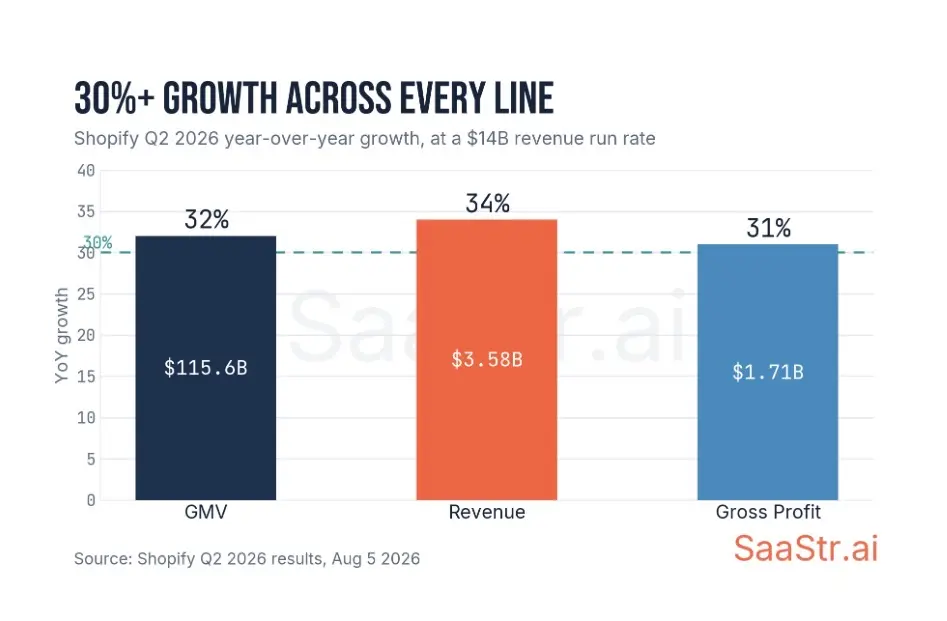
The headline numbers tell a story of staggering scale paired with accelerating velocity. Shopify posted $116 billion in merchant sales (Gross Merchandise Value, or GMV), a 32% year-over-year increase, marking five consecutive quarters of greater-than-30% GMV growth. Total revenue reached $3.6 billion, up 34% year-over-year, driving a $14 billion revenue run rate. Simultaneously, the company generated $654 million in free cash flow, translating to an 18% margin.
For a company operating at this scale to grow its top line by over 30% while expanding free cash flow margins is an anomaly in modern technology markets. Yet, beneath these headline financial metrics lies a much deeper structural shift. Shopify’s Q2 2026 earnings report serves as the first definitive macroeconomic scoreboard for agentic commerce—proving that the winners of the AI revolution will not necessarily be the companies with the flashiest user interfaces, but those that control the clean, structured data required by autonomous AI agents to transact.
Detailed Chronology and Financial Breakdown
To understand how Shopify achieved this market-shaking quarter, one must examine the precise architecture of its growth. The narrative of Q2 2026 is defined by a deliberate pivot away from classic SaaS metrics toward outcome-based, transaction-heavy models, underscored by disciplined operational efficiency.
Transactional vs. Subscription Dynamics
A common misconception in public markets is treating Shopify as a traditional B2B SaaS company. The revenue split reveals a very different reality. The transactional half of the business grew an impressive 37% year-over-year, while the subscription software half grew 22%. Crucially, subscriptions now account for only 22% of total revenue.
Monthly recurring revenue (MRR) sits at $221 million, compounding at roughly 18% annually over a five-year horizon. While respectable, this classic SaaS metric represents less than a quarter of what Shopify collects in a single quarter. The true engine of growth—expanding at 37%—is tied directly to merchant success: payments, capital, shipping solutions, cross-border tools, and variable platform fees. Even within the subscription bucket, the mix is shifting. Apps, themes, domains, and variable platform fees have surged from 11% of Subscription Solutions in Q1 2023 to 21% today, proving that even recurring revenue streams are increasingly usage-weighted.
Payments Penetration and the Trillion-Dollar Milestone
Shopify’s payments engine hit a monumental milestone in Q2 2026, with gross payments volume (GPV) crossing the $1 trillion mark cumulatively since inception. In the quarter alone, Shopify processed $78 billion in gross payments volume, representing a staggering 68% attach rate of total GMV.
Two out of every three dollars transacted on the platform now flow through Shopify’s proprietary payment rails rather than third-party gateways. While payments carry a lower gross margin than pure software—bringing overall Q2 gross margins to 47.7%—Shopify has made this trade deliberately. The strategy sacrifices gross margin percentage in exchange for far greater gross profit dollars and an unshakeable operational lock-in with its merchants. Transaction and loan losses, largely driven by Shopify Capital, hovered at a manageable 3.9% of revenue.
Operating Leverage and the Rule of 52
Perhaps the most striking aspect of Shopify’s Q2 performance was the simultaneous expansion of growth and efficiency. By keeping operating expenses down and driving opex down by roughly 300 basis points, Shopify achieved a "Rule of 52" status at a $14 billion revenue run rate—growing GMV, revenue, gross profit, and free cash flow all above 30% concurrently.
This financial health was not achieved by accident. It is the delayed dividend of a painful operational reset executed years prior, which included a 20% workforce reduction and the strategic divestiture of its logistics business. By defining itself strictly as an infrastructure and payments titan rather than a physical fulfillment provider, Shopify unlocked structural operating leverage that continues to compound.
Supporting Context & Metrics: The AI and Cohort Imperatives
1. The AI Multiplier: Structured Data as the Ultimate Moat
The most profound revelation of Q2 2026 was the measurable impact of artificial intelligence on merchant storefronts. Traffic originating from AI channels tripled year-over-year, and orders resulting from AI searches mirrored that triple-digit growth. More importantly, AI channels delivered new-buyer conversion rates at twice the rate of traditional channels like Google, social media, and direct traffic.
Unlike traditional acquisition channels that often merely re-route existing demand, AI is actively generating net-new demand. Shopify’s secret weapon is structured data. Shopify Catalog now houses over 1 billion products organized in a format that AI agents can directly read, parse, and query. AI searches powered by this structured catalog convert at double the rate of searches reliant on scraped web data. Agents equipped with real-time inventory, exact pricing, and precise product variants recommend far more accurately than agents forced to guess based on human-facing user interfaces.
2. Cohort Resilience and Upmarket Expansion
Skeptics of Shopify have historically pointed to SMB (Small and Medium-Sized Business) churn as an inevitable structural leak. However, cohort data disproves this thesis. The merchant cohort from Q1 2015 has grown its revenue 3.3x since signup, representing a robust 12% compound annual growth rate sustained over more than a decade.
While individual micro-merchants naturally cycle out of business, the survivors rapidly scale their GMV, adopt Shopify Payments, expand internationally, and adopt cross-border tools fast enough to outpace baseline churn. This foundational SMB strength is further fortified by an aggressive upmarket motion. Q2 alone saw the launch or addition of enterprise giants such as Holt Renfrew, Guess, Fred Segal, Avon, Country Road, and Arhaus, joining historical enterprise migrations like Canada Goose, Starbucks, Estée Lauder, General Motors, and L’Oréal.
Official Statements and Leadership Perspectives
Addressing investors and analysts following the release, Shopify President Harley Finkelstein characterized the period as an exceptional inflection point for the global commerce ecosystem.
"Q2 is in, and it was a monster quarter," Finkelstein shared in a public statement.
- $116B in merchant sales, up 32% YoY
- $3.6B revenue, up 34% YoY
- $654M free cash flow, 18% margin
"Five quarters running, GMV has grown more than 30%. The bigger story is underneath the numbers: every shift AI is creating happens to align directly with our infrastructure."
Finkelstein emphasized that achieving simultaneous 30%+ growth across GMV, revenue, gross profit, and free cash flow is the true measure of operational mastery, particularly given that these metrics historically operate as a zero-sum trade-off.
Management’s forward guidance for Q3 reaffirmed this momentum, projecting revenue growth in the low 30s and operating expenses managed tightly between 33% and 34% of revenue, signaling that the company’s post-restructuring financial discipline is embedded permanently into its corporate DNA.
Future Outlook: Implications for the Broader Tech Landscape
Shopify’s Q2 2026 earnings report transcends the boundaries of retail technology; it serves as a macroeconomic blueprint for the era of agentic commerce. As autonomous AI agents increasingly handle consumer purchasing decisions, the battleground for digital dominance has shifted decisively away from front-end consumer marketing and toward back-end data architecture.
For technology founders and enterprise leaders, three foundational takeaways emerge from Shopify’s historic quarter:
- Structured Data is King: The primary beneficiaries of agentic buying will not necessarily be companies boasting the most sophisticated conversational AI models, but those that own the proprietary, meticulously formatted structured data that AI systems must query to function. UI wrappers built on rented data will falter; foundational data owners will command immense leverage.
- Outcome-Based Monetization Wins: Seat-based software subscription models are maturing into the low-to-mid twenties growth brackets, while transaction-, consumption-, and outcome-based models are scaling rapidly past 35%. Aligning revenue directly with customer success creates a resilient, high-growth financial engine.
- Logo Churn is a Vanity Metric for SMB Models: When evaluating businesses with SMB exposure, top-of-funnel logo churn can be deceptive. Multi-year cohort revenue expansion—where surviving accounts exponentially outpace baseline attrition—is the true indicator of long-term platform value.
By proving that it can scale to a $14 billion revenue run rate with 34% top-line growth and 18% free cash flow margins, Shopify has demonstrated that legacy software platforms can successfully transition into dominant utility infrastructures for the next generation of computing. The age of agentic commerce has arrived, and its earliest and most lucrative beneficiary has officially claimed its throne.