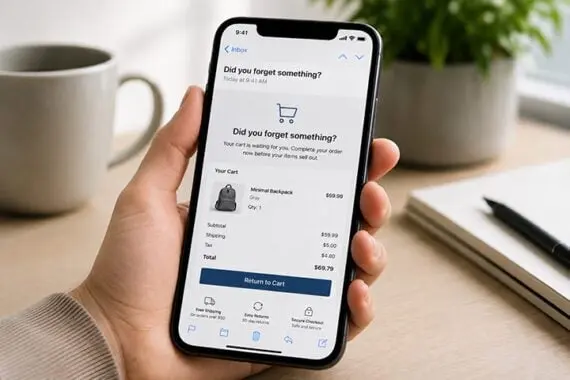
After three decades of e-commerce evolution, the digital shopping cart remains the most critical battleground for retail profitability. Despite decades of user-experience refinements, lightning-fast checkout integrations, and advanced targeting, shopping cart abandonment persists as an intractable industry headache.
According to benchmark data from the Baymard Institute, roughly 70% of all e-commerce shopping carts are abandoned before a transaction is completed. For merchants, this represents billions of dollars in unrealized revenue left stranded at the digital register.
For years, the standard antidote has been the automated recovery sequence—a dependable mix of reminder emails and SMS pings designed to coax reluctant buyers back. However, as consumer expectations shift and digital noise increases, fixed automation sequences are displaying systemic cracks. They rely on rigid logic that treats a shopping cart as a static destination rather than a dynamic behavioral puzzle.
As digital marketing matures, merchants face a stark fork in the road: continue pouring resources into manually optimized, rule-based sequences, or pivot toward AI-driven decision engines capable of personalizing recovery paths in real-time.
Executive Overview
E-commerce cart recovery is undergoing a structural transformation. Historically, recovery messaging has relied on broad, one-size-fits-all automation trees. A shopper leaves an item behind, an algorithm counts down a predetermined time window—usually one hour, 24 hours, and 48 hours—and dispatches a pre-written email or text message.
While these campaigns routinely generate a baseline return on investment, they suffer from a fundamental design flaw: an abandoned cart records an outcome, not a reason.
An e-commerce platform can effortlessly track that a consumer left a $250 jacket in their cart, but it cannot immediately discern why they departed. Did they experience sticker shock from unexpected shipping fees? Were they merely comparing prices for future purchase? Did they encounter a glitch at checkout, or were they simply distracted by a phone call and forgot to complete the order?
Because fixed automation sequences cannot diagnose intent, they frequently miss the mark. They may send a steep discount to a high-intent buyer who would have purchased without an incentive, eroding profit margins. Conversely, they might send generic product feature reminders to a price-sensitive shopper who desperately needed free shipping or a clear return policy to feel secure.
To solve this dilemma, modern retail brands are abandoning rigid rulebooks in favor of two distinct paths: rigorous, granular manual optimization, or adaptive AI decisioning systems. Understanding how these methodologies function—and where they diverge—is essential for any digital merchant hoping to reclaim lost revenue without sacrificing brand equity or margin health.
Detailed Chronology: The Evolution of Cart Recovery
To understand where cart recovery stands today, it helps to examine how the discipline has evolved over the past thirty years.
Phase 1: The Wild West of Early E-Commerce (Late 1990s–2000s)
In the nascent days of online retail, cart abandonment was largely viewed as an unavoidable cost of doing business. Websites were clunky, payment gateways were unreliable, and session persistence across browsers was erratic.
- The Strategy: Recovery, to the extent that it existed, was reactive. Customers had to rely on "Saved Carts" features tied to user accounts, requiring them to log back in and manually track down lost items. Automated email remarketing was in its infancy, often limited to basic order confirmations and shipping updates rather than behavioral triggers.
Phase 2: The Rise of Behavioral Trigger Automations (2010s)
As marketing automation platforms matured, e-commerce brands gained the technical capability to track user sessions and trigger outbound emails based on abandoned checkouts.
- The Strategy: The classic three-email drip campaign became the industry gospel.
- Email 1 (1 hour later): A gentle, customer-service-oriented reminder ("Did you forget something?").
- Email 2 (24 hours later): Social proof and product reassurance (reviews, FAQs, benefits).
- Email 3 (48 to 72 hours later): A financial incentive (a 10% discount code or free shipping) designed to create urgency.
- The Limitations: While effective for early adopters, these sequences quickly became ubiquitous. Consumers grew wise to the "wait for the discount" playbook, deliberately abandoning items to trigger lower prices.
Phase 3: Omnichannel Integration and SMS Emergence (Early–Mid 2020s)
As consumers shifted heavily toward mobile commerce, email open rates faced downward pressure due to crowded inboxes and privacy updates.
- The Strategy: Brands integrated SMS and push notifications into their recovery workflows. Because text messages boast near-instant open rates, mobile recovery became a high-performing channel. Platforms like LiveRecover and others demonstrated that quick, human-backed or highly conversational text outreach could recover upwards of 20% of abandoned carts.
- The Limitations: Managing multiple channels (email, SMS, push, retargeting ads) created coordination nightmares. If a customer received a discount via email, a reminder via SMS, and a retargeting ad on Instagram all within a two-hour window, the brand risked looking desperate and annoying the customer.
Phase 4: The AI Decisioning Era (Present Day)
Today, the industry is transitioning away from static multichannel workflows toward intelligent, autonomous decision engines.
- The Strategy: Instead of routing every customer down a predetermined flowchart, machine learning models evaluate real-time signals—such as historical browsing behavior, device type, cart value, discount sensitivity, and product category—to determine the exact channel, timing, message, and offer that maximizes the probability of conversion while preserving margin.
Supporting Context & Metrics: The Numbers Behind the Abandonment Crisis
The scale of cart abandonment is well-documented by industry watchdogs. According to multi-year aggregate data compiled by the Baymard Institute, the average cart abandonment rate across all recorded e-commerce studies hovers stubbornly around 70.19%. This means that for every ten shoppers who load a product into a digital basket, roughly seven walk away empty-handed.

Why do they leave? Baymard’s research points to several primary friction points:
- Extra costs too high (shipping, tax, fees): 48% of respondents cite unexpected costs as a dealbreaker.
- Required account creation: 24% abandon carts because the site forces them to create an account.
- Slow delivery speeds: 22% leave if shipping is too sluggish.
- Checkout process too long or complicated: 18% abandon due to poor UX design.
- Website errors or crashes: 13% walk away when technical glitches interrupt the payment flow.
When brands attempt to recapture these lost shoppers, performance metrics vary wildly depending on the channel used. According to recent data from Ringly, abandoned cart emails remain the indispensable baseline for recovery, boasting an average open rate of 50.5% and a strong conversion rate of 10.7%.
Meanwhile, SMS and mobile messaging routinely outperform email in terms of immediate engagement speed. However, raw performance metrics hide a deeper strategic challenge: high conversion rates achieved through constant discounting can quietly destroy unit economics. This reality has forced merchants to look beyond simple open rates and focus on metrics that measure true incremental profitability.
Official Industry Perspectives and Strategic Frameworks
To navigate the limitations of fixed sequences, digital marketing experts generally divide modern optimization strategies into two distinct operational models: Manual Optimization and AI Decisioning.
The Manual Optimization Blueprint
Merchants who choose the hands-on approach must build, test, and refine their recovery workflows through rigorous experimentation. According to leading e-commerce strategists, manual optimization typically focuses on four core pillars:
- Timing and Cadence Tuning: Testing whether a 30-minute delay outperforms a 2-hour delay, or whether evening pushes generate better mobile conversions than morning reminders.
- Message Copy and Creative Iteration: A/B testing subject lines, imagery, and copywriting to find the balance between helpful customer service and urgent commercial messaging.
- Segmented Offer Strategies: Moving away from blanket discounts by offering promotions only to low-margin or high-value cart segments where price elasticity demands it.
- Channel Orchestration: Balancing email, SMS, and paid retargeting ads to ensure frequency capping prevents brand fatigue.
The Measurement Imperative: Manual optimization is impossible without accurate attribution and measurement. Savvy merchants rely on two critical metrics:
- Revenue Per Recipient (RPR): Evaluating the financial efficiency of each distinct recovery sequence.
- Control Groups: Allocating a small percentage of abandoned cart visitors (e.g., 5%) to receive no recovery messages. By comparing the conversion rates of the control group against the treated group, merchants can determine whether their automated outreach is generating true incremental sales or simply claiming credit for shoppers who would have returned anyway.
The AI Decisioning Framework
For brands managing large product catalogs with complex pricing structures, distinct consideration periods, and diverse customer demographics, manual optimization quickly hits a wall of diminishing returns. This has given rise to AI Decisioning Platforms.
In an AI-driven recovery ecosystem, the mechanics shift fundamentally:
- Human Control Over Strategy: Merchants retain overarching strategic control. They establish brand guidelines, define allowable discount thresholds, set gross margin floors, and create the core content treatments (such as product reassurance guides, free shipping banners, or tiered discounts).
- Autonomous Execution: Rather than following a rigid flowchart, an AI decision engine evaluates incoming shopper signals in real-time. It reviews cart value, historical purchase frequency, product category margins, browsing depth, and device context.
- Dynamic Treatment Selection: The system evaluates all approved recovery tactics and selects the precise message, offer, timing, and channel most likely to secure a conversion without giving away unnecessary margin.
Crucially, AI decisioning differs from traditional automation because it learns continuously. While a fixed sequence executes static merchant instructions regardless of results, an AI model evaluates the success or failure of every interaction—noting which shoppers bought, which ignored messages, and which abandoned carts were lost—and dynamically refines its future decisions.
Future Outlook: The Next Decade of Conversion Recovery
As we look toward the future of e-commerce, the boundary between customer service, personalization, and conversion recovery will continue to blur. Several key trends are poised to redefine how merchants handle abandoned carts over the next five to ten years:
1. Hyper-Contextual Predictive Triggers
Future recovery systems will move beyond reacting to abandoned carts after they happen. Predictive AI models will analyze micro-behaviors during the active browsing session—such as mouse-movement velocity, hesitation over shipping calculators, or repeated toggling between product specs—to intervene before the user abandons the cart. Real-time chat prompts or dynamic incentive banners will address objections on the spot, preventing abandonment entirely.
2. Conversational AI Recovery Agents
Static email copy and automated SMS text trees will increasingly be replaced by generative, conversational AI agents. If a customer abandons a cart containing technical gear, a recovery text might initiate an intelligent dialogue: "Hey Sarah, noticed you left the Alpha-X Camera in your basket. Did you have questions about lens compatibility or our warranty?" The AI will be equipped to answer complex product questions, apply dynamic discounts within pre-set merchant limits, and guide the user back to a pre-populated checkout seamlessly.
3. Privacy-First Attribution and Zero-Party Data
As third-party cookies fade and privacy regulations tighten, reliance on cross-site tracking will diminish. Future cart recovery programs will depend heavily on zero-party data—information that customers intentionally share during their browsing and shopping journeys. AI systems will utilize this first-party behavioral data to craft privacy-compliant, highly relevant recovery experiences that feel helpful rather than invasive.
Summary
Ultimately, the core mission of cart recovery remains unchanged: identifying the friction point that caused a shopper to hesitate and removing it. Whether a merchant chooses to meticulously engineer manual optimization loops or deploy adaptive AI decisioning engines, the winning strategy will always prioritize customer understanding over brute-force automation. In a maturing e-commerce landscape, the brands that win will be those that treat every abandoned cart not as a lost sale, but as an opportunity for intelligent dialogue.