Executive Overview
In the rapidly evolving landscape of enterprise software and artificial intelligence, the boundary between passive tools and active autonomous agents is dissolving. The latest proof point of this paradigm shift is Superhuman’s strategic acquisition of Fathom, a Y Combinator-backed meeting notetaker. Rather than continuing to build an in-house transcription and summarization tool from scratch, Superhuman—long celebrated for its lightning-fast email client—has opted for inorganic growth, absorbing Fathom to anchor its burgeoning suite of productivity applications.
This acquisition is far more than a routine corporate consolidation; it represents a fundamental pivot in how modern software platforms intend to capture user workflow. For years, AI productivity platforms have relied on reactive interaction models. Users were required to draft explicit text prompts, manually initialize workflows, or navigate disparate software silos to execute daily administrative tasks. However, the holy grail of modern enterprise AI is proactive execution: systems that anticipate needs, initiate tasks independently, and seamlessly bridge the gap between spoken conversation and digital execution.
Meetings are the ultimate crucible of business context. They are where strategic decisions are made, deadlines are agreed upon, and actionable items are assigned. By capturing, parsing, and internalizing the nuance of human discussions, AI platforms gain the foundational data needed to truly automate work. Superhuman’s integration of Fathom signifies a concerted effort to embed AI at the very epicenter of enterprise communication.
This in-depth report explores the anatomy of the acquisition, the competitive pressures forcing independent startups to consolidate, the financial and operational metrics underpinning both companies, and what the future holds for an increasingly crowded ecosystem dominated by generative AI.
Detailed Chronology: From Internal Tests to M&A Realization
To fully appreciate the gravity of the Superhuman-Fathom deal, one must trace the developmental timeline that led both executive teams to the negotiating table. The roots of this transaction stretch back over several years, marked by changing market conditions, technological hurdles, and a hyper-competitive race for user acquisition.
The Rise of Fathom (2020–2024)
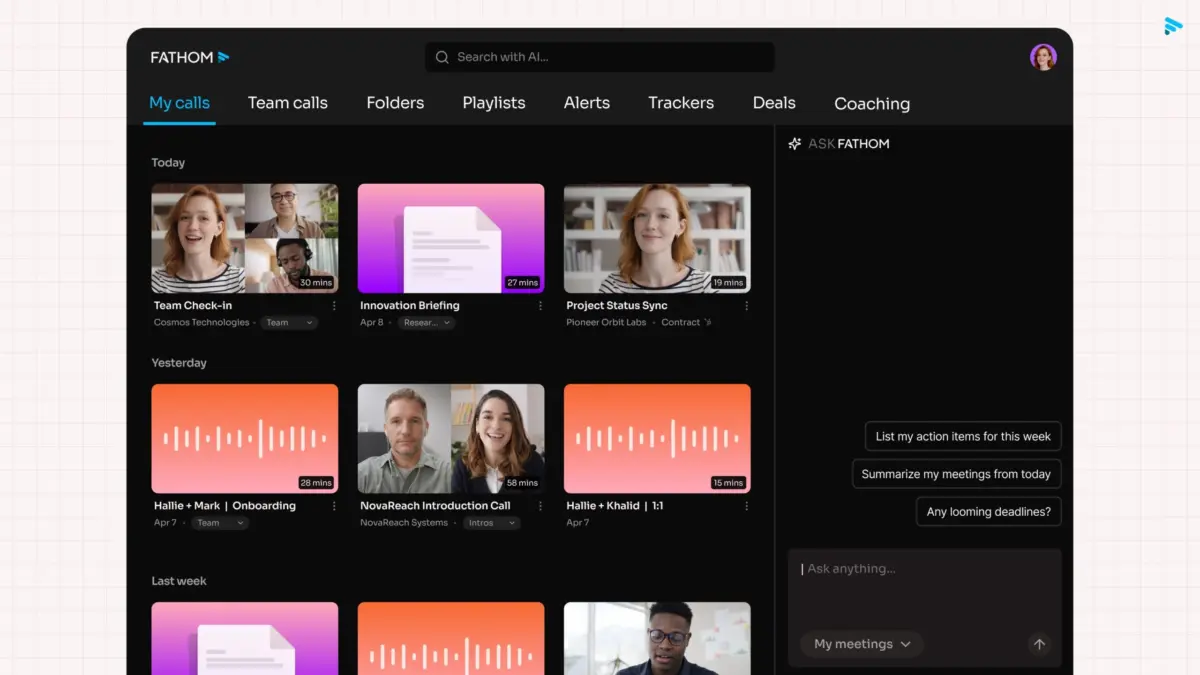
Founded in 2020, Fathom entered the market as a specialized tool designed to record, transcribe, and summarize virtual meetings. Long before generative AI became a ubiquitous feature in enterprise software, Fathom carved out a loyal user base by offering a frictionless, high-accuracy meeting companion. Over successive funding rounds, the startup secured over $30 million in venture capital from prominent institutional backers such as the Zoom Apps Fund, Telescope Partners, BoxOne Ventures, Character Capital, and Maven Ventures. Its cap table also boasted heavy-hitting angel investors and tech leaders, including Reddit CEO Steve Huffman, former Twitch CEO Emmett Shear, and Cruise co-founder Kyle Vogt.
By maintaining a robust and generous free plan, Fathom achieved viral growth, scaling to over 400,000 monthly active users. Cumulative metrics indicate that over 1 million people have relied on the platform to record and archive their professional conversations. As the market matured, Fathom continued to innovate, notably launching a "bot-less" meeting mode earlier this year to counter privacy concerns and streamline the recording experience.
Superhuman’s Internal Experiments
Concurrently, Superhuman—under the leadership of CEO Shishir Mehrotra—recognized that the modern email client could no longer exist in isolation. To compete in an ecosystem where users demand unified workflows across calendar, email, and documentation apps, Superhuman began exploring the meeting notetaker space.
Earlier this year, Superhuman quietly initiated internal trials of a native notetaking tool, testing its capabilities with a select group of internal and beta users. While the initial prototypes functioned, the exercise served as a sobering reality check. Building a world-class meeting recording and transcription pipeline is deceptively complex. Edge cases abound—ranging from handling overlapping speakers and background noise to accurately discerning technical jargon, action items, and cross-platform integrations.
Realizing the immense engineering depth required to rival specialized market leaders, Superhuman’s leadership pivoted from internal development to acquisition. Conversations with Fathom revealed a mutual alignment of vision, paving the way for the buyout.
Supporting Context & Metrics: The Economics of the Meeting Notetaker Space
The valuation and metrics surrounding Fathom paint a vivid picture of a sector experiencing both explosive growth and intense market headwinds. Valued at $94 million in 2024 according to PitchBook data, Fathom managed to scale efficiently despite operating in a hyper-crowded vertical.
The Competitive Landscape
The meeting notetaker market is currently undergoing a brutal consolidation and scaling phase. Venture-backed startups are facing immense pressure to evolve beyond single-feature products into comprehensive enterprise platforms. Among the primary players heating up the market are:
- Granola: A prominent rival that recently closed a massive $125 million funding round, catapulting its valuation to a staggering $1.5 billion as it transitions from a simple meeting notetaker into a full-fledged enterprise AI application.
- Read AI: Another heavyweight in the space, which secured $50 million to integrate its meeting bots directly into Slack, email, and other communication hubs.
- Wispr: A surging new market entrant that has begun preparing its own meeting notetaker capabilities, signaling that barriers to entry—while technically high—are perpetually contested by agile startups.
Despite boasting healthy customer bases and impressive revenue run rates, these independent notetakers face a structural vulnerability: user acquisition costs and the continuous pressure to expand product surface areas. Without a broader ecosystem to cross-sell or anchor their utility, standalone notetakers risk becoming commoditized features integrated natively into foundational platforms like Zoom, Microsoft Teams, or Google Meet.
Official Statements and Strategic Rationale
The strategic logic behind the acquisition was illuminated during exclusive discussions with TechCrunch, featuring insights from both Shishir Mehrotra and Fathom CEO Richard White.
Shishir Mehrotra on Engineering Complexities
Reflecting on Superhuman’s aborted attempt to build an in-house notetaker, Mehrotra was candid about the hidden intricacies of the technology:
"We’ve been working internally on this area for a while as well. I think it greatly increased our confidence in the demand in this category. It also becomes very clear how deep the products in this category are and how much you need to build. A lot of these products make the job feel really easy, but it’s actually quite tricky to do a great job in all parts [of meeting recording]."
While Mehrotra declined to detail the specific technical architectures that impressed him within Fathom’s codebase, he did offer a glimpse into Superhuman’s immediate product roadmap. By integrating Fathom, Superhuman aims to pioneer real-time context-surfacing, ensuring that users have relevant meeting data at their fingertips precisely when they need it.
Richard White on Scale and Distribution
From Fathom’s perspective, the decision to join forces with Superhuman came down to the timeless software adage: distribution is king. Fathom CEO Richard White noted that operating as an independent company would have required building out an extensive suite of auxiliary productivity tools that Superhuman has already perfected.
"The reach of Superhuman is massive. I have always thought about M&A in terms of speed of building a product that everyone uses, and a part of that comes down to distribution. If we were to operate Fathom as a stand-alone company, we would have to build a lot of things that are already in the Superhuman platform."
By plugging Fathom into Superhuman’s expansive user base—which spans roughly 40 million users—Fathom’s technology instantly scales to an enterprise audience orders of magnitude larger than it could have reached independently.
The Evolving Superhuman Ecosystem
To understand why Fathom is the missing puzzle piece for Superhuman, one must examine the broader architectural blueprint that Mehrotra and his team have quietly assembled over the past few years.
Superhuman is no longer merely an elite email client. Through a series of organic product launches and strategic acquisitions, the company has methodically constructed a comprehensive workplace suite:
- The Email Client: The foundational anchor known for keyboard shortcuts and speed.
- Docs App & Database Solutions: Modern, lightweight alternatives to traditional document editing and data tracking.
- Calendar Management: Integrated scheduling tools designed to streamline time management.
- AI Agent Builder Platform: A newly launched framework allowing users to construct custom autonomous agents.
Closing the Loop with Fathom
The addition of Fathom acts as the nervous system connecting these disparate applications. Historically, productivity suites suffered from the "fragmentation tax"—users had to manually move data from a Zoom transcript into a CRM, draft a follow-up email in another window, and schedule a calendar invite through a third app.
With Fathom embedded at the core of Superhuman, the workflow transforms into an autonomous loop:
- Capture: Fathom records and transcribes the meeting, extracting key decisions and action items.
- Contextualize: Superhuman’s AI surfaces relevant background data in real time during or immediately after the call.
- Execute: Autonomous AI agents draft follow-up emails, update database entries, schedule necessary calendar events, and trigger downstream tasks across Superhuman’s document and database apps without requiring manual prompting from the user.
Future Outlook: What Lies Ahead for AI-Driven Productivity
The Superhuman-Fathom acquisition is a harbinger of broader consolidation trends across the B2B SaaS and generative AI sectors. As foundational models become commoditized, the competitive moat is shifting away from raw transcription accuracy toward workflow ownership and distribution.
Standalone tools that rely solely on capturing audio or summarizing text will find it increasingly difficult to survive against multi-app suites that can ingest meeting data and immediately translate it into business actions. For users, this consolidation promises a more cohesive, less fragmented digital work experience. The era of toggling between ten different single-purpose tabs is rapidly drawing to a close, replaced by unified intelligent workspaces where AI agents work proactively in the background.
As Superhuman rolls out the integrated Fathom technology across its 40-million-user ecosystem, the industry will be watching closely to see whether this synergy delivers on the grand promise of autonomous, zero-prompt productivity. If successful, it may well establish the blueprint for how modern software companies absorb, scale, and weaponize generative AI in the post-standalone era.