The unauthorized disclosure of pre-release intellectual property is one of the most damaging events a major entertainment studio can experience. For Take-Two Interactive and its subsidiary Rockstar Games, the stakes are uniquely colossal. As anticipation reaches a fever pitch ahead of the slated release of Grand Theft Auto VI—arguably the most commercially significant entertainment product of the decade—the company has found itself embroiled in a high-stakes, fast-moving legal chess match.
Following a major security breach in which an individual operating under the alias “Cyberleek” began disseminating raw, unpolished gameplay footage months ahead of schedule, Take-Two launched an aggressive legal counter-offensive. Leveraging the Digital Millennium Copyright Act (DMCA), the gaming giant has mobilized federal courts in the United States to unmask the perpetrators.
Recent court filings in a New York federal court reveal that Take-Two’s internal investigation is "rapidly evolving." In a strategic shift, the company has filed a heavily restricted, sealed DMCA subpoena request targeting specific Discord users and communities, aiming to prevent suspected infringers from anticipating legal steps or destroying evidence. Simultaneously, Take-Two has opted to withdraw a high-profile subpoena previously directed at Google regarding YouTube accounts, signaling a tactical pivot in its investigative priorities. This comprehensive report examines the legal mechanics, digital footprint, and strategic evolution of Take-Two’s ongoing pursuit to protect the Grand Theft Auto franchise.
Detailed Chronology: From Initial Breach to Sealed Federal Subpoenas
The Breach and the Initial Wave of Takedowns
The saga began roughly two weeks ago when an online entity known as “Cyberleek” surfaced, uploading substantive gameplay clips and internal development builds of Grand Theft Auto VI. The leak triggered immediate shockwaves throughout the gaming community, forcing Rockstar Games to contend with fragmented, low-quality video files circulating across social media, video-sharing platforms, and instant messaging networks.
Take-Two’s response was swift and unyielding. The publisher deployed a widespread campaign of automated takedown notices alongside a cluster of formal DMCA subpoenas filed in U.S. federal court. These legal instruments were designed to unmask the real-world identities behind accounts facilitating the distribution of the leaked assets without the lengthy and expensive preliminary step of filing a full civil lawsuit.
Broad-Net Tactics and the First Public Subpoena
In its initial phase, Take-Two cast a remarkably wide net. The publisher targeted thousands of anonymous Discord users, while simultaneously issuing broad requests to major technology platforms including Microsoft, X (formerly Twitter), and Google’s YouTube.
Because these early filings were a matter of public record, media outlets and legal researchers were able to dissect the documentation. The public filing explicitly named three specific Discord servers, including one tied to prominent content creator DarkViperAU. This initial request, issued on August 21, was formally served on Discord, according to Take-Two’s legal representatives, though procedural anomalies in court docketing left the clerk’s official issuance unlisted.
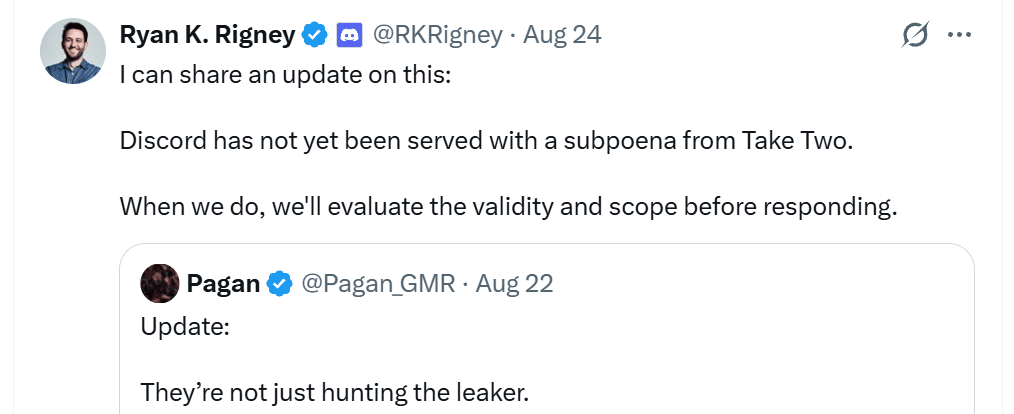
Public visibility quickly sparked friction. Discord’s Vice President of Communications, Ryan Rigney, took to X on August 24 to clarify that Discord had not yet been formally served with a subpoena from Take-Two at that exact moment, emphasizing that the platform intended to rigorously evaluate the validity and scope of the demands before rendering any user data.
The Pivot to Secrecy: The Second Discord Subpoena
Against the backdrop of Rockstar Games streaming an extended preview of the title on Netflix, Take-Two returned to the New York federal court on a Friday to file a second, fundamentally different DMCA subpoena request.
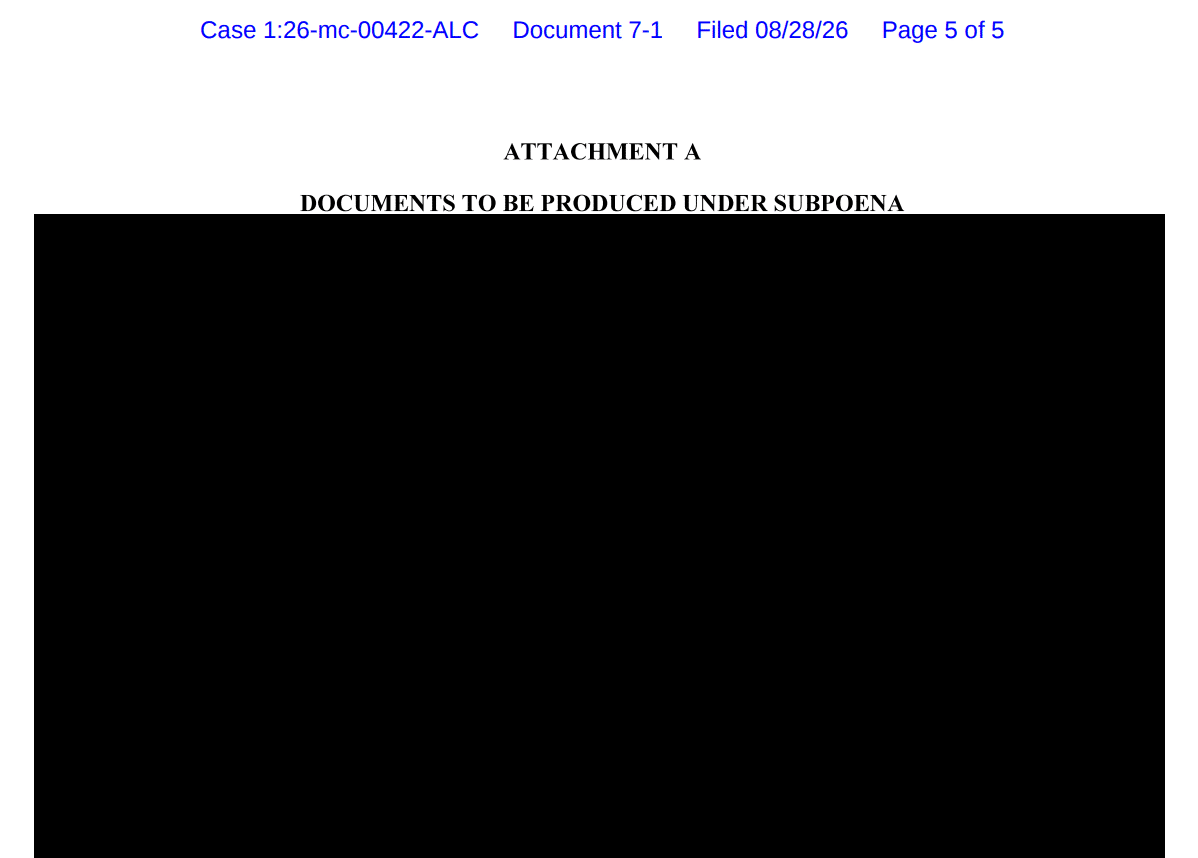
Rather than laying out its targets in plain view, Take-Two filed a motion to keep the second subpoena entirely under seal. This protective measure completely blacks out the identities of the newly targeted individuals and specific community servers. According to accompanying legal declarations, this second wave of requests zeroes in on one brand-new Discord user, additional identifying data for a previously flagged user, and deeper metrics regarding the community servers highlighted in the initial subpoena.
Supporting Context & Metrics: The Mechanics of DMCA Subpoenas
To understand the significance of Take-Two’s legal maneuvers, one must examine the precise legal tool being utilized. Section 512(h) of the DMCA allows copyright holders to obtain a subpoena directly from a U.S. district court clerk, compelling a service provider (such as Discord, Google, or Microsoft) to disclose the identity of a subscriber alleged to be infringing copyright.
The Advantages and Limits of DMCA Subpoenas
Ex Parte Nature: Subpoenas can typically be requested without notifying the target in advance, preventing preemptive data scrubbing.
Streamlined Discovery: It bypasses the need for a formal complaint, serving as a rapid investigative highway.
Platform Cooperation: Major tech platforms are legally bound to comply unless they successfully motion to quash or modify the subpoena on grounds of overbreadth, First Amendment protections, or undue burden.
The Risk of Public Filings in Fast-Moving Cyber Investigations
In fast-evolving digital investigations, public transparency can inadvertently function as an early warning system for sophisticated threat actors. When high-profile litigation documents are made immediately accessible via public court dockets, targets are instantly alerted that a corporate legal team—and potentially federal law enforcement—is closing in on their digital footprint.
Take-Two’s decision to move for a sealed filing underscores a classic law enforcement dilemma: balancing the public’s right to judicial transparency against the pragmatic necessity of preserving fragile digital evidence. By keeping the targets blacked out, Take-Two aims to mitigate the risk that suspects will purge communication logs, wipe hard drives, or abandon anonymized digital profiles.
Official Statements and Legal Arguments
The legal justification for shrouding the second Discord subpoena in secrecy rests heavily on the argument of evidentiary preservation. In its motion to seal, Take-Two’s legal counsel articulated clear operational anxieties regarding the digital trail of the leak.
The "Rapidly Evolving" Standard
Take-Two explicitly characterized its ongoing security investigation as "rapidly evolving and ongoing." The motion to seal states that the subpoena attachment:
"reveals highly sensitive, confidential information about an ongoing investigation into copyright infringement and the misappropriation of Take-Two’s confidential information."
The filing elaborates further on the dangers of premature disclosure, warning the presiding judge that:
"Public disclosure of this information could compromise Take-Two’s ongoing investigation and even tip off the alleged infringers as to the nature and progress of Take-Two’s investigation and information Take-Two has gathered about the infringement."
By utilizing the plural noun "infringers," Take-Two’s legal team suggests that the leak was not merely the work of a single rogue individual, but potentially a coordinated network operating across encrypted channels and community servers.
The Strategic Withdrawal of the YouTube Subpoena
While the Discord investigation intensified behind closed doors, Take-Two executed a simultaneous strategic retreat on another legal front.
In its prior filings concerning Google, Take-Two had attempted to force the tech giant to unmask three specific YouTube personas—CyberLeeks, Surfer24k, and CyberLeek_ar_io—who had hosted variations of the leaked footage. However, U.S. District Judge John P. Cronan initially declined to sign off on the Google subpoena, demanding a clearer demonstration of how these specific accounts were legally linked to the underlying copyright infringement.
Although Take-Two submitted supplementary documentation attempting to satisfy the judge’s evidentiary standard, the publisher ultimately chose to withdraw the request altogether. Legal filings submitted to the court noted:
"Take-Two has determined it no longer needs the particular information requested. Thus, Take-Two respectfully withdraws its subpoena request."
Crucially, this withdrawal does not represent a permanent defeat. Take-Two has explicitly reserved its legal right to return to Google with a fresh, more refined subpoena request should future investigative developments warrant it. For now, however, the publisher has consolidated its resources, shifting the focal point of its legal pressure away from public video platforms and toward private messaging infrastructure on Discord.
Future Outlook: What Lies Ahead for Take-Two and the Leak Investigation
As the legal proceedings continue to unfold in the New York federal court, several critical questions remain unanswered:
Judicial Approval of the Seal: Judge Cronan or the designated magistrate must ultimately rule on whether Take-Two’s motion to keep the second Discord subpoena permanently or temporarily sealed is legally justified under established First Amendment and common law standards of judicial openness.
Platform Compliance: Once Discord is formally served with the updated, targeted requests, how the platform responds—and whether it chooses to challenge the scope or validity of the subpoena—will dictate how quickly Take-Two can secure identifying information like IP logs, email addresses, and billing records.
Potential Criminal Referrals: While Take-Two is currently utilizing civil DMCA tools, the scale of intellectual property theft involved in corporate trade secret misappropriation and massive commercial pre-release leaks often attracts the attention of federal law enforcement agencies, such as the FBI. Civil subpoenas frequently serve as the foundational groundwork for broader criminal indictments.
Conclusion
The pursuit of the Grand Theft Auto VI leakers highlights the modern challenges facing the multi-billion-dollar gaming industry in an era of hyper-connected, decentralized digital communities. Take-Two Interactive’s tactical shift—abandoning a broad, public net on YouTube in favor of a tightly controlled, sealed investigative push on Discord—demonstrates a maturing legal strategy designed to outmaneuver sophisticated digital actors. As the release window for Grand Theft Auto VI draws closer, Take-Two’s aggressive defense of its intellectual property serves as a stark warning to anyone attempting to profit from unauthorized corporate leaks.